A modern vehicle body is held together by three to five thousand resistance spot welds, plus meters of seam weld — and a single undetected crack or missing weld in a structural joint can lead to catastrophic failure. The problem is that inspecting all of them by hand at production speed is impossible, and the traditional fallback, X-ray sampling, only checks a fraction and misses everything between sample points. So most welds on most vehicles are never individually verified. AI vision changes that arithmetic. It inspects every spot and seam weld in real time, distinguishing a genuine porosity cluster or missing nugget from the harmless cosmetic variation that makes a perfectly good weld look different from the last — reaching detection accuracy that legacy systems and tired inspectors cannot. iFactory's vision defect detection turns weld QC from a sampling bet into 100% inline verification.
iFactory Vision Defect Detection
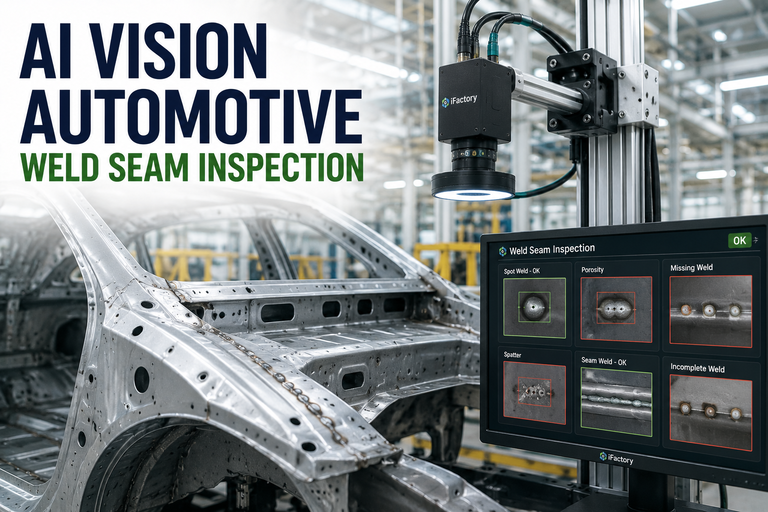
AI Vision Automotive Weld Seam Inspection
Inspect spot and seam welds for porosity, spatter, and missing welds on body-in-white at line speed — catch the structural defect before the body moves to the next station.
The math of body-in-white welding defeats traditional inspection. With thousands of spot welds per vehicle laid down by robotic cells running at takt, manual inspection cannot keep up and X-ray sampling checks only periodic points — so a missing weld from a robot programming error, or a porosity cluster from a shielding-gas problem, can pass undetected between samples. And the hardest part is not finding defects; it is not crying wolf, because good welds vary in shape, color, and reflectivity, and mistaking that variation for a defect floods the line with false rejects.
Sampling & Rule-Based
Checks Some, Overkills the Rest
X-ray sampling misses defects between sample points
Manual checks can't keep pace with thousands of welds at takt
Rule-based vision mistakes normal weld variation for defects — overkill
A missing weld from a robot program error can ship unseen
AI Vision Inspection
Every Weld, Real Defects Only
100% inline inspection — every spot and seam verified, no gaps
Deep learning distinguishes acceptable variation from genuine defect
False rejects slashed — fewer good bodies pulled for nothing
Missing or misplaced welds flagged before the body advances
Anatomy of a Spot Weld — Good vs Defective
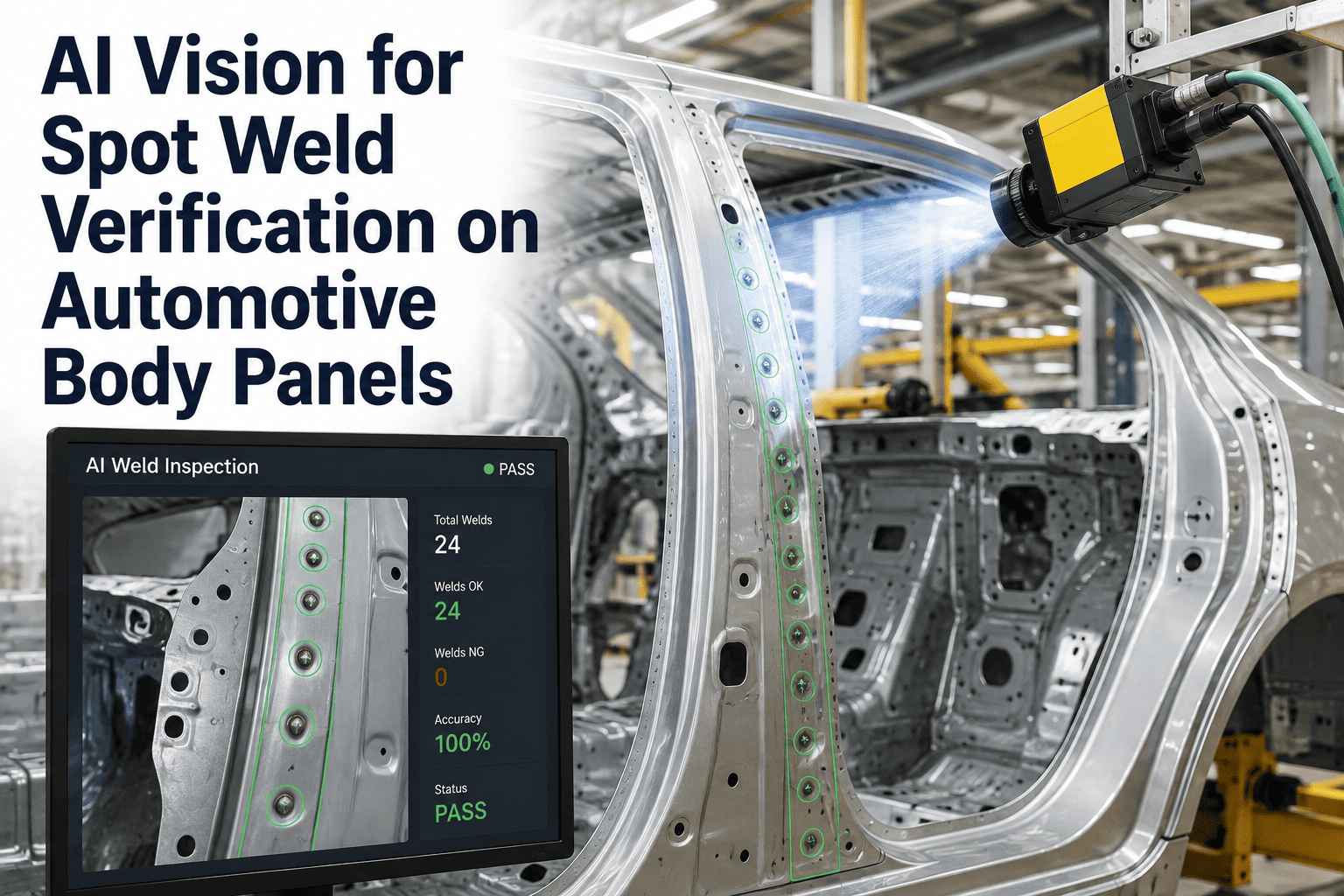
Resistance spot welding is the backbone of body-in-white, and its quality reduces to a few measurable features: nugget diameter, indentation depth, and the absence of expulsion. AI verifies each against the qualified standard. Here is what separates a sound nugget from the defect classes that compromise IATF 16949 strength requirements.
Spot Weld Nugget — What AI Verifies
Sound nugget — full diameter and penetration, meets strength spec
Expulsion — molten metal expelled as spatter, voids in the nugget
The Defect Classes AI Reads on Every Weld
Spot and seam welds fail in characteristic ways, and AI is trained on each. From the ripple pattern of a sound MIG bead to the smooth surface of a TIG joint, deep-learning models learn the signature of good and flag the deviations that matter — on resistance spot, MIG, laser, and TIG processes alike.
Porosity
Gas inclusions and voids on or below the bead surface from contamination or poor shielding — trained models detect them from thousands of examples.
Spatter
Small metallic droplets expelled during welding that solidify near the seam. Reflectivity and morphology analysis identifies them, flagging grinding needs.
Missing Weld
A weld skipped from a robot-program error or electrode fault — caught before the body advances, the defect manual sampling most easily misses.
Undercut
Continuous grooves or depressions at the bead edge from excessive energy or electrode angle, found through 3D surface reconstruction.
Lack of Fusion
Incomplete fusion and insufficient penetration — thermal imaging of the weld-zone heat signature reveals what surface optics alone can miss.
Burn-Through
Holes where the base metal has melted through — a severe defect compromising structural resistance, flagged instantly at the station.
Want to see AI catch a weld defect your line keeps passing? Book a 30-minute walkthrough and we'll run detection live on your weld samples or our reference library.
Surface, Subsurface, and Geometry — Three Ways to See
A weld hides defects at different depths, so the strongest inspection fuses imaging modes. Optical cameras read the bead surface, thermal imaging reveals fusion problems beneath it, and 3D profiling measures the geometry against the qualified bead — together correlating surface appearance with subsurface quality, predicting structural integrity without destructive testing on every unit.
Optical Vision
High-resolution cameras capture bead surface, spatter, and surface porosity. Multi-camera setups image the seam from several angles during and after welding.
Thermal Imaging
Weld-zone heat signatures during the welding cycle expose incomplete fusion, porosity, and missing welds that surface optics cannot see.
3D Profiling
Laser profilometry generates a cross-sectional point cloud — bead width, height, undercut depth, toe angle — mapped directly to ISO 5817 acceptance.
Catch It Before the Body Advances
The decisive advantage of inline AI is timing. Inspecting during and immediately after welding means a defective weld is caught at the station that made it — so a robotic cell can rework it automatically before the body moves on, instead of discovering it after paint or, worse, in the field. That is where the 94% reduction in downstream weld failures comes from.
From Weld to Rework in Real Time
1
Capture
Multi-Angle
Cameras and thermal sensors image each weld during and right after the cycle
2
Infer
Edge AI
Deep-learning models classify and severity-score defects on edge hardware in real time
3
Rework
In-Cell Fix
The robotic cell reworks a defective weld before the body moves to the next station
4
Trace
Work Order
Every defect logged with visual confirmation for traceability and root-cause analysis
What Inline Weld Vision Delivers
The return on AI weld inspection is among the fastest in automotive quality, because a single prevented structural failure or recall dwarfs the cost of the system. These figures come from automotive weld-inspection deployments and industry analysis.
94%
Fewer downstream failures
defects caught and reworked before the body advances
15%
Less body build time
from eliminating downstream rework loops
150
Seams in 40 seconds
inspection at full production speed, not a sampling pace
4 mo
ROI payback
documented across automotive weld deployments
Every structural failure avoided starts with verifying all the welds, not a sample of them. Want the weld-vision plan scoped to your cells? Talk to our vision engineers.
Frequently Asked Questions
Can AI inspect every weld at line speed, or just a sample?
Every weld. Edge AI classifies defects in real time — fast enough to inspect on the order of 150 seam welds in 40 seconds and verify thousands of spot welds per body at takt. That replaces X-ray sampling, which only checks periodic points and misses defects in between. The whole value is moving from a sampling bet to 100% inline verification.
How does it avoid false rejects on good welds?
That's the core problem deep learning solves here. Sound welds vary in shape, color, reflectivity, and surface marking, and rule-based systems flag that normal variation as defects — "overkill" that floods the line with false rejects and scrap. AI models learn from images of good and flawed welds to distinguish acceptable variation from genuine, performance-affecting defects, which is how they hold 97-99% accuracy without crippling false-reject rates.
Can surface vision really catch subsurface weld problems?
Partly on its own, and much more when fused with thermal and 3D. Optical vision reads surface defects; thermal imaging of the weld-zone heat signature exposes incomplete fusion and porosity beneath the surface; and models trained on metallurgical cross-section data correlate surface appearance with subsurface quality, predicting structural integrity without destructive-testing every unit. For volumetric verification on fracture-critical joints, AI complements rather than fully replaces radiographic NDT.
Does it handle spot, MIG, laser, and TIG welds?
Yes, with models tuned to each. Resistance spot welding needs nugget diameter, indentation depth, and expulsion checks for body-in-white; MIG models learn the bead ripple pattern; TIG requires different lighting and resolution for its smoother surface and tighter tolerance; laser welds need high magnification for micro-cracks and keyhole porosity. The platform covers all four, since a body line uses several.
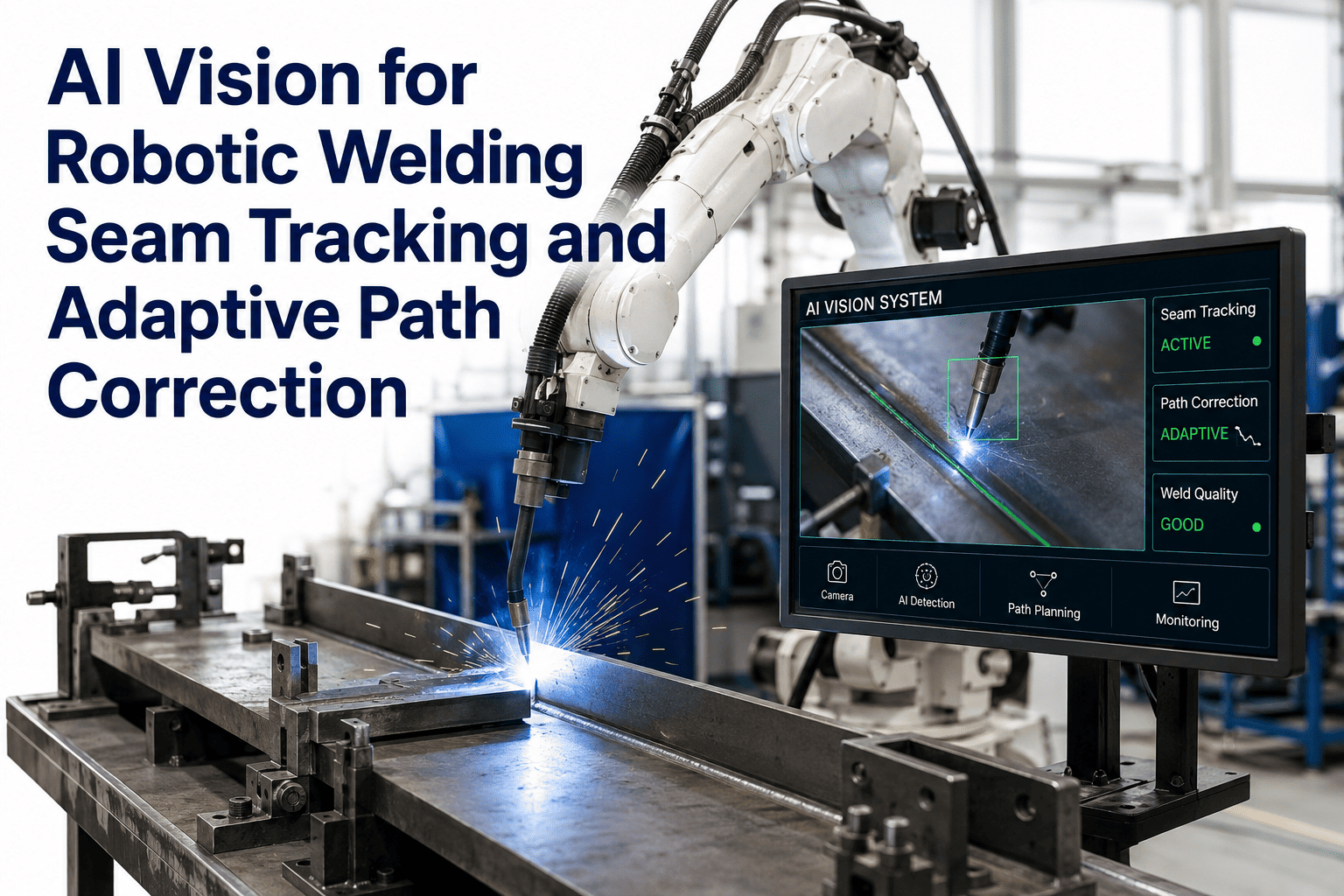
How does it connect to our robotic welding cells?
Through inline integration that closes the loop. Because inspection happens during and immediately after the weld, a detected defect can trigger automatic rework in the cell before the body moves to the next station — and every defect is logged with visual confirmation, severity score, and a work order for traceability and root-cause analysis, feeding the quality and production systems.
Verify Every Weld, Not Every Hundredth.
See Weld Vision Inspect Your Body-in-White — in 30 Minutes
Bring a weld defect that keeps slipping past sampling — a porosity cluster, a missing nugget, spatter. We'll show AI catch it during the cycle on edge hardware, severity-score it, and trigger in-cell rework before the body advances. Your welds, every one verified.