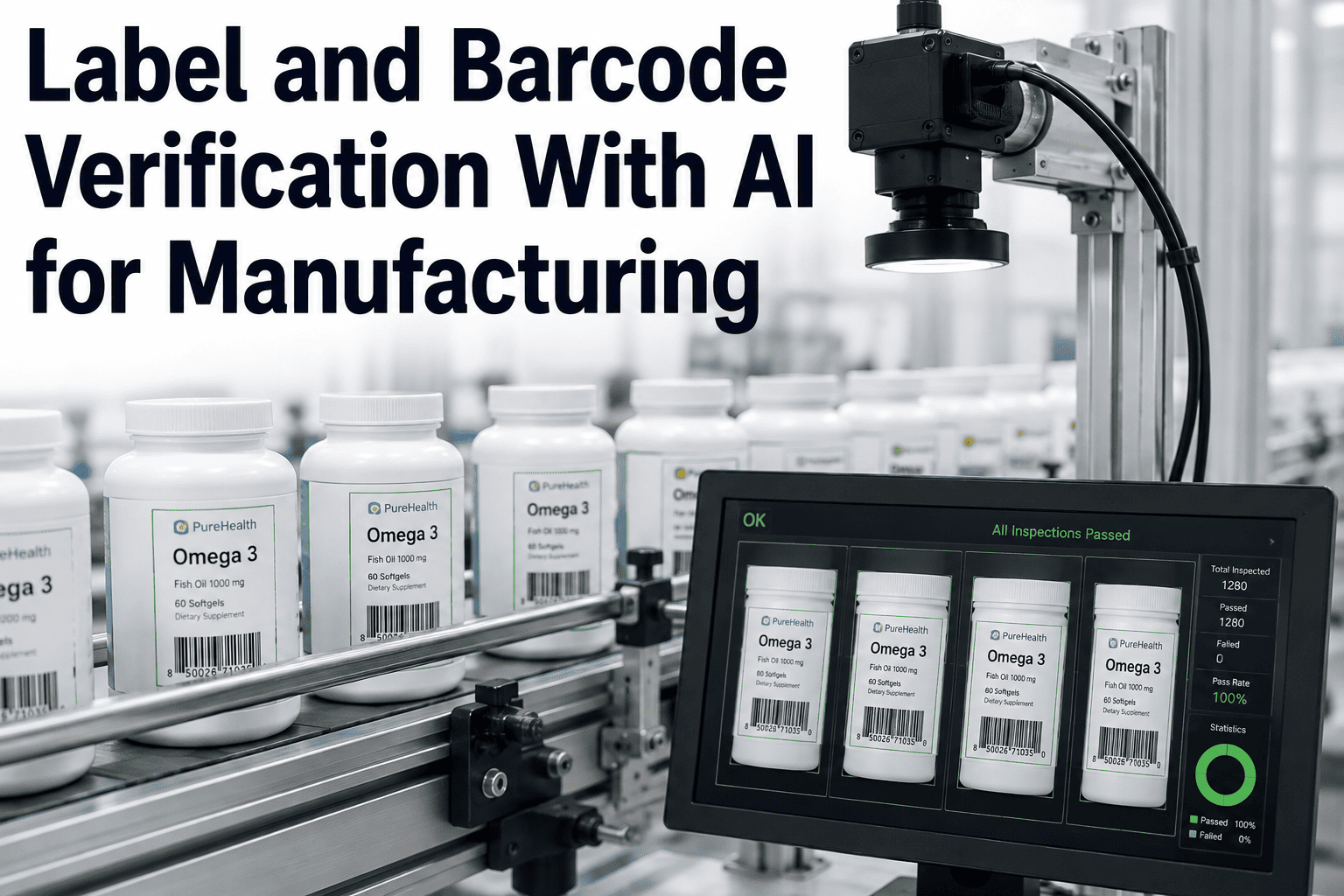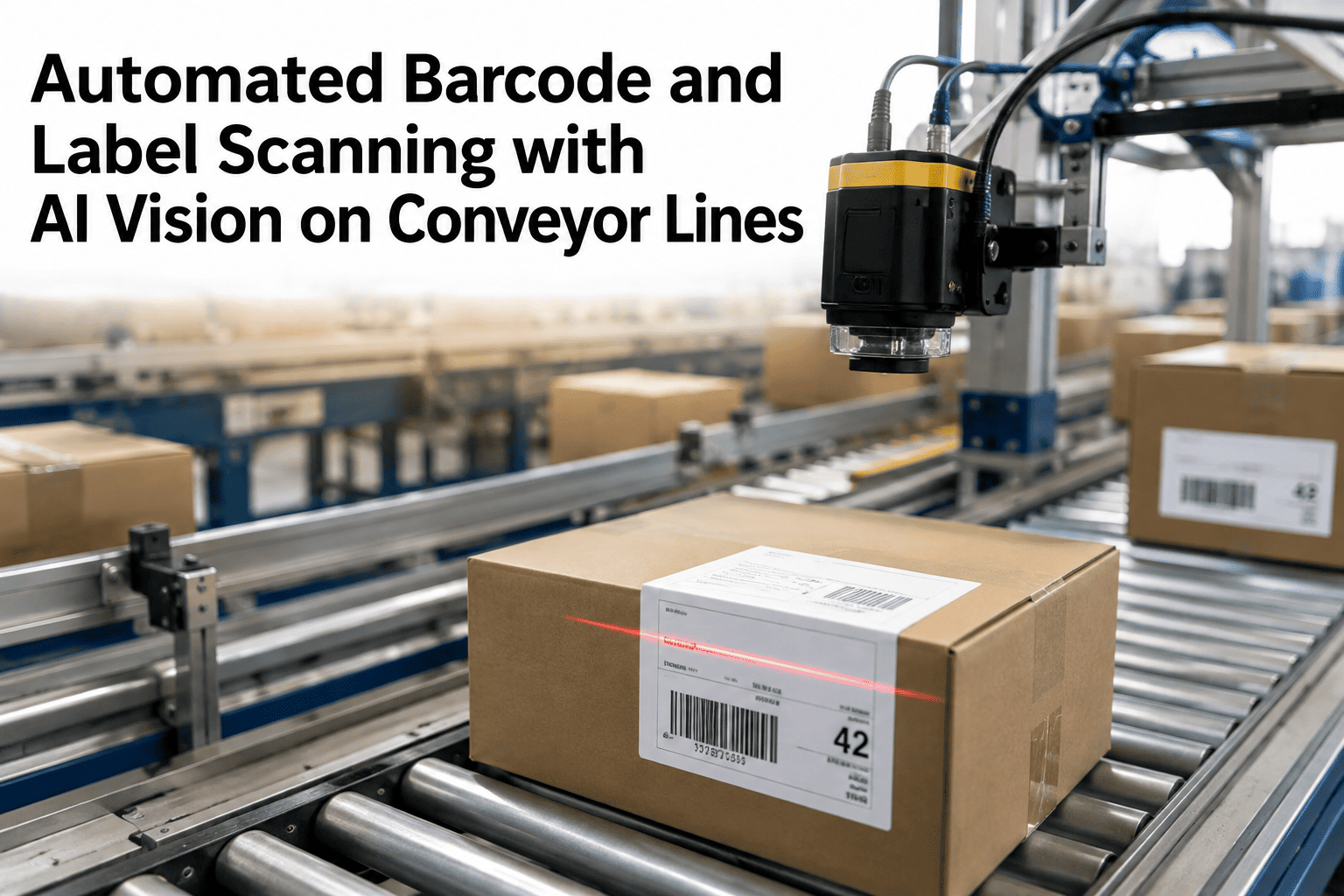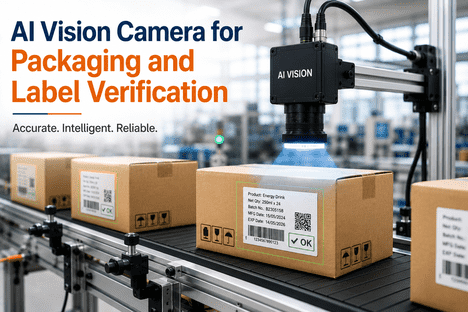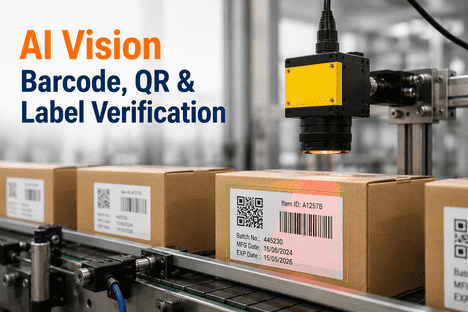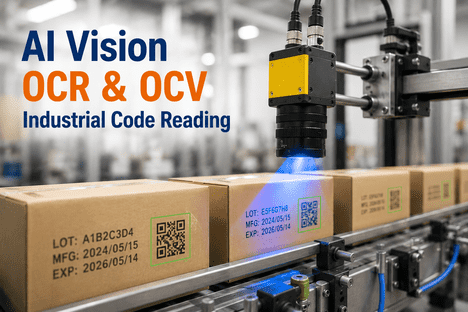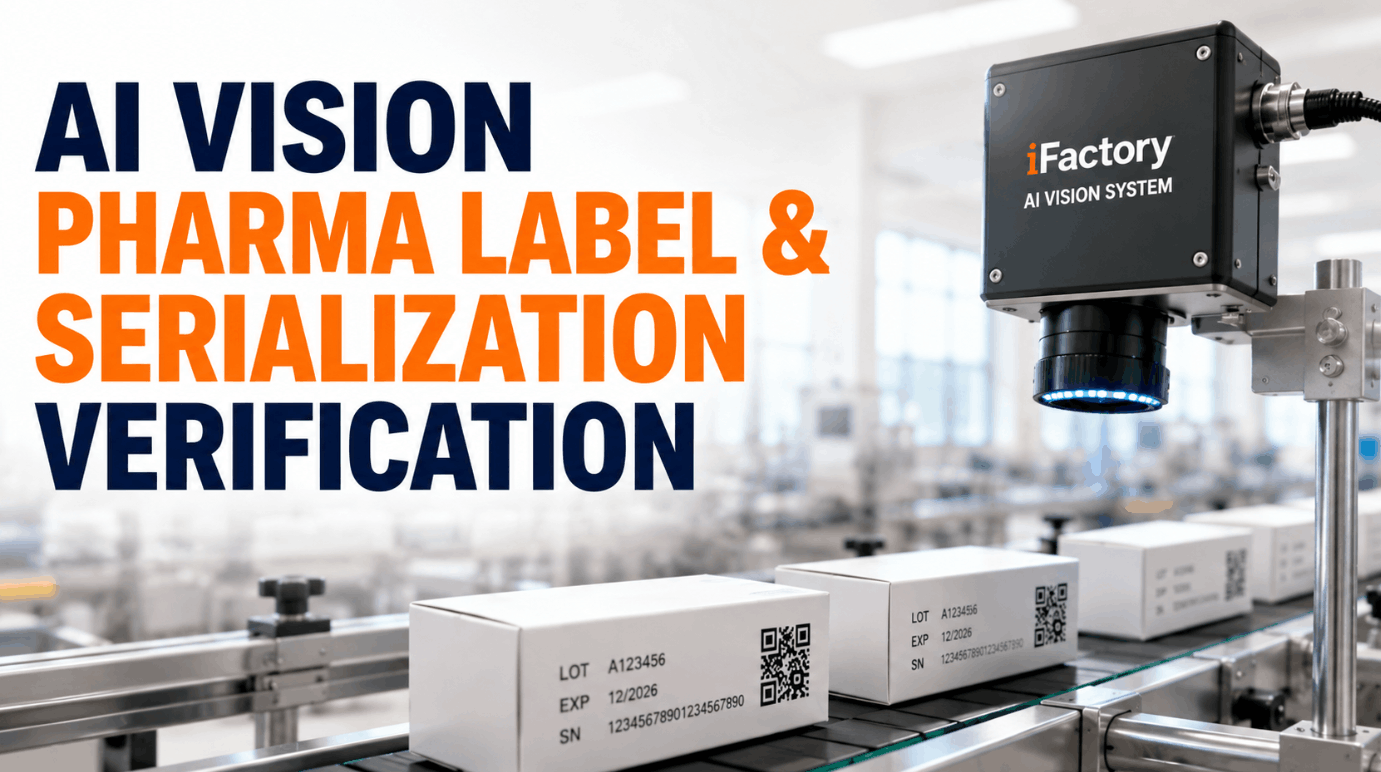
A single unreadable code on a saleable unit is not a scanning problem. It is a compliance event, a chargeback, and, in regulated industries, up to eleven thousand dollars per violation. Every carton, blister, bottle, and pallet now carries a stack of machine-readable and human-readable identifiers — GTINs, serials, lot codes, expiries, UDIs — that must be captured, cross-verified, and archived on every unit at line speed. Traditional laser scanners were built for a simpler era; today's regulatory and packaging complexity needs AI-grade vision that can decode a damaged DataMatrix, read a smeared inkjet date, and grade the print quality in the same frame. Book a code-reading assessment to see your own product decoded live.
Every Code Decoded. Every Character Verified. Every Unit Traceable.
iFactory's AI vision reads 1D, 2D, DPM codes and OCR text on the same frame — decoding, grading against ISO 15416/15415/29158, and cross-verifying human-readable fields to lock traceability into every unit that leaves the line.
The Real Cost of a Missed or Misread Code
Traceability failures are the single most expensive quality event in a regulated industry, and one of the most preventable. The numbers below explain why DSCSA, EU FMD, UDI, and GS1 have moved from checkbox to daily audit.
DSCSA penalty per violation, per unit, when serial numbers cannot be verified
date and lot codes an average FMCG line prints in a single production day
of saleable pharma units require GS1 DataMatrix + human-readable cross-verification
the ISO grading scale that decides if your code is compliant or ships as a violation
The Code Zoo: Every Format iFactory Reads on One Line
Modern packaging carries a mix of code families, and the AI reads them all from the same camera in the same frame. Here is what shows up on a typical carton, and how it is decoded.
UPC, EAN, Code 128, Code 39
Retail classics. Fast to print, fast to scan, up to 85 characters. Read against ISO 15416 across ten scan lines and nine parameters.
QR Code, Data Matrix (ECC 200)
Pharma and electronics workhorse. GS1 DataMatrix holds GTIN + serial + lot + expiry in a 12mm square. Graded against ISO 15415.
Direct Part Marking
Laser-etched or dot-peened directly onto metal, castings, and surgical instruments. Graded to ISO/IEC TR 29158 with dome or angled lighting.
EXP 04/2027
SN 5901234567890
Human-readable text fields
Date, lot, serial in printed characters. OCR reads what the text says; OCV verifies it matches the ERP/MES reference and the 2D code on the same unit.
Anatomy of a Failed Read Before AI Vision Catches It
A traditional laser scanner returns two outcomes: read or no-read. It cannot tell you whether the code was borderline, whether printed text disagrees with the barcode, or whether a whole lot of "reads" were degrading toward the reject threshold. AI vision returns the story.
The scanner says "read"
A single scan line found enough contrast to decode. It does not tell you nine other scan lines failed, or that print modulation grade is now D.
The AI grades it
Same frame, ISO 15416 or 15415 applied across the entire code. Modulation, contrast, defects, decodability, quiet zone — each scored A-F.
The AI cross-checks OCR
Human-readable lot, date, and serial are extracted and compared character-by-character to the encoded 2D code and the MES reference string.
The trend appears
Grade drift over the last thousand units is charted. When modulation slides from A to C, the operator sees it before the first F prints.
The Three ISO Standards Every Traceability Line Answers To
"Does it scan" is not compliance. ISO grading is compliance. Every code type on your line falls under one of three international standards, and each has its own parameters, methodology, and pass threshold your customer will audit against.
15416
1D Barcode Grading
The standard for linear symbols — UPC, EAN, Code 128, Code 39. Ten scan lines across the height; each graded on decode, symbol contrast, minimum reflectance, edge contrast, modulation, defects, and decodability.
15415
2D Label Code Grading
Covers QR and Data Matrix printed on labels. Symbol contrast, fixed-pattern damage, modulation, decode, axial non-uniformity, grid non-uniformity, unused error correction. Lowest individual grade becomes the overall grade.
TR 29158
DPM Code Grading (AIM DPM)
The DPM variant. Adaptive global-threshold calculation and 30/45/90-degree or dome lighting for etched, dot-peened, and laser marks on curved or reflective metal where ISO 15415 alone cannot resolve modulation.
The A-to-F Grade Scale Your Auditor Will Ask About
Every ISO-graded code carries a letter grade. Most brand owners specify B or better as accept threshold; regulated industries push toward A on saleable units. Here is what each grade means on the line.
Move From "Reads" to "Graded, Verified, Archived."
See a live capture of one of your own printed cartons — decoded, ISO-graded, and OCR-cross-checked against your MES reference. iFactory scopes camera, lighting, and integration for a fixed-price 10-week pilot on one line.
OCR + OCV: Read the Text, Then Verify It Actually Matches
Regulators do not care what your barcode encodes. They care that the human-readable text a pharmacist reads matches the machine-readable code a DC scans. Traditional systems do one of these. iFactory does both, on every unit.
Reads what the text actually says
- Extracts printed date, lot, serial from carton or blister
- Handles inkjet, thermal, laser, dot-matrix fonts on any substrate
- Reads faint prints, curved surfaces, low-contrast metallic backgrounds
- Outputs the string exactly as printed — truth-of-record for regulators
Verifies what was read matches the reference
- Cross-references OCR string against MES/ERP expected value character-by-character
- Confirms 2D DataMatrix payload matches the human-readable serial on the same unit
- Flags out-of-range serials, wrong lot on wrong SKU, expired date-format prints
- Writes pass/fail per parameter to batch audit trail with archived image evidence
Six Ways Codes Fail on a Production Line
A laser scanner tells you a code did not read. It cannot tell you why. AI vision returns the diagnostic — so the next hundred units do not fail the same way.
Low print modulation
Ink starvation, worn thermal ribbon, or dying print head drifts bar contrast. Grade slides from A to D over a shift without anyone noticing until the DC rejects a pallet.
Quiet-zone violation
Text, artwork, or a neighbouring code encroaches on the mandatory blank margin around the symbol. Scan may work in-house; retail POS often fails.
Substrate reflection glare
Foil blisters, gloss lamination, or shrink-wrap create hotspots that hide code cells. Solved with dome or diffuse coaxial lighting.
Curved-surface distortion
Codes wrapped around bottles, vials, or ampoules distort into non-uniform grids. AI perspective-correction reads what fixed-focus laser cannot.
OCR-code mismatch
Machine-readable serial says 5901234; human-readable says 5901284. Unit passes traditional inspection and fails at customs when discrepancy surfaces.
Missing or duplicate serials
Print engine hiccups skip a serial, or a jammed carriage repeats one. Aggregation to the parent case fails at EPCIS commissioning.
The iFactory Code Reading Architecture
Every unit passes through a vision station where camera, lighting, decode engine, OCR/OCV, and traceability integration run as one deterministic pipeline. Under three seconds from trigger to archive.
Trigger-locked capture
PLC signal, encoder pulse, or photo-eye triggers exposure. Freeze-frame lighting isolates motion blur even on 600-parts-per-minute lines.
Multi-format decode
All code families decoded in parallel from the same frame — 1D, 2D, DPM, and OCR fields — without operator format selection.
ISO grading
Modulation, contrast, defects, decodability, and quiet zone parameters scored per unit against the applicable ISO standard.
MES/ERP cross-check
Decoded strings compared to the expected value for the current batch. Wrong SKU, expired date, or out-of-range serial rejects instantly.
Archive & EPCIS emit
Per-unit image, grade, and decoded payload stored on-prem. EPCIS commissioning event dispatched to your traceability platform in real time.
Regulatory Coverage Matrix
The same iFactory vision stack answers to every major serialisation framework, in the same platform. Configure per SKU, per market, per shipping lane.
What Changes When Every Code Is Read, Graded, and Verified
Numbers from typical pharma, medical device, and FMCG deployments in the first 120 days of go-live.
The 10-Week Fixed-Price Traceability Pilot
One line, one product family, one fixed price. Ten weeks from kickoff to live code grading, OCV cross-check, and EPCIS emission on 100% of production.
Inventory of every code on the packaging, SKU-level ISO grade baseline, MES reference schema.
Vision station, PLC trigger wiring, lighting selection for substrate and code type, focal calibration.
AI model tuned on your fonts, substrates, print engines. ISO grader calibrated against a certified verifier.
Batch commissioning, aggregation events, trading-partner XML dispatch, exception routing.
IQ/OQ/PQ run, parallel operation against legacy scanner, quality and compliance sign-off.
Frequently Asked Questions
Does the AI system replace our existing barcode scanners?
On the primary inspection station, yes — AI vision replaces fixed-mount laser scanners because it does more in the same frame (decode, grade, OCR, OCV, archive). Handheld verifiers and warehouse scanners stay in place. Shop-floor scanners become fallback and offline verification tools, while the AI station handles 100% inline traceability. Book a scoping call to map the transition for your line.
Can it read damaged or partially obscured codes?
Yes, within reason. Deep-learning decoders handle codes torn, smeared, blurred, or up to 30% obscured — well beyond laser scanner threshold. What the AI adds is honesty: it decodes marginal codes and simultaneously grades them, so a code that "reads" at F is still flagged as a compliance risk. That trade-off between decoding aggressively and grading strictly is configurable per SKU.
How does it handle direct part marking on shiny metal parts?
DPM codes on stainless, aluminium, or coated substrates require carefully chosen lighting geometry — 30, 45, 90-degree, or dome — to bring mark contrast up without hotspots. iFactory selects the geometry during line audit and grades against ISO/IEC TR 29158 (AIM DPM), the correct standard for direct part marks that adapts modulation calculation to metal surface behaviour.
What line speed can the system handle?
Standard configurations run to 600 parts per minute for label-mounted 2D codes and 1,200 per minute for high-speed 1D on FMCG bottling and pouching. The limits come from lighting freeze time and camera frame rate, scoped during line audit. On pharma cartoning at 200-400 per minute, the same hardware runs with ample headroom for full OCR/OCV plus ISO grading. Talk to a specialist about your line speed.
Is the system validated for DSCSA and EU FMD compliance?
Yes. The platform ships with IQ/OQ/PQ protocols, CFR 21 Part 11 electronic-record and electronic-signature controls, full audit trails on every decoded unit, and GS1 EPCIS 2.0-compliant event emission in XML or JSON-LD. Validation packages are typically completed within the 10-week pilot and hand off directly to your compliance team for regulator inspection.
The Bottom Line on Inline AI Code Reading
Barcode scanning was a solved problem for one code, one format, one line. Traceability is a different problem. Every saleable unit now carries multiple codes, multiple standards, multiple regulators — and the cost of getting one wrong is measured in recalls and license risk. AI vision handles decode, grading, OCR, verification, and EPCIS emission on the same frame, on every unit — turning traceability from audit exposure into a documented process asset.
See Your Own Code Decoded, Graded, and Cross-Verified
Book a 30-minute scoping call. Send a sample carton, blister, or DPM part. iFactory demonstrates a full AI decode, ISO grading, OCR extraction, and OCV cross-check on your artwork, then builds a fixed-price 10-week pilot proposal with an ROI worksheet tied to your rejection and recall rates.