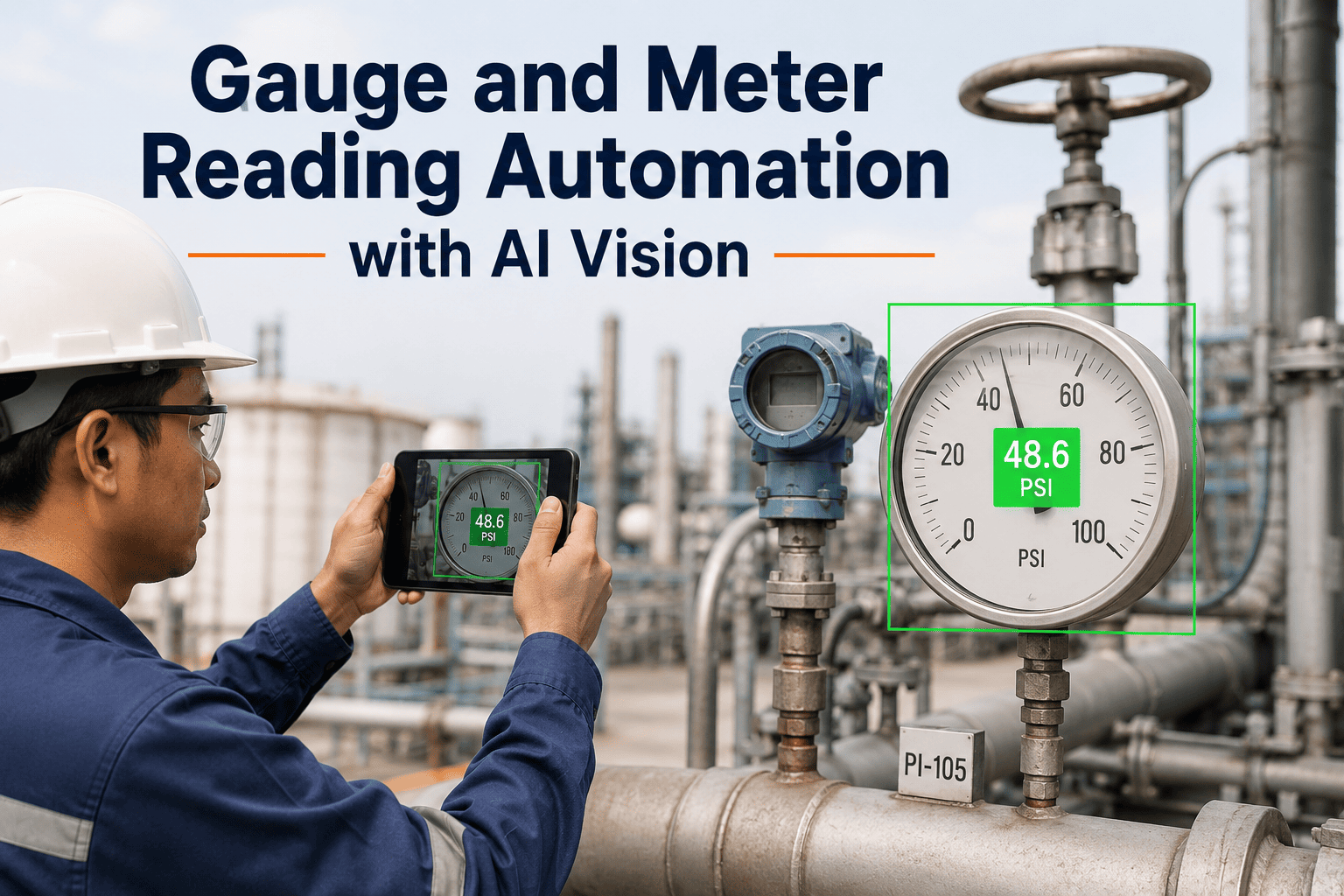
Somewhere on your plant floor right now, a decades-old pressure gauge is holding a number that matters, and the only way anyone will know that number is if an operator walks over, reads a needle at an angle, and writes it on a clipboard. Roughly 73 percent of industrial facilities still run this way, not because digital monitoring is undesirable but because replacing every legacy gauge with a digital transmitter is rarely affordable. iFactory's AI reads those same gauges optically, and you can book a demo to see it reading your own instruments.
73 Percent of Facilities Still Read Critical Gauges With a Clipboard and a Guess
iFactory's AI vision reads analog gauges and digital displays automatically during rounds or continuously from fixed cameras, eliminating parallax error, transcription mistakes, and the hours lost compiling manual logs.
The Instrument Types iFactory's AI Is Trained to Read
Every facility carries a mix of legacy analog instruments installed long before digital sensors were standard, and each dial format requires a slightly different reading approach to get right consistently.
Pressure Gauges
Bourdon tube and diaphragm gauges are read across ranges from vacuum to high pressure, on dial sizes from small panel units to large process gauges.
Temperature Indicators
Bimetallic and filled-system temperature dials are read continuously, giving visibility into process points where thermocouple retrofits are costly.
Level Meters
Tank and vessel level indicators are monitored to prevent overflow or shortage conditions between scheduled operator rounds.
Digital Displays and Flow Meters
Seven-segment and LCD digital readouts are captured through optical character recognition alongside analog flow indicators.
What Manual Gauge Rounds Actually Cost a Facility
The cost of manual gauge reading is rarely visible in a single line item, but it shows up as delayed anomaly detection, transcription errors in compliance logs, and hours of skilled labor spent walking routes instead of solving problems.
From Camera Image to a Validated Reading in Your Historian
iFactory's AI turns a photograph of a physical dial into a trusted, timestamped data point that flows directly into your existing systems.
Image Capture
Fixed cameras or mobile devices capture the gauge face, whether on a scheduled round or continuously from a mounted position.
Needle and Scale Detection
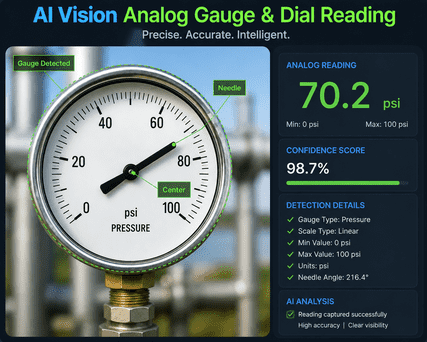
The AI identifies the dial face, needle position, and scale markings, correcting for glare, condensation, and viewing angle.
Reading Validation
Each reading is scored for confidence, and low-confidence captures are flagged for exclusion rather than passed downstream as fact.
System Integration
Validated readings publish to your process historian, SCADA system, or CMMS via standard industrial protocols in real time.
Every Misread Gauge Is a Decision Made on Bad Data
iFactory's AI reads your existing analog gauges and digital displays automatically, eliminating parallax error and transcription mistakes without replacing a single instrument.
Manual Rounds vs AI Vision Reading, Side by Side
The economics rarely favor a wholesale digital instrument replacement, which is why optically reading existing gauges is the more practical path for most facilities.
| Factor | Manual Operator Rounds | AI Vision Reading |
|---|---|---|
| Reading Frequency | Scheduled rounds only | Continuous or on-demand |
| Hardware Changes Needed | None | Camera only, no gauge changes |
| Transcription Errors | Common, manual entry | Eliminated, direct to system |
| Audit Trail | Paper log, hard to verify | Timestamped image and value record |
From First Camera to Full Round Elimination
iFactory's rollout starts with your highest-value instruments and expands coverage as accuracy is validated against your existing manual process.
Instrument Survey
Critical gauges, dial types, and viewing conditions across the facility are catalogued to plan camera placement.
Camera Install and Calibration
Cameras are mounted and calibrated against each gauge's specific dial format, scale, and lighting condition.
Parallel Validation
AI readings run alongside manual rounds for a validation period to confirm accuracy before full handover.
Full System Integration
Validated readings replace manual rounds and publish directly into your historian, SCADA, or CMMS platform.
Results From AI-Driven Gauge Reading Deployments
The figures below reflect outcomes reported from facilities that deployed AI vision gauge and meter reading across pressure, temperature, level, and flow instruments.
Common Questions From Plant and Facilities Teams
Your Gauges Already Know the Answer, They Just Cannot Tell Anyone Yet
The information locked inside a legacy analog gauge is just as real-time and just as valuable as anything coming off a digital transmitter, it simply has no way to reach your systems without a person walking over and reading it manually. That gap creates delay, error, and cost that compounds every single shift.
iFactory's AI closes that gap by reading your existing gauges optically and publishing validated readings directly into the systems your team already relies on. The result is fewer misreads, faster anomaly detection, and hours of skilled labor returned to actual problem-solving. Book a demo to see iFactory's AI reading live gauge data from your own facility.
Stop Walking Routes to Read Numbers a Camera Can Read for You
iFactory's AI reads analog gauges and digital displays automatically, with no instrument replacement and a direct feed into your existing systems.