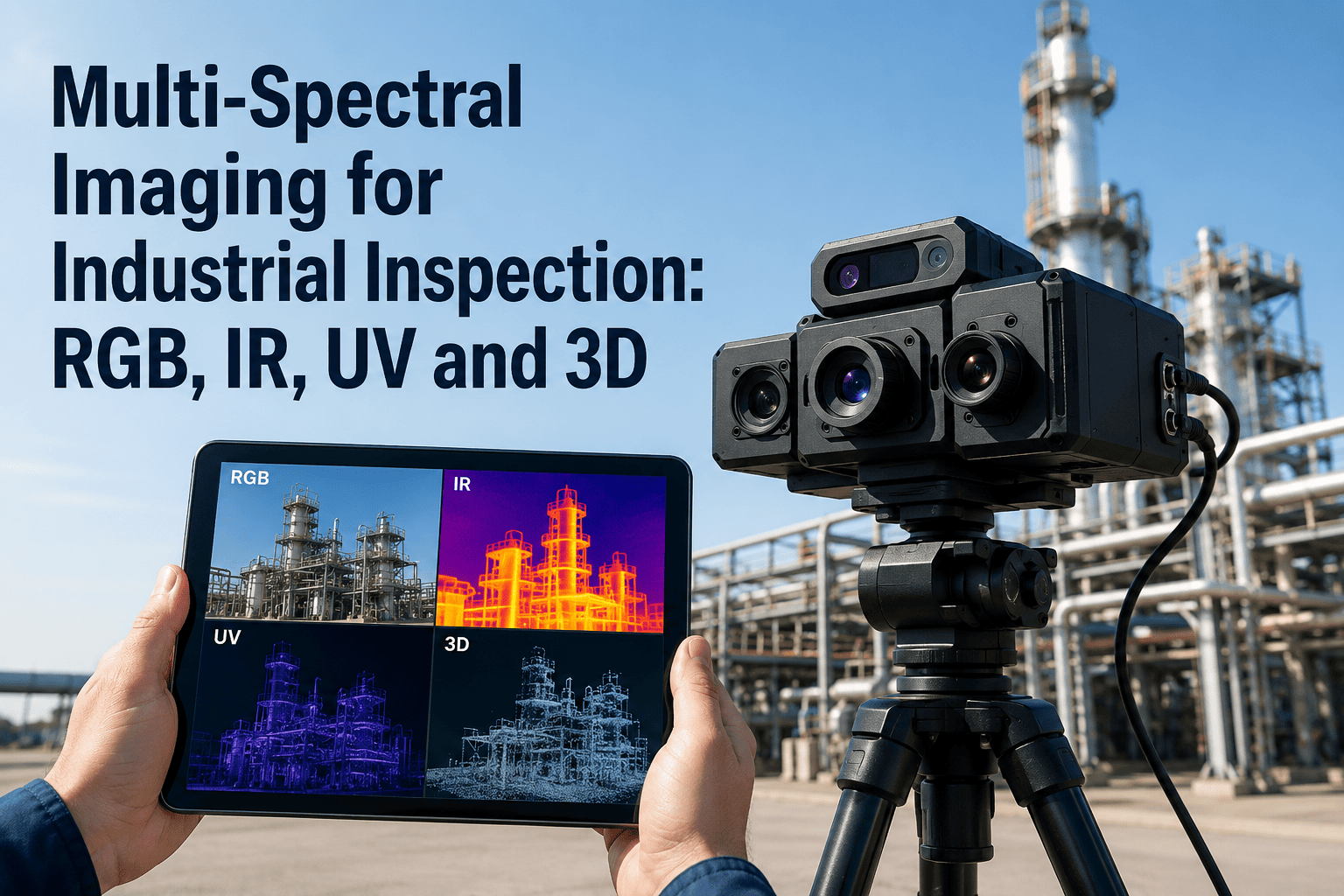
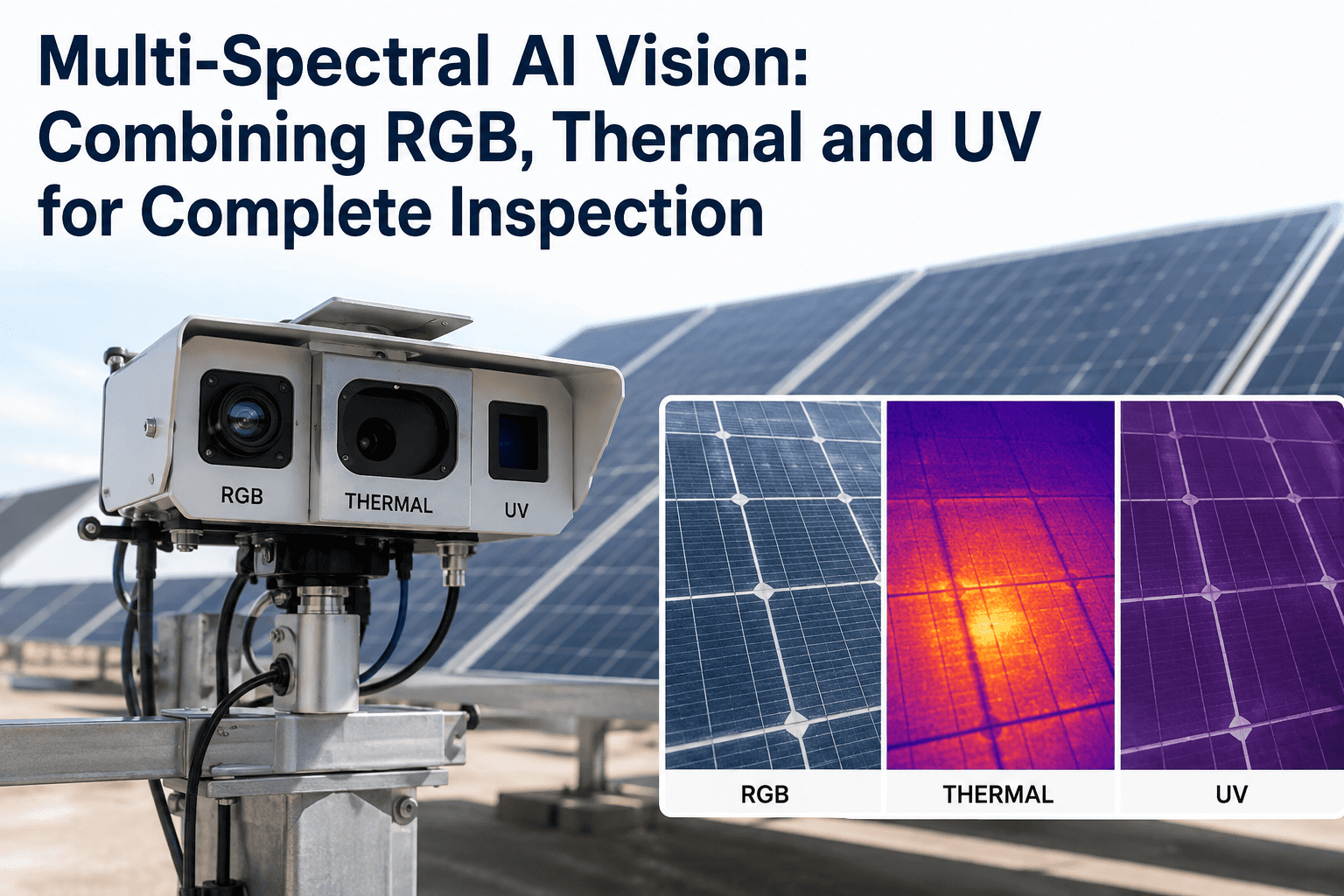
Every industrial defect has a preferred spectrum. Surface scratches show up in visible light. Heat-related failures show up in infrared. Fluorescent penetrant cracks show up under ultraviolet. Dimensional deformations show up only in 3D depth data. The problem is that no single sensor can see all four — a colour camera cannot detect a bearing that is 40°C hotter than its neighbour, a thermal camera cannot see a hairline crack thinner than a human hair, a UV lamp cannot detect a dimensional shift of two millimetres, and a 3D scanner cannot read a printed label. That is why single-sensor inspection systems keep missing the defects that matter most, and it is why iFactory's multi-spectral platform fuses RGB, thermal IR, UV fluorescence, and 3D depth into a single AI-processed condition assessment — book a demo to see multi-spectral fusion running on your product images.
MULTI-SPECTRAL FUSION · RGB · IR · UV · 3D
Four Sensors Looking at the Same Part See Four Different Truths — Fusion Turns All Four Into One Definitive Answer
iFactory's multi-spectral inspection platform combines visible light, thermal infrared, UV fluorescence, and 3D depth data into a single AI-processed condition report — catching the defects that any one modality would miss and giving your quality team a single source of truth per inspection.
4x
Spectra fused into one decision
365nm
UV-A wavelength for FPI & MPI
µm
Sub-hair-width crack detection
3D
Geometric deformation depth data
THE SINGLE-SENSOR BLIND SPOT
Why the Best Camera in the World Still Misses the Defect That Matters
Peer-reviewed research on the MVTec AD industrial defect benchmark now shows that RGB-only inspection has essentially reached the practical accuracy limit for the defects that colour and texture can express. The problem is not the algorithm — it is that colour and texture cannot represent the physical dimensions of the defect. A dent that is invisible in RGB is obvious in 3D depth. A microcrack that is invisible in RGB is obvious under UV fluorescence. A heated connection that is invisible in RGB is obvious in thermal IR. Every industrial inspection question has a right modality — and picking the wrong one is a permanent, unrecoverable blind spot.
THE FOUR SPECTRA
What Each Modality Sees — And What It Cannot See No Matter How Hard the Camera Tries
Multi-spectral inspection means using the right physics for the right defect. Each of the four modalities in the iFactory platform captures a class of information the other three physically cannot access.
RGB
400–700 nm · Visible Light
Detects
Colour, texture, label print, surface scratches, contamination, assembly presence, part identity, print quality
Cannot see
Heat, subsurface cracks, dimensional deformation, sub-visible surface flaws, temperature trajectory
IR
8–14 µm · Thermal Infrared
Detects
Temperature, hot spots on connections, bearing heat, motor windings, refractory loss, steam trap leakage, insulation failure
Cannot see
Fine surface detail, colour, print, small dimensional variance, sub-thermal microcracks, part identity
UV
365 nm · UV-A Fluorescence
Detects
Hairline cracks with fluorescent penetrant, magnetic particle indications on ferrous parts, contamination, leaks with UV tracers
Cannot see
Subsurface defects, heat, dimensional variance, defects on unprepared surfaces without penetrant chemistry
Detects
Dimensional variance, undulations, material loss, dents, warping, height and depth measurement, missing features on 3D geometry
Cannot see
Colour, print quality, surface texture, temperature, fluorescent indications, sub-resolution surface defects
The Defect Your Best Camera Missed Was Not a Camera Problem — It Was the Wrong Physics for the Wrong Question
iFactory's multi-spectral platform captures RGB, thermal IR, UV fluorescence, and 3D depth on the same part in the same inspection window, then fuses the four streams into a single AI-processed condition report.
FAILURE MODE COVERAGE
Which Modalities Catch Which Failure Modes — And What Fusion Adds That Any Single One Cannot
The clearest way to see the fusion advantage is a defect-by-defect table showing which modalities can even detect each failure mode. Notice how many failure modes cross multiple modalities — that overlap is where fusion transforms a suspicion into a definitive classification.
Hairline Cracks (µm scale)
Weld Defects (Porosity, Cracks)
ON
Primary detection modality
P
Partial or context-dependent
-
Blind to this failure mode
FUSION ARCHITECTURE
How AI Actually Combines Four Sensor Streams Into One Condition Assessment
Sensor fusion is not "run four models and vote". Modern multi-modal industrial anomaly detection uses learned fusion architectures — for example dual-channel reverse-distillation and multi-memory feature banks — that preserve each modality's unique information while learning where the modalities correlate and where they must diverge.
↓ registration and alignment ↓
Multi-Modal AI Fusion Layer
Cross-modal feature extraction · Modality-specific memory banks · Learned fusion weights per defect class · Uncertainty-aware confidence scoring
↓ single decision ↓
Unified Condition Report
Defect class + confidence score
Contributing modality per finding
Severity level and recommended action
Auto-posted work order to CMMS
INDUSTRY APPLICATIONS
Where Multi-Spectral Fusion Is Already the Standard of Care in Inspection
Multi-spectral inspection is not a general-purpose tool for every line. It earns its cost on the parts where the consequence of a missed defect is catastrophic, or where the defect vocabulary genuinely requires more than one modality to describe.
AEROSPACE COMPONENTS
Turbine blades, landing gear, airframe components. UV fluorescent penetrant testing is often mandated by aerospace specifications, and combining UV crack detection with 3D geometric verification and IR thermal signature reveals defects that any single method would miss on safety-critical parts.
AUTOMOTIVE FORGINGS
Crankshafts, axles, and safety-relevant components inspected with fluorescent magnetic particle testing under UV, dimensional verification in 3D, and surface quality in RGB — all fused into a single pass/fail decision per part.
ADDITIVE MANUFACTURING
Powder bed fusion parts inspected in-process with IR thermal signature during build, then post-process with UV penetrant for surface cracks and 3D scanning for dimensional accuracy. Fusion is essential because the failure modes span all four spectra.
OIL, GAS & POWER GENERATION
Piping, welds, and rotating equipment inspected with UV fluorescent testing for cracks, IR thermography for thermal signature, RGB for visual condition, and 3D for wall thickness and geometric integrity.
ELECTRONICS AND PCB
RGB for solder joint quality and component placement, IR for thermal load and hotspot detection, UV fluorescence for conformal coating coverage verification, and 3D for solder joint volume and component height accuracy.
HEAVY MACHINERY MANUFACTURING
Cast and forged components inspected for both surface flaws (UV fluorescence) and dimensional accuracy (3D scanning) with RGB for surface quality — the combination that reveals defects each modality alone would suppress or dilute.
DEPLOYMENT BUNDLE
How iFactory Puts Multi-Spectral Inspection on Your Line
Multi-spectral inspection is more than four cameras bolted to a bench — it is a calibrated, registered, synchronized capture system with fusion inference on shared inference hardware. iFactory ships the entire stack: sensors, hardware, models, integration, and 24×7 monitoring.
Hardware Bundle
Pre-configured NVIDIA AI server ships racked and ready. RGB machine vision cameras, radiometric thermal cameras, 365 nm UV-A illumination with UV-sensitive sensors, and 3D structured-light or laser scanners selected for your part. All software pre-loaded — rack it, plug power and Ethernet, and multi-spectral capture is live.
Registration & Calibration
Every sensor calibrated against a common reference frame so that a hot spot in IR, a crack in UV, and a dimensional shift in 3D can all be attributed to the same physical location on the part. Registration is what makes fusion meaningful.
Integration Scope
Cabling, network, PLC and SCADA integration for reject signals, MES connectivity for full-modality defect logging, operator HMI showing all four modalities per part, training for line operators, and 24×7 remote monitoring by iFactory engineers.
Live in 6–12 Weeks
Weeks 1–3: sensor selection, hardware installation, part fixturing. Weeks 4–8: registration, calibration, fusion model training on your defect classes. Weeks 9–12: line integration, operator training, cutover to production inspection.
Quality Engineer
Fusion flagged Casting 4712 as reject. Which modality drove the decision?
iFactory AI
UV fluorescence detected a 2.3 mm crack at coordinates (X: 41, Y: 88) with 96% confidence. 3D scan confirmed a corresponding surface depression at the same location. RGB and IR were unremarkable. Fusion increased confidence to 98.7% because two modalities agreed on the location. Priority-1 reject with the composite image attached to the CMMS record.
1000+
Clients on iFactory AI across manufacturing verticals
99.9%
Multi-spectral platform uptime SLA on production lines
3-Phase
Structured deployment roadmap from kickoff to cutover
Four Sensors Talking to Each Other Beats Any One Sensor Talking Louder
iFactory's multi-spectral platform captures RGB, thermal IR, UV fluorescence, and 3D depth on the same part in the same window and fuses them into a single AI-processed decision with a full audit trail — live on your line in 6–12 weeks.
MODALITY SELECTION GUIDE
Which Combination of Modalities for Which Inspection Task
Not every inspection needs all four modalities. The table below maps common industrial inspection tasks to the minimum useful modality combination — from single-sensor inspections that RGB alone can handle to safety-critical parts that genuinely need the full four-sensor stack.
| Inspection Task |
Recommended Modalities |
Rationale |
| Label print and package verification |
RGB only |
Colour and print recognition — no other modality adds signal |
| Electrical panel monitoring |
RGB + IR |
RGB for visual condition, IR for hot spots and thermal trend |
| Machined part dimensional QC |
RGB + 3D |
RGB for surface, 3D for dimensional and geometric verification |
| Aerospace crack inspection |
UV + 3D |
UV fluorescent penetrant for cracks, 3D for geometry verification |
| Weld quality inspection |
RGB + UV + 3D |
RGB for visual bead, UV for surface cracks, 3D for bead geometry |
| Additive manufacturing build |
IR + 3D |
In-process IR thermal signature and 3D layer geometry |
| Safety-critical forging or casting |
All four |
Every modality contributes; consequence of miss justifies the full stack |
FREQUENTLY ASKED QUESTIONS
Questions Quality Engineers Ask About Multi-Spectral Fusion
Do we really need all four modalities, or can we start with two and add more later?
Most iFactory deployments start with two modalities matched to the highest-consequence defect classes on the line, then add additional modalities as defect categories are added to the inspection scope. The platform is designed for incremental expansion — the fusion architecture accepts additional sensor streams without a full redesign, and the registration and calibration workflow adds one new sensor at a time. Deciding which two to start with is a defect-mode analysis rather than a budget decision.
Book a demo to walk through the two-modality starting point for your defect classes.
How does the platform handle disagreement between modalities when one flags a defect and another does not?
Disagreement between modalities is signal, not noise. The fusion architecture applies learned modality weights per defect class — a UV fluorescence indication of a hairline crack does not require RGB confirmation because RGB is physically blind to sub-visible cracks, while an RGB label defect does not require UV confirmation. When modalities that should agree disagree, the fusion layer flags the finding with reduced confidence and escalates it for human review. The disagreement itself becomes part of the audit record.
Contact our support team to see modality-disagreement handling examples.
What happens if one sensor fails or needs maintenance — does the whole inspection stop?
Recent research on multimodal industrial defect detection has focused specifically on modality-missing scenarios, and the iFactory platform applies missing-aware prompts and cross-modal consistency modelling to continue detecting defects on the modalities that remain online. Inspection continues at reduced sensitivity for defect classes that depended on the failed sensor, with a clear indicator to line operators that partial-modality inspection is active. A missing sensor triggers an automatic maintenance work order without stopping production.
Book a demo to see graceful degradation behaviour under sensor failure.
Does UV inspection require the fluorescent penetrant or magnetic particle process that FPI and MPI need?
Yes — UV fluorescence inspection only reveals cracks when a fluorescent penetrant or magnetic particle process is applied to the part first, because the fluorescence itself comes from the chemistry that pools inside surface flaws under UV-A light. iFactory's platform accepts parts that are prepared with existing FPI or MPI processes and provides the automated UV imaging, AI detection, and 3D crack localization on top. For parts that do not require chemistry preparation, UV can still detect certain contaminants, coatings, and leaks through UV tracers.
Contact our support team to discuss chemistry preparation integration.
How is the multi-modal data logged for audit and traceability in regulated industries?
Every inspection record includes the raw capture from each modality, the fusion decision, the contributing-modality breakdown, the AI confidence score, the operator disposition, and the CMMS work-order linkage. For regulated industries like aerospace, automotive, and pharmaceuticals, the record satisfies the audit trail requirement of the applicable standard because it captures both the finding and the reasoning behind the finding. Records are retained for the retention period your regulatory framework requires.
Book a demo to see the audit trail structure for your regulatory environment.
The Right Inspection Is Not the One Camera That Sees Best — It Is the Four That Together See Everything
iFactory's multi-spectral platform delivers RGB, thermal IR, UV fluorescence, and 3D depth as a registered, calibrated, AI-fused inspection stack live on your line in 6–12 weeks, with the audit trail regulated industries require.