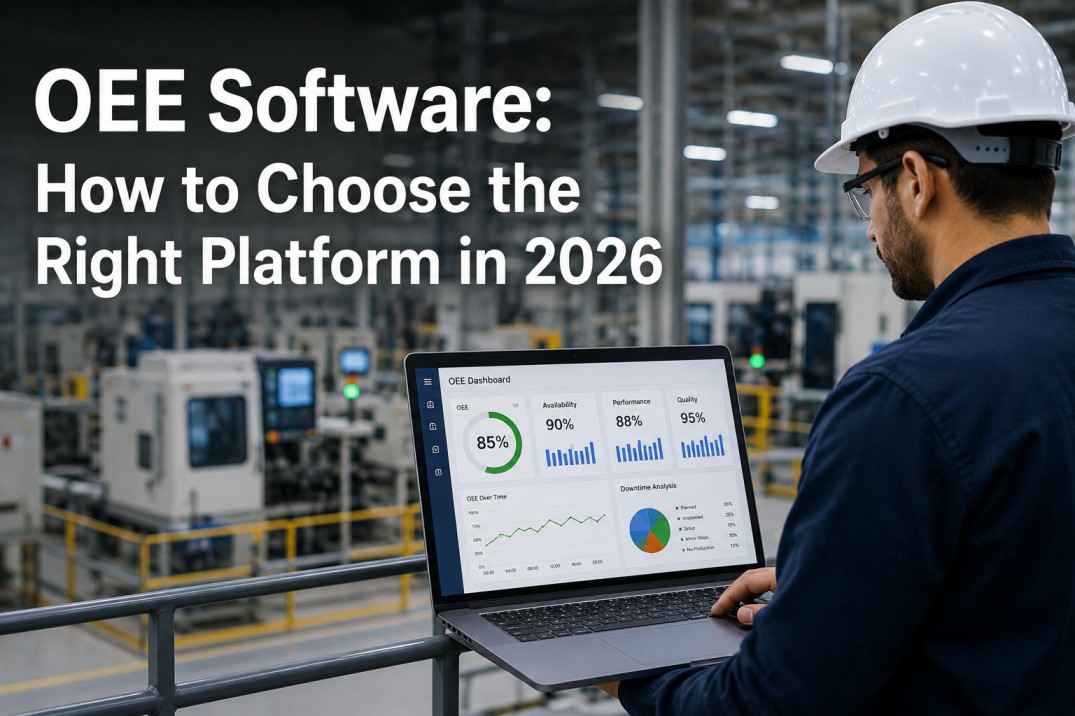
OEE Software: How to Choose the Right Platform in 2026

By Daniel Crawford on May 30, 2026

oee-software-how-to-choose-platform-2026

OEE (Overall Equipment Effectiveness) has been the manufacturing benchmark for decades, but most plants still calculate it with spreadsheets, manual stopwatch studies, or disconnected point solutions. In 2026, AI-powered OEE software changes that — by connecting directly to your automation layer and calculating Availability, Performance, and Quality in real time, while automatically classifying every loss into the Six Big Losses framework. This guide covers what modern OEE software should do, how to evaluate platforms, and why edge-first AI gives iFactory a unique advantage for manufacturers who want OEE data they can actually act on.

OEE Platform — iFactory

Real OEE. Real Time. No Spreadsheets.

iFactory connects directly to your PLCs and sensors, calculates OEE automatically, classifies every loss, and lets you ask questions in plain English. Deployment in weeks — not months.

Fundamentals

OEE: The Three Factors

OEE is the product of Availability, Performance, and Quality. AI-powered software automates the calculation of all three factors from live machine data — eliminating manual data collection and the errors it introduces.

OEE
=
Availability
Run Time / Planned Production Time
Measures downtime losses — breakdowns, setup, adjustment. AI detects and classifies each stoppage automatically.
×
Performance
Ideal Cycle Time × Total Parts / Run Time
Measures speed losses — idling, reduced speed, micro-stops. AI identifies patterns invisible to manual tracking.
×
Quality
Good Parts / Total Parts Produced
Measures defect losses — scrap, rework, start-up defects. AI correlates quality data with upstream parameters.
Loss Framework

The Six Big Losses — Classified by AI

Traditional OEE relies on operators to manually select a loss reason from a dropdown. AI-powered OEE platforms analyse machine signals and classify each loss event automatically — removing subjectivity and enabling accurate trend analysis across shifts, lines, and plants.

Breakdowns
Availability Loss
AI detects unplanned stops from machine signals — no operator entry needed.
Setup & Adjustment
Availability Loss
AI identifies changeover events by correlating product codes, speed ramps, and stop signals.
Idling & Minor Stops
Performance Loss
AI detects micro-stops (under 5 minutes) that manual tracking consistently misses.
Reduced Speed
Performance Loss
AI compares actual cycle times against ideal and flags gradual speed degradation trends.
Defects & Rework
Quality Loss
AI correlates defect data with production parameters to trace root causes upstream.
Start-Up Defects
Quality Loss
AI identifies defect spikes after changeovers and tracks yield ramp-up time per product.
Approach

How AI Transforms OEE Tracking

The difference between traditional OEE software and AI-powered OEE is not just automation — it is the shift from retrospective reporting to real-time, prescriptive loss management.

Traditional OEE
  • Manual data entry or batch spreadsheet uploads
  • Operator-classified loss reasons (inconsistent)
  • Static OEE targets with post-shift reporting
  • No visibility into micro-stops or speed drift
  • Root-cause analysis requires manual investigation
  • OEE data stays in the engineering office
AI-Powered OEE
  • Automatic data ingestion from PLCs and sensors
  • AI-classified losses into Six Big Losses
  • Real-time OEE with predictive alerts
  • Micro-stop and speed drift detection via ML
  • Automated root-cause tracing across correlated streams
  • OEE dashboards accessible to operators on the floor
iFactory Edge

Why Edge AI Matters for OEE

Most AI-powered OEE platforms run anomaly detection and loss classification in the cloud. iFactory runs AI inference at the edge — on the same gateway that collects your PLC data. This matters for three reasons.

01

Real-Time Classification

Loss events are classified in milliseconds — not seconds or minutes — because inference happens locally. When a micro-stop occurs, the AI engine classifies it and updates OEE before the operator has time to reach the HMI.

02

Offline Resilience

Edge inference means OEE calculation and loss classification continue during network outages. The cloud synchronises when connectivity returns. Plants with intermittent internet never lose a data point.

03

Lower Total Cost

Processing data at the edge reduces cloud ingestion and storage costs by 60-80%. For multi-plant deployments with high-frequency data streams, this makes AI-powered OEE economically viable at a fraction of cloud-only alternatives.

Deployment

Deployment Models & Pricing

OEE software pricing varies significantly by architecture. Understanding the trade-offs between edge, cloud, and hybrid models is essential for choosing a platform that fits your operational profile and budget.

Cloud-Only
$15k–$60k/yr
  • Data sent to cloud for OEE calculation
  • Requires stable internet connection
  • Per-connector or per-data-volume pricing
  • 5-15 second latency typical
  • Limited offline functionality
Best Value
Edge + Cloud (iFactory)
$8k–$35k/yr
  • OEE calculated at the edge in real time
  • Full offline resilience
  • Per-gateway pricing — predictable costs
  • Sub-second inference latency
  • 60-80% lower cloud data costs
On-Premise
$50k–$200k/yr
  • Full on-site server deployment
  • Highest data governance
  • Requires IT infrastructure and support
  • Longer deployment timelines
  • Higher upfront capital expenditure
ROI

ROI Impact of AI-Powered OEE

Manufacturers who switch from manual or traditional OEE tracking to AI-powered OEE platforms report measurable improvements. The figures below are based on published case studies and industry benchmarks from 2025-2026.

18%
Average OEE Gain
Within 6 months of deployment — driven by visibility into previously invisible losses
34%
Less Unplanned Downtime
Through predictive alerts and automated root-cause tracing
2.8x
Average ROI
Within 12 months across surveyed plants, with edge-AI platforms showing highest returns
92%
Operator Adoption
Operators use AI OEE dashboards daily when deployed with role-based interfaces
Edge AI OEE

See iFactory's Turnkey Edge AI OEE in Action

We will build a demo connected to your PLC data — showing real-time OEE, automatic loss classification, and natural-language Q&A specific to your production environment.

Selection

OEE Software Buyer's Checklist

Use this checklist to evaluate OEE platforms against the criteria that matter most for manufacturing operations. Each item includes the specific questions you should ask vendors.

Native Industrial Protocols Does the platform support OPC UA, Modbus, MQTT, and Profinet without middleware? Can it connect to Siemens, Rockwell, Mitsubishi, and Beckhoff PLCs natively?
Edge Processing Capability Can OEE calculation and loss classification run at the edge during network outages? Does the platform cache data locally and sync when connectivity returns?
Automatic Loss Classification Does the platform classify losses into the Six Big Losses automatically using ML models? Can you train models on your own historical data? What is the stated classification accuracy?
Micro-Stop Detection Can the platform detect and classify micro-stops under 5 minutes? What threshold configuration is required? Does it use ML to distinguish micro-stops from normal cycle variation?
Natural-Language OEE Queries Can operators ask "Why did OEE drop on line 3 last shift?" and get an instant answer with root-cause trace? Does the NLQ understand manufacturing terminology?
Total Cost of Ownership What is the all-in cost including gateways, cloud storage, and support? Is pricing per-connector, per-user, or per-data-volume? Are there overage charges for high-frequency data?
Multi-Plant Normalisation Can the platform normalise OEE calculations across different equipment generations and brands? How does it handle different shift patterns, product mixes, and reporting standards?
Integration with Existing Systems Does the platform integrate with your MES, CMMS, and ERP? Can it push OEE data to Power BI, Tableau, or other BI tools? Is there a REST API for custom integrations?
FAQ

Frequently Asked Questions About OEE Software

Do I need a data team to deploy OEE software?
Not with edge-AI platforms like iFactory. The gateway connects directly to your PLCs, calculates OEE, and classifies losses without a data pipeline team. Configuration takes hours, not months. Cloud-only platforms typically require more data engineering support for setup and ongoing maintenance.
How accurate is AI-based loss classification?
Classification accuracy depends on data quality and model training. Leading platforms achieve 85-95% accuracy after training on plant-specific historical data. Edge-AI platforms have an advantage because they can apply real-time contextual signals (operator inputs, product changeovers, ambient conditions) that cloud-only systems lack access to at inference time.
Can OEE software handle multi-plant deployments?
Yes, but the complexity varies. Platforms with edge gateways at each plant and a cloud layer for consolidation provide the best architecture for multi-plant OEE. They maintain local autonomy (each plant's OEE continues calculating during cloud outages) while enabling corporate-level benchmarking and cross-plant loss analysis.
What is the payback period for AI-powered OEE?
Most manufacturers achieve payback within 6 to 12 months. The primary drivers are reduced unplanned downtime (typically 30-40% reduction), improved OEE (15-20% gain), and elimination of manual data collection labour. Edge-AI platforms typically have faster payback due to lower ongoing cloud costs and faster deployment timelines.
Is OEE software compatible with legacy equipment?
Yes — this is where edge gateways excel. They can connect to analog sensors, serial ports, and older PLC protocols that modern cloud platforms cannot reach directly. If your plant has a mix of legacy and modern equipment, an edge-first OEE platform is often the only practical option for unified OEE tracking across the entire operation.
Get Started

Ready to Make OEE a Real-Time Decision Tool?

Book a 30-minute discovery call. We will review your current OEE tracking process, identify the biggest hidden losses, and show you iFactory connected to live production data.

Share This Story, Choose Your Platform!