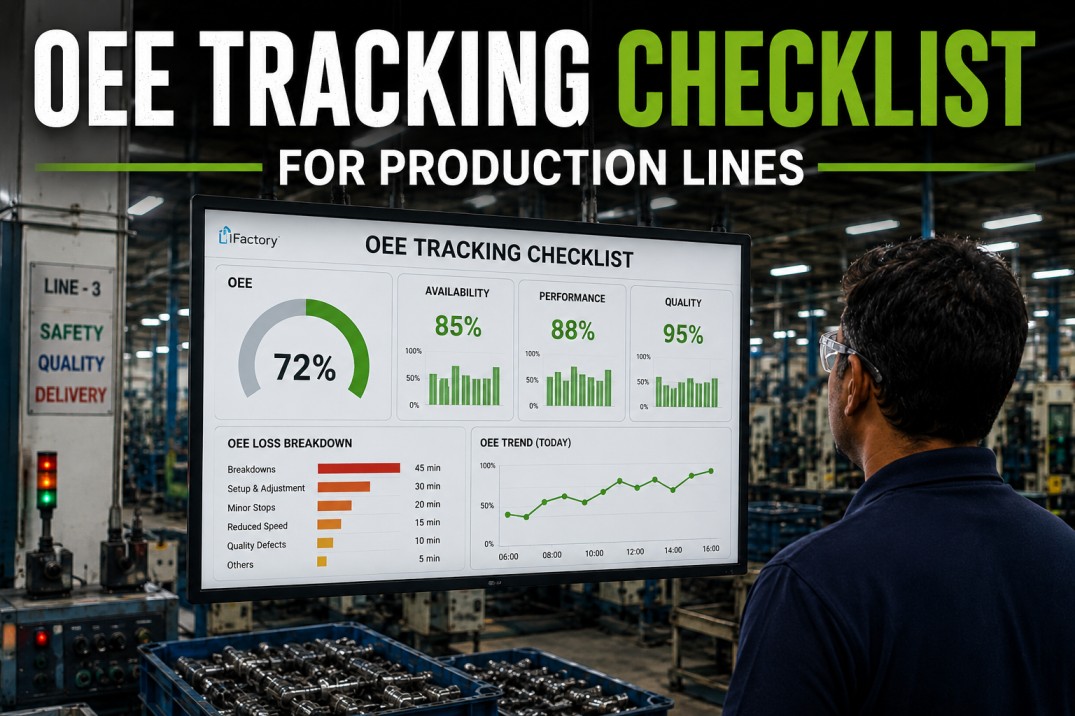
Schedule attainment — the ratio of actual production output to planned production within a defined time period — is the single most visible measure of plant-floor execution effectiveness. Yet most manufacturers track schedule attainment in spreadsheets that aggregate too late to drive corrective action. This checklist covers seven critical dimensions of schedule attainment tracking: an executive attainment scoreboard for at-a-glance performance, a production plan vs actual variance table by product line, schedule variance breakdown cards by root cause category, an OTIF (On-Time In-Full) attainment matrix, a weekly attainment trend table with directional indicators, a shift-level schedule adherence heatmap for pattern detection, and a structured schedule attainment improvement checklist — giving production planners, plant managers, and operations leaders the tools to move from reactive variance reporting to proactive schedule adherence management.
Schedule Attainment
Track Schedule Attainment Live for Every Line with iFactory
iFactory's manufacturing analytics platform ingests production schedules and actual output data in near real-time — from ERP planned orders, MES production records, and PLC cycle counts — to calculate schedule attainment automatically for every product line, shift, and plant. Production planners and plant managers get live variance alerts, root cause attribution, and trend analysis that transforms schedule attainment from a lagging monthly report into a leading operational control.
Schedule Attainment Scoreboard: Four Key Performance Metrics
The schedule attainment scoreboard provides an at-a-glance snapshot of four critical schedule execution metrics — overall schedule attainment percentage, plan adherence rate, on-time delivery performance against promise dates, and the number of orders with missed schedules requiring escalation — giving plant managers and production planners immediate visibility into whether the day's production plan is on track or requires intervention.
Production Plan vs Actual Variance Table: Line-by-Line Attainment
The plan vs actual variance table compares scheduled production quantities against actual output across seven product lines, showing the planned quantity, actual produced units, variance in both units and percentage, an attainment progress bar, and a colour-coded status badge that immediately signals whether each line met its schedule target. This line-level visibility enables production planners to identify which product lines are driving overall attainment shortfalls and require root cause investigation.
| Product Line | Planned (units) | Actual (units) | Variance | Attainment | Status |
|---|---|---|---|---|---|
| Engine Assembly A | 1,200 | 1,176 | -24 (-2.0%) | 98% | On Plan |
| Transmission Line B | 850 | 782 | -68 (-8.0%) | 92% | Below Plan |
| Component Stamping | 3,500 | 3,605 | +105 (+3.0%) | 103% | Above Plan |
| Paint & Finish | 920 | 846 | -74 (-8.0%) | 92% | Below Plan |
| Final Assembly C | 650 | 598 | -52 (-8.0%) | 92% | At Risk |
| Packaging Line 1 | 2,100 | 2,058 | -42 (-2.0%) | 98% | On Plan |
| Moulding & Extrusion | 1,500 | 1,485 | -15 (-1.0%) | 99% | On Plan |
Schedule Variance Breakdown Cards: Six Root Cause Categories
Schedule attainment variance is rarely random — it clusters around recurring root cause categories that, once identified, can be systematically addressed. The variance breakdown cards below analyse six common schedule attainment gap categories — material shortages, machine breakdowns, labour constraints, quality rework, setup overruns, and engineering changes — showing the number of occurrences in the review period, the total production hours lost, and the estimated cost impact of each category.
On-Time In-Full Attainment Matrix: Delivery Performance by Order Type
The OTIF attainment matrix evaluates delivery performance across the four quadrants defined by on-time delivery and in-full delivery for five order categories — standard production orders, rush orders, export orders, interplant transfers, and spare parts. Each cell shows the OTIF percentage with a colour-coded background, and the row summary card highlights the weighted composite score for each order type, enabling supply chain and production teams to pinpoint which order categories are driving OTIF shortfalls.
| Order Type | On-Time | In-Full | OTIF |
|---|---|---|---|
| Standard Production Orders | 94.2% | 96.8% | 92.1% |
| Rush / Expedite Orders | 72.5% | 84.0% | 66.3% |
| Export / International Orders | 78.3% | 92.1% | 74.5% |
| Interplant Transfers | 91.6% | 95.2% | 88.3% |
| Spare Parts | 93.8% | 97.4% | 91.4% |
Weekly Schedule Attainment Trend Table: Five-Week Performance Trajectory
The weekly attainment trend table tracks schedule attainment performance across five consecutive weeks for six product lines, with each week's attainment percentage shown alongside inline progress bars and directional trend arrows that indicate whether performance is improving or declining. The week-over-week change column and trailing average highlight emerging patterns before they become systemic problems — enabling production planners to detect deterioration early and adjust schedules or root cause interventions proactively.
| Product Line | Week 1 | Week 2 | Week 3 | Week 4 | Week 5 | Trend |
|---|---|---|---|---|---|---|
| Engine Assembly A | 95% | 96% | 94% | 97% | 98% | |
| Transmission Line B | 88% | 85% | 72% | 68% | 78% | |
| Component Stamping | 92% | 94% | 96% | 98% | 97% | |
| Paint & Finish | 78% | 76% | 74% | 82% | 84% | |
| Packaging Line 1 | 91% | 93% | 95% | 94% | 96% |
Schedule Adherence Heatmap: Shift-Level Attainment by Day of Week
The schedule adherence heatmap visualises schedule attainment percentage across three daily shifts and five weekdays, with colour-coded cells that immediately reveal shift-day combinations where schedule adherence is strong or weak. Dark green cells indicate attainment above 95%, light green shows 85-95%, amber signals 70-85%, and red flags attainment below 70% — enabling plant managers to identify chronic shift-level gaps, such as poor Monday morning attainment or weekend shift degradation, and design targeted interventions.
| Shift | Monday | Tuesday | Wednesday | Thursday | Friday |
|---|---|---|---|---|---|
| Day Shift (06:00-14:00) | 96% | 94% | 97% | 95% | 93% |
| Afternoon Shift (14:00-22:00) | 82% | 88% | 84% | 86% | 68% |
| Night Shift (22:00-06:00) | 76% | 78% | 72% | 65% | 58% |
Real-Time Tracking
iFactory Tracks Schedule Attainment Live for Every Line, Every Shift
iFactory's manufacturing analytics platform connects directly to your ERP planned orders and MES production records to calculate schedule attainment automatically — by product line, shift, plant, and order type — in near real-time. Production planners and plant managers get live variance alerts, root cause attribution by category, OTIF tracking, shift-level heatmaps, and trend analysis that transforms schedule attainment from a monthly spreadsheet exercise into a live operational control that drives proactive plan adherence.
Schedule Attainment Tracking Improvement Checklist
This checklist provides a structured improvement roadmap for moving from reactive schedule variance reporting to proactive schedule adherence management. Each item includes a rectangular checkbox for completion tracking, a detailed description of the required action, the function responsible, the implementation timeline, and a priority badge that helps operations leaders sequence schedule attainment improvements by business impact.
Get Started
Ready to Move from Reactive Reporting to Proactive Schedule Adherence?
iFactory's manufacturing analytics platform gives production planners and plant managers real-time schedule attainment visibility across every line, shift, and plant — with automated variance detection, root cause attribution, OTIF tracking, and shift-level heatmaps that transform schedule attainment from a monthly spreadsheet exercise into a live operational control. Built to integrate with your existing ERP, MES, and SCADA systems without rip-and-replace, iFactory delivers production-tested schedule attainment analytics in weeks, not months.
Frequently Asked Questions
What is schedule attainment and how is it calculated?
Schedule attainment measures the percentage of scheduled production output that was actually produced within a defined time period. The standard formula is: Schedule Attainment = (Actual Output + Planned Output) x 100, calculated for a specific shift, day, line, or product group. Industry best practice defines planned output as the quantity scheduled at the start of the period, excluding unplanned rush orders added during the period. Actual output includes all good-quality units produced, excluding scrap, rework that has not been completed, and in-process inventory that did not complete all operations. Attainment above 95% is considered On Plan, 80-95% Below Plan requiring attention, and below 80% At Risk requiring immediate escalation.
What is the difference between schedule attainment and OEE?
Schedule attainment and OEE are complementary but different metrics. Schedule attainment answers the question Did we make what we planned? comparing actual output to the production schedule. OEE answers the question How efficiently did we use our available time? measuring availability, performance, and quality against theoretical maximum. A line can have high OEE but low schedule attainment if it ran efficiently against the wrong mix of products, or high attainment but low OEE if it ran overtime to catch up on a schedule shortfall. Best-in-class plants track both metrics together — OEE for process efficiency improvement and schedule attainment for plan execution discipline.
How often should schedule attainment be tracked?
Schedule attainment should be tracked at the shift level — every 8-12 hours — for production lines with cycle times shorter than 30 minutes. For long-cycle or batch production (cycle times over 2 hours), daily attainment tracking is sufficient. Real-time attainment tracking (hourly or continuous) is recommended for high-volume lines where a 30-minute gap can produce 100+ units of variance. The review cadence follows the management rhythm: shift-level review in daily standups, weekly trend review in production planning meetings, and monthly composite review in operations reviews.
How does iFactory automate schedule attainment tracking?
iFactory connects directly to ERP systems (SAP, Oracle, Microsoft Dynamics) to ingest planned production orders and to MES / SCADA systems to collect actual output counts in near real-time. The platform automatically calculates schedule attainment per product line, shift, and plant using the standard formula, applies user-defined threshold bands (On Plan, Below Plan, At Risk), and provides automated variance alerts when attainment drops below target for a specified duration. Root cause categorisation is built in, allowing shift supervisors to tag variance events with reason codes that feed into the variance breakdown analytics, weekly trend reports, and shift-level heatmaps — all without manual data consolidation or spreadsheet manipulation.


.png)