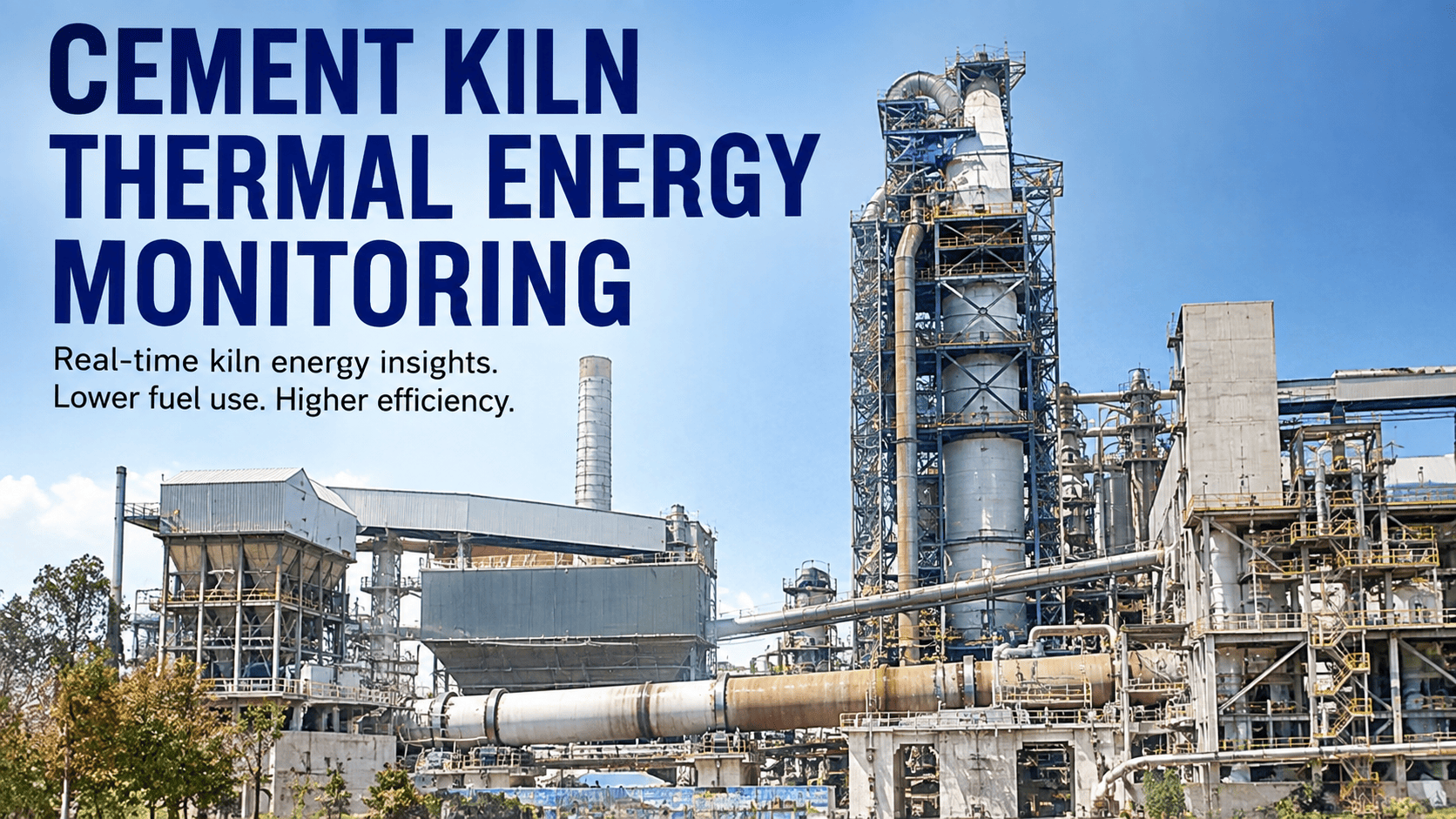
The single most expensive number in a cement plant is not on the balance sheet. It sits on the kiln control screen, refreshing every few seconds: kcal per kg of clinker. Thermal energy is roughly 30 to 40 percent of the cost of a tonne of cement, and pyroprocessing burns almost all of it. Shave a few percent off that number and the saving flows straight to margin, every hour the kiln runs. The problem is that the heat leaks out in places a control-room operator cannot watch continuously and cannot tune fast enough by hand. That is exactly the gap iFactory cement energy AI was built to close — cutting kiln heat consumption 3 to 8 percent by tuning clinker-cooler heat recovery, secondary air temperature, and false air in real time.
Energy Optimization for Cement Plants
AI-Powered Kiln Fuel Efficiency and Heat Consumption
Every kiln runs on one number — kcal per kg of clinker. iFactory's cement thermal efficiency AI reads it against clinker-cooler heat recovery, secondary air temperature, and false air, and tunes the kiln continuously to hold the lowest heat rate your process allows.
3-8%
heat consumption cut
~420
kcal/kg theoretical floor
90%
of plant energy is thermal
Every Kiln Is Judged Against One Number
Specific energy consumption, expressed as kcal per kg of clinker, is the honest scorecard of a pyroprocessing line. The chemistry of turning limestone into clinker has a hard theoretical minimum of around 420 kcal/kg — the heat the reactions actually consume. Everything above that line is inefficiency you are paying for. A modern six-stage preheater and precalciner kiln in top condition runs near 680 to 700 kcal/kg. Most operating plants live somewhere between 730 and 820, and an aging line with tired cooler and heavy air ingress drifts higher still. The distance between your plant and best-in-class is the prize.
Where cement kiln heat consumption lands, in kcal per kg of clinker
The band between your line and a best-in-class kiln is recoverable heat. On a 5,000 tonne-per-day kiln, every 10 kcal/kg is meaningful fuel spend, repeated every single day the kiln turns.
Where the Heat Actually Goes
Most of the energy you put into the kiln does not become clinker. Only the reaction heat is truly unavoidable. The rest walks out as hot gas up the preheater, as exhaust off the clinker cooler, as radiation through the shell, and as sensible heat still trapped in the clinker as it leaves. These loss streams are where cement plant heat recovery lives — and where an operator watching a wall of screens simply cannot react quickly enough to keep them minimized shift after shift.
A simplified kiln heat balance
57%Clinker formation
19%Preheater exhaust
13%Cooler exhaust
11%Shell + clinker + misc
Useful and unavoidable — the reaction heat clinker chemistry demands
Recoverable losses — the 40-plus percent an energy AI works to shrink
The Three Levers That Move the Number
Cutting kiln fuel consumption is not one big switch. It is three interacting levers held at their best point continuously. Push one too hard and another suffers, which is why manual tuning trades one loss for the next. The value of cement plant energy AI is holding all three at once, in real time, as raw mix, fuel quality, and feed rate drift through the day.
Lever 01
Clinker Cooler Heat Recovery
The grate cooler is your recuperator. Well-tuned, it sends hot secondary and tertiary air back to the kiln and precalciner, meaning less fuel does the same work. Bed depth, grate speed, and cooling-air distribution decide how much heat comes home versus vents to atmosphere.
Poorly managed recovery can waste 40 to 80 kcal/kg
Lever 02
Secondary Air Temperature
Hotter secondary air off the cooler means the flame needs less fuel to reach burning-zone temperature. Every degree of recovered air temperature offsets fuel at the burner. Holding it high and stable is one of the most direct routes to a lower kcal number.
Directly offsets burner fuel demand, degree for degree
Lever 03
False Air Infiltration
Air leaking in through kiln seals, the inlet, preheater joints, and ducts is cold air you must reheat for nothing. It dilutes gases, drags up fan power, and quietly inflates heat consumption. Detecting and controlling false air is often the fastest efficiency win on an older line.
Excess and false air commonly add 5 to 15% to fuel use
Which of the three levers is quietly costing you the most on your kiln right now? Book a 30-minute demo and we'll map your heat balance against live optimization.
Why Legacy Control Leaves Heat on the Table
Traditional kiln control leans on operator experience, PID loops, and static setpoints. That worked when disturbances were slow, but a modern kiln burning variable alternative fuels shifts constantly. By the time a person notices the burning zone drifting and adjusts, the loss is already banked. Rule-based and linear model-predictive systems help, yet they struggle with the nonlinear, interacting nature of the kiln. The result is a plant that runs safe but consistently above its best achievable heat rate.
Manual and static control
Setpoints tuned to the worst case, so margin is left on the table by design
Reacts after the burning zone drifts, not before
One lever tuned at a time; the others quietly drift
Heat rate depends on which operator is on shift
Cooler and false air rarely optimized together in real time
iFactory cement energy AI
Holds the lowest safe heat rate your process allows, continuously
Predicts drift and corrects before it costs fuel
Balances cooler, secondary air, and false air together
Same best-practice control on every shift, every day
Soft sensors surface losses no single gauge shows
How iFactory Tunes the Kiln in Real Time
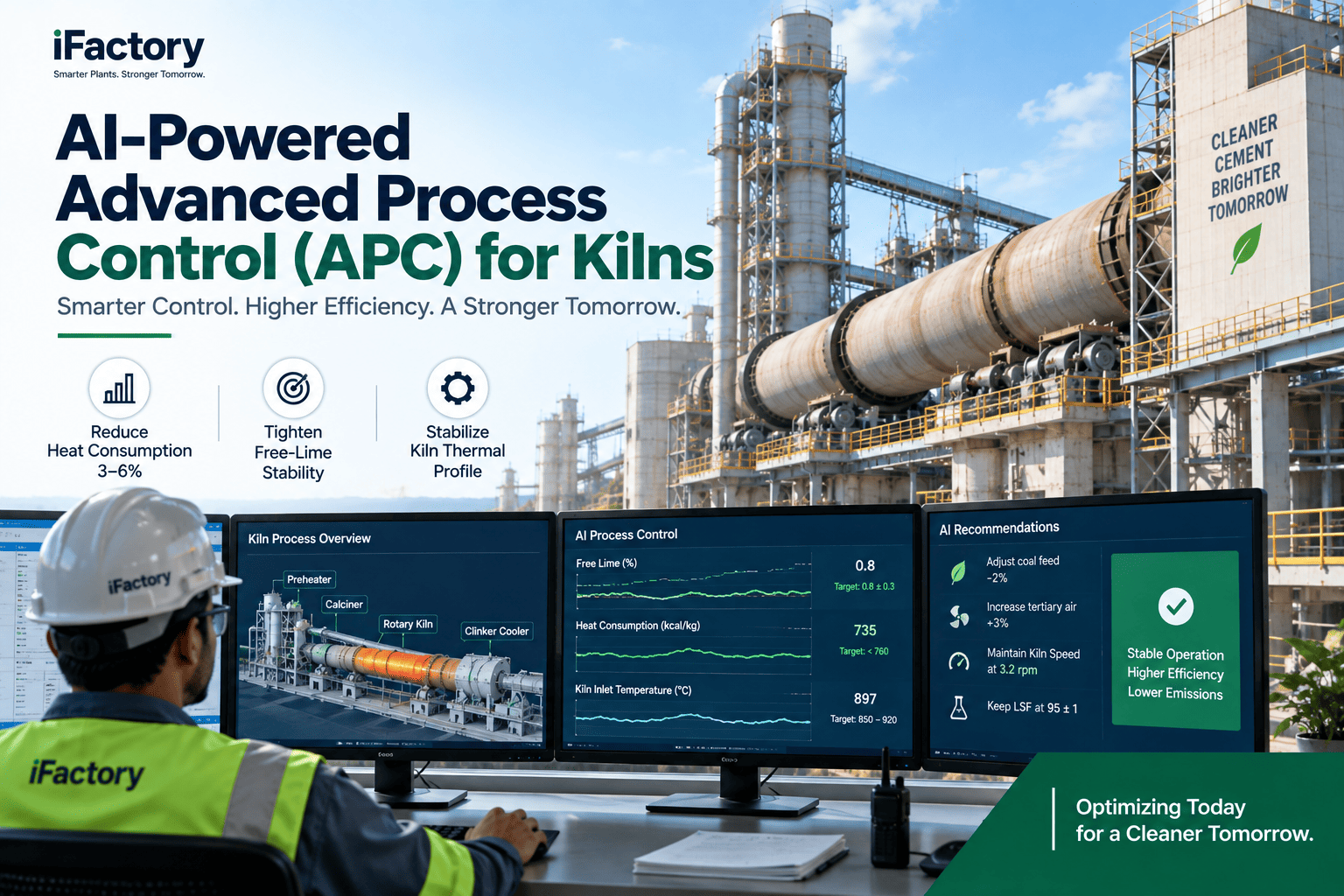
iFactory reads the tags your plant already produces — cooler, burner, preheater, gas analyzers, feed and fuel rates — and turns them into a live picture of thermal efficiency. It learns the kiln's nonlinear behaviour, predicts where heat consumption is heading, and recommends or drives the moves that hold the kcal number at its floor without risking clinker quality or refractory life.
1
Sense
Ingests existing kiln, cooler, and gas-analyzer data plus soft sensors for variables no gauge reads directly.
2
Predict
Models the nonlinear kiln to forecast heat rate, secondary air, and false-air drift minutes ahead.
3
Optimize
Solves all three levers together for the lowest kcal/kg that keeps clinker quality and stability intact.
4
Act
Recommends to the operator or writes setpoints in closed loop, then measures the saving and learns.
What a 3 to 8 Percent Cut Actually Means
Thermal energy dominates cement variable cost, so a small percentage on heat consumption is a large number in fuel spend and CO2. Because the kiln runs continuously, the saving compounds every hour of every day. These are the outcomes plants pursuing cement thermal efficiency AI typically target as the levers come under continuous control.
3-8%
Lower heat consumption
fewer kcal per kg of clinker, held around the clock
↓ CO2
Emissions per tonne
less fuel burned means fewer combustion emissions
Stable
Clinker quality
a steadier burning zone, not efficiency at quality's cost
Fast
Payback window
continuous fuel saving on a continuously running kiln
Frequently Asked Questions
How much can AI realistically cut cement kiln heat consumption?
A 3 to 8 percent reduction in specific heat consumption is a realistic target for kilns that still tune levers manually or with static setpoints. The exact number depends on your starting heat rate, cooler condition, and how much false air the line carries. A kiln already near best-in-class has less to gain; an older line with a tired cooler and heavy air ingress usually has more. A demo on your own data shows where your kiln sits.
Does iFactory replace our existing kiln control system?
It works alongside it. iFactory reads the data your DCS or PLC already produces, builds a live model of thermal efficiency, and either advises the operator or writes optimized setpoints back in closed loop. You keep your existing control and safety systems; the AI is the optimization layer that holds the lowest safe heat rate on top of them.
Will optimizing for fuel efficiency hurt clinker quality?
No. The objective is the lowest heat rate that still holds clinker quality and process stability. Quality parameters and refractory-protecting constraints are built into the optimization, so the AI never chases fuel savings past the point where clinker suffers. A steadier burning zone often improves consistency rather than harming it.
What data and sensors do we need to get started?
Most kilns already generate what is needed: burner and fuel rates, feed rate, cooler data, preheater temperatures and pressures, and gas-analyzer readings. iFactory adds soft sensors to estimate variables that are hard to measure directly, such as effective false air and heat recovery. The starting point is a review of your existing tag list.
How long before we see a saving on the kcal number?
Because the kiln runs continuously, savings begin as soon as the optimization is live and validated against your baseline. The fastest way to size the opportunity is a demo on your own heat balance and tag data — bring your current heat rate, cooler configuration, and a sense of your false-air situation, and we will map the levers against live optimization.
Lower the Most Expensive Number in Your Plant.
See Your Kiln's kcal/kg Against Live AI Optimization
Bring your current heat rate, cooler configuration, and tag list. We'll show where your clinker-cooler heat recovery, secondary air temperature, and false air are leaking kcal — and what a 3 to 8 percent cut looks like on your line.