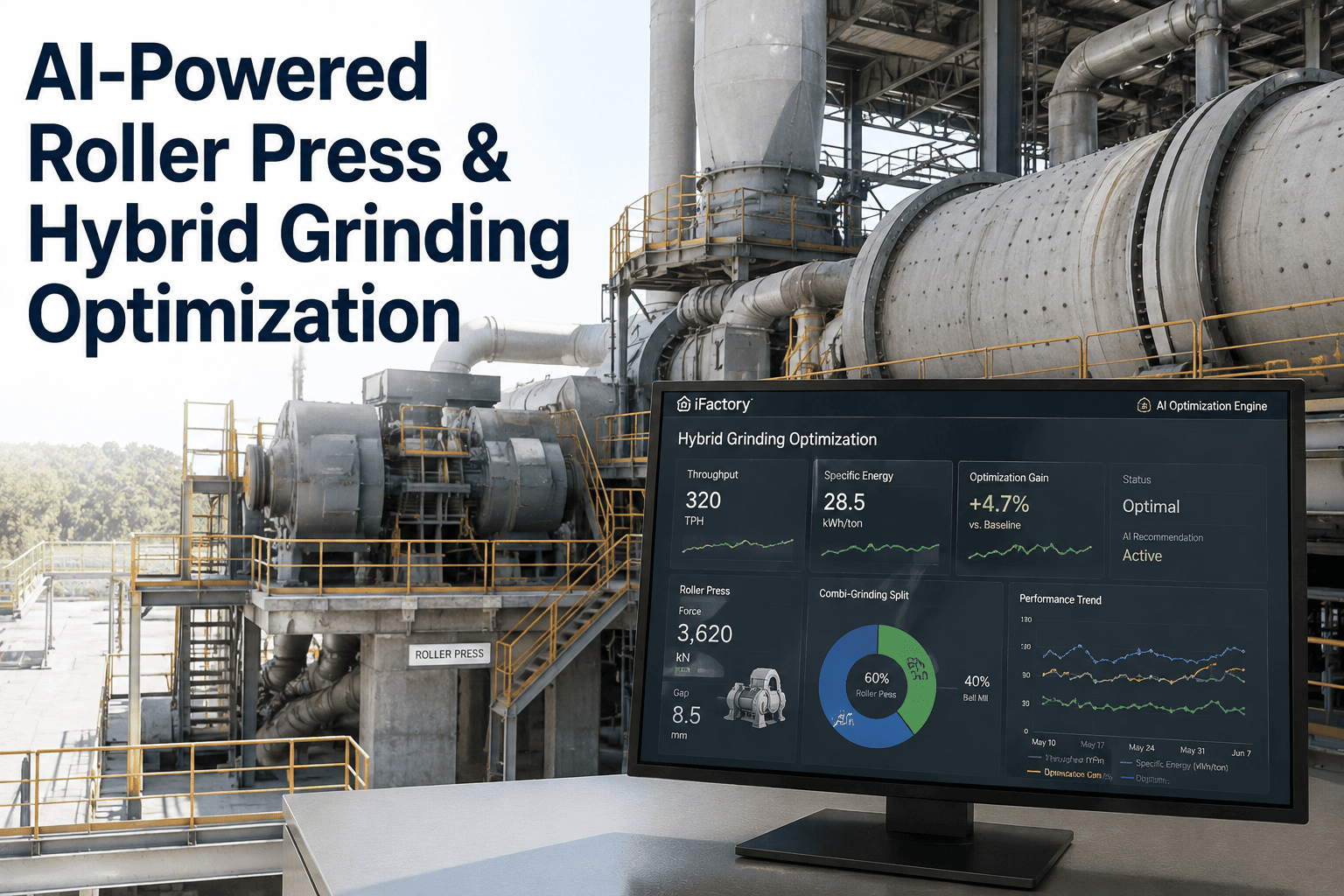
Somewhere on your finish mill there is a number that represents the most tonnes per hour the circuit can safely make. Your plant almost never touches it. Not because the mill can't, but because a human operator, watching separator speed, water injection, feed rate, and mill differential pressure all at once, cannot safely ride the edge of that limit as conditions shift minute to minute. So they back off. They leave a buffer. And that buffer, repeated on every shift of every day, is throughput you paid to build and never collect. iFactory's AI optimization engine coordinates all four levers in real time and pushes the circuit to its true edge — typically lifting cement mill throughput 5 to 10 percent without sacrificing fineness or stability.
Grinding Optimization for Cement Plants
AI-Powered Cement Grinding Circuit Optimization
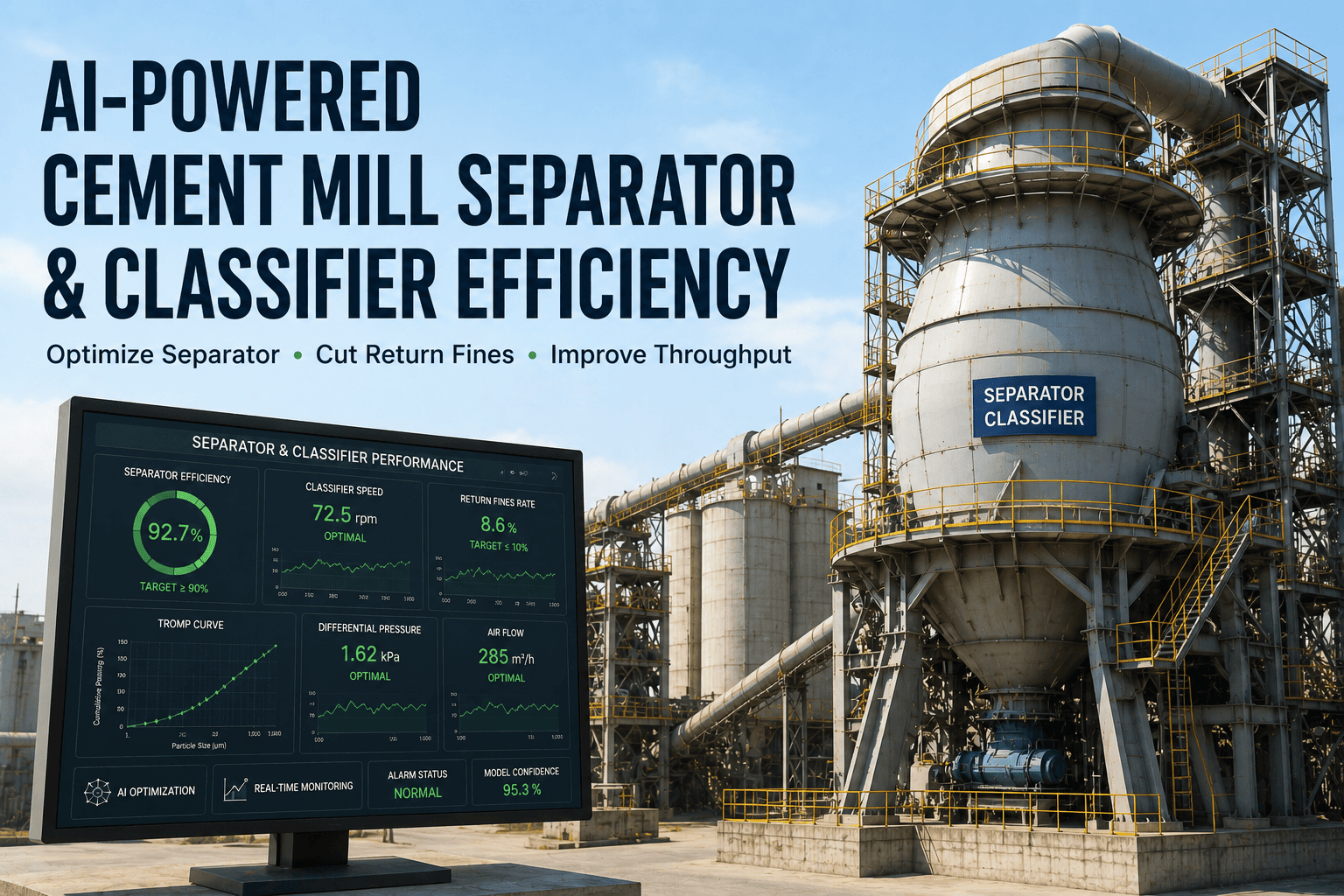
iFactory coordinates separator speed, water injection, feed rate, and mill differential pressure as one system — holding the circuit at its productive edge every second, so throughput rises while fineness and energy stay in control.
Your Mill Has a Ceiling, and You Are Running Below It
Every grinding circuit has a real limit set by its physics: the point where feeding more would overload the mill, choke the separator, or push the product off spec. Best practice is to run just below that limit, harvesting maximum tonnes while staying stable. In reality, plants run well below it, because the safe distance a person keeps from the edge has to be generous — conditions drift, material hardness changes, and nobody wants to be the operator who plugged the mill. That generous buffer is the difference between the throughput you have and the throughput you own.
Four Levers That Never Sit Still
The finish circuit is not controlled by one dial but by four, and they pull against each other. Move one to chase throughput and you disturb fineness, loading, or temperature. This is why tuning by hand is a game of constant compromise — and why coordinating all four at once is where the gains live.
Separator speed
Sets the cut size and therefore product fineness. Push it for finer cement and circulating load climbs, dragging throughput down.
Tension: fineness versus throughput
Feed rate
The direct throughput lever. Raise it and tonnes rise, but mill loading and differential pressure rise with it toward the overload limit.
Tension: tonnes versus stability
Water injection
Controls mill temperature, prevents ball coating and agglomeration, and manages gypsum. Too little risks coating; too much risks quality.
Tension: temperature versus quality
Mill differential pressure
The window into mill loading and fill level. Let it run high for throughput and you edge toward choking; run it low and capacity sits idle.
Tension: loading versus overload
Finding the Edge of the Envelope
Picture the circuit as an operating map. There is a safe zone and, at its border, the constraint wall where overload and plugging begin. A manual operation sits comfortably inside the zone, a wide buffer from the wall. The AI optimization engine reads the live state of the circuit and inches the operating point up toward that wall — close enough to capture the throughput, controlled enough never to cross it. The recovered distance is the 5 to 10 percent.
Operating point: manual buffer versus AI at the edge
The gap between the two points is real capacity. AI does not raise the mill's limit — it lets you safely use the margin you were leaving unused.
How big is the buffer between your mill's typical run and its real limit? Book a 30-minute demo and we'll map your circuit against live optimization.
One Engine, Every Lever, Every Second
What a person cannot do is solve four interacting levers against three competing objectives, continuously, forever. That is exactly what an optimization engine is built for. iFactory reads the live state of the circuit, computes the lever moves that maximize throughput while keeping fineness on spec and specific power down, and applies them — then recomputes as conditions change.
Levers it moves
Separator speed
Water injection
Feed rate
Mill differential pressure
AI Optimization Engine
Coordinates all levers in real time
Objectives it holds
Maximum throughput
On-spec fineness
Lower kWh per tonne
What Coordinated Control Delivers
Turning four hand-tuned dials into one coordinated engine changes the circuit's economics. The mill runs closer to its limit, more consistently, on every product and every shift.
5-10%
More throughput
the buffer below the limit, put to work
↓ kWh/t
Lower specific power
more tonnes for the same energy
Steady
Stable operation
fewer trips, plugs, and manual saves
On spec
Held fineness
throughput without quality drift
Frequently Asked Questions
How is this different from the APC we may already have?
Classic advanced process control relies on linear models and fixed rules, which struggle with the nonlinear, interacting nature of a grinding circuit and often need frequent retuning. iFactory's engine learns your circuit's real behaviour and adapts as conditions change, so it holds the operating point closer to the true constraint across more products and material variations than a static controller manages.
Does it work on both ball mills and vertical roller mills?
Yes. The levers differ in detail, but the principle is the same: coordinate feed, separator, and loading against throughput, fineness, and energy objectives. The engine is configured to the levers and constraints of your specific circuit, whether it is a ball mill with a dynamic separator or a VRM.
Is it safe to push the mill closer to its limit?
Safety is the point of doing it with AI rather than by hand. The engine respects hard constraints on loading, differential pressure, and quality, and reacts far faster than an operator to pull back when the circuit approaches an edge. It captures the margin precisely because it can ride closer to the limit without crossing it.
Does it replace the operator?
No. It removes the impossible task of balancing four levers by hand and lets the operator supervise, handle exceptions, and manage the plant. Many sites begin in advisory mode, with recommended moves shown on screen, then move to closed-loop control once the value is proven.
How quickly do we see the throughput gain?
Once the engine is configured to your circuit and running, the gain appears as the operating point moves toward the constraint under stable control. The fastest way to size it is a demo on your own mill data — bring your process history and typical operating points, and we will estimate how much buffer your circuit is currently leaving on the table.
Collect the Throughput You Already Built.
See How Close Your Circuit Runs to Its Real Limit
Bring your finish-mill process data and typical operating points. We'll show the buffer between how you run and how the circuit could run, and what 5 to 10 percent more throughput looks like on your line — with fineness and energy still in control.