Galvanizing Line Maintenance — Zinc Pot, Sink Roll & Air Knife AI Performance
By Josh Brook on July 8, 2026
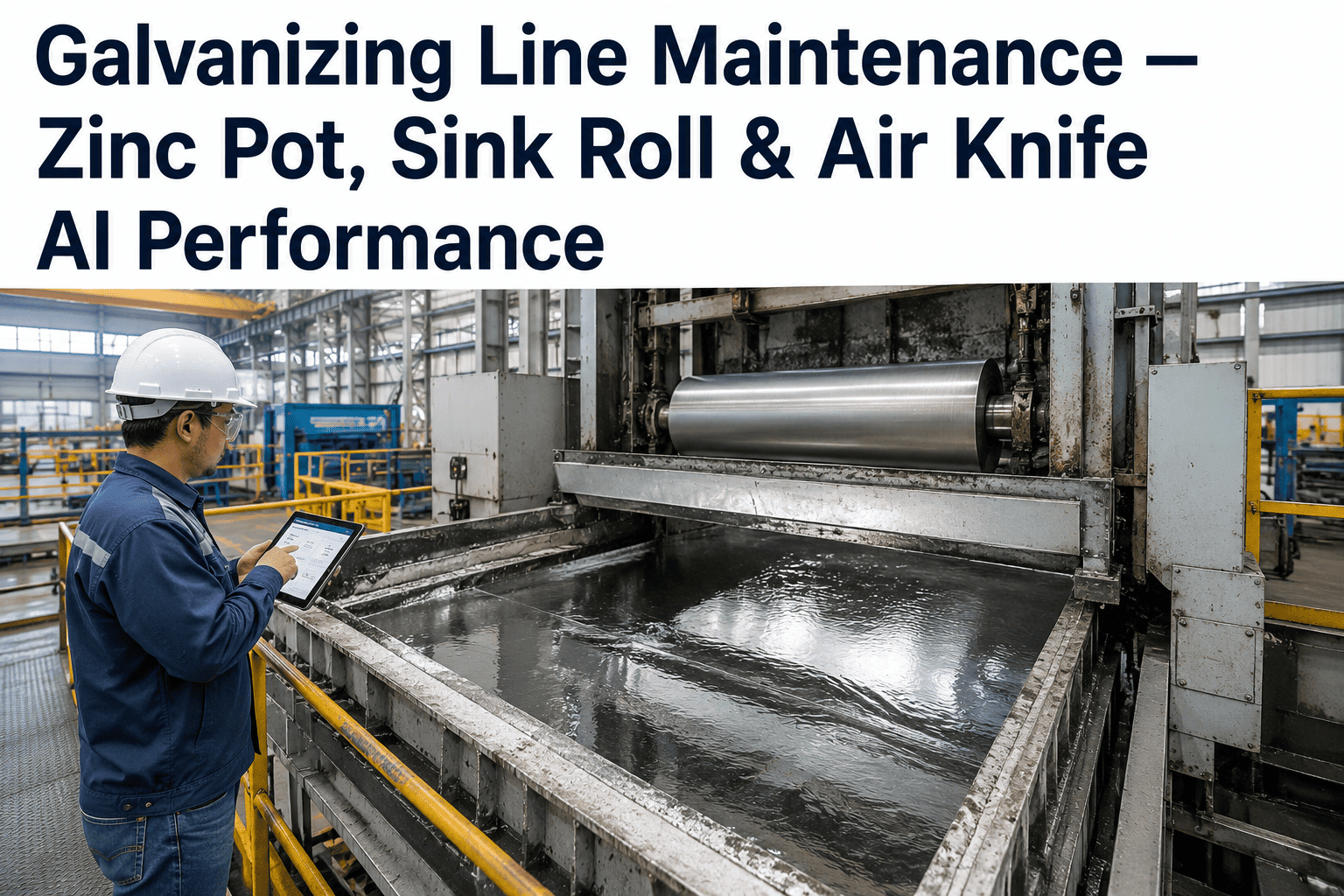
A zinc pot holds 250 tons of molten metal at 460 degrees Celsius. The aluminum drifts from 0.20% to 0.23% over a shift — three hundredths of a percent — and nobody sees it happen. But below the surface, that drift has already changed the inhibition layer on every coil passing through. Coating adhesion weakens, and the defect will not show until the stamping press at the OEM. This is the central problem of galvanizing line maintenance: the zinc pot, the sink roll, and the air knife each degrade on their own timeline, and by the time a human catches the drift, the damage is already in the coil. An iFactory on-prem AI layer watches all three assets simultaneously and flags the drift before it becomes a defect — running inside your network, on your data.
iFactory · Steel Finishing AI
AI-Monitored Galvanizing: Zinc Pot Chemistry, Sink Roll Condition, Air Knife Uniformity — One Layer Watching All Three
Your CGL produces the signals that reveal coating quality drift. On-prem AI reads zinc bath chemistry, sink roll wear, and air knife pressure together — predicting coating weight deviation and adhesion loss before the coil leaves the pot.
A galvanizing line is not one process — it is three interdependent systems running in series, each with its own failure mode and its own timeline of degradation. The zinc pot controls what the coating is made of. The sink roll controls how the strip moves through it. The air knife controls how much stays on. When any one drifts, coating quality follows — and the drift is always silent.
Zinc Pot
Controls coating composition
Bath chemistry — aluminum at 0.18-0.22%, iron below saturation, temperature within 5 degrees — determines the Fe-Al inhibition layer that bonds zinc to steel. Drift here means adhesion failure at the OEM stamping press.
Sink Roll
Controls strip path and stability
Submerged in molten zinc at 460 degrees Celsius, the sink roll and its bearings fight constant corrosion, dross buildup, and strip tension. Bearing wear causes strip vibration — and vibration means uneven coating and surface defects on every coil.
Air Knife
Controls coating thickness
Twin jets wipe excess zinc as the strip exits the bath. Pressure, gap, knife-to-strip distance, and line speed interact non-linearly. A clogged nozzle or a pressure drift of a few kPa shifts coating weight outside the tolerance band across the full coil width.
What Drifts, What Breaks, What It Costs
Each asset degrades differently, and the cost of missing the drift is different in each case. A zinc pot chemistry excursion ruins coating adhesion — an invisible defect that reaches the customer. A sink roll bearing failure forces an emergency pot-roll change at $25,000 per hour of downtime. An air knife pressure drift wastes zinc on every coil until someone notices the coating weight gauge trending off-spec. The common thread: all three are detectable from process signals before they become product defects.
Zinc Pot
Al drops below 0.18% or Fe exceeds solubility limit
Brittle Fe-Zn alloy layer forms instead of ductile inhibition layer — coating peels during stamping
Strip vibration at the air knife — coating weight variation across width, surface marking on every coil
Sink Roll
Dross buildup clogs roll grooves
Band-shaped groove marks on the coated strip — automotive-grade rejection
Air Knife
Nozzle gap or pressure drifts by a few kPa
Coating weight outside tolerance — zinc overconsumption of 15-25% or under-coated product
How AI Connects the Signals Across All Three
The insight that changes galvanizing maintenance is this: the zinc pot, the sink roll, and the air knife do not fail independently — they interact. A bath temperature spike accelerates dross formation, which fouls the sink roll bearings faster, which causes strip vibration at the air knife, which throws coating weight off-spec. A human operator manages them as three separate checklists. AI reads the combined signal stream and sees the cascade developing before any single parameter crosses its alarm threshold.
Signals In
Bath temperature
Al and Fe concentration
Roll bearing vibration
Strip tension and speed
Air knife pressure and gap
XRF coating weight
AI Model
Cross-correlates all inputs
Predicts coating weight per coil
Detects cascade patterns early
Actions Out
Dressing schedule adjustments
Chemistry correction alerts
Roll change prediction
Air knife auto-trim guidance
Zinc Pot Chemistry: The Tightest Window on the Line
The zinc bath is the most chemically sensitive asset on the CGL. Aluminum content must stay between 0.18% and 0.22% for GI product — a window of four hundredths of a percent. Below that range, a brittle iron-zinc alloy forms instead of the ductile inhibition layer, and the coating peels under deformation. Above it, bare spots appear on high-silicon steels. Iron content must stay below the solubility limit, or it precipitates as dross that fouls every submerged surface. Temperature must hold within 5 degrees of setpoint. AI tracks these variables continuously and predicts when a chemistry correction is needed — hours before the sampling interval would catch it.
Below 0.18%
Brittle Fe-Zn layer
0.18% - 0.22% Al
Ductile inhibition layer
Above 0.22%
Bare spots on high-Si steels
AI predicts chemistry drift and calls for correction before the next manual sample would catch it — closing the gap between 4-hour sampling intervals.
Want to see how AI tracks your zinc bath chemistry in real time? Talk to a galvanizing AI specialist and we will model the prediction on your line's data.
Sink Roll: The Most Vulnerable Asset in the Pot
The sink roll operates in conditions no other industrial bearing faces — fully submerged in molten zinc at 460 degrees Celsius, under constant strip tension, with dross particles grinding into every bearing surface. A typical campaign lasts around 14 days before bearing wear forces a pot-roll change. That change means draining or lowering the bath, swapping the roll assembly, and restarting the line — hours of downtime at $25,000 per hour. AI extends the campaign by tracking bearing vibration signature, cumulative tonnage, and bath chemistry interactions to predict exactly when the roll will cross the wear threshold. No more conservative early changes that leave bearing life on the table, no more emergency failures that stop the line.
Without AI prediction
~10-12 days
Conservative fixed-interval change — bearing life left unused
With AI prediction
14-18 days
Condition-based prediction — full bearing life extracted safely
Air Knife: Where Pennies of Zinc Become Millions in Cost
The air knife is the final control point. Twin pressurized jets wipe excess zinc from both sides of the strip as it exits the bath, and the coating weight left on the steel is a function of air pressure, nozzle gap, knife-to-strip distance, strip speed, and zinc viscosity — all interacting non-linearly. Research using deep neural networks has improved coating weight prediction accuracy significantly, raising the percentage of in-tolerance samples from 77% to over 82% — and closing the remaining gap requires the kind of multi-variable real-time adjustment that only an on-prem AI loop can deliver at line speed.
Pressure
Primary control — sets the wiping force that determines coating weight
Nozzle gap
Slot opening width — narrower gap gives higher jet velocity at same pressure
Stand-off distance
Knife-to-strip distance — must be uniform across width for even coating
Line speed
Faster strip carries more zinc past the knife — pressure must compensate
Knife height
200-400mm above bath — balances splash risk against coating control
AI adjusts these five parameters together, coil to coil, to hold coating weight within the tolerance band — not one variable at a time the way a PID loop does, but all five simultaneously based on the predicted interaction.
From Checklists to Predictions
The shift from reactive to predictive changes what galvanizing maintenance actually looks like — not just in the control room, but on the floor, in the zinc consumption numbers, and in the customer complaint reports.
Before: checklist-driven
After: AI-predicted
Chemistry sampled every 4-8 hours by lab
Chemistry drift predicted continuously from process signals
Sink roll changed on a fixed campaign calendar
Roll change scheduled when vibration signature predicts threshold
Air knife set once per product and left
Knife parameters adjusted coil to coil by AI guidance
Coating weight deviation found at the XRF gauge downstream
Deviation predicted before the coil reaches the gauge
Dross buildup discovered during pot-roll change
Dross accumulation rate predicted from chemistry and tonnage data
Ready to move from checklists to predictions on your CGL? Book a demo and we will scope the AI layer to your line's specific equipment and product mix.
Why On-Prem for a Galvanizing Line
Galvanizing process data is high-frequency, high-volume, and deeply proprietary — it encodes how you make your product and what your quality tolerances actually are. Running the AI on-premise keeps three things intact that a cloud architecture cannot guarantee.
Speed
Coating weight corrections need to happen within seconds of the strip exiting the bath. Local inference eliminates the round-trip latency that makes cloud-based control impractical at line speed.
Security
Bath chemistry profiles, coating specifications, and quality tolerances are competitive intelligence. On-prem keeps that data inside your plant perimeter — it never leaves.
Resilience
The line runs 24/7. If the internet drops, the AI keeps running. No external dependency, no gap in predictive coverage, no risk of running blind during an outage.
Frequently Asked Questions
What signals does the AI actually use from a galvanizing line?
The signals the line already produces: bath temperature, aluminum and iron concentration from inline or lab analysis, sink roll bearing vibration, strip tension and line speed, air knife pressure and stand-off distance, and downstream XRF coating weight. No new sensors are typically required — the model trains on the data your Level-1 control system already collects.
How does AI extend sink roll campaign life?
By tracking the actual wear signature — vibration, cumulative tonnage, and chemistry-driven corrosion rate — instead of using a fixed calendar. The model predicts when the bearing will cross its wear threshold and schedules the change at the last safe moment, extracting full bearing life without risking an emergency failure.
Can the AI handle both GI and GA product on the same line?
Yes. The model learns separate chemistry and coating weight profiles for each product type. When the line switches from galvanized (GI) to galvannealed (GA), the prediction adjusts to the different aluminum target, annealing temperature, and coating weight specification automatically.
What about zinc consumption — does AI reduce it?
Lines using predictive air knife control and chemistry monitoring typically reduce zinc overconsumption by 15-25% within the first few months. The savings come from tighter coating weight control — less zinc wasted as over-coating — and from reduced dross formation through better temperature and chemistry management.
How long does deployment take?
A turnkey on-prem deployment — pre-configured NVIDIA AI server, integration with your Level-1 system, model training on your historical data — typically goes live in 6-12 weeks. The first phase connects to one CGL and proves the prediction accuracy; scaling to additional lines is faster because the integration pattern is already established.
Your CGL already generates the data. Let AI read it.
See AI Monitoring Running on Your Galvanizing Line
Bring your line's process data — bath chemistry logs, air knife settings, coating weight records. We will train a model on your steels and your product mix, and show you where the prediction catches drift that your current monitoring misses. Turnkey on-prem AI: pre-configured server, live in weeks, 1000+ industrial clients, 99.9% uptime.