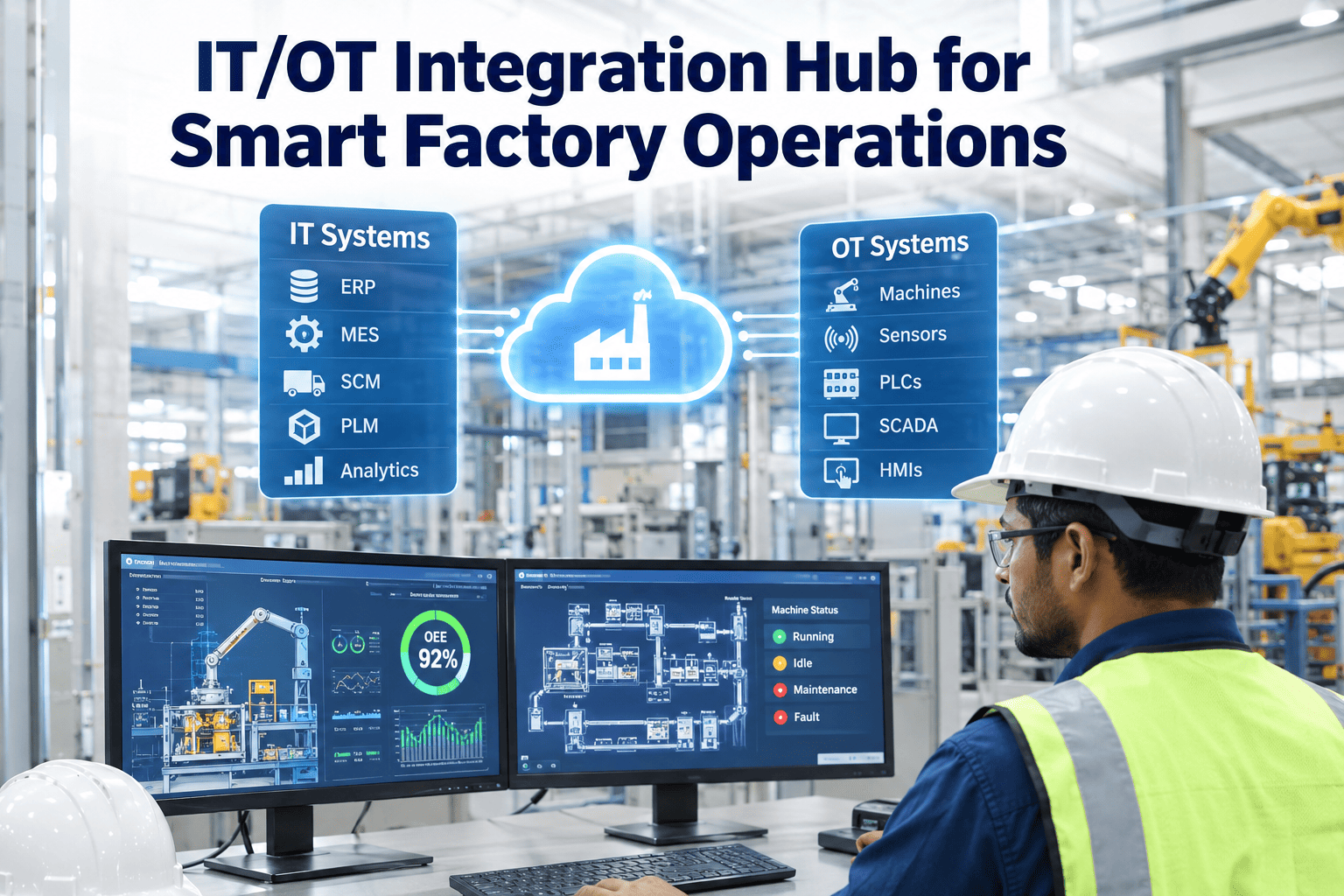
Every smart factory initiative eventually hits the same wall: the data exists, but it's trapped. Your PLCs speak Modbus. Your SCADA runs on proprietary protocols. Your MES expects structured SQL. Your ERP lives are in the cloud. And somewhere between the shop floor sensor and the executive dashboard, the signal dies—lost in translation between operational technology that controls machines and information technology that runs the business. This IT/OT gap is the single biggest reason 65% of manufacturing digital transformation projects fail to hit their objectives. The $50 billion IT/OT convergence market exists because of one hard truth: you cannot build a smart factory on disconnected systems. The architecture that bridges this gap—how data flows from a Level 0 sensor to a Level 4 business decision in real time—is the foundation every other Industry 4.0 capability depends on.
$101.9B
IT/OT Convergence Market by 2030
75%
Of Manufacturers Converging IT/OT
20%
Efficiency Gains From Convergence
29B+
Industrial IoT Devices by 2030
Manufacturers using bridge the IT/OT divide with a single system that ingests shop-floor data from PLCs, sensors, and SCADA, contextualizes it at the edge, and delivers it to dashboards, analytics, and ERP systems in real time—no custom middleware, no spaghetti integrations, no data puddles. See how it works →
The IT/OT Gap: Why Smart Factories Stall
IT and OT were never designed to work together. They evolved in parallel with different priorities, protocols, and people. Understanding this divide is the first step to bridging it.
OT World
Operational Technology
PLCs, SCADA, DCS, HMIs
Modbus, Profinet, OPC-UA, EtherNet/IP
Priority: Uptime, safety, determinism
Cycle: Milliseconds to seconds
Change: Cautious, validated, rare
THE GAP
Different protocolsDifferent teamsDifferent prioritiesDifferent lifecycles
IT World
Information Technology
ERP, MES, BI, Data Lakes, Cloud
REST APIs, SQL, MQTT, HTTP/S
Priority: Insight, agility, scalability
Cycle: Minutes to hours
Change: Frequent, agile, iterative
Struggling with siloed systems and fragmented data? Book a free architecture assessment — we'll map your current IT/OT landscape and identify the fastest path to convergence.
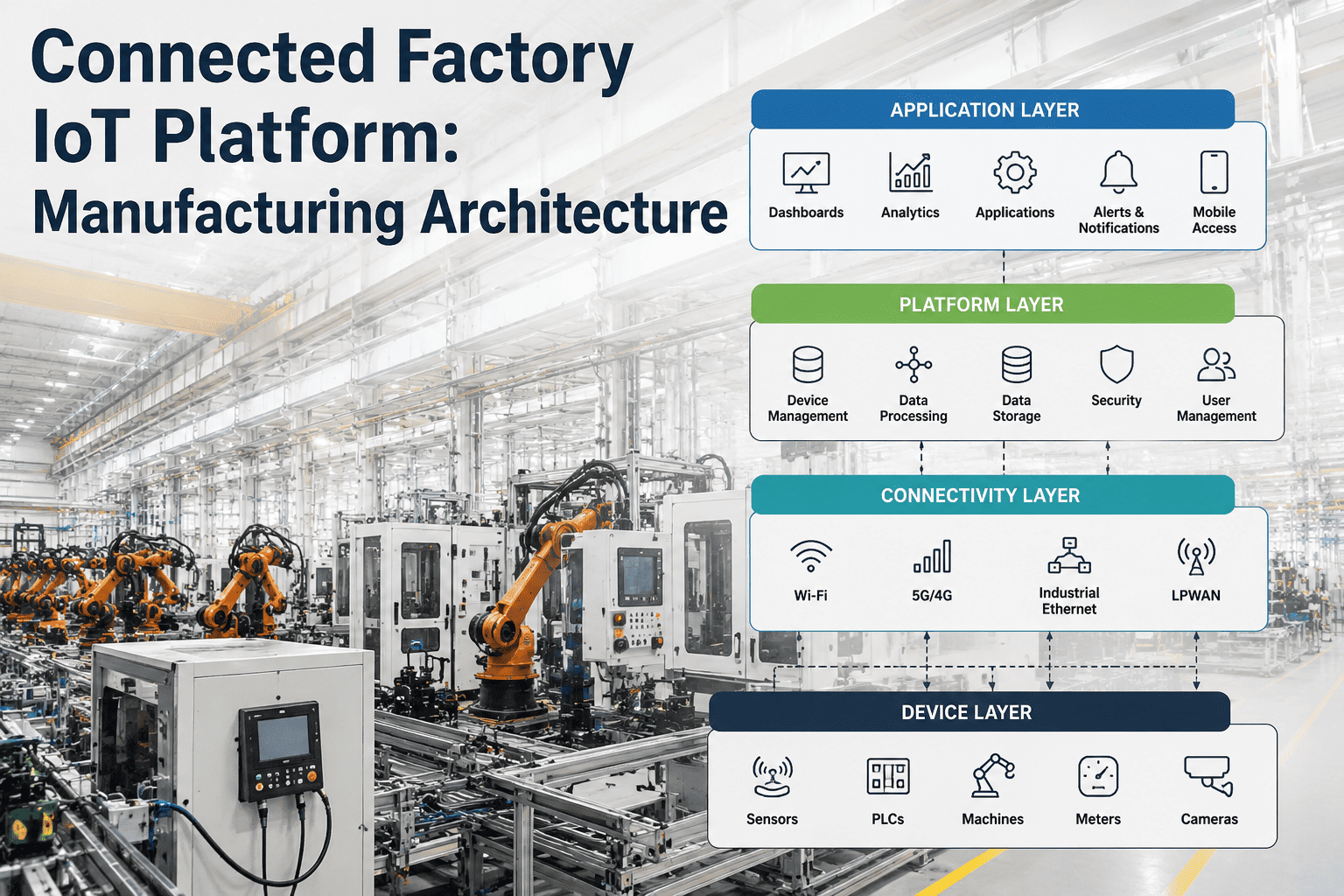
The Architecture Stack: From Sensor to Strategy
Smart factory data architecture follows a layered model based on ISA-95 and the Purdue Reference Model. Each layer has a specific function—and where most plants fail is in the connections between them.
Level 4
Enterprise / Business Systems
ERPSupply ChainBI / AnalyticsCloud Data Lake
Strategic decisions, demand planning, financial reporting. Consumes contextualized data from below to drive business outcomes.
IT Zone
Level 3
Manufacturing Operations / MES
MESHistorianQuality / SPCCMMSScheduling
Production execution, traceability, quality management. The critical bridge layer where OT data becomes business context.
IT/OT Bridge
Level 2
Supervisory Control
SCADAHMIEdge GatewayOPC-UA Server
Real-time monitoring, alarming, process visualization. Aggregates data from controllers and makes it available upstream.
The physical world. Temperature, pressure, vibration, position, flow. Raw signals that become data when captured and contextualized.
OT Zone
Old Model vs. New Model: The Architecture Shift
The Purdue Model served manufacturing for 40 years. But its rigid, layer-by-layer data flow creates bottlenecks that make real-time analytics impossible. The Unified Namespace (UNS) approach flattens data access without sacrificing security.
Legacy: Point-to-Point (Purdue)
ERP
↕
MES
↕
SCADA
↕
PLC
Data must flow layer-by-layer sequentially
Custom integration at every connection point
"Spaghetti" of fragile point-to-point links
Adding new sensors = custom coding at every layer
Data gets lost between siloed systems
→
Modern: Unified Namespace (UNS)
ERP
MES
UNS / MQTT Broker
SCADA
PLC
Any system accesses any data in one hop
Publish-subscribe via MQTT + Sparkplug
Single source of truth for all data
Adding devices = plug into the namespace
ISA-95 hierarchy for logical data structure
Bridge Your IT/OT Gap Without Ripping Out What Works
iFactory's MES platform connects to your existing PLCs, SCADA, and ERP systems—creating a unified data layer that delivers shop-floor visibility to every level of your organization without replacing your installed base.
5 Building Blocks of Smart Factory Data Architecture
A complete IT/OT architecture isn't just about connectivity. These five pillars must work together to turn raw machine signals into business intelligence.
01
Edge Connectivity
Edge gateways translate OT protocols (Modbus, Profinet, EtherNet/IP) into standardized formats (MQTT, OPC-UA) and perform local processing to reduce cloud latency. This is where raw signals become structured data.
Raw data (tag: "AI_0042 = 347.2") means nothing without context. Contextualization adds asset identity, location, timestamp, unit of measure, and process state—turning a number into "Line 3 / CNC-07 / Spindle Temp / 347.2°F / Running."
Manufacturing is the #1 cyberattack target for 4 consecutive years. Converged IT/OT networks need industrial DMZs, network segmentation (IEC 62443), zero-trust policies, and OT-specific threat monitoring to protect production.
IEC 62443Industrial DMZZero-trust OT
04
Analytics & AI Layer
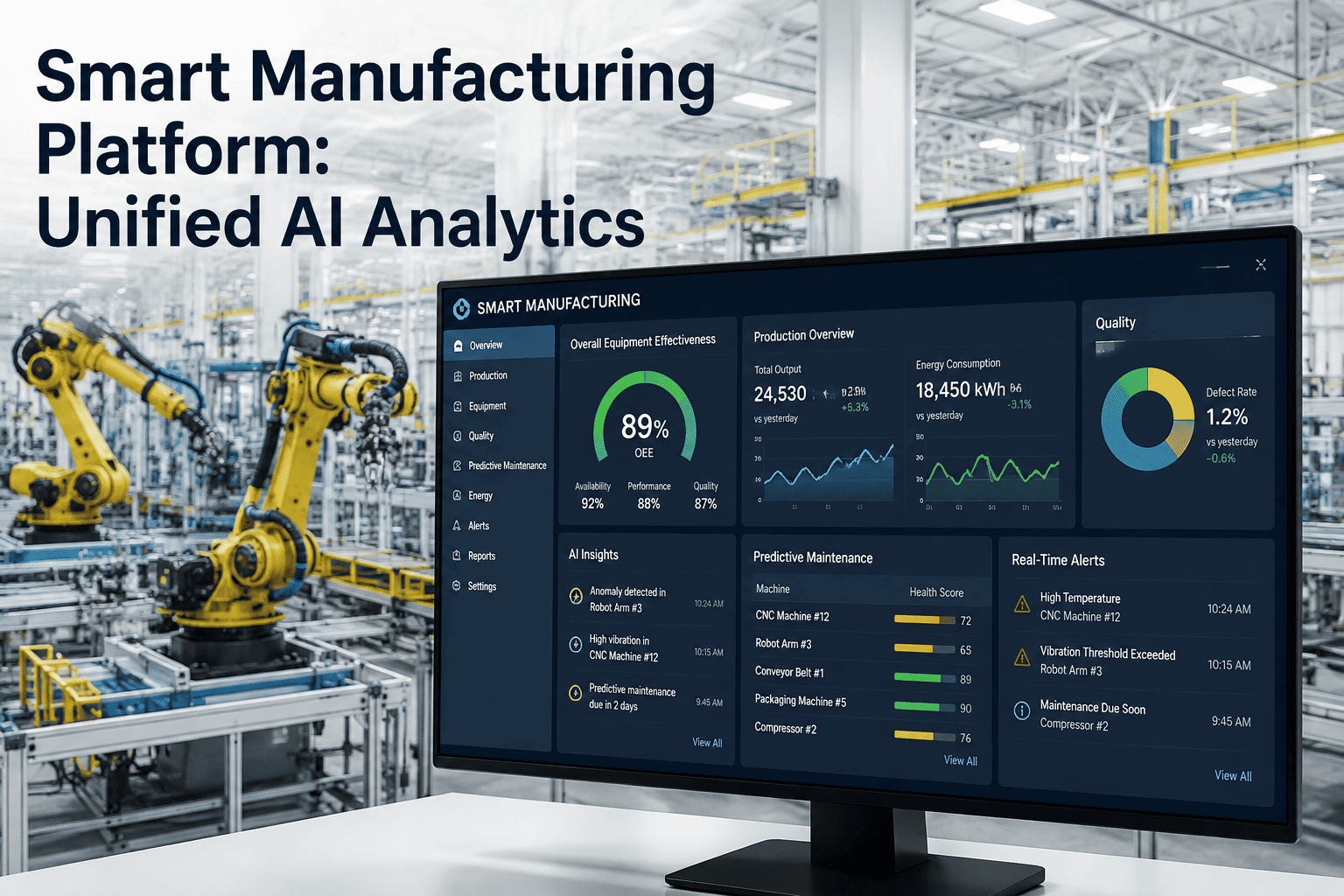
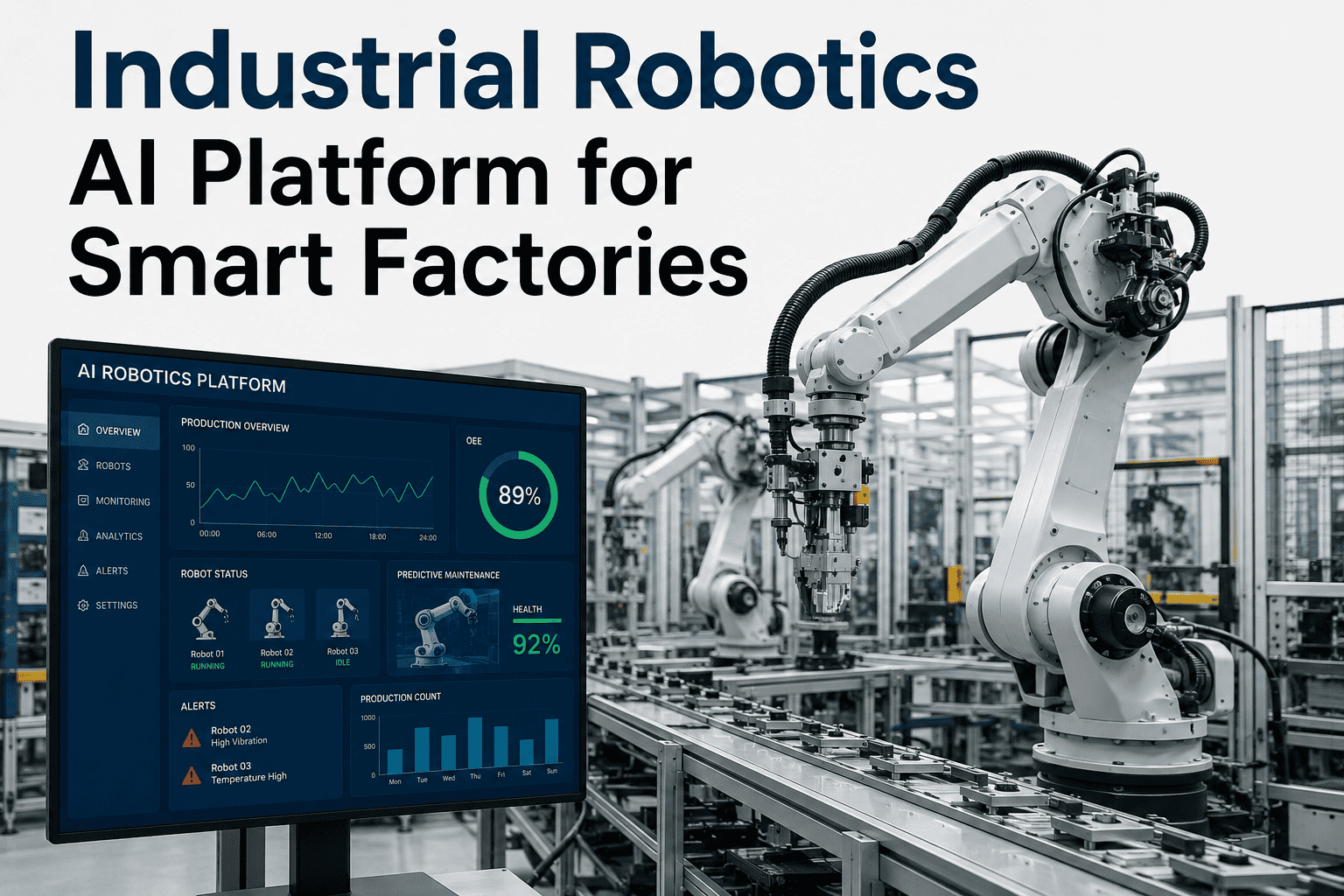
Once data is connected, contextualized, and secured, analytics can extract value: predictive maintenance, anomaly detection, SPC trend analysis, and AI-driven scheduling. 40% of manufacturers rank data analytics as their top investment priority.
Architecture must scale from one line to multi-site without rebuilding. Standardized data models, role-based access, and modular deployment let you add plants, lines, and devices without creating new integration debt.
Need help designing your smart factory data architecture? Schedule a consultation with our IT/OT integration specialists. Already have a plan? Sign up for iFactory to start building on a proven MES platform.
Key Protocols & Technologies
MQTT
Messaging
Lightweight publish-subscribe protocol. The backbone of UNS architectures. ISO/IEC 20237:2023 standard.
OPC-UA
Interoperability
Platform-independent industrial communication. Secure, cross-vendor data exchange from field to cloud.
Sparkplug B
Payload Format
Standardized MQTT payload for industrial data. Adds birth/death certificates, metrics, and device awareness.
Edge Computing
Infrastructure
Process data locally for sub-second response. Reduces cloud dependency and bandwidth. Enables real-time AI at the machine.
ISA-95 / IEC 62264
Data Model
Hierarchical data structure: Enterprise → Site → Area → Line → Cell → Equipment. Used to organize UNS topic namespaces.
IEC 62443
Cybersecurity
Industrial automation security standard. Defines zones, conduits, and security levels for converged IT/OT networks.
Expert Analysis: The Market Is Moving Fast
The IT/OT convergence market was valued at $50 billion in 2024 and is projected to reach $101.9 billion by 2030. Deloitte's 2025 survey of 600 manufacturing executives found that 80% plan to invest 20% or more of improvement budgets in smart manufacturing, with data analytics ranked as the #1 or #2 investment priority by 40% of respondents. Meanwhile, manufacturing has been the most targeted sector for cyberattacks for four consecutive years—making security-first architecture not optional but existential.
12.6%
IT/OT Market CAGR to 2030
56%
Piloting Smart Manufacturing
47%
Breaches Are Ransomware
Ready to move from pilot to plant-wide? Book a consultation to design your scalable IT/OT architecture, or sign up for iFactory to start connecting your shop floor today.
Your Data Architecture Is Your Competitive Advantage
iFactory gives you the MES layer that connects OT systems to IT strategy—real-time production data, quality traceability, maintenance integration, and analytics-ready architecture that scales from one line to every plant.
IT/OT convergence is the integration of information technology systems (ERP, MES, cloud, analytics) with operational technology systems (PLCs, SCADA, sensors, industrial controllers) into a unified data architecture. Traditionally, these systems operated in separate silos with different protocols, teams, and priorities. Convergence connects them so that real-time shop-floor data flows seamlessly into business systems for analytics, decision-making, and process optimization. The IT/OT convergence market was valued at $50 billion in 2024 and is projected to reach $101.9 billion by 2030, reflecting how critical this integration has become for competitive manufacturing.
What is a Unified Namespace (UNS) and why does it matter?
A Unified Namespace is a modern data architecture that replaces the traditional Purdue Model's rigid layer-by-layer communication with a flat, publish-subscribe framework. Instead of data flowing sequentially from PLC → SCADA → MES → ERP (requiring custom integration at every hop), a UNS uses an MQTT broker where any system can publish data and any other system can subscribe to it in one hop. It uses the ISA-95 hierarchy (Enterprise/Site/Area/Line/Cell) as a logical structure for organizing topics, creating a single source of truth that eliminates data silos while maintaining security through topic-level access controls.
What is the Purdue Model and is it still relevant?
The Purdue Reference Model (based on ISA-95) organizes manufacturing systems into hierarchical levels: Level 0 (field devices/sensors), Level 1 (controllers/PLCs), Level 2 (SCADA/HMI), Level 3 (MES/operations), and Level 4 (ERP/enterprise). It remains relevant as a conceptual framework for understanding system roles and for cybersecurity segmentation (IEC 62443 references it). However, its rigid data flow model—where information must pass through each layer sequentially—creates bottlenecks that prevent real-time analytics. Modern architectures use the Purdue levels for logical organization while enabling flexible data access through UNS or edge-to-cloud patterns.
How do you secure a converged IT/OT network?
Manufacturing has been the #1 target for cyberattacks for four consecutive years, with ransomware accounting for 47% of breaches. Securing converged networks requires industrial DMZs between IT and OT zones, network segmentation following IEC 62443 zones and conduits, zero-trust policies that verify every device and user, OT-specific threat monitoring that understands industrial protocols, and regular cybersecurity assessments—68% of manufacturers surveyed by Deloitte performed one in the last year. The key principle is defense-in-depth: multiple security layers so that no single point of failure compromises production.
Where does MES fit in smart factory architecture?
MES sits at Level 3 of the ISA-95 hierarchy—the critical bridge layer between OT (shop floor) and IT (enterprise). It takes raw data from SCADA, PLCs, and sensors and transforms it into production context: which order is running, what quality results were recorded, which operator performed which task, and what maintenance was completed. MES is where data becomes information. In modern architectures, cloud-based MES platforms like iFactory also serve as the integration hub—connecting to both OT systems below and ERP/analytics above through standardized APIs and data models, making them the natural convergence point for IT/OT integration.