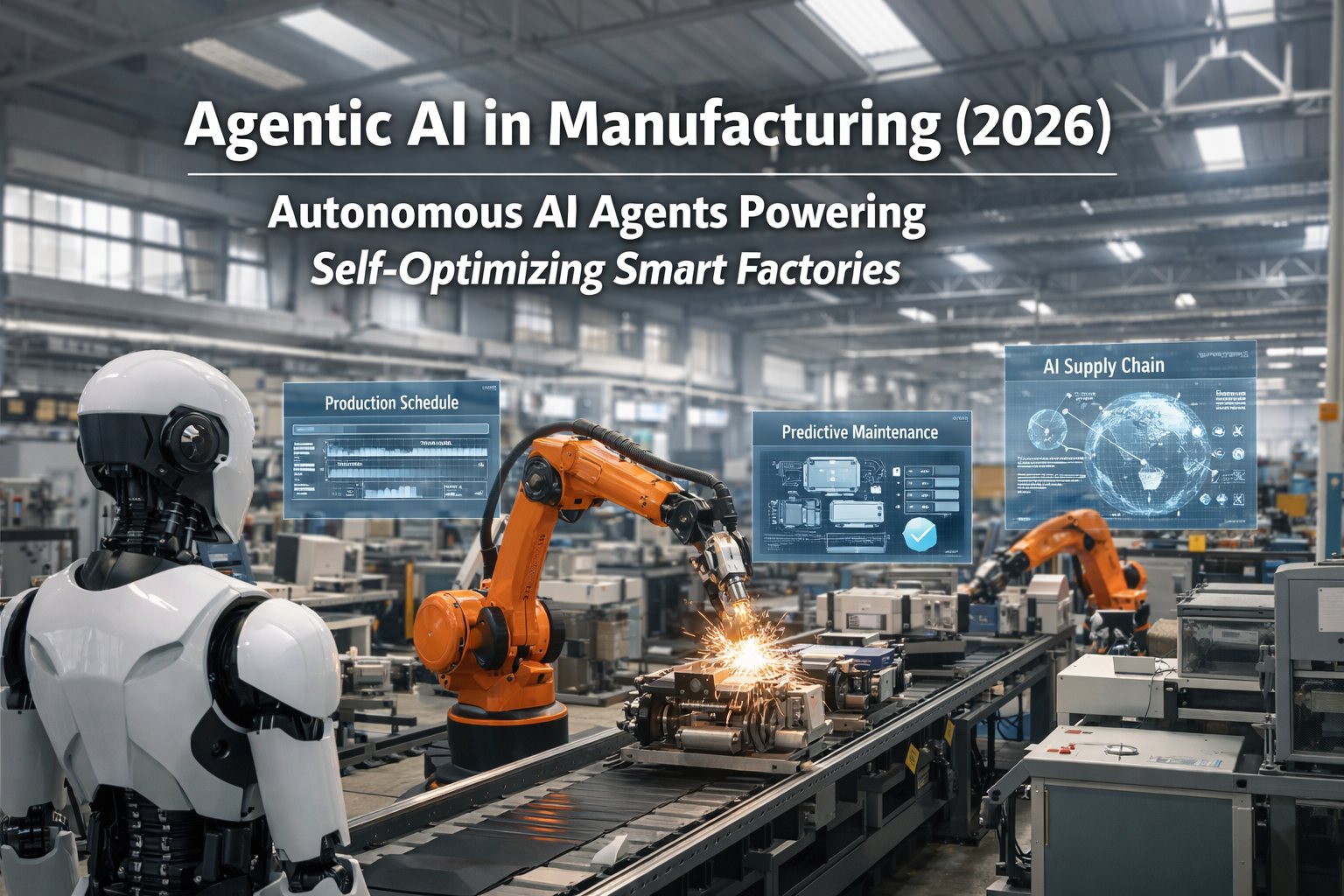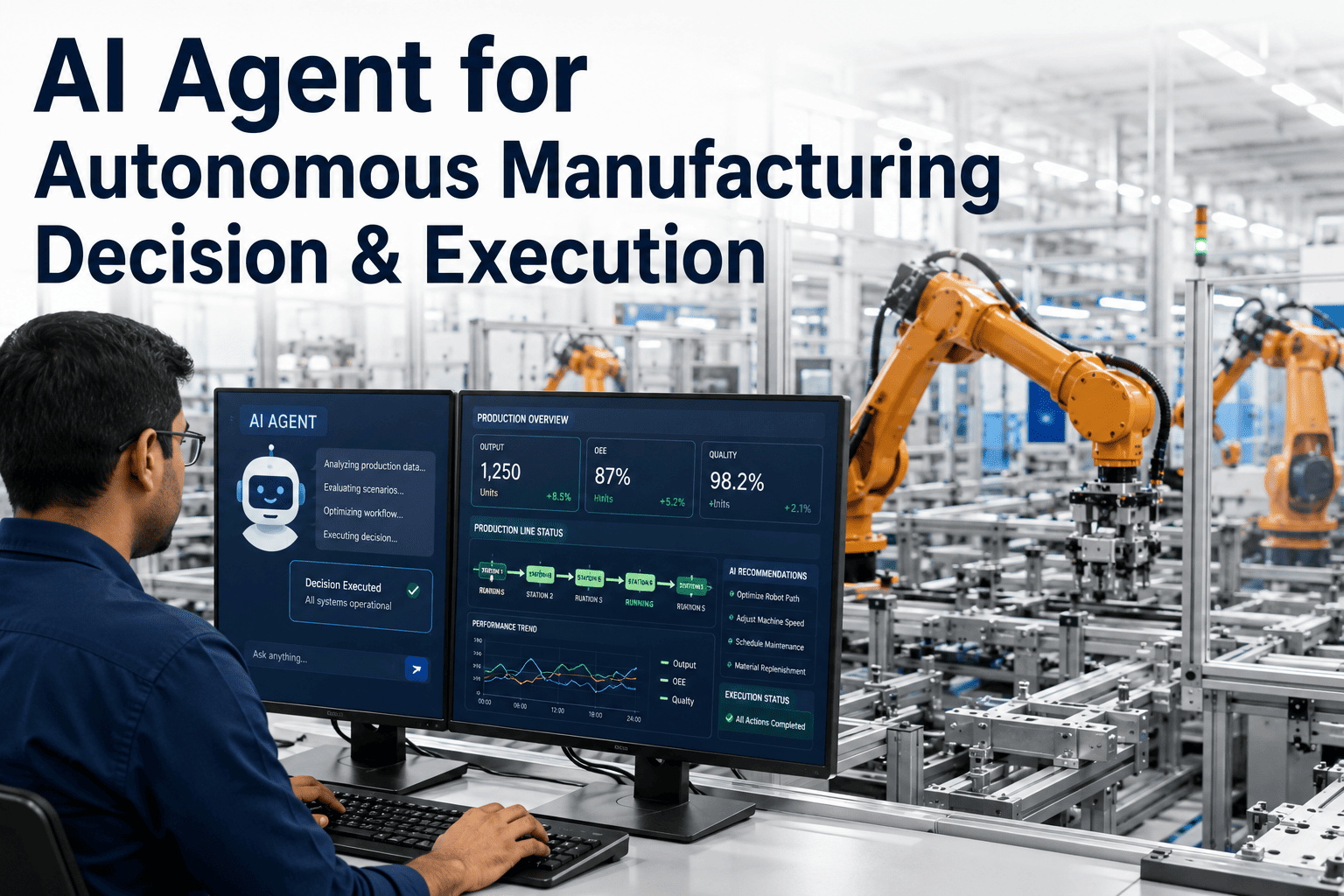
Traditional AI in manufacturing follows a simple loop: sense, analyze, recommend — then a human operator makes the final call. An autonomous AI agent breaks that pattern. It perceives a condition, reasons through the options, decides on an action, and executes it — closing the loop between insight and action without waiting for someone to approve each step. This is a genuinely different capability from the copilots most manufacturers piloted in 2024 and 2025, not simply a faster version of the same recommendation engine. It's also a capability with real, currently-documented limits: fully autonomous closed-loop control on safety-rated systems remains pilot-stage industry-wide, and vendor claims in that specific territory deserve scrutiny rather than being taken at face value. Getting the scope right — where full autonomy is genuinely earned and where a human still belongs in the loop — is the actual work of deploying this technology responsibly. See how iFactory deploys closed-loop AI agents with defined confidence thresholds and escalation rules, matched to what's actually production-ready today.
AI Agent for Autonomous Manufacturing Decision & Execution
Automated parameter adjustment, self-correcting processes, and closed-loop AI that acts on a condition instead of just flagging it — with the confidence thresholds and escalation rules that keep autonomy inside its actual competence.
The Distinction That Actually Matters
A copilot answers when asked. An agent acts on triggers and schedules, escalating to a human only when confidence is low or a defined approval threshold is crossed. The economic difference is significant: a copilot saves minutes per query by giving someone a faster answer. An agent removes an entire monitoring-and-response loop from a human queue entirely, which is why 2026's dominant industrial AI project isn't deploying new copilots — it's upgrading existing copilot deployments into agentic execution. Understanding this distinction is the first step in evaluating any vendor's "AI agent" claim, since the term gets applied loosely to systems that are still, functionally, copilots waiting for approval.
Detect, Diagnose, Adjust, Verify — Without a Human Touching a Keyboard
In practice, an agentic system on a factory floor might detect a quality drift, diagnose its root cause, adjust the upstream process parameter responsible, verify the fix actually resolved the drift, and log the entire decision chain — the full loop, completed autonomously. This differs fundamentally from a system that detects the same drift and generates an alert for someone to review at their convenience, which is what most manufacturing AI still does today despite being described as "real-time." The visual below maps the full cycle explicitly, including the specific point where a copilot stops and an agent keeps going.
The sixth stage — Log — is easy to treat as an afterthought, but it's what makes the other five defensible. An autonomous action nobody can review after the fact is a liability regardless of how well it performed, because there's no way to confirm it performed well beyond trusting the system's own report. A complete, auditable record of what was observed, why, what was done about it, and how the outcome was verified is what turns an autonomous decision from a black box into something a human can actually govern, extend, or correct.
A System That Only Alerts Hasn't Closed Anything — It's Just Faster Monitoring
iFactory deploys agents that complete the full perceive-reason-decide-act loop within defined authority boundaries, escalating to a human only when confidence drops or a threshold is crossed.
Production-Ready vs. Still Pilot-Stage
Agentic AI adoption is genuinely accelerating — Deloitte's research projects roughly a fourfold increase in manufacturing adoption this year alone. But adoption speed and production maturity are two different things, and treating every agentic use case as equally proven is a mistake worth avoiding. The table below reflects current 2026 industry consensus on where each use case actually stands, not where the marketing around it suggests it stands.
| Use Case | 2026 Maturity | What to Verify Before Deploying |
|---|---|---|
| Quality Defect Triage & Root-Cause Correlation | Production-ready — computer-vision detection paired with disposition and root-cause categorization is deployed at scale | Detection accuracy on your specific defect types, escalation threshold calibration |
| Predictive Maintenance Scheduling | Production-ready — correlating sensor signatures to self-schedule work orders is a mature category | False-positive rate on scheduled interventions, integration with parts inventory |
| Non-Safety Process Parameter Adjustment | Production-ready in defined domains — adjusting a process parameter within a validated safe range | The boundaries of the validated range, and what triggers escalation outside it |
| Fully Autonomous Production Scheduling | Pilot-stage — genuine deployments exist but are not yet broadly production-proven | Scope of the pilot, what human oversight remains in practice |
| Closed-Loop Control on Safety-Rated Systems | Pilot-stage — industry-wide consensus is this remains early; treat vendor claims here with particular scrutiny | Independent verification of any safety-rated autonomy claim, not vendor documentation alone |
Documented Results From Where Autonomy Is Actually Mature
The production-ready categories in the table above aren't theoretical. Independently reported deployments show measurable gains specifically in the domains where agentic AI has genuinely matured — quality triage, maintenance scheduling, and validated-range process adjustment — rather than in the still-pilot territory of fully autonomous scheduling or safety-rated closed-loop control.
Siemens' Erlangen factory, for instance, has been cited for productivity improvements attributed to agentic quality and maintenance systems, and multiple World Economic Forum Lighthouse factories report substantial productivity gains from scaled AI quality systems operating within this same production-ready scope. The pattern across credible reporting is consistent: real gains show up where the autonomy is properly bounded and governed, not where it's broadest.
Confidence Thresholds and Escalation Rules
These four practices are what separate a genuinely governed autonomous deployment from one that's simply autonomous and hoping for the best.
The plants getting real value from agentic AI right now are the ones being precise about where autonomy actually applies. Quality triage, maintenance scheduling, parameter adjustment inside a validated range — genuinely production-ready, genuinely valuable, genuinely different from the copilots everyone piloted a year or two ago. The plants getting burned are the ones that heard "agentic AI" once and assumed it meant full autonomous control everywhere, including territory where the industry itself is still being careful. The technology deserves the excitement it's getting. It also deserves the specific scoping discipline that keeps it inside what's actually been proven, not what a sales deck implies — and that discipline is honestly the harder, less glamorous part of the deployment.
Frequently Asked Questions
Close the Loop Where It's Ready. Keep a Human in It Where It Isn't.
iFactory deploys closed-loop AI agents with explicit confidence thresholds, documented escalation rules, and a full auditable decision chain — matched to what's genuinely production-ready today, not a broader autonomy claim than the technology actually supports.