The AI revolution in manufacturing is no longer a future promiseit's today's competitive reality. The global AI in manufacturing market is projected to grow from $5.94 billion in 2024 to $68.36 billion by 2032, a staggering 33.5% compound annual growth rate. Manufacturers implementing AI report 38% profit increases, 50% reduction in unplanned downtime, and defect detection accuracy jumping from 70% to over 97%.
Yet technology alone doesn't deliver these results. Success requires thoughtful leadership oversight, robust governance frameworks, and strategic implementation that aligns AI capabilities with business objectives. Ready to explore AI implementation for your operations? Book a consultation to discuss your specific needs.
This guide explores how machine learning enhances decision-making and maintenance while providing the leadership frameworks necessary for successful AI deployment.
AI Impact StatsAI Impact on Manufacturing: By the Numbers
In This Guide
Explains How Machine Learning Enhances Decision-Making and Maintenance
Machine learning—the dominant AI technology in manufacturing—transforms raw operational data into actionable intelligence. In 2024, machine learning accounted for the largest share of the AI manufacturing market due to its effectiveness in enabling data-driven decisions, process optimization, and adaptive automation.
From Reactive to Predictive Operations
Traditional manufacturing operates reactively: equipment breaks, production stops, maintenance teams respond. Machine learning inverts this model. By analyzing millions of data points from sensors, machines, and enterprise systems, ML algorithms uncover patterns invisible to human observation, enabling manufacturers to anticipate problems before they impact production.
ML algorithms process sensor data continuously, providing operators with instant insights on equipment health, quality trends, and production efficiency. Decisions that once required hours of analysis now happen in seconds.
Machine learning analyzes historical sales, market trends, and external factors to predict demand with unprecedented accuracy. Manufacturers can optimize inventory levels, reduce waste, and improve customer satisfaction.
ML models identify optimal parameters for each product, tailoring configurations to maximize quality and minimize resource consumption. AI can reduce design time by 50% through generative design capabilities.
The Predictive Maintenance Revolution
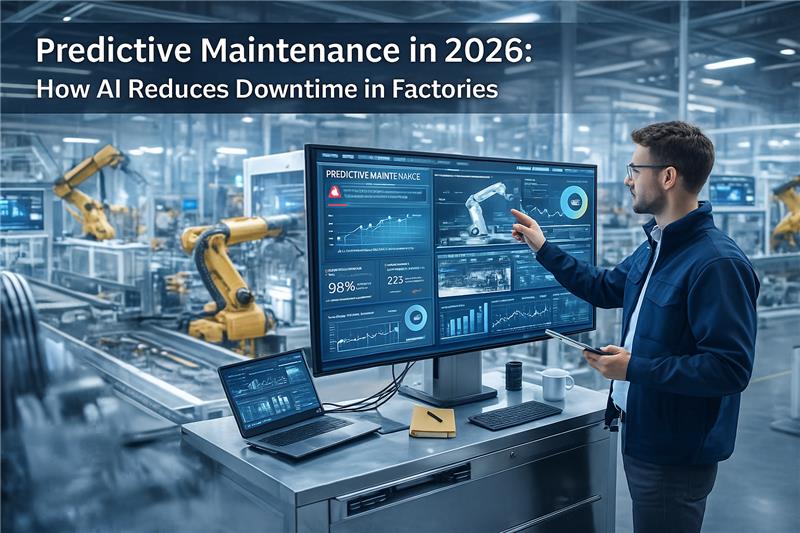
Predictive maintenance represents the highest-impact AI application in manufacturing. About 90% of leading machine manufacturers are investing in predictive analytics technology, recognizing its transformative potential.
Predictive Maintenance Results
The shift from reactive to predictive maintenance represents a fundamental change in how manufacturers approach equipment upkeep. By analyzing real-time data from sensors and historical performance records, AI systems predict when machinery is likely to fail, allowing for proactive maintenance scheduling.
Key sectors including automotive, heavy machinery, energy and power, and semiconductor manufacturing have prioritized predictive maintenance, particularly in high-volume and capital-intensive operations where unplanned outages result in significant losses. Questions about implementing predictive maintenance? Contact our support team for guidance.
Top AI Applications in Manufacturing
AI transforms every stage of the manufacturing lifecycle. Understanding where to focus investments maximizes return and minimizes implementation risk.
Quality Control & Visual Inspection
AI-powered computer vision systems achieve 97%+ defect detection accuracy compared to 60-70% with manual inspection. Systems identify microscopic defects at full production speed while automatically adjusting parameters to maintain quality. Siemens reports 25% improvement in defect detection rates using AI visual inspection.
Production Planning & Scheduling
Machine learning optimizes production schedules by balancing equipment capacity, material availability, labor constraints, and delivery requirements. AI-driven planning reduces production time and improves on-time delivery while maximizing resource utilization.
Supply Chain Optimization
85% of logistics professionals predict AI/ML adoption for supply chain management within five years. AI optimizes route planning, supplier selection, inventory management, and demand forecasting—reducing logistics costs by 15% and inventory levels by 35%.
Energy Consumption Optimization
AI algorithms optimize energy usage based on production schedules, weather, and energy prices. Volkswagen achieved over 20% reduction in factory energy consumption through AI-powered optimization, demonstrating environmental and cost benefits.
Highlights Leadership Oversight in AI Implementation
Technology delivers results only when paired with effective leadership and governance. Despite 95% of senior leaders investing in AI, only 34% incorporate AI governance—creating significant risk exposure and unrealized potential.
The AI Governance Gap
The 2024 Microsoft and LinkedIn Work Trend Index found that while 79% of leaders agree AI adoption is critical to competitiveness, 60% worry their company lacks a vision and plan to implement it. This governance gap manifests in several ways: lack of clarity around AI accountability, unclear ownership across departments, insufficient oversight of third-party AI tools, and absence of ethical guidelines.
Building Effective AI Leadership
Successful AI implementation requires executive sponsorship, cross-functional collaboration, and clear accountability structures. Manufacturing leaders must balance innovation with risk management—promoting progress while ensuring safety and fairness.
CEO, CIO, and CTO must actively champion AI initiatives, allocate resources, and ensure strategic alignment with business objectives.
AI governance cannot be left to one person or department. Success requires collaboration between IT, operations, legal, compliance, and business stakeholders.
Maintain "human-in-the-loop" for high-risk AI applications. AI should augment human decision-making, not replace human judgment in critical situations.
AI Governance Framework for Manufacturing
Effective AI governance requires structured frameworks that enable innovation while managing risk. The following SMART AI framework provides manufacturing leaders with actionable guidance. Ready to build your AI governance strategy? Schedule a consultation with our experts.
Structures & Accountability
Establish AI governance councils with representatives from product, IT, security, and compliance. Define clear ownership: CTO leads development, CIO implements data governance, Chief Risk Officer conducts assessments, legal counsel ensures regulatory compliance.
Monitoring & Oversight
Implement continuous monitoring of AI model performance, bias detection, and outcome tracking. Maintain audit trails documenting training data, decision rationale, and human oversight interventions.
Accountability & Ethics
Develop ethical AI principles, implement bias mitigation strategies, and create reporting mechanisms for AI decisions. Assign responsibility for AI outcomes to specific roles.
Risk Management
Conduct regular risk assessments for AI applications. Classify AI systems by risk level and apply appropriate controls. Address privacy, security, and compliance requirements proactively.
Transparency & Explainability
Ensure AI decisions are explainable to stakeholders. Document model logic, data sources, and decision criteria. Build trust through openness about AI capabilities and limitations.
5-Step AI Implementation Roadmap
Successful AI deployment follows a structured approach that builds capability progressively while managing risk.
Assess & Define Objectives
Evaluate current operations to identify high-impact AI use cases. Define measurable objectives aligned with business strategy. Prioritize applications with clear ROI potential—predictive maintenance and quality control typically offer fastest returns.
Establish Governance Framework
Create AI governance council before deployment. Define accountability structures, ethical guidelines, and oversight protocols. Address data privacy, security, and regulatory compliance requirements. Governance built upfront prevents costly remediation later.
Build Data Infrastructure
Ensure data quality—AI is only as good as its training data. Integrate IoT sensors, establish data pipelines, and implement security protocols. Create unified data platforms that break down departmental silos.
Deploy Pilot Projects
Start with focused pilots that demonstrate value and build organizational capability. Choose projects with measurable outcomes and supportive stakeholders. Document learnings to inform broader rollout.
Scale & Optimize
Expand successful pilots across operations. Continuously monitor performance and iterate based on results. Build internal AI expertise through training and strategic hiring. Create feedback loops for continuous improvement.
Overcoming AI Adoption Challenges
AI implementation faces both technical and organizational barriers. Understanding these challenges enables proactive mitigation. Need help navigating AI adoption challenges? Reach out to our experts for personalized guidance.
Skills Gaps
72% of IT leaders cite AI skills as crucial gaps requiring urgent attention. 60% of public sector IT professionals consider AI skills shortages the top implementation challenge.
Data Quality & Integration
AI success depends on high-quality, accessible data. Departmental silos fragment data standards and objectives, making unified governance nearly impossible.
Privacy & Security Concerns
43% of leaders cite privacy and security of data as top AI challenges. 88% are excited about AI potential, but 44% don't feel ready to deploy.
Workforce Impact Concerns
32% of leaders worry about AI's impact on workforce. Trust in AI companies has declined from 61% to 53% globally over five years.
The Competitive Imperative
Manufacturers using AI and machine learning see approximately 8% higher annual profit growth compared to competitors not using these technologies. Companies with mature AI and data governance frameworks outperform peers by 21-49%. The question is no longer whether to implement AI, but how quickly and effectively you can deploy it with proper oversight.