Every hour a weld goes unverified, a paint defect slips past inspection, or a torque fault reaches the end of line, it costs the average automotive plant $22,000 in rework, recall risk, and lost throughput. Yet most plants are still running manual visual checks and paper-based torque logs — processes designed for a world that no longer exists. The manufacturers pulling ahead are not doing more — they are seeing more, reacting faster and eliminating defects before they ever reach the customer. AI Vision Cameras are the difference between a line that reacts to problems and one that prevents them.
iFactory AI Vision Intelligence
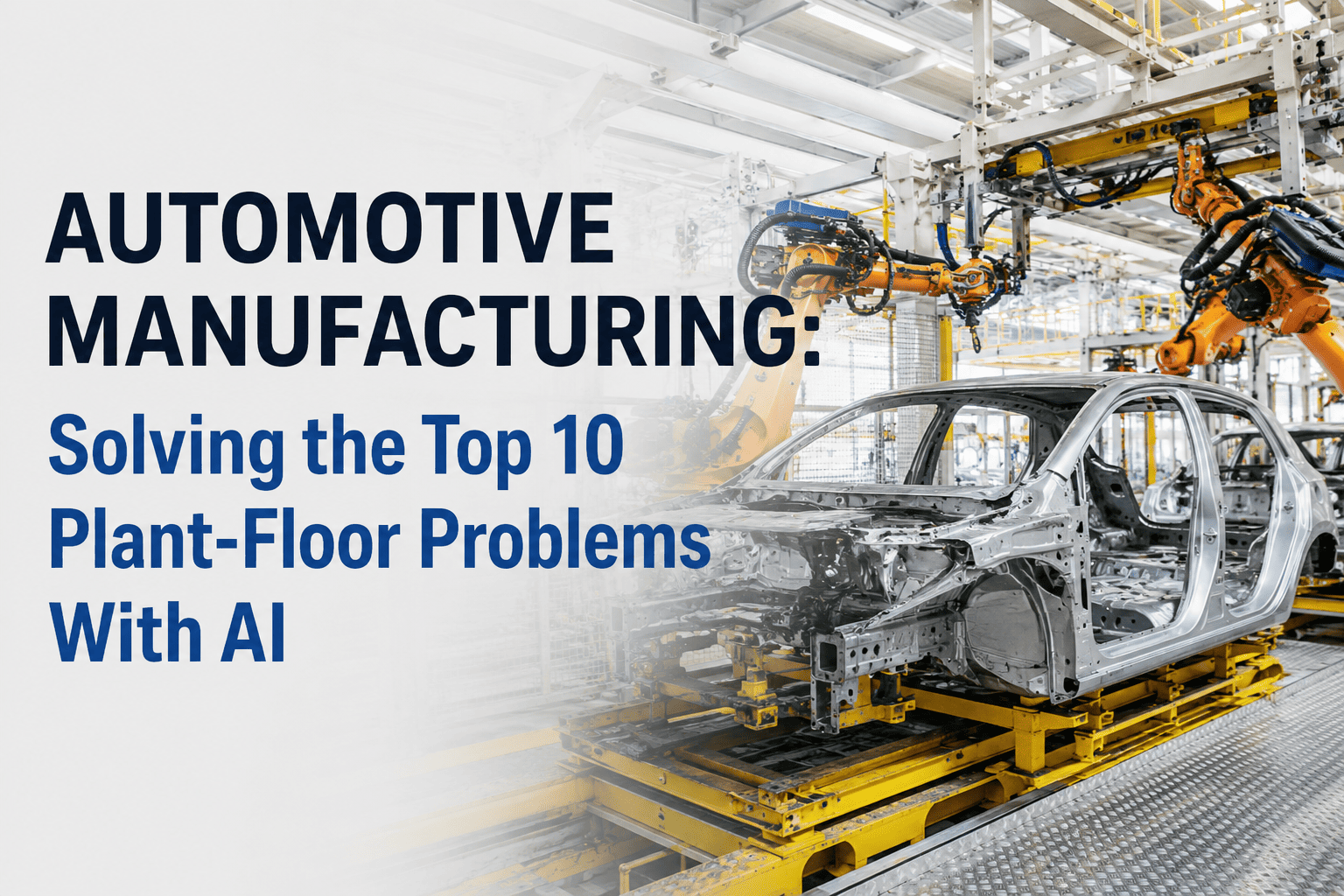
Automotive Manufacturing: Solving the Top 10 Plant-Floor Problems With AI
How AI Vision Cameras eliminate paint defects, body shop weld failures, torque misses, and 7 other critical plant-floor breakdowns — with measurable ROI from week one.
$22K
Cost per hour of undetected defect
99.4%
Defect detection accuracy with AI Vision
6 wk
Time to first measurable quality ROI
40%
Reduction in end-of-line rework costs
Why AI Vision Is Now a Competitive Necessity, Not a Luxury
The global automotive market punishes quality failures with brutal efficiency. A single recall costs an average of $500 million. Customer satisfaction scores drop 18% after one quality incident. And with OEMs tightening supplier scorecards, a defect rate above 50 PPM can cost you a contract worth millions annually. Manual inspection — even with experienced technicians — caps out at 78% detection accuracy. AI Vision Cameras achieve 99.4%. That gap is the difference between a plant that thrives and one that loses business to competitors who have already made the switch.
Executive Summary
⚡
ROI from Week 6
First measurable defect reduction and rework savings typically documented within 6 weeks of deployment — before full-scale rollout.
?
Recall Risk Mitigation
AI Vision creates a 100% inspection audit trail — every part, every weld, every torque event — eliminating the gap that leads to field failures.
?
OEE Uplift
Automated inline inspection eliminates manual check bottlenecks, cutting cycle time waste by 15–22% across high-volume lines.
The 10 Biggest Automotive Plant-Floor Problems — Solved by AI
01
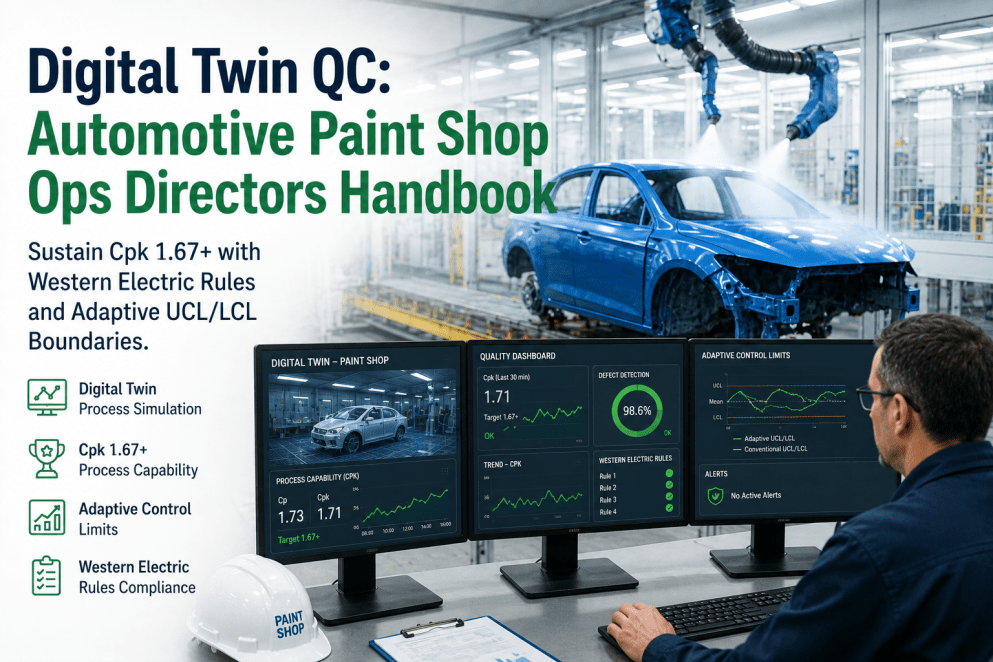
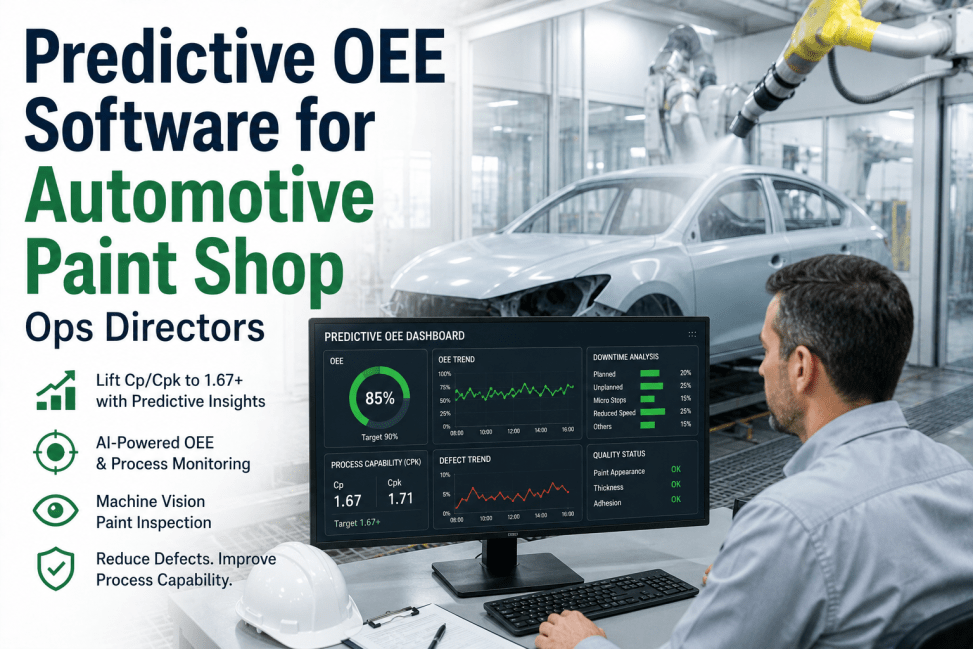
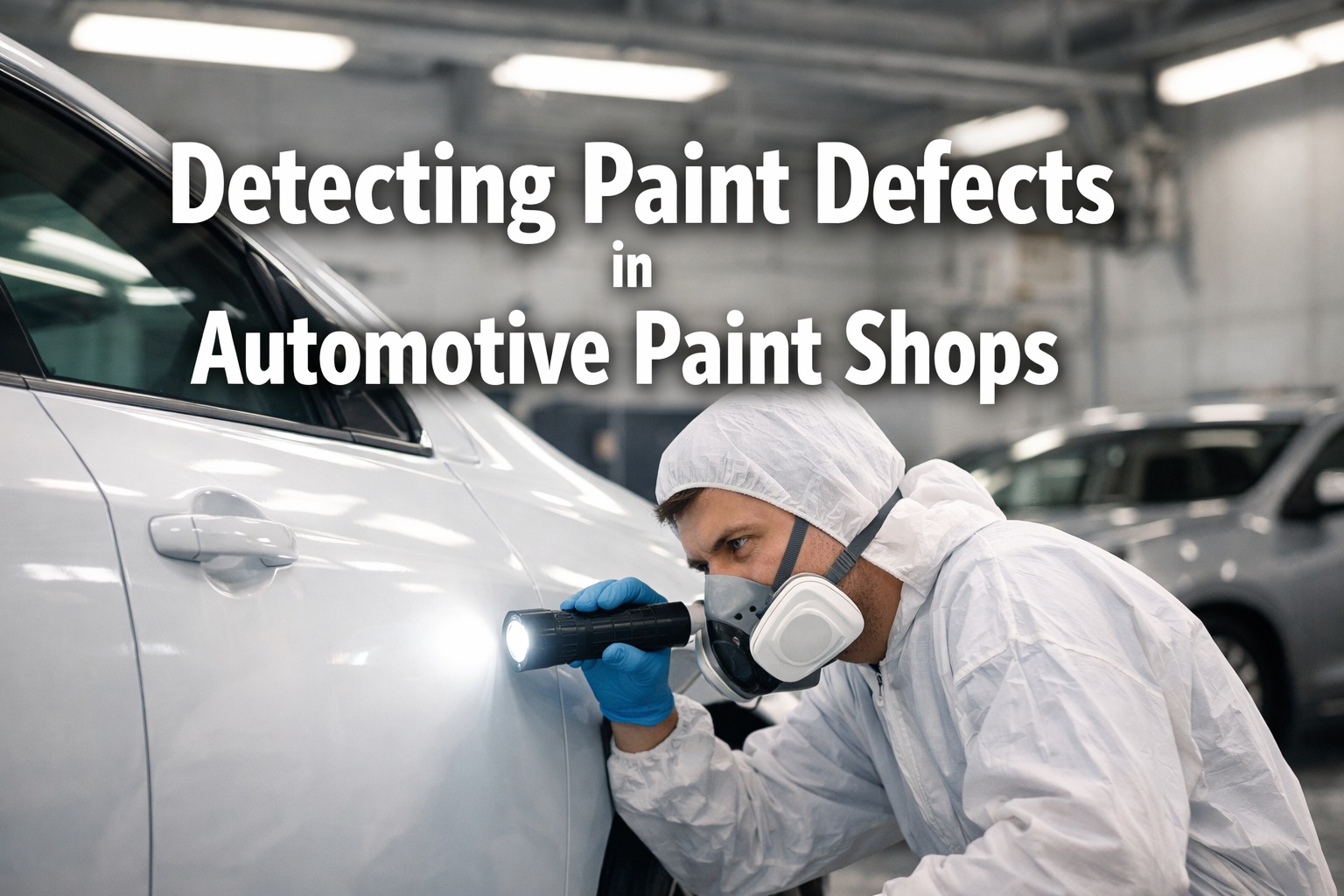
Paint Shop Surface Defects
Runs, sags, orange peel, cratering, and contamination are the most costly rework drivers in any body plant. Human inspectors under fluorescent lighting miss up to 22% of sub-surface defects.
AI Fix AI Vision Cameras with structured light and multi-angle LED arrays detect surface anomalies down to 0.1mm. Defects are flagged inline — before the car enters the next zone — eliminating downstream rework cascades.
02
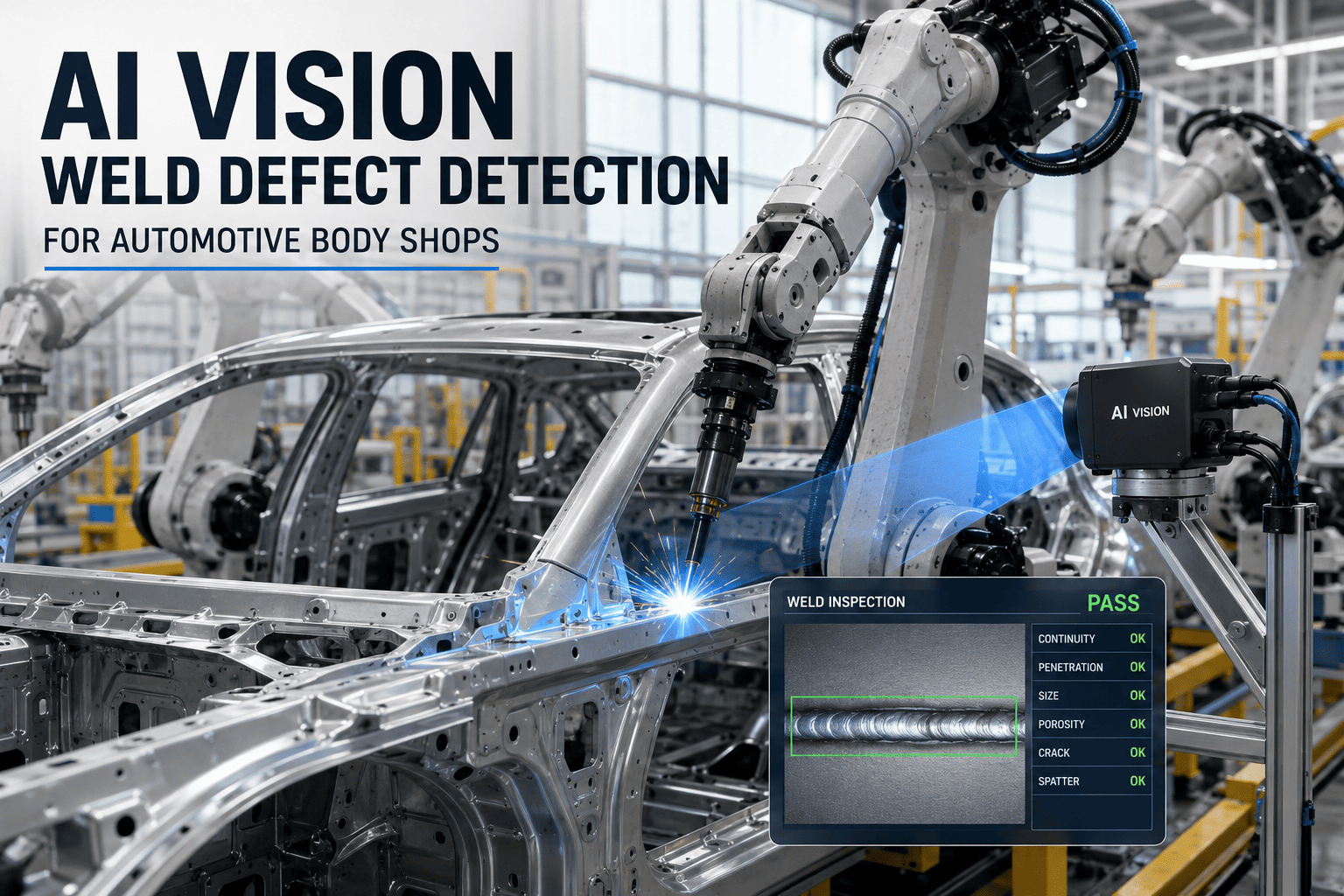
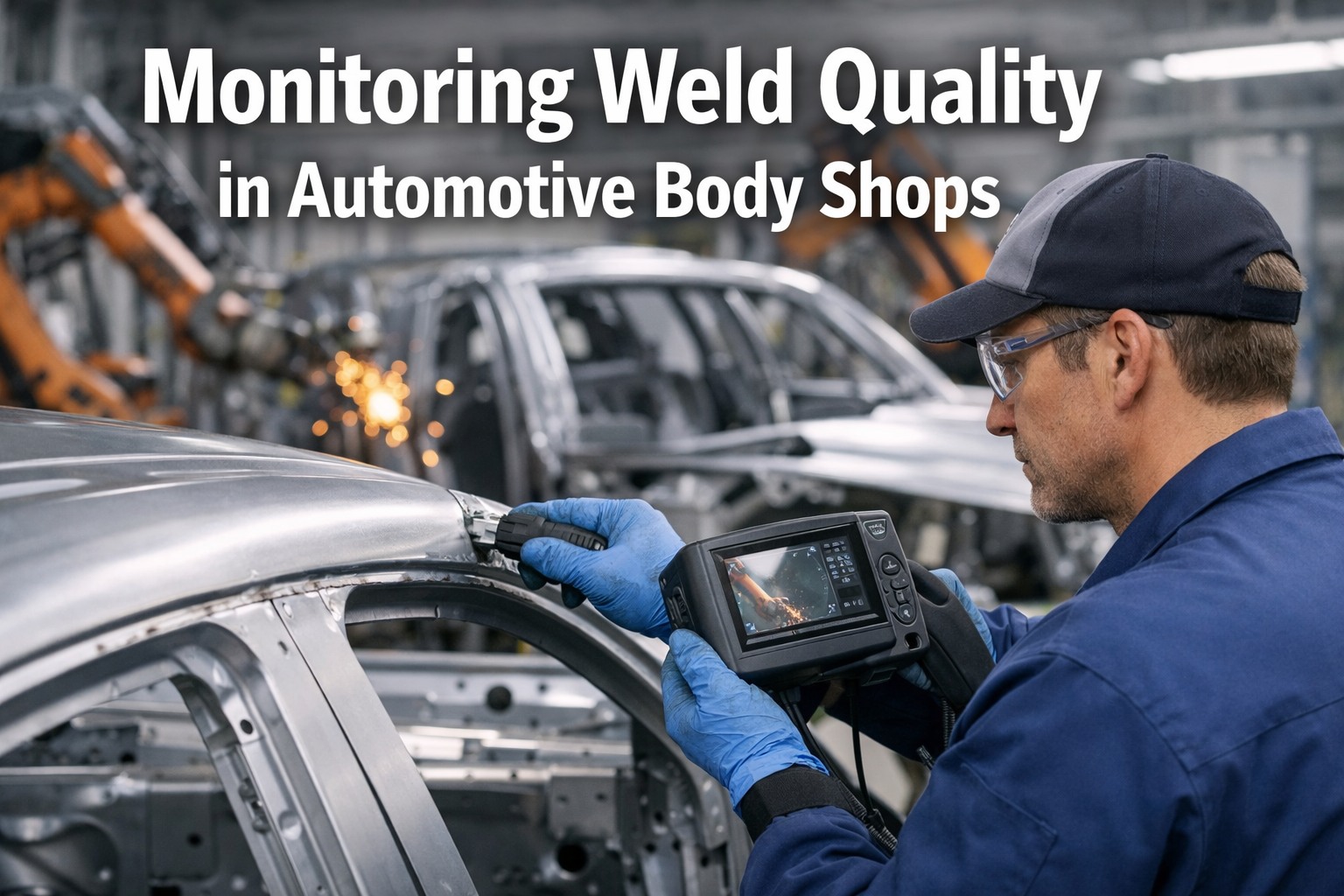
Body Shop Weld Verification
Missing welds, cold welds, and dimensional weld anomalies are invisible to the naked eye. Manual sampling catches less than 5% of actual weld population — leaving 95% uninspected.
AI Fix 100% weld verification using AI Vision with thermal imaging. Every spot weld is measured for position, diameter, and heat signature. Non-conformances trigger an immediate line stop and work order.
03
Torque and Fastener Verification Failures
Undertorqued fasteners in safety-critical assemblies — suspension, steering, brakes — represent the highest recall risk on any automotive line. Paper-based logging creates zero real-time traceability.
AI Fix AI Vision integrates directly with torque tool controllers. Every fastener event is camera-verified, timestamped, and linked to the VIN. Non-conformances are flagged before the vehicle moves.
04
Assembly Sequence Errors
Wrong part, wrong orientation, missing clip, reversed connector — assembly errors that slip through visual inspection generate disproportionate warranty costs and customer dissatisfaction.
AI Fix Part presence, orientation, and sequence verification at every station. AI Vision confirms correct assembly state before the line moves — creating a digital proof chain across the full build.
05
Dimensional Variation in Stampings
Die wear, material batch variation, and press drift cause dimensional creep that compounds across a body structure. Coordinate Measuring Machine (CMM) sampling catches problems hours or days after they begin.
AI Fix Inline 3D photogrammetry with AI Vision delivers 100% dimensional checks at line speed. Trend data feeds predictive die maintenance before variation moves outside tolerance.
06
Gap and Flush Failures on Body Panels
Door gaps, hood lines, and trunk alignment that fall outside spec generate immediate customer rejection. Manual gap gauges are operator-dependent, slow, and create throughput bottlenecks.
AI Fix AI Vision gap-and-flush measurement across all body closures at line speed — no physical gauges, no operator variability. Non-conforming vehicles are flagged and routed to correction before final trim.
07
Seal and Adhesive Application Defects
Underfill, skip, and bead-width variation in sealant and adhesive applications cause NVH issues, corrosion paths, and water leaks — defects that often appear in the field months after delivery.
AI Fix 100% bead inspection using AI Vision with width, continuity, and position verification. Gap detection sensitivity to 2mm ensures no corrosion path exits the plant undetected.
08
Label, VIN, and Compliance Marking Errors
Missing, misread, or misplaced regulatory labels and VIN plates create compliance failures, recall complications, and export documentation risk — often discovered only at the end of line or by auditors.
AI Fix AI Vision OCR verifies every label, barcode, and VIN marking for presence, legibility, and placement accuracy — linked to the digital build record and compliance database in real time.
09
Robotic Cell Deviation and Collision Risk
Robotic path drift, fixture wear, and part-presentation variation cause robotic cells to operate outside programmed parameters — increasing collision risk and quality variation without triggering existing alarms.
AI Fix AI Vision monitors robotic cell geometry and part presentation continuously. Deviation from nominal triggers an alert before a collision or quality escape occurs, protecting both tooling and throughput.
10
End-of-Line Audit Bottlenecks
Final audit stations staffed by inspectors working from paper checklists create throughput constraints, introduce human fatigue variability, and generate no searchable digital quality record.
AI Fix AI-assisted end-of-line audit replaces paper checklists with guided vision inspection. Every check is digitally recorded, timestamped to the VIN, and searchable for traceability and warranty analysis.
Legacy Inspection vs. AI Vision: The Performance Gap
The table below translates the operational reality of manual inspection versus AI-powered vision for automotive plants. These are not theoretical projections — they reflect documented outcomes across deployed iFactory installations.
| Metric | Legacy Manual Inspection | iFactory AI Vision Cameras |
| Defect Detection Accuracy |
72–78% |
99.4% consistently |
| Inspection Coverage |
Sample-based (1–5%) |
100% of production |
| Weld Verification |
Manual gauge sampling |
Every weld, every unit |
| Traceability |
Paper logs, unlinked |
VIN-linked digital audit trail |
| Torque Evidence |
Tool log, no visual proof |
Camera-verified, timestamped |
| Defect Discovery Point |
End of line or field |
At the station where it occurs |
| Rework Cost Driver |
Cascade — defect travels zones |
Contained inline, no cascade |
| Operator Dependency |
High — fatigue, shift variation |
Zero — AI is consistent 24/7 |
| Time to Quality Data |
Hours to days |
Real-time, per-unit |
| Recall Preparation Time |
Days of manual record search |
Seconds — VIN query returns full build record |
Business Impact: What AI Vision Delivers Across the Plant
?
Workflow Transformation
- Inline defect containment eliminates rework cascade across zones
- Automated work orders route non-conforming units without human intervention
- Shift handover quality data available in seconds, not morning reports
- End-of-line audit time cut by 35–50% through AI pre-screening
?
Overhead Reduction
- Manual inspection headcount redeployed to higher-value tasks
- Warranty cost reduction of 25–40% through field failure prevention
- Rework material and labor costs cut by up to $1.8M annually per line
- CMM and gauge calibration costs reduced through inline digital measurement
?
Output and Growth
- OEE improvements of 8–15% from eliminated inspection bottlenecks
- Supplier scorecards improve — PPM reduction opens new OEM contracts
- Audit-ready compliance documentation available on demand
- New model launches accelerated through AI-assisted ramp validation
Implementation: From First Camera to Full-Line Coverage
iFactory's phased deployment model means your plant sees measurable defect reduction in weeks — not after a 12-month implementation. The approach starts with the highest-impact inspection points on your most critical line, proves value in 4–6 weeks, and scales systematically across your facility.
Week 1–4
Pilot Deployment
AI Vision Cameras installed at 3–5 highest-risk inspection points. Integration with existing MES and quality systems. First defect detections live within 2 weeks.
Week 5–10
Model Tuning and Validation
AI models trained on your specific product variants and defect library. False positive rates tuned with quality team. First documented ROI from avoided rework.
Month 3–6
Line Expansion
Coverage scales to full line — paint, body, trim, and final audit. VIN-linked traceability active across all inspection points. Quality reporting automated.
Month 6+
Enterprise Intelligence
Cross-shift and cross-line quality benchmarking. Predictive defect trending. Supplier quality correlation. Compliance reporting automated for OEM and regulatory audits.
Frequently Asked Questions
Can AI Vision work alongside our existing quality management system?
Yes. iFactory AI Vision integrates via standard APIs with all major QMS, MES, and ERP platforms. The cameras add inspection intelligence on top of your current systems without requiring rip-and-replace. Defect data flows directly into your existing quality records and work-order workflows.
How does the system handle model changeovers and variant families?
AI Vision models are trained per product variant and switch automatically on barcode or RFID scan at line entry. Multi-variant lines — including mixed-model assembly — are fully supported. New model onboarding typically requires 2–4 weeks of training data and validation.
What happens when the AI flags a defect — how does the line respond?
Defect triggers are fully configurable: line hold, andon alert, automated work order, or reroute to repair. Integration with your existing andon and CMMS systems means the response workflow matches your current operating procedures — AI provides the detection, your team owns the response.
How does iFactory handle the lighting and environmental variation in a paint shop?
iFactory's paint shop cameras use multi-angle LED arrays with structured light — purpose-designed for the reflectivity and colour variation of automotive paint. The AI models are trained specifically on automotive surface defect types and are validated across metallic, pearl, and matte finishes.
Stop Letting Defects Leave Your Plant
See How AI Vision Eliminates Your Top 10 Plant-Floor Quality Problems
iFactory's AI Vision Cameras are deployed and detecting defects in automotive plants within weeks — not years. Book a strategy session and we will map your highest-impact inspection points, quantify your current defect cost, and show you a deployment roadmap built for your line.
40%
Rework cost reduction