Every product recall begins the same way: a frantic search through disconnected spreadsheets, paper logs, and siloed ERP records — while regulators wait, customers panic, and production halts. For manufacturers without a real traceability system, that search can take days. The average food recall costs $10 million in direct expenses alone, not counting brand damage or lost contracts. In automotive, a single non-conformance without documented genealogy can trigger line shutdowns worth $250,000 per hour. The question is not whether traceability matters — regulators, customers and insurers have already answered that. The question is whether your current system can deliver the right answer in minutes, not days.
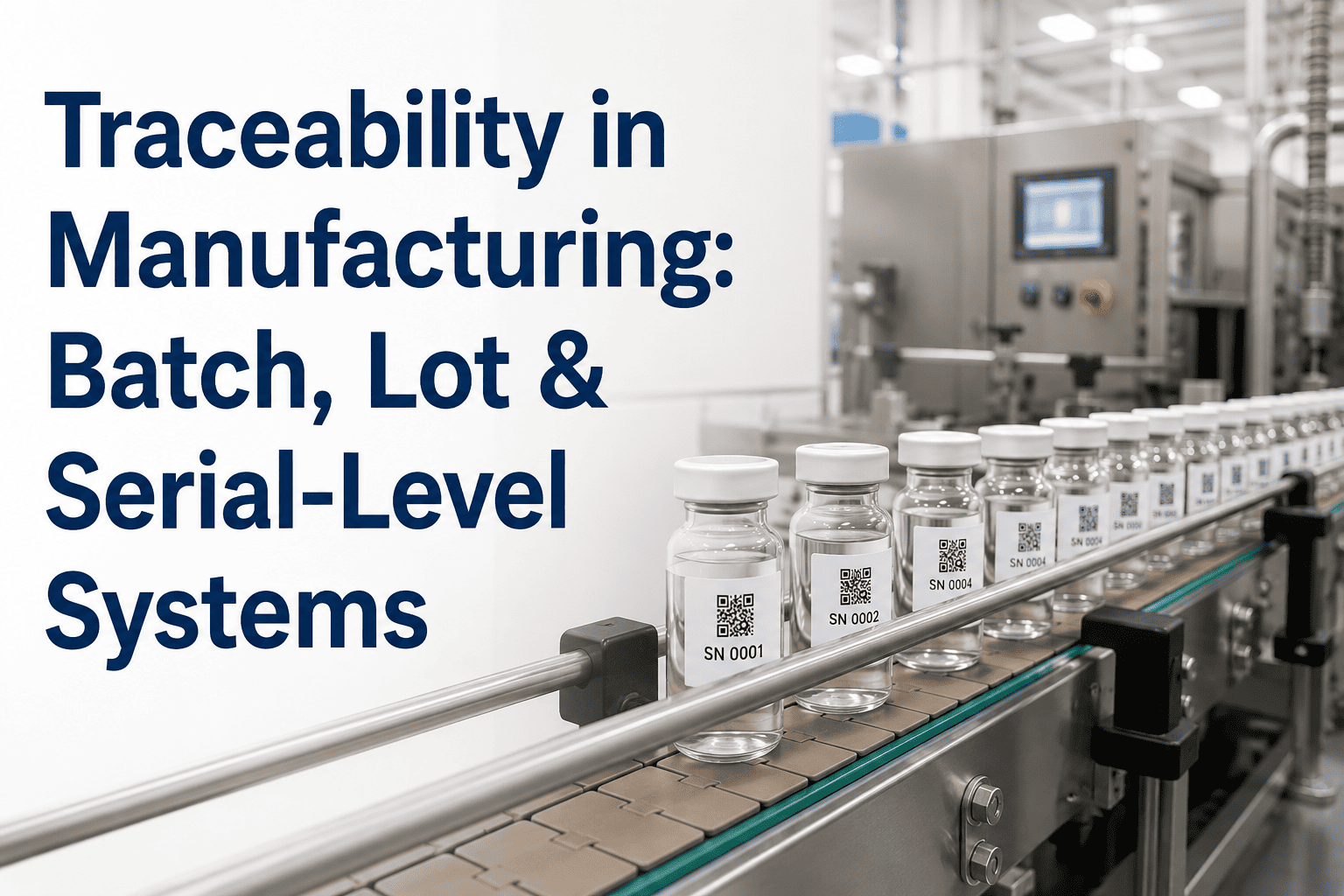
Traceability in Manufacturing: Batch, Lot & Serial-Level Systems Explained
What Is Manufacturing Traceability — and Why the Definition Matters
Manufacturing traceability is the documented ability to reconstruct the complete history of a product: which raw materials entered it, which processes transformed it, which equipment touched it, which operators approved it, and where it went after leaving your facility. Regulators call this genealogy. Customers call it accountability. Supply chain teams call it risk management. Every stakeholder has the same underlying need: when something goes wrong, they need to isolate the problem with surgical precision — not detonate an entire production run.
Traceability operates at three distinct levels of granularity, and choosing the wrong level for your regulatory environment or product risk profile is one of the most expensive mistakes a manufacturer can make.
Regulatory Requirements: What FDA, FSMA, and IATF 16949 Actually Demand
Traceability requirements are not uniform across industries, and the penalties for misunderstanding them are severe. Below is a practical summary of the three major regulatory frameworks most manufacturers encounter.
- Complete batch production and control records for pharmaceuticals and medical devices
- Equipment identification, operator records, and in-process testing documentation per batch
- Records must be retained for at least one year past product expiry or two years past distribution
- Traceability records must be retrievable within 72 hours of an FDA request during inspections
- Electronic records acceptable under 21 CFR Part 11 with audit trail and access controls
- Applies to high-risk foods on the FDA Food Traceability List (FTL): leafy greens, seafood, fresh produce, eggs, nut butters
- Requires Key Data Elements (KDEs) at Critical Tracking Events (CTEs): growing, receiving, transforming, creating, shipping
- Traceability Lot Codes (TLCs) must link across the supply chain from farm to retailer
- Records must be provided to FDA within 24 hours of a request during an active outbreak
- Non-compliance: mandatory recall authority, facility registration suspension, criminal referral
- Clause 8.5.2 mandates traceability of products by unique identification throughout production and delivery
- Customer-specific requirements (CSRs) from GM, Ford, Stellantis, BMW often extend serial traceability to Tier 2 suppliers
- Control plans must document traceability methods as part of the Advanced Product Quality Planning process
- PPAP submission requires demonstration of traceability capability before production approval
- Containment actions triggered by field failures require part-level genealogy to bound the scope of recall
Legacy Friction vs. Optimised Excellence: The Traceability Gap
Most manufacturers believe they have traceability. What they actually have is a collection of records — paper forms, spreadsheets, ERP lot numbers, and maintenance logs — that might, under ideal conditions, be assembled into something approaching genealogy. The distinction becomes critical the moment an auditor or a recall event tests the assumption.
| Dimension | Legacy Friction — Old Way | Optimised Excellence — iFactory MES |
|---|---|---|
| Genealogy Creation | Manual entry into ERP after production; prone to transcription errors and omissions | Automated capture at every process step via barcode, RFID, and machine integration |
| Recall Scope Determination | 2–5 days of cross-referencing spreadsheets, paper logs, and ERP records | Sub-4-minute query returning full affected lot or serial range with distribution map |
| Regulatory Retrieval | Staff scramble to compile records; high risk of gaps under FDA 72-hour window | One-click audit package generation with complete chain of custody and e-signatures |
| Supplier Lot Linkage | Incoming lot numbers logged separately from production; linkage manual and unreliable | Inbound supplier lots automatically linked to production genealogy at goods receipt |
| Non-Conformance Containment | Broad quarantine of entire production runs due to inability to isolate affected units | Precision containment to specific serial or lot range; unaffected inventory released immediately |
| Customer Traceability Requests | Days to respond to automotive CSR or retailer audit; risk of losing approved supplier status | Instant export of unit-level genealogy in customer-specified format |
| Operator Accountability | Shift logs on paper; operator identity rarely tied to specific units produced | Every operation stamped with operator ID, timestamp, and equipment record |
| Continuous Improvement | Root cause analysis limited by incomplete production data; lessons lost between shifts | Full process parameter history enables statistical correlation between conditions and defects |
How MES Enforces Full Genealogy at Every Step
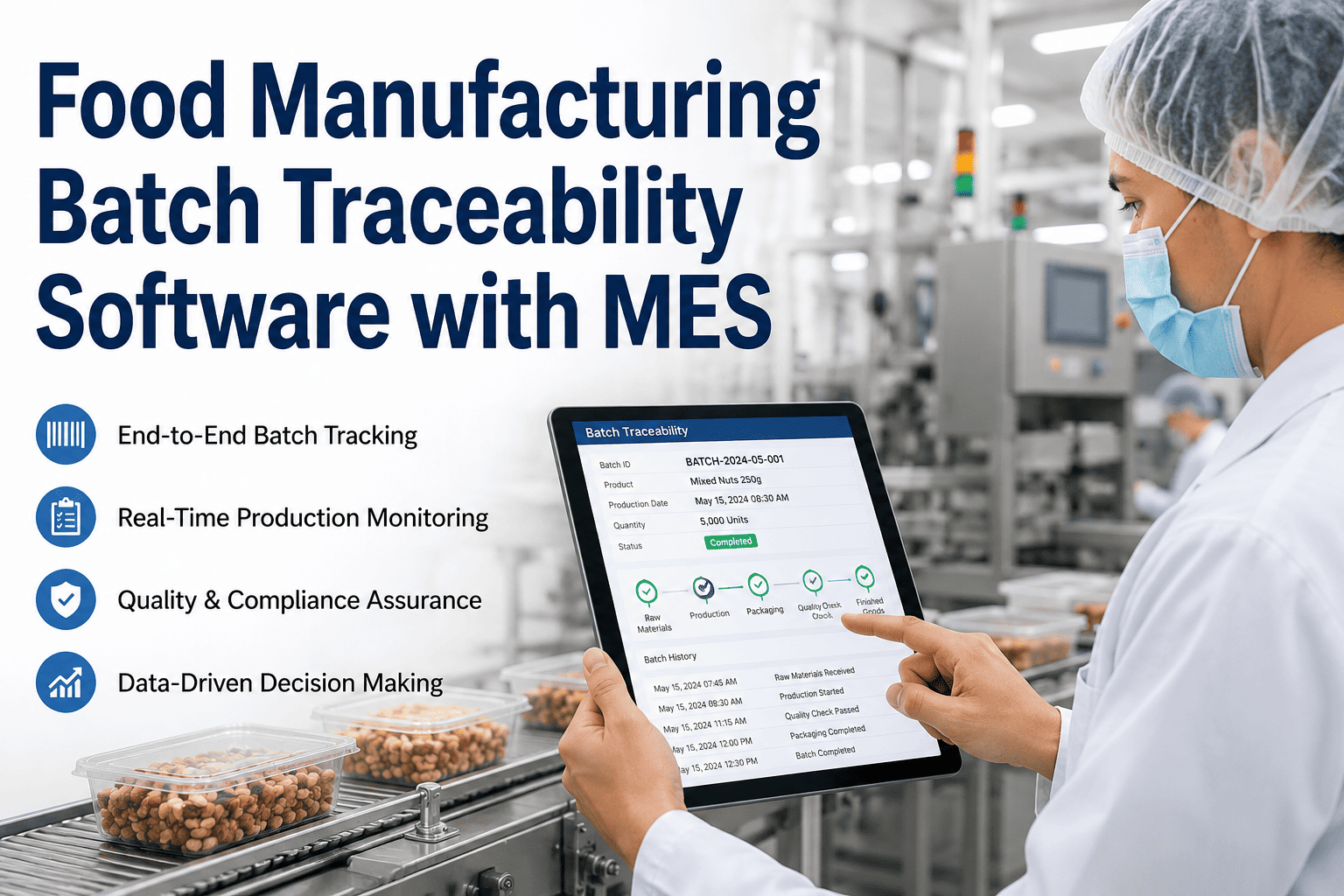
A Manufacturing Execution System transforms traceability from a documentation exercise into a real-time operational capability. Instead of reconstructing history after the fact, an MES captures it automatically as production occurs — at every workstation, every process transition, and every quality gate.
- Electronic work orders enforce process sequence — operators cannot skip steps or record out-of-order
- Material consumption recorded at point of use, not estimated in ERP after the fact
- Quality hold triggers auto-quarantine of downstream units using the same input lot
- Deviation management links NCR records directly to the affected genealogy records
- Eliminates manual batch record compilation — saving 15–30 hours per product line per month
- Automated audit package generation reduces regulatory response preparation from days to minutes
- Precision recall scoping reduces over-quarantine costs by up to 60% compared to paper-based systems
- Supplier corrective action cycles shortened by immediate lot-to-production linkage
- Approved supplier status protected — instant response to automotive CSR and retailer audit requests
- New product introduction accelerated — genealogy templates replicated from existing configurations
- Multi-site traceability unified in a single platform — same query returns results across facilities
- Data foundation for AI-powered defect correlation and predictive quality analytics
Selecting the Right Traceability Level for Your Operation
Traceability architecture decisions have long-term consequences. Over-engineering serialisation for a commodity food product wastes implementation resources. Under-engineering batch traceability in pharmaceutical manufacturing invites regulatory action. The selection framework below guides the decision based on regulatory exposure, product risk, and customer requirements.