Every hour of unplanned downtime costs manufacturers an average of $260,000. Multiply that by the industry average of 800 unplanned downtime hours per year, and you are looking at a $208 million exposure — not from market shifts or supply chain disruption, but from equipment failures your sensors already knew were coming. Predictive maintenance is no longer a competitive advantage. It is the baseline for operational survival in 2026.
iFactory Implementation Intelligence
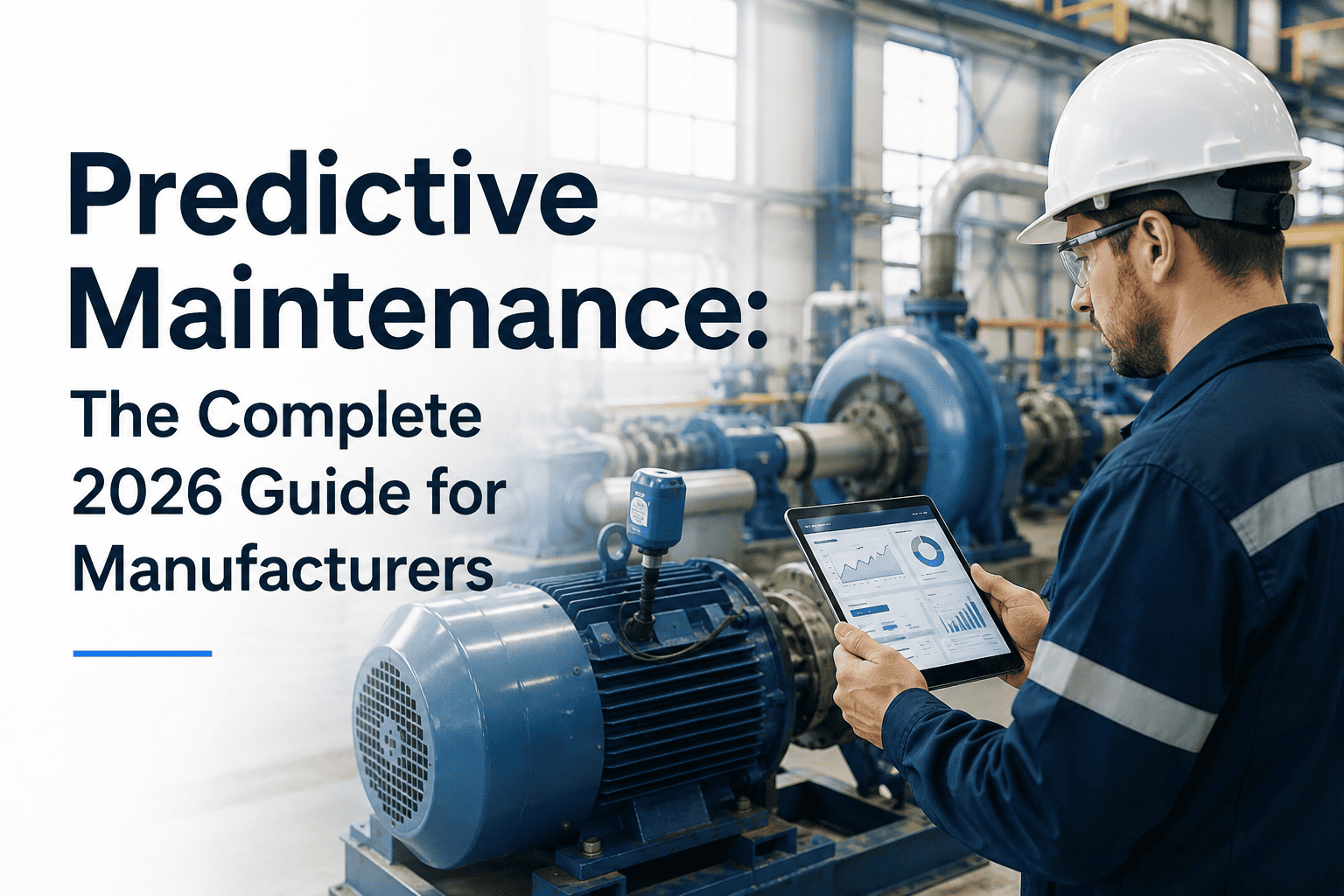
Predictive Maintenance: The Complete 2026 Guide for Manufacturers
How sensors, AI models, and a 90-day rollout plan cut unplanned downtime by 45% and MRO costs by 30% — with measurable ROI inside the first quarter.
45%
Reduction in unplanned downtime
95%
Of adopters report positive ROI
90 days
Time to first measurable result
What Is Predictive Maintenance — and Why 2026 Is the Tipping Point
Predictive maintenance (PdM) uses real-time sensor data, machine learning models, and AI analytics to forecast equipment failures before they occur — scheduling interventions only when data says they are needed. Unlike time-based preventive maintenance, PdM eliminates both reactive emergencies and unnecessary scheduled shutdowns. The convergence of affordable IIoT sensors, cloud-native AI platforms, and mature LSTM forecasting models has pushed PdM from experimental to essential in 2026.
Executive Summary
▲
ROI
10–30x return on investment. First avoided failure typically covers Phase 1 deployment cost entirely.
■
Scalability
Start with 10–20 critical assets. Expand to 200+ across multiple facilities without rearchitecting.
●
Risk Mitigation
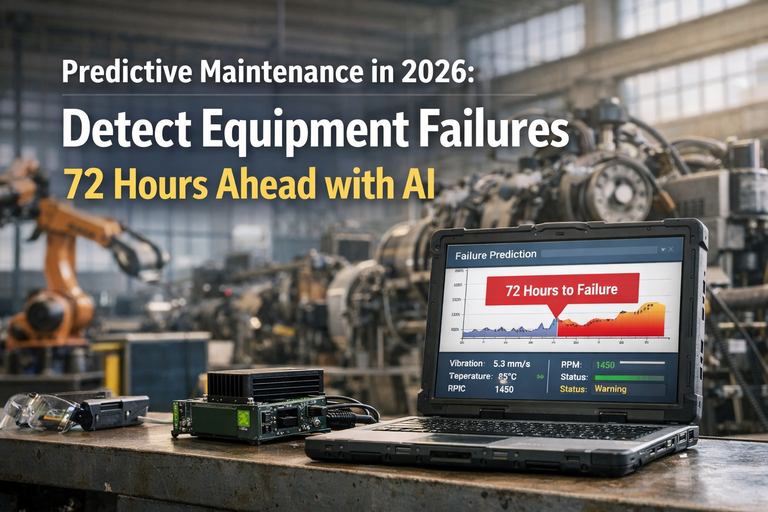
14–21 day advance failure warnings replace reactive firefighting with calm, planned interventions.
The Four Pillars of a Modern PdM System
Effective predictive maintenance in 2026 is built on four integrated layers — each dependent on the one before it. Skipping any layer is why implementations stall.
01
Sensor Infrastructure
Vibration, temperature, current, and acoustic sensors installed at $50–100 per monitoring point. Wireless units eliminate shutdown requirements for installation. OPC-UA and MQTT protocols feed data directly to the analytics layer.
02
AI Anomaly Detection
Machine learning models learn normal operating baselines — load profiles, thermal envelopes, vibration signatures. Deviations trigger condition alerts within 4–6 weeks of deployment, validated against maintenance team knowledge.
03
Predictive Forecasting
LSTM and gradient boosting models generate Remaining Useful Life (RUL) projections with 90%+ accuracy as training data matures at months 3–6. Failures predicted 14–21 days in advance across motors, pumps, compressors, and fans.
04
Autonomous Workflows
AI auto-generates CMMS work orders with correct parts, procedures, and scheduling. Generative AI assistants enable natural language queries on asset health. Financial systems receive automated TCO and replacement-timing feeds.
See all four pillars deployed in a live manufacturing environment.
Book a Demo Now
Legacy Maintenance vs. AI-Powered Predictive Maintenance
The gap between reactive maintenance and AI-driven predictive operations is no longer incremental — it is existential. Here is how the two approaches compare across every dimension that matters to the executive team.
| Dimension |
Legacy Friction (Old Way) |
Optimised Excellence (PdM) |
| Failure Detection |
After breakdown occurs |
14–21 days before failure |
| Maintenance Trigger |
Calendar schedule or emergency |
Real-time condition data |
| Downtime Cost |
$260K+ per unplanned hour |
45% reduction in unplanned events |
| Parts Inventory |
Overstocked buffers or emergency orders |
Just-in-time procurement from RUL data |
| Maintenance Labour |
Reactive crew deployment |
Planned, optimised scheduling |
| Energy Consumption |
Uncorrelated to asset condition |
Monitored and optimised per asset |
| Compliance Docs |
Manual assembly for audits |
Auto-generated from twin data |
| CAPEX Planning |
Experience-based estimates |
Data-backed replacement timelines |
The 90-Day PdM Rollout Plan
Successful predictive maintenance deployments follow a phased pattern validated across single-site plants and multi-facility enterprises. The 90-day plan below gets your first assets monitored, your first anomaly alerts firing, and your first measurable savings documented — before the end of Q1.
Days 1–28
Assessment & Foundation
- Audit existing SCADA, historians, and CMMS for data sources
- Select 10–20 critical assets — motors, pumps, compressors, fans
- Deploy wireless vibration and temperature sensors at $50–100 per point
- Establish OPC-UA, MQTT, and REST integrations to ERP and CMMS
- Document 3–5 financial KPIs with baseline values
Gate: Real-time data flowing from all pilot assets into platform
Days 29–60
Condition Monitoring & Baseline Learning
- AI models learn normal operating profiles for each pilot asset
- Real-time health dashboards go live with trend charts and thresholds
- First anomaly detection alerts fire and are validated with maintenance team
- False-positive tuning to eliminate alarm fatigue
- First avoided failure or unnecessary maintenance event documented
Gate: Anomaly alerts validated by maintenance team
Days 61–90
Predictive Analytics & Expansion
- LSTM models begin predicting failures 14–21 days in advance
- Remaining Useful Life projections go live for all pilot assets
- Sensor coverage expands to next tier — 50–100 additional points
- Energy monitoring layer activates, correlating consumption to condition
- ROI business case validated with documented savings in dollar terms
Gate: Predictive alerts achieving 90%+ accuracy on pilot assets
Business Impact: Three Dimensions of PdM Value
Predictive maintenance delivers value across three distinct dimensions simultaneously — each independently justifiable and compounding when combined.
▼
Reduced Overhead
- 30% reduction in MRO parts spend via just-in-time procurement
- Elimination of time-based maintenance on healthy assets
- Labour hours redirected from reactive to planned work
- Insurance and compliance costs reduced via documented condition history
▲
Improved Workflow
- 14–21 day advance warnings enable calm, planned interventions
- AI-generated work orders with correct parts and procedures
- Maintenance team shifts from reactive firefighting to strategic ownership
- Natural language asset queries replace manual log reviews
●
Increased Output
- 45% fewer unplanned downtime events across monitored assets
- Energy optimisation produces 8–12% consumption reduction
- New asset commissioning accelerated 30–40% via virtual twin testing
- $1.2–3.5M annual savings potential at full enterprise scale
Request a performance audit for your facility — identify your highest-value PdM opportunities in 30 minutes.
Request a Performance Audit
Selecting the Right Pilot Assets
The most common implementation mistake is starting with the most complex asset. The right pilot asset is critical enough that avoided downtime produces measurable ROI, but standard enough that sensor data is readily available and failure modes are well understood.
Electric Motors
Well-understood failure modes. Vibration and current monitoring at low cost. High failure frequency makes ROI fast.
Centrifugal Pumps
Cavitation, bearing wear, and seal failure detectable weeks in advance. High replacement cost justifies monitoring investment immediately.
Compressors
Unplanned compressor failure creates cascade downtime. Thermal and vibration signatures give 21+ day advance warnings.
Industrial Fans
Imbalance and bearing degradation monitored at minimal sensor cost. Simple failure modes make model training fast.
Conveyor Systems
Belt tension, roller wear, and motor load monitoring prevents line-stoppage failures that trigger entire facility shutdowns.
Heat Exchangers
Fouling and thermal efficiency degradation detectable early. Energy waste identification compounds the ROI case rapidly.
PdM Investment and Return by Phase
The phased investment model ensures each stage is funded by savings from the last. No large upfront commitment. No deferred payback periods that exhaust executive patience.
Phase 1
Weeks 1–4
$50–150K for sensors, platform setup, and integrations
Baseline KPIs established. Infrastructure in place.
Phase 2
Weeks 5–12
$30–80K incremental for model training and onboarding
$100–400K in first avoided failures and eliminated maintenance
Phase 3
Months 3–6
$80–200K for expansion sensors and energy monitoring
$400K–1.2M annually. ROI turns positive in this phase.
Phase 4–5
Month 6+
$100–300K for enterprise scale-out and multi-site
10–30x ROI. $1.2–3.5M annual savings. Compound AI improvement.
Frequently Asked Questions
How quickly will we see results from a PdM deployment?
Most deployments produce the first avoided failure within 6–10 weeks. For assets with $260K+ per hour downtime cost, a single avoided incident typically exceeds the entire Phase 1 investment. Define 3–5 financial KPIs upfront and report monthly in dollar terms executives can compare directly against spend.
What if our sensor infrastructure is limited?
This is the most common starting point. With wireless vibration sensors now costing $50–100 each, comprehensive instrumentation of 10–20 pilot assets can be completed in 1–2 weeks for $15–40K with no plant shutdown. The platform also ingests whatever SCADA and historian data already exists, maximising value from infrastructure you have already paid for.
Will PdM disrupt our existing CMMS and ERP systems?
No. The platform integrates via standard APIs and runs alongside existing systems. Maintenance teams continue using their current CMMS for work execution while the twin adds predictive intelligence on top. Over time, AI-generated work orders feed directly into the CMMS — no rip-and-replace required.
How much internal resource does implementation require?
Phase 1 typically requires 1–2 maintenance engineers part-time for asset selection and sensor placement, one IT resource for 2–4 weeks of integration work, and a project sponsor for governance. Total internal effort is typically 80–120 person-hours across 4 weeks — significantly less than traditional digital transformation programmes.
Start Monitoring. Stop Reacting.
Your First 12 Sensors Can Deliver ROI Before the End of Q1
iFactory's AI-powered predictive maintenance platform deploys in weeks, not months. Define your pilot assets today and let our engineers build your implementation roadmap — at no cost.
4–6wk
Time to first value
$3.5M
Annual savings potential
10–30x
Return on investment