Every unplanned equipment failure is a financial event. A seized compressor at 2 AM is not a maintenance problem — it is a revenue problem, a scheduling problem, and a customer-confidence problem all collapsing at once. Yet most manufacturers still operate on strategies designed when sensors cost thousands of dollars, and data storage was scarce. The cost of that inertia is measurable: industry research consistently places unplanned downtime losses between $125,000 and $260,000 per hour for mid-to-large production facilities. If your maintenance strategy has not evolved in the last five years, you are not saving money — you are deferring losses.
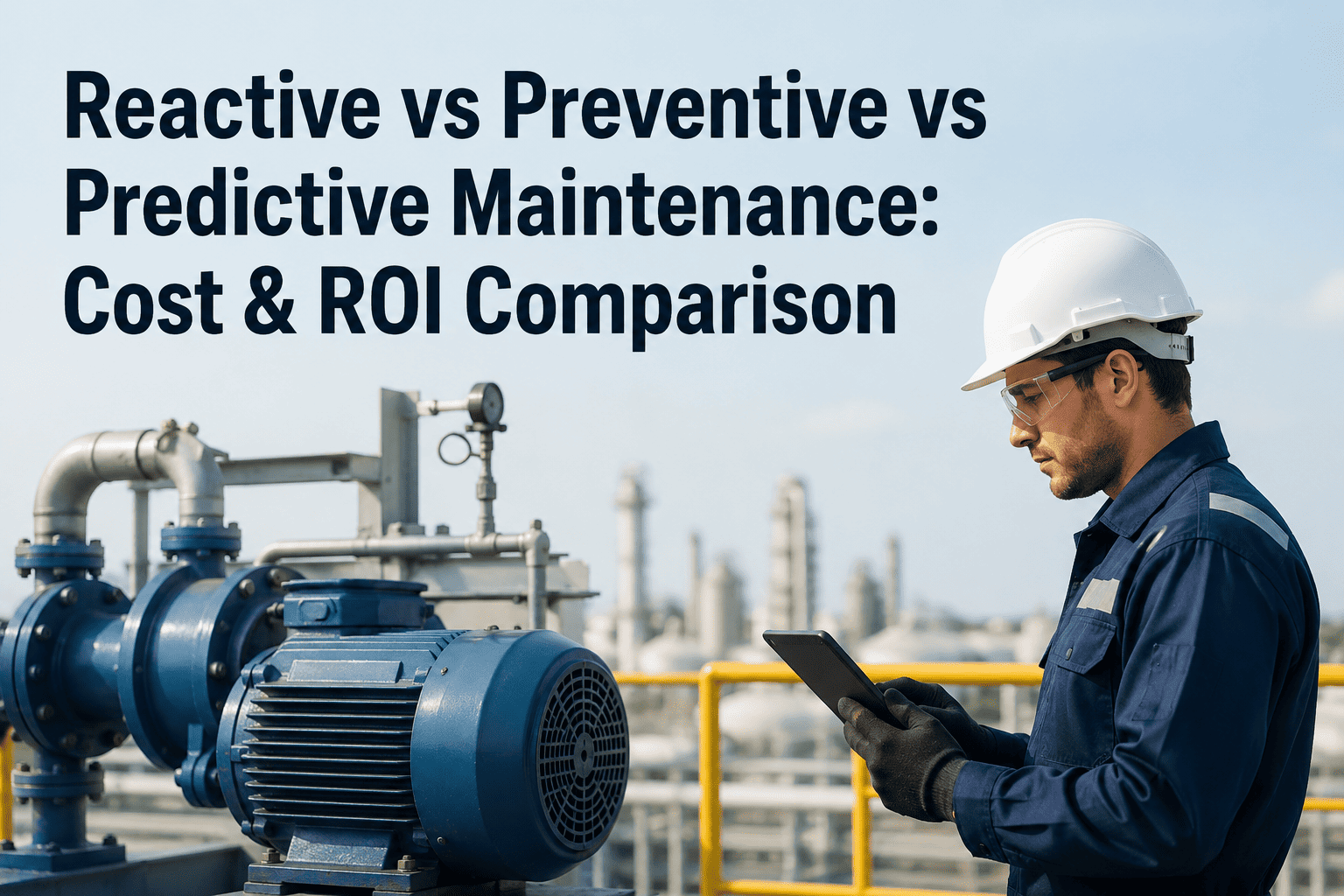
Reactive vs Preventive vs Predictive Maintenance: Cost, ROI & When to Upgrade
A decision-maker's guide to understanding what each maintenance strategy actually costs — and the financial case for predictive maintenance in modern manufacturing.
The Three Strategies: A Plain-Language Overview
Before comparing costs and ROI, it helps to define exactly what each strategy entails — and what assumptions it makes about failure behaviour.
No scheduled maintenance. Assets operate until they break. Repair or replace after the failure event. Appropriate only for non-critical, easily replaced assets with low failure consequences.
- Zero upfront maintenance cost
- Unpredictable failure timing
- High collateral damage risk
- Emergency labour premiums
Scheduled maintenance at fixed intervals regardless of asset condition. Industry standard for decades. Eliminates some failures but replaces parts that may have remaining useful life.
- Predictable scheduling
- Reduces catastrophic failures
- 25–30% unnecessary work
- Does not eliminate all failures
AI-driven monitoring of real-time asset condition data. Maintenance is triggered by actual degradation signals — vibration, temperature, current draw — not calendars. Intervene only when needed.
- 14–21 day failure advance warning
- Eliminate unnecessary downtime
- Extend asset lifespan 20–40%
- 95% of adopters report positive ROI
Cost Per Failure: What the Numbers Actually Say
Comparing strategies on sticker price alone is misleading. The true cost of a maintenance strategy includes direct repair costs, production losses, emergency labour, secondary equipment damage, and regulatory exposure. The table below normalises these costs across a representative mid-size manufacturing facility.
| Cost Factor | Reactive | Preventive | Predictive |
|---|---|---|---|
| Avg. repair cost per failure event | $18,000–$45,000 | $8,000–$18,000 | $3,000–$8,000 |
| Unplanned downtime per year (hours) | 80–160 hrs | 30–60 hrs | 4–12 hrs |
| Labour efficiency (% wasted on unnecessary tasks) | N/A | 25–30% | Less than 5% |
| Spare parts inventory premium | High (emergency orders) | Moderate (scheduled) | Low (planned ahead) |
| Asset lifespan impact | Shortened by 20–35% | Near-standard lifespan | Extended 20–40% |
| Typical annual maintenance cost (200-asset facility) | $2.8M–$4.5M | $1.6M–$2.4M | $680K–$1.2M |
The Legacy vs Optimised Gap: Operational Comparison
The difference between a reactive or calendar-based maintenance programme and an AI-driven predictive one is not incremental. It is structural. Below is a side-by-side view of how the two operational realities compare across the decisions that matter most to operations leaders.
Reactive & Calendar PM
AI Predictive Maintenance
Three Business Outcomes That Define the ROI Case
Predictive maintenance ROI flows from three distinct value streams. Each is measurable independently — which means each can be tracked from week one of deployment.
Advance warning of 14–21 days converts emergency stoppages into planned maintenance windows. A single avoided failure on a critical line typically recovers $200K–$600K in production value — often exceeding the entire Phase 1 deployment cost.
AI-generated work orders with correct parts, procedures, and scheduling eliminate the wasted effort of calendar-based PM tasks on assets in good condition. Maintenance teams work on what needs attention — not what the calendar dictates.
Continuous condition monitoring prevents the secondary damage that reactive failures cause. Catching bearing degradation before it damages the shaft eliminates a $4,000 repair from becoming a $40,000 asset replacement.
When to Escalate: Decision Criteria by Strategy
Not every asset requires predictive monitoring — and not every facility should abandon preventive maintenance overnight. The right escalation path depends on asset criticality, failure cost, and current data infrastructure. Use this framework to prioritise where predictive pays first.
Frequently Asked Questions
Your Highest-ROI Assets Are Already Telling You Something. Are You Listening?
iFactory's AI digital twin platform gets your first critical assets monitored in weeks, your first avoided failure documented within months, and your full ROI realised within 12–18 months. Every phase funds the next.