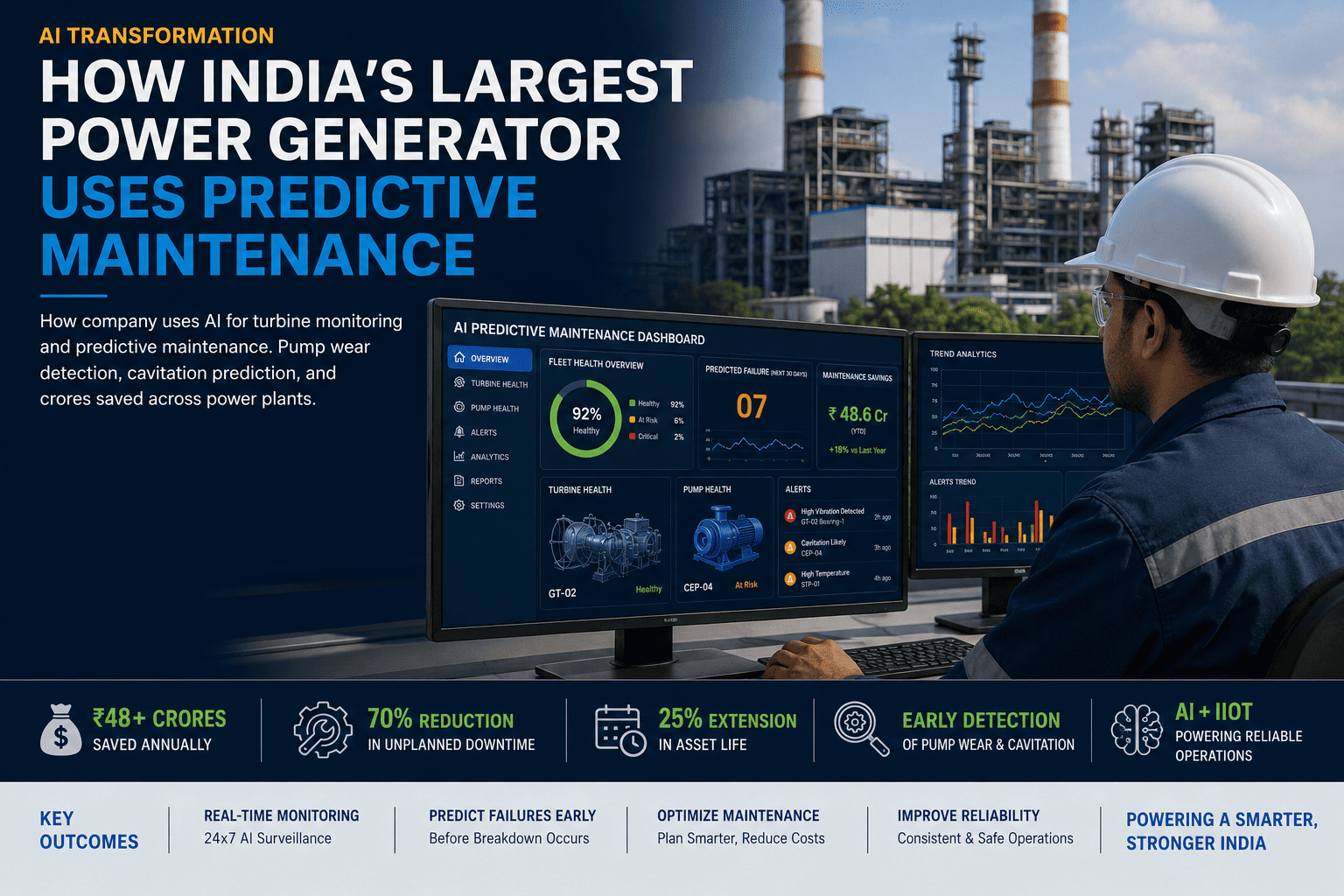
India's power demand will surge from 203 GW (2022) to 277 GW by 2027—a 36% jump in 5 years. Yet the sector faces a paradox: capacity additions accelerate while plant efficiency, grid stability, and asset reliability decline. State utilities operate 20-25 year old fleets at 82% availability (vs 88% benchmark), losing ₹15,000+ crores annually to unplanned outages, inefficient operations, and reactive maintenance. The conventional approach—add more capacity, operate reactively—cannot scale. The solution isn't just more generation; it's intelligent generation. Leading utilities like NTPC, Tata Power and Adani have proven that AI-driven operations deliver 2-4% efficiency gains, 20-35% O&M reductions, and enable the integration of 500 GW renewable capacity by 2030.
This is the executive roadmap for building India's intelligent power sector—from Industry 4.0 foundations to AI-driven utilities. Not theoretical frameworks, but proven transformation paths with quantified business outcomes. Schedule a strategic assessment to see your utility's digital maturity and transformation roadmap, or continue reading.
Building India's Intelligent Power Sector: From Industry 4.0 to AI-Driven Utilities
277 GW by 2027 | 500 GW Renewables by 2030 | Executive Transformation Roadmap
The Strategic Imperative: Why Traditional Approaches Fail
Three Converging Challenges
Demand Growth
36% increase in 5 years (203 → 277 GW by 2027). Adding capacity alone costs ₹6-8 lakh/MW—₹4.4 lakh crores investment needed just to keep pace.
Aging Assets
Average thermal plant age: 22 years. 82% availability vs 88% benchmark = ₹15,000 Cr annual losses. Replacement prohibitive—must maximize existing asset performance.
Renewable Integration
500 GW RE by 2030 (currently 175 GW). Solar/wind intermittency requires grid intelligence—forecasting, balancing, storage—impossible with manual operations. Discuss renewable challenges.
Can't build fast enough, can't afford replacements, can't manage complexity manually. AI extracts 15-25% more value from existing infrastructure—equivalent to adding 35-50 GW capacity without construction. This is why NTPC invested ₹1,200 Cr in digital transformation: ROI 775% over 5 years through efficiency gains alone.
Get Your Utility's Digital Maturity Assessment
We'll evaluate your current digitalization level and map the optimal transformation path. See where you stand vs leading utilities and what investments deliver fastest ROI.
Not sure where to start with digital transformation? Our utility strategists can guide you — We'll help prioritize initiatives for your specific context.
Three-Stage Evolution: The Transformation Path
From Reactive to Predictive to Autonomous
Traditional (Manual)
Current state for 60% of utilities. Time-based maintenance, manual operations, siloed systems. DCS for control, SCADA for visualization, but no analytics. Result: 82% availability, high O&M costs, reactive failures.
Industry 4.0 (Connected)
Foundation layer. IoT sensors, data historians, cloud platforms. Equipment connected, data flowing, dashboards visualizing. Enables monitoring but decisions still manual. 25% of utilities here—have data, need intelligence.
AI-Driven (Autonomous)
Target state. Predictive maintenance, real-time optimization, autonomous operations. AI recommends (or executes) actions. Digital twins simulate scenarios. Result: 88-92% availability, 20% O&M reduction. Only 10% of utilities achieved—massive opportunity. Map your evolution path.
Five Pillars of Intelligent Power Sector
Technical Architecture for AI-Driven Utilities
Connectivity
10,000+ sensors per plant. OT-IT integration. Real-time data streaming. Edge computing for latency-sensitive control.
Data Platform
Time-series historians. Data lakes for ML training. 90-day real-time + 10-year historical storage. APIs for system integration.
AI/ML Models
Predictive maintenance (85%+ accuracy). Performance optimization (2-4% gains). Forecasting (renewables, demand). Digital twins.
Cybersecurity
IEC 62443 compliance. OT-IT segmentation. Data diodes. Industrial firewalls. Cannot compromise safety for intelligence.
Change Management
Operator training. Process redesign. Culture shift from reactive to predictive. Success = 70% people, 30% technology.
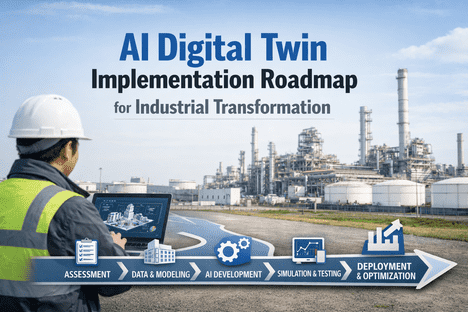
Implementation Roadmap: 24-36 Month Journey
Phased Transformation Approach
Phase 1: Foundation
Digitalize: Sensors, historians, connectivity. Baseline performance. Quick wins (DGA monitoring, vibration analysis). Investment: 30% of total budget.
Phase 2: Intelligence
AI Models: Predictive maintenance, efficiency optimization. Advisory mode (AI recommends, operators decide). Build trust. Investment: 35% of budget.
Phase 3: Optimization
Closed-loop: AI controls non-critical parameters. Heat rate, emissions optimization. Digital twins deployed. Scale across fleet. Investment: 25% of budget. Struggling with implementation planning? Our PMO team can help.
Phase 4: Transformation
Autonomous: AI-driven operations standard. Portfolio-wide optimization. Continuous improvement culture. Investment: 10% ongoing OPEX.
Proven Examples: Leading Indian Utilities
Real Transformation Results
NTPC (2016-2020)
₹1,200 Cr digital investment across 70+ plants. iROC command center managing 15 plants remotely. 250+ digital twin models.
Key insight: CEO-led transformation with burning platform (crisis motivation). Centralized expertise (iROC) scales knowledge across fleet—single metallurgist optimizes 15 blast furnaces remotely via digital twins.
Tata Power RE (2021-2024)
AI forecasting for 5.2 GW wind/solar portfolio. Real-time grid integration, battery optimization, DSM management.
Key insight: Portfolio-scale intelligence (50+ sites) delivers 5% better accuracy vs single-site forecasting. Proves renewables can be reliable grid resource through AI—participating in ancillary services markets (₹2-4 Cr/GW revenue).
Business Case: Investment vs Returns
Executive Financial Justification
Typical Investment
₹60-120Cr3-year transformation for 3,000-5,000 MW utility. ₹12-20 Cr/plant for sensors, AI platform, integration, training. Phased deployment spreads CAPEX.
Annual Value
₹200-400Cr2% availability gain + 15% O&M reduction + 2% efficiency improvement = ₹40-80 Cr per 500 MW plant × 5-10 plants = ₹200-400 Cr fleet-wide annually.
Strategic ROI
250-450%Year 1 ROI typical. Payback: 4-9 months. But real value: enables renewable integration (regulatory compliance), defers ₹1,000+ Cr replacement CAPEX, positions utility for competitive markets. Get custom ROI model.
Regulatory compliance: CEA mandates 88% availability, renewable integration targets. Competitive positioning: As markets open, efficient operators win. Talent retention: Engineers want modern tech—intelligent utilities attract best people. Risk mitigation: Cybersecurity, grid resilience increasingly critical. Digital transformation isn't optional—it's survival.
Intelligent Power Sector Roadmap Takeaways
- 277 GW demand by 2027 requires intelligent operations—can't build capacity fast enough, must optimize existing assets
- Three-stage evolution: Manual (60% of utilities) → Industry 4.0 (25%) → AI-driven (10%)—massive transformation opportunity
- Five pillars: Connectivity + Data + AI + Cybersecurity + Change Management—all required, technology alone insufficient
- 24-36 month journey: Digitalize (0-6mo) → Intelligence (6-12mo) → Optimization (12-24mo) → Transformation (24-36mo)
- Proven ROI: 250-450% typical (NTPC 775%, Tata Power ₹85 Cr annually)—business case compelling for executives
- CEO commitment essential: NTPC's Narendran personally championed—transformation fails without C-suite ownership
Ready to build your utility's intelligent power strategy?
Begin Your Intelligent Power Sector Transformation
Get custom digital maturity assessment and transformation roadmap based on proven utility methodologies.
See your optimal path from current state to AI-driven operations with phased investment and ROI timeline.