A missed corrective action entry. A CCP deviation logged three hours after it happened. A pre-operational sanitation sign-off buried in a binder nobody can find during an audit. These are not rare mistakes — FDA Form 483 observation data from 2024 through 2026 consistently shows HACCP documentation failures as the single most cited deficiency category in food manufacturing inspections. Most quality teams already understand critical control points, critical limits, and corrective actions perfectly well. The real problem is that paper and hybrid recordkeeping systems simply cannot keep pace with how fast a modern production line moves, and every gap that opens between what happened on the floor and what got written down becomes a liability the next time an auditor walks in.
Compliance Documentation That Keeps Pace With Your Production Line
FSMA Section 204 now requires 24-hour record production for foods on the Food Traceability List, and GFSI auditors under BRCGS, SQF, and FSSC 22000 are tightening evidence requirements for every CCP monitoring record. iFactory automates HACCP documentation, CCP monitoring, and corrective action tracking so your plant stays audit-ready every single day, not just during inspection week.
Why Paper-Based HACCP Systems Are Failing in 2026
Most cited FDA inspection deficiency: incomplete or inconsistent HACCP records
Window to produce traceability records under FSMA Section 204
Of QA team time consumed by manual documentation in conventional plants
Tolerance auditors now have for a static food safety plan that was never reanalyzed
From Deviation to Audit-Ready Record: The Automated Trail
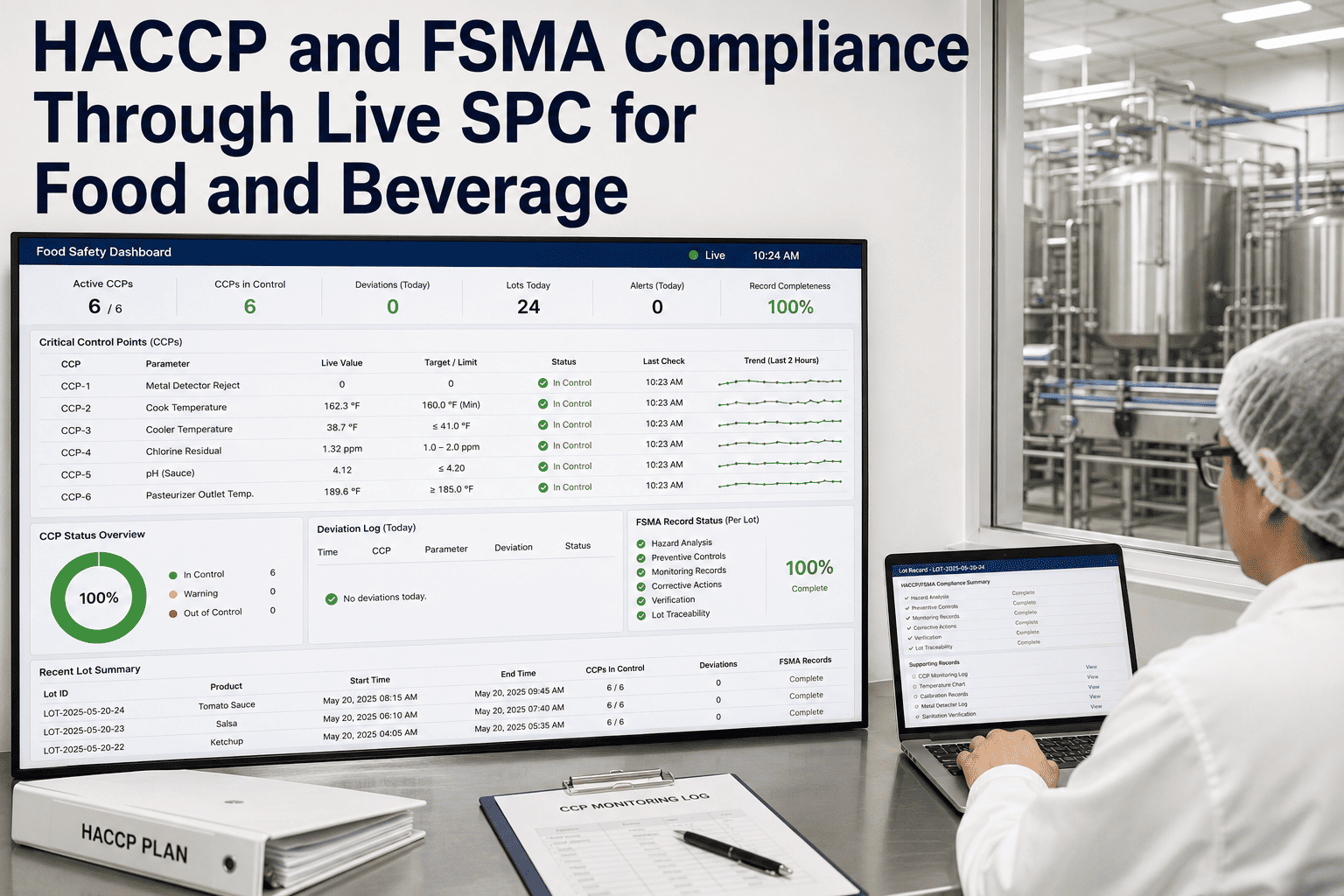
Every CCP event moves through the same automated sequence, so nothing depends on someone remembering to write it down later.
Live Sensor Capture
Temperature, pressure, pH, and water activity are read continuously at every defined critical control point, replacing manual spot checks with a constant stream of verified data.
Instant Deviation Alert
The moment a reading breaches a critical limit, the system flags it in real time and notifies the responsible operator before the product moves any further down the line.
Guided Corrective Action
A structured CAPA workflow captures root cause, immediate correction, and preventive action with a timestamp and the responsible party's name attached automatically.
Audit-Ready Record
Every entry assembles into a complete, timestamped record that can be produced in minutes, not the days it takes to search through binders and spreadsheets.
Paper Logs vs. Automated HACCP Documentation
| Documentation Task | Paper or Hybrid System | iFactory Automated System |
|---|---|---|
| CCP temperature logging | Manual rounds every 2-4 hours | Continuous automated capture |
| Deviation notification | Discovered on next round | Instant alert to shift supervisor |
| Corrective action record | Handwritten after the fact | Guided workflow, timestamped live |
| Audit record retrieval | Hours to days, manual search | Minutes, filtered by date or CCP |
| FSMA 204 traceability | Manual lot linking, error prone | Automatic KDE capture at every CTE |
See Your Own CCP Data Turn Into an Audit-Ready Report
Bring one of your current HACCP plans to the call and our food safety team will show exactly how it maps into automated monitoring and one-click documentation.
FSMA Section 204: The Traceability Layer Most Plants Underestimate
The Food Traceability Rule requires manufacturers producing foods on the FDA's Food Traceability List to capture Key Data Elements at every Critical Tracking Event across the supply chain. That means linking inbound ingredient lot codes to outbound product lot codes at the transformation event, something spreadsheets were never built to do reliably at production speed.
Receiving
Supplier lot codes, quantities, and receipt dates captured automatically at intake, not re-keyed later from a delivery slip.
Transformation
Inbound lots are linked to outbound product lots the moment a batch is created, closing the gap auditors look for first.
Shipping
Outbound KDEs assemble into a submission-ready record so a 24-hour FDA request never triggers a scramble.
What Plants See After Automating HACCP Documentation
- Audit prep time cut roughly 70% because records are already organized, timestamped, and searchable instead of scattered across binders and spreadsheets.
- Fewer non-conformance findings since deviations are caught and corrected in real time rather than discovered retrospectively during a review.
- QA teams shift from paperwork to process improvement, reviewing trend data and investigating near misses instead of chasing signatures.
- A defensible record for every recall scenario, with lot-level traceability that can be produced well inside the 24-hour FSMA 204 window.
Frequently Asked Questions
Does automated HACCP documentation replace our existing food safety plan?
No, it doesn't replace the plan itself, it strengthens how the plan gets executed and proven day to day. Your HACCP plan still defines the hazards, critical control points, and critical limits your team identified. What changes is how monitoring, deviation handling, and corrective action get captured, moving from manual entry to continuous automated recording. Most plants keep their existing plan structure and simply digitize the monitoring and documentation layer around it. You can review the full approach or reach our support team with specific questions about your current plan.
How does this help specifically with FSMA Section 204 traceability?
Section 204 requires capturing Key Data Elements at every Critical Tracking Event for foods on the Food Traceability List, and producing those records within 24 hours of a request. Manual systems struggle here because linking inbound lots to outbound lots at the transformation step is easy to get wrong under production pressure. Automated capture ties receiving, transformation, and shipping data together as it happens, so the record is already assembled rather than reconstructed under deadline pressure. You can see this mapped against your own product list on a call, which you can arrange through this booking link.
What happens when a CCP deviation is detected?
The system flags the breach the moment it happens and routes an alert to the responsible operator or shift supervisor immediately, rather than waiting for the next manual round. From there, a guided corrective action workflow walks the team through root cause identification, the immediate correction applied, and the preventive action taken, with every step timestamped automatically. This is the exact sequence auditors expect to see, and it removes the gap between what happened on the floor and what eventually gets written down.
Can this integrate with our current SQF, BRCGS, or FSSC 22000 program?
Yes, the documentation structure is built around the evidence categories GFSI-benchmarked schemes already require, including CCP monitoring records, corrective action logs, verification activities, and supplier documentation. Rather than forcing a new framework onto your program, it organizes the records your current scheme already demands so they are complete and retrievable on demand. Facilities running any of these three schemes typically see the fastest transition since the evidence categories map closely to existing audit checklists.
How long does it take to get a plant fully documented and audit-ready?
Most facilities see CCP monitoring and corrective action tracking active within the first few weeks, since sensor integration and workflow configuration are the main setup tasks and neither requires stopping production. Full audit-readiness, meaning historical trend data, verification records, and traceability documentation all populated, typically builds out over the following month as data accumulates. The fastest way to get a specific timeline for your plant's equipment and product mix is to get in touch with our team directly.
Stop Preparing For Audits. Stay Ready For Them.
Schedule a walkthrough with our food safety team and see your own CCP data turned into a complete, audit-ready record in real time.