Every food safety manager knows the inspection nightmare, because it actually happened to someone: 23 hours reconstructing a quarter of monitoring records across three binders and two clipboards, seven entries illegible, four missing, two logged at 3:47 a.m. on a Sunday the plant was closed — a Form 483, an OAI on the public record, and a $47,000 corrective action. The FDA\'s own pattern is just as blunt: roughly 75% of Form 483 observations in food facilities cite documentation of preventive controls and corrective actions, and the average recall runs $10 million. iFactory\'s CCP monitoring on live SPC ends the binder era: critical control points charted continuously, deviations alerted in seconds with the lot held, and the HACCP and FSMA evidence pack built automatically, per lot, as production runs.
iFactory Food & Beverage CCP Monitoring
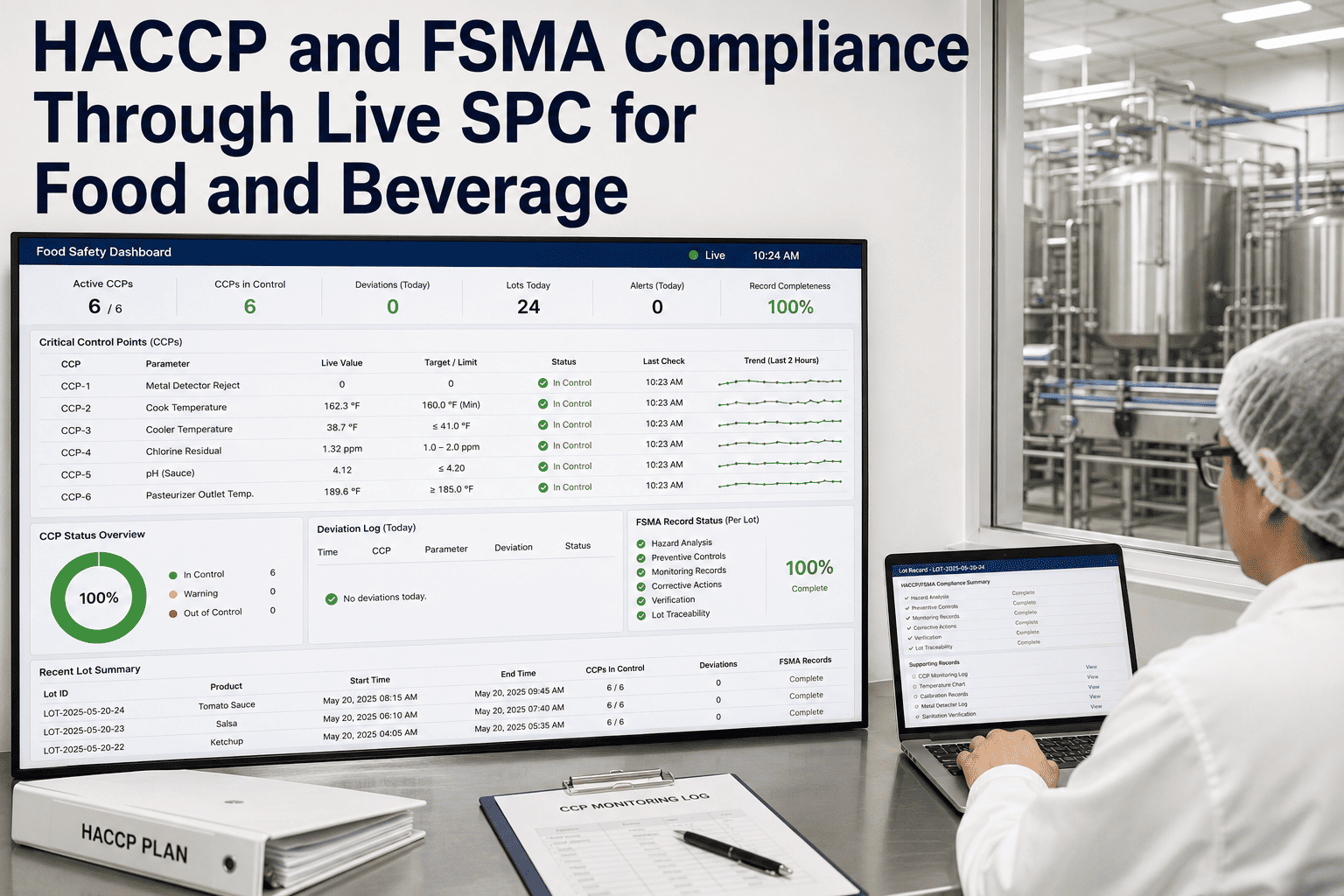
HACCP and FSMA Compliance, Built Per Lot by Live SPC
Every CCP monitored continuously against its critical limits, every deviation alerted in seconds with containment attached, and every lot\'s monitoring, corrective-action, and verification records assembled automatically — inspection-ready, electronically.
75%
of food-facility 483s cite documentation gaps
$10M
average cost of a food recall
Seconds
from CCP deviation to alert and hold
Per lot
evidence pack auto-built, 2-year retention
The Plan Is Fine. The Paper Is the Violation.
Most facilities that receive a 483 had working preventive controls — the monitoring happened, the cook hit temperature, the corrections were made. What failed was the record. FDA\'s most-cited FSMA violation is exactly this: CCP monitoring records with gaps, missing signatures, or retroactive entries. And investigators treat an undocumented corrective action as one that never happened.
Gaps & Missing Signatures
The single most-cited FSMA violation — a clipboard round skipped on a busy shift becomes a federal observation a year later.
Retroactive Entries
Records filled in after the fact carry impossible timestamps — the 3:47 a.m. Sunday entry that destroys credibility for the whole log.
Pencil-Whipped Uniformity
Identical readings across shifts raise immediate investigator suspicion and routinely trigger broader records requests.
Undocumented Corrections
The operator fixed it, the product was diverted, the deviation was handled — and without a record, none of it legally occurred.
Every HACCP Principle, Running Live
Live SPC doesn\'t change your HACCP plan — it executes it continuously. Each CCP\'s critical limits become control limits on a live chart fed by your sensors, and the monitor-alert-correct-verify-record loop runs in seconds instead of clipboard rounds.
1
Monitor
Cook temps, metal detection, pH, seal integrity — every CCP charted continuously from instruments, not sampled by rounds.
2
Alert
A critical-limit breach — or a trend heading toward one — alerts the floor and food safety in seconds, with the CCP and lot named.
3
Correct
The affected lot is held automatically; the corrective-action workflow opens with disposition options and required sign-offs.
4
Verify
Calibrations, record reviews, and PCQI verification tasks are scheduled, tracked, and tied to the records they verify.
5
Record
Every reading, alert, action, and signature lands in the lot\'s evidence pack the moment it happens — nothing reconstructed, ever.
Which CCP would fail the records test today? Book a demo and run your HACCP plan on live SPC.
The Lot Evidence Pack: What the Inspector Sees
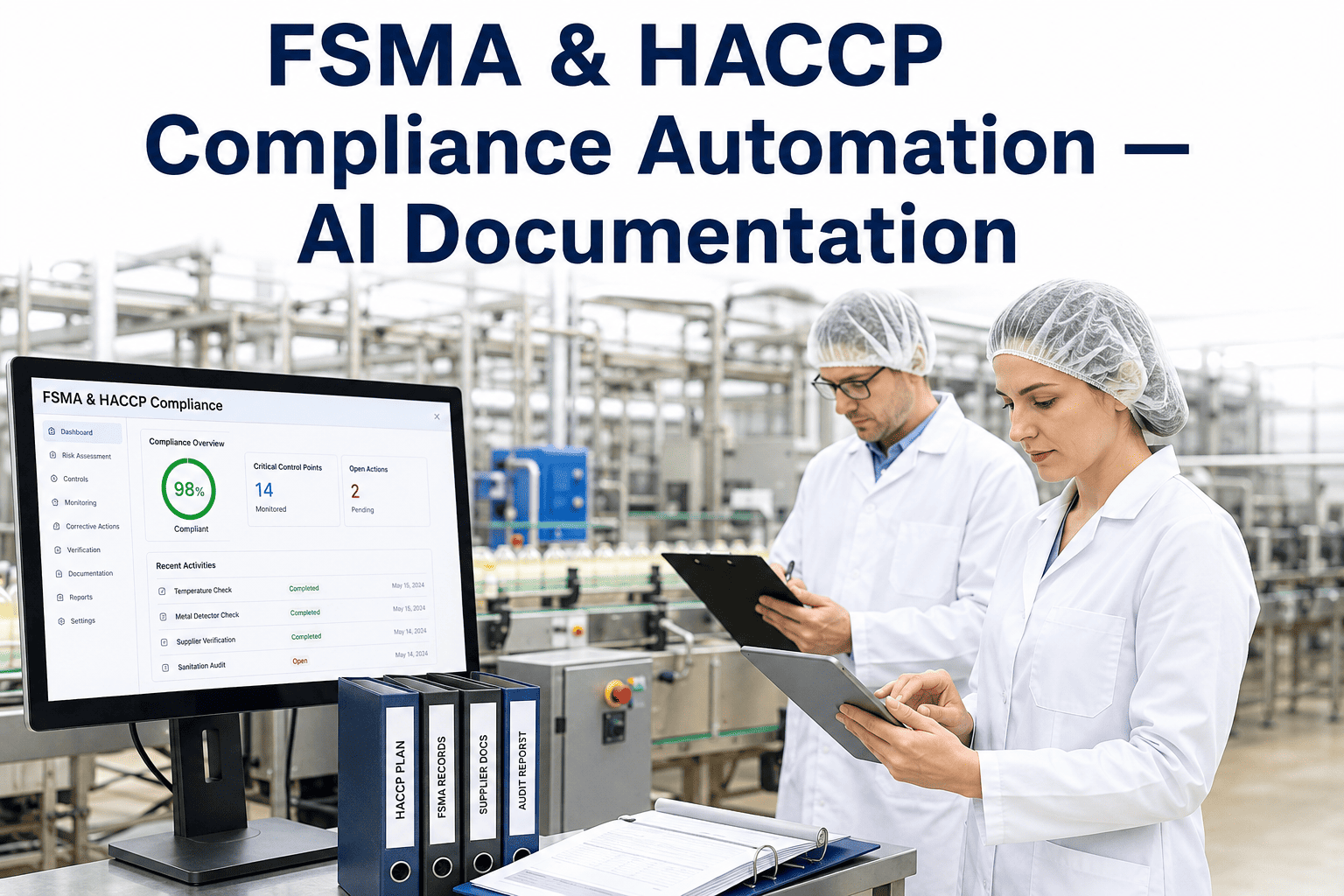
This is what "auto-built per lot" means — every CCP\'s monitoring trail, deviations, corrective actions, and verifications assembled under the lot number as it runs. When the inspector asks for electronic access, this is the answer, in seconds.
FSMA Evidence Pack — Lot 24-1187 · Chicken Soup RTE
Complete · Released
CCP 1 · Cook Temperature
Limit: 74°C min, 15 sec
2,140 readings · all conforming
CCP 2 · Metal Detection
Limit: reject on detect, verified hourly
1 deviation · CA-0412 closed, 38 units diverted, QA signed 14:22
CCP 3 · Cooling Rate
Limit: 54°C to 21°C within 2 hr
Continuous trace · conforming · Cpk 1.62
Verification
Calibrations current · record review done
PCQI review signed · 21 CFR 117 retention active
Built Against the Rules You\'re Audited On
The platform\'s record model follows the regulation, not the other way around — so what auto-builds is what 21 CFR Part 117 and your HACCP plan actually require.
21 CFR Part 117 Records
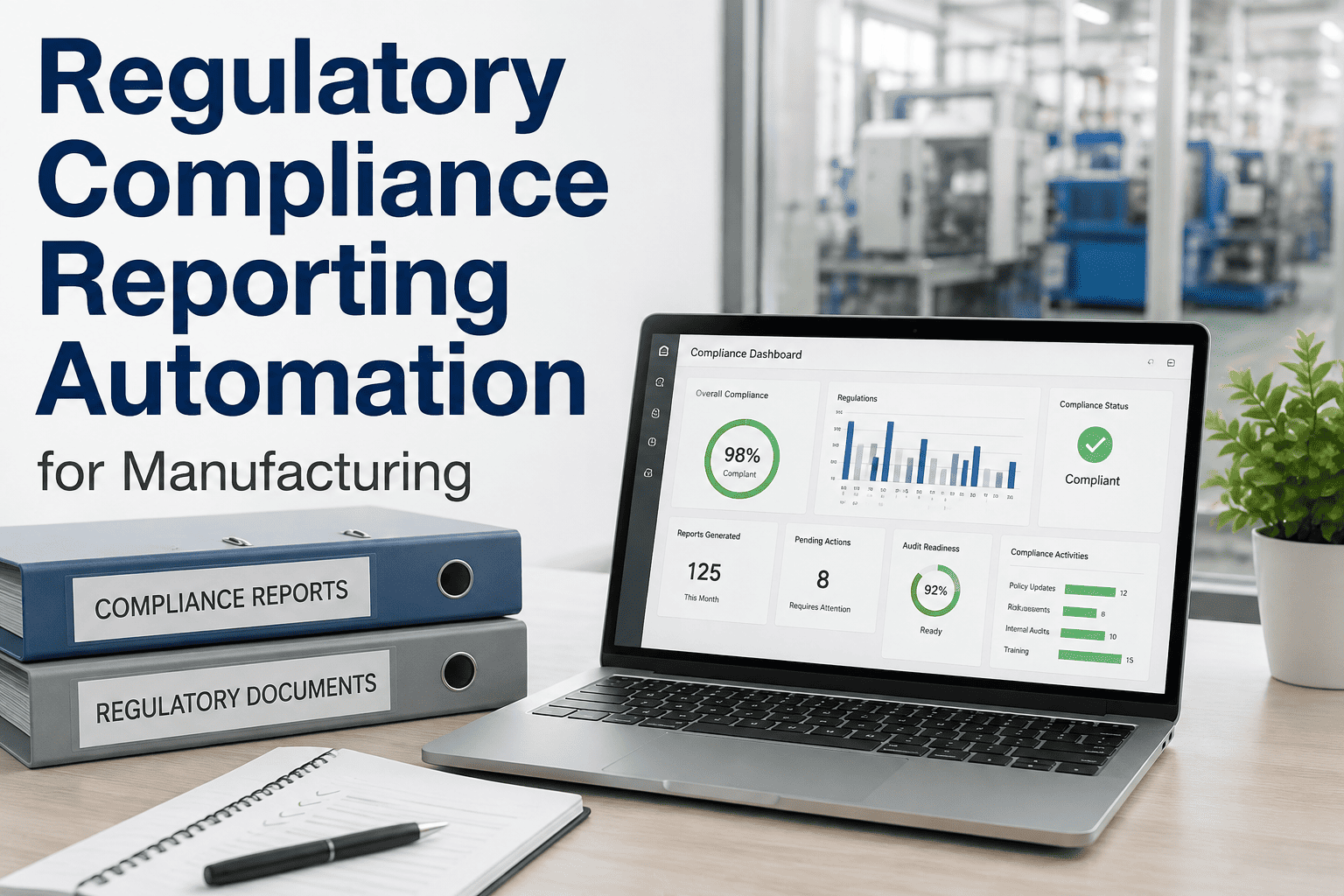
Monitoring, corrective action, and verification records with real timestamps and e-signatures, retained for the required two years and exportable on demand.
FSMA 204 Traceability
Lot-level genealogy from ingredient receipt to shipped consignee — the enhanced traceability rule\'s data captured as a by-product of production.
PCQI Workflow Support
Verification schedules, record reviews, and reanalysis triggers on process changes — the plan\'s living obligations tracked, not remembered.
Electronic Inspection Access
FDA increasingly requests electronic records during inspections — facilities on binders face longer inspections and more 483s. You\'ll be the short visit.
How long would a full quarter of CCP records take you to produce right now? Talk to our food safety team and make the answer "seconds."
Deviations: Seconds to Alert, One Workflow to Closure
A CCP deviation is a race — against the product moving downstream and against the documentation decaying. Live SPC wins both: the lot holds itself, and the record writes itself while the correction happens.
Instant Lot Hold
The breach triggers an automatic hold on affected production, bounded by timestamps — containment sized by data, not by fear.
Guided Corrective Action
Disposition, root cause, and preventive measures captured in a structured workflow with mandatory sign-offs — no step skippable, no step forgettable.
Trend Alerts Before Breach
SPC run rules flag a cook temperature drifting toward its critical limit while it\'s still conforming — the deviation that never happens needs no CA.
Maintenance Linked
An equipment-caused deviation raises a work order automatically — the burner, detector, or chiller fixed before the next lot, with the link recorded.
What Food Safety Gets Back
Moving CCPs onto live SPC converts directly into deviations caught in seconds, inspections that end early, and a recall plan that can actually demonstrate lot-level traceability on demand.
Zero
Reconstructed records
the most-cited FSMA violation becomes structurally impossible
Seconds
Deviation to hold
alert, containment, and the open CA before product moves on
Minutes
Mock recall time
lot genealogy answers FSMA 204 traceability in one query
Shorter
FDA inspections
electronic records access turns the records request into a non-event
What did your last audit prep cost in hours and overtime? Talk to our food safety team and retire the binders.
Frequently Asked Questions
Does this replace our HACCP plan or food safety plan?
No — it executes it. Your hazard analysis, CCPs, critical limits, and corrective-action procedures stay exactly as your PCQI wrote them; the platform turns them into live monitoring, automatic alerts, guided workflows, and auto-built records. When the plan changes, the configuration changes with it, and the reanalysis is documented.
What exactly is in the per-lot evidence pack?
Every CCP\'s monitoring trail for the lot — continuous readings or checks against critical limits — plus any deviations with their full corrective-action records and sign-offs, verification activities like calibrations and record reviews, and lot genealogy from ingredient lots to shipped consignees. It assembles as the lot runs and is retained per 21 CFR Part 117 requirements.
How does live SPC go beyond simple limit alarms on CCPs?
Critical limits are the floor; SPC adds the early warning above it. Run rules and capability tracking flag a cooker drifting toward its limit or a cooling profile losing margin while everything is still technically conforming — so the team intervenes before a deviation exists, which is the cheapest corrective action there is.
Can it handle manual checks as well as instrumented CCPs?
Yes. Instrumented CCPs stream automatically; operator checks — metal detector challenges, seal inspections, visual checks — are captured digitally at the line with real timestamps and signatures, scheduled and escalated if missed. No clipboard, no retroactive entry, no 3:47 a.m. Sunday.
What does deployment involve, and where do our records live?
The platform runs on a pre-configured edge server on-premise, inside your firewall, reading your sensors, detectors, and line systems inbound-only with no external egress — your records stay in the plant under your retention control. The fastest way to evaluate fit is a demo against your own HACCP plan; bring it, plus last quarter\'s deviation log.
Monitor Live. Hold in Seconds. Audit in Minutes.
Put Your CCPs on Live SPC
Bring your HACCP plan and last quarter\'s deviation log. We\'ll wire your CCPs to live charts, trigger a deviation end to end — alert, hold, corrective action, signature — and pull the finished lot evidence pack the way an FDA inspector would. On-prem, inside your firewall.
Live CCPs
charted continuously
Seconds
deviation to hold
Per lot
evidence auto-built
On-prem
inside your firewall