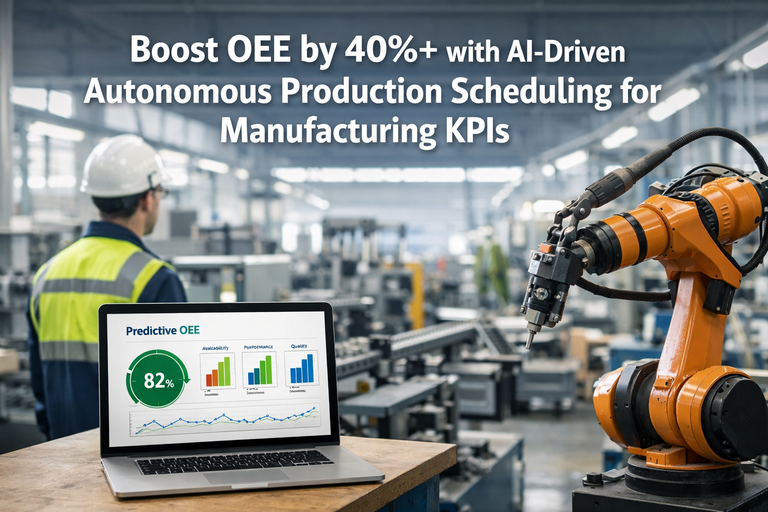
The average factory operates at 60% OEE — losing nearly half its production capacity every single shift without realizing it. That's not a machine problem. It's a scheduling problem. Traditional production scheduling relies on static plans, tribal knowledge, and spreadsheets that can't adapt when a machine goes down, a material runs late, or demand shifts mid-week. AI-driven autonomous scheduling changes the equation: it evaluates millions of scenarios in seconds, adjusts in real-time, and simultaneously optimizes the three pillars of OEE — Availability, Performance, and Quality. iFactory customers see 35% OEE improvement, 45% downtime reduction, and 200%+ ROI within the first year. This guide shows exactly how autonomous scheduling works, the 6 losses it eliminates, and the 3-phase roadmap to measurable OEE gains. Book a free OEE assessment to benchmark your plant.
AI-Native Digital Transformation for Smart Manufacturing
Join iFactory's expert-led session covering predictive OEE, autonomous scheduling, real-time production intelligence, and the 90-day pilot methodology — with live architecture review and open Q&A for your specific plant challenges.
Register Now — Free Session →OEE Deconstructed: The 3 Pillars AI Optimizes Simultaneously
OEE isn't one metric — it's three independent metrics multiplied together. That multiplication is why small improvements in each pillar compound into massive gains. Traditional scheduling optimizes one pillar at a time. AI optimizes all three simultaneously — in real time.
The 6 Hidden OEE Losses — and How AI Eliminates Each One
Every factory loses capacity to six specific categories of waste. Traditional scheduling addresses maybe two. AI-driven autonomous scheduling attacks all six simultaneously — because it sees the interdependencies that human planners can't.
Unplanned Downtime (Availability Loss)
Equipment breakdowns are the biggest OEE killer. The average factory loses 5–20% of scheduled time to unplanned stops. Predictive maintenance with AI reduces equipment downtime by 35–55% — catching failures 2–4 weeks before they happen by analyzing vibration, temperature, and acoustic patterns.
Changeover & Setup Time (Availability Loss)
Frequent product changeovers are one of the largest sources of planned downtime. Traditional scheduling sequences products by order date — not by setup similarity. AI sequences production to minimize changeover time by grouping similar products back-to-back and pre-staging tooling automatically.
Micro-Stops & Small Stoppages (Performance Loss)
Brief stops of 1–5 minutes don't trigger alarms but accumulate into hours of lost capacity per shift. They're invisible on paper but devastating in aggregate. AI detects micro-stop patterns in real time — correlating them with upstream conditions, material batches, or operator actions that human planners never connect.
Reduced Speed & Slow Cycles (Performance Loss)
Machines running below rated speed — often because operators reduce speed to "play it safe" after a quality issue. AI optimizes equipment performance within safe operating limits, finding the maximum sustainable speed for each product-machine combination based on historical performance data.
Startup Rejects & Scrap (Quality Loss)
Products produced during startup, warm-up, or after changeover that don't meet spec. AI learns the exact warm-up profile for each machine-product combination and automatically adjusts startup parameters to reach spec faster — reducing startup scrap by up to 50%.
In-Production Defects & Rework (Quality Loss)
Defects produced during stable production — often caused by material variation, tool wear, or environmental drift. AI identifies deviations across all four Ms (Man, Machine, Material, Method) and corrects parameters before defects are created — not after.
How Autonomous Scheduling Actually Works
Traditional scheduling is a plan. Autonomous scheduling is a living system. It continuously recalculates the optimal production sequence based on real-time conditions — machine health, material availability, order priorities, energy costs, and workforce capacity — every few minutes.
Real-Time Data From Every Machine and System
iFactory's Unified Namespace streams live data from every PLC, sensor, MES, and ERP system into one event-driven bus. The scheduling AI sees machine health, current output rates, quality trends, material levels, and order status — all in real time.
AI Evaluates Millions of Scenarios in Seconds
The scheduling agent evaluates every possible production sequence — weighing changeover time, machine capability, operator skill, energy cost, and delivery deadlines. It selects the schedule that maximizes OEE across all lines simultaneously, not just one at a time.
Continuous Re-Optimization When Conditions Change
When a machine flags a maintenance need, a material shipment is delayed, or a rush order arrives — the AI reschedules automatically within minutes. No manual replanning. No phone calls to the floor. The schedule adapts as fast as reality changes.
What the Experts and Data Say
AI can help manufacturers improve efficiency, sometimes exceeding traditional OEE targets by 50% or more — by transforming OEE from a lagging indicator into a real-time operational compass.
Predictive maintenance can reduce equipment downtime by 35–55% and boost OEE by 5–15%. Companies implementing AI-driven strategies see average ROI of 10:1 within two years.
Organizations leveraging Agentic AI report up to a 25% increase in operational efficiency and cost savings of up to 30% through waste reduction and output optimization.
The math is simple: a factory running at 60% OEE that improves to 85% has unlocked 41% more production capacity from the same equipment. That's the output of an entire new production line — without buying a single machine. iFactory's AI-driven scheduling, predictive maintenance, and real-time quality control are the fastest path to that 25-point OEE gain.
Unlock 40%+ Hidden Capacity From Your Existing Equipment
iFactory delivers 35% OEE improvement, 45% downtime reduction, and 200%+ ROI in the first year — with measurable results within 60 days.
Frequently Asked Questions
A Factory at 60% OEE Is Wasting 40% of Its Capacity Every Shift
iFactory's AI-driven scheduling, predictive maintenance, and real-time quality control unlock that hidden capacity — 35% OEE improvement in 3–6 months, 200%+ first-year ROI.
.jpeg)
