Solvent-based painting is one of your plant's largest sources of volatile organic compounds (VOCs) and hazardous air pollutants (HAPs). A busy coating line runs a continuous solvent load through the booth, and every gram that escapes uncaptured — or slips through the oxidizer undestroyed — counts against your air permit. Controlling paint shop VOC emissions requires a carefully tuned capture and destruction train, from the booth through the rotor concentrator to the regenerative thermal oxidizer (RTO). The gap between passing an EPA inspection and tripping a Title V violation often comes down to a few percentage points of destruction efficiency — and a switching valve you never saw leak. You only stay compliant if you monitor that train continuously and in real time, not in a quarterly report written after the damage is done. This guide walks the full control chain, the numbers that actually decide compliance, and the parameters you must watch to catch a silent failure before it becomes a violation. Explore live emissions monitoring
Paint Shop VOC Emissions & RTO Control Metrics
The Emission Control Chain
The emission-control train is a sequential process. You must capture the solvent-laden air before you can concentrate and destroy it. A failure at any stage compromises the entire system.
(Capture)
(Concentrate)
(Thermal Destruction)
(Release)
Why Paint Shops Are a VOC Problem
VOCs come from the solvents in paints, coatings, and thinners. When these solvents evaporate during application and curing, they release VOCs into the air. HAPs, or hazardous air pollutants, are a regulated subset of VOCs—like toluene, xylene, and methyl ethyl ketone—that pose specific health risks. Because of the sheer volume of solvents used, automotive and industrial coating plants are typically a major-source category for these emissions.
Under the U.S. Clean Air Act, the EPA regulates these emissions strictly. Your facility likely operates under a Title V air permit, which requires rigorous monitoring and recordkeeping. MACT (Maximum Achievable Control Technology) and NESHAP surface-coating standards set specific emission limits based on facility type and coating usage. These standards dictate not just what you emit, but how you monitor and document it. Failing to meet these limits triggers heavy fines, mandated corrective actions, and potential operational constraints. You cannot manage what you do not measure continuously.
How an RTO Destroys VOCs
The emission-control train has three main stages. First, capture. Enclosed paint booths and curing ovens capture the solvent-laden air. However, capture efficiency is never 100%; some fugitive emissions always escape through doors, conveyor openings, or general ventilation.
Second, concentrate. A large volume of dilute airflow moves through a zeolite rotor concentrator. This wheel adsorbs the VOCs and then desorbs them into a much smaller, richer stream of air. This concentration step allows the oxidizer to be significantly smaller and more fuel-efficient than if it processed the full booth exhaust.
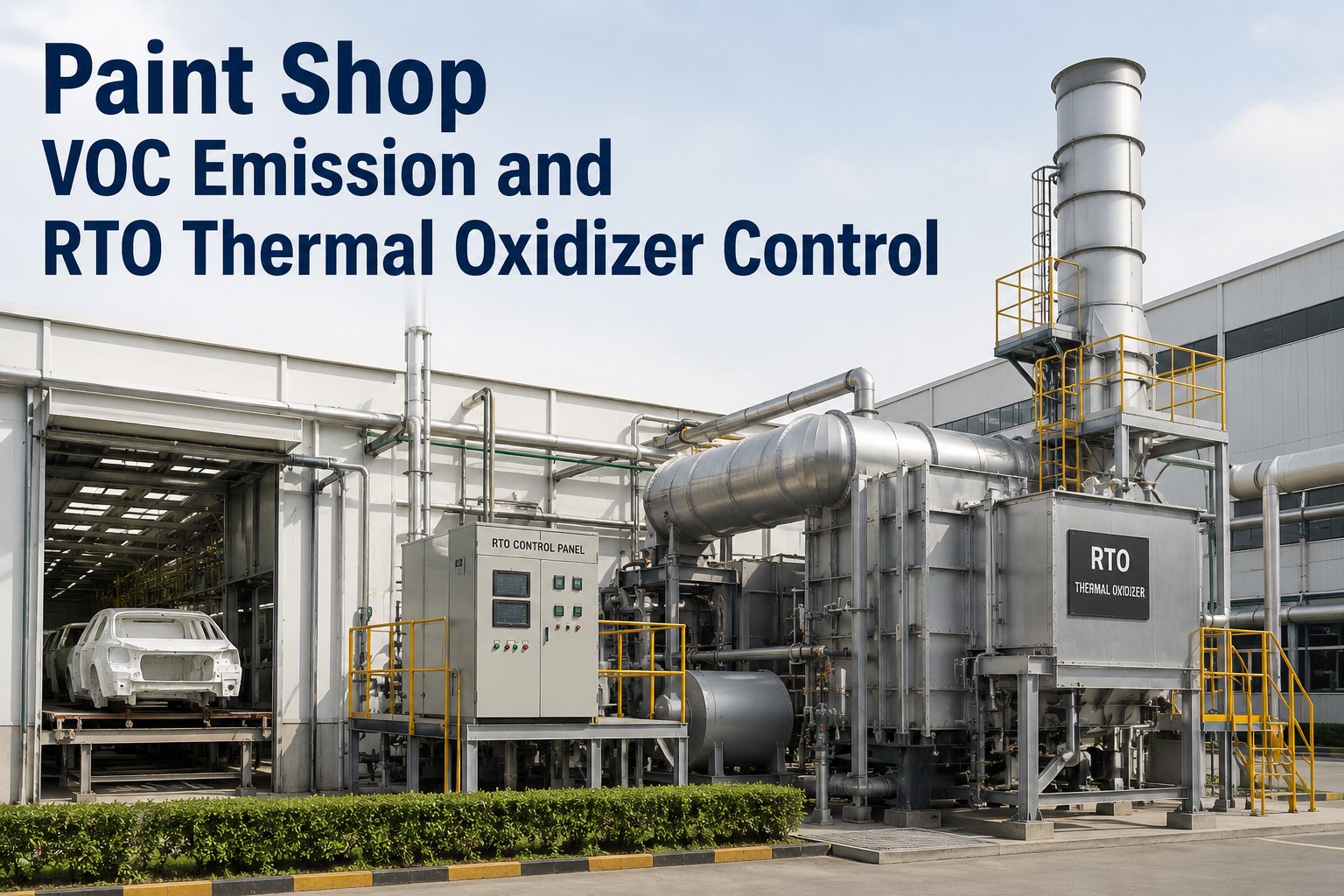
Third, destroy. The RTO takes that concentrated stream and oxidizes the VOCs in a combustion chamber at roughly 1,500°F (~815°C). At this temperature, the hydrocarbon chains break down into carbon dioxide and water vapor. Ceramic media beds recover the heat from the cleaned exhaust before it leaves the stack. This thermal energy recovery often reaches ~95%, meaning most of the heat generated by burning the VOCs is captured and reused to preheat the incoming stream. Flow switches between the ceramic beds via poppet or switching valves to maximize heat recovery.
The Number That Matters: Destruction Efficiency
Destruction Removal Efficiency (DRE) is the fraction of VOC destroyed by the RTO, typically 95–99%+. However, DRE alone does not equal compliance. OVERALL VOC removal equals your capture efficiency multiplied by your destruction efficiency. If your booth captures 90% of the solvents, and your RTO destroys 98% of what it receives, your overall removal is only 88.2%. Both numbers must stay high.
Combustion chamber temperature is the operational surrogate many permits use. The logic is simple: hold the minimum required temperature (e.g., ~1,500°F) and DRE is assured. If you run the RTO cooler to save fuel, DRE drops. But temperature is not the only failure mode. RTO valve seat leakage is a real and common problem. Leaking switching-valve seats let unoxidized VOC-laden air bypass the ceramic beds entirely, bleeding straight to the stack. This quietly cuts your actual DRE even while the combustion temperature looks perfectly fine. You must monitor valve integrity to catch this silent failure.
Parameters You Must Monitor
You must track a combination of operational, safety, and compliance parameters. Relying on a single data point hides systemic failures. A robust monitoring system captures the full picture.
| Parameter | What it reveals | Why it matters |
|---|---|---|
| Inlet/Outlet VOC ppm | VOC load and removal rate | Confirms destruction is actually happening |
| Combustion Chamber Temp | Oxidation conditions | Primary permit surrogate for DRE |
| DRE (Destruction Efficiency) | Actual VOC destruction | Proves compliance performance |
| Capture Efficiency | Solvent captured vs. escaped | Determines overall removal rate |
| Valve Seat Leakage | Bypass leakage rate | Catches silent DRE failures |
| Heat Recovery Efficiency | Energy/fuel usage | Tracks RTO health and operating cost |
| LEL % | Explosion safety limit | Keeps inlet safely below lower explosive limit |
| Pressure Drop | Airflow restriction | Indicates blockages or media degradation |
Staying Compliant: Monitoring & EPA Reporting
Continuous temperature monitoring acts as your primary permit surrogate, but it is not enough for a robust defense. You need rigorous recordkeeping, periodic performance tests, and accurate Title V reporting. Environmental auditors look for complete, unbroken data trails. Manual logbooks and delayed data entry fail audits. The EPA requires Continuous Monitoring Systems (CMS) for key parameters, and the data availability must be high—often 95% or greater.
iFactory operates as your industrial-AI platform for this exact challenge. It monitors RTO temperature, VOC ppm, destruction efficiency, and valve performance in real time. It flags valve-seat leakage and capture loss before they trigger a permit violation. Furthermore, iFactory automates air-permit recordkeeping and report generation, ensuring your MACT and Title V submissions are accurate, auditable, and on time.
Book an Emissions Monitoring Demo
See how iFactory tracks RTO temperature, VOC ppm, and valve integrity in real time to keep you compliant.
"An RTO can hit 99% destruction on paper, but a leaking valve seat quietly bleeds unoxidized VOCs straight to the stack. You monitor temperature to prove compliance, but you monitor valves to ensure it."
Common VOC & RTO Monitoring Pitfalls
- Watching only combustion temperature and missing valve-seat leakage. A hot chamber does not guarantee destruction if the valves leak. You must track valve position and seat integrity.
- Ignoring capture-efficiency losses at the booth. If the booth fails to capture solvents, the RTO cannot destroy them. Monitor enclosure pressures and airflow.
- Running the RTO cool to save fuel and dropping DRE. Fuel savings mean nothing if they trigger a costly air-permit violation. Maintain the permit-specified minimum temperature.
- Manual or late recordkeeping that fails an audit. Paper logs get lost, and manual entry creates gaps that regulators penalize. Automate your data collection.
- No real-time alerting so a violation is found after the fact. By the time the quarterly report is due, the damage is done. You need alerts the moment a parameter drifts.
The Bottom Line
Your paint shop VOC emissions depend on a healthy, integrated control train. You must monitor capture, concentration, and destruction together. Relying on combustion temperature alone hides valve leaks and capture losses. Continuous, automated monitoring of the entire train keeps you compliant, efficient, and ready for any EPA inspection.
Ready to Modernize Your Air-Permit Compliance?
Stop relying on manual logs and isolated data silos. Let iFactory unify your RTO monitoring and reporting.
Frequently Asked Questions
What is a paint shop VOC emission?
A paint shop VOC emission occurs when volatile organic compounds evaporate from solvents in paints, coatings, and thinners during the application and curing process. These emissions are heavily regulated under the Clean Air Act because they contribute to smog formation and can contain hazardous air pollutants.
What is an RTO (regenerative thermal oxidizer)?
An RTO is an industrial air-pollution-control device that destroys VOCs by oxidizing them in a high-temperature combustion chamber (roughly 1,500°F). It uses ceramic media beds to capture and recover heat from the exhaust, making it highly fuel-efficient compared to other oxidizers.
What is VOC destruction efficiency?
VOC destruction efficiency (DRE) is the percentage of volatile organic compounds that the RTO successfully destroys, typically 95–99%+. It is a critical metric for air-permit compliance. However, overall removal depends on DRE multiplied by the booth's capture efficiency.
What is the difference between a VOC and a HAP?
A VOC (volatile organic compound) is any organic chemical that easily vaporizes at room temperature. A HAP (hazardous air pollutant) is a specific subset of VOCs that the EPA has identified as causing serious health and environmental effects, such as toluene or xylene.
How does iFactory help monitor paint shop VOC and RTO compliance?
iFactory provides real-time industrial-AI monitoring of your RTO temperature, VOC ppm, destruction efficiency, and valve performance. It flags issues like valve-seat leakage early and automates Title V and MACT recordkeeping. Book a demo to see how it works.