A thermography contractor walks your plant once a quarter, points an infrared camera at your critical assets for about two hours, and leaves. Out of roughly 2,190 operating hours in that quarter, the equipment was actually watched for two — a coverage rate of 0.09%. It is no surprise that periodic surveys catch only 10 to 15% of developing thermal faults; the other 85 to 90% grow and fail in the gap between visits. A motor bearing that runs 20 to 50°C above normal for weeks before it seizes shows nothing on a snapshot taken at the wrong moment. AI thermal vision closes that gap — watching motors, bearings, panels, and equipment continuously, flagging the hotspot the day it appears, and turning it into a work order before failure.
iFactory Predictive Maintenance Vision
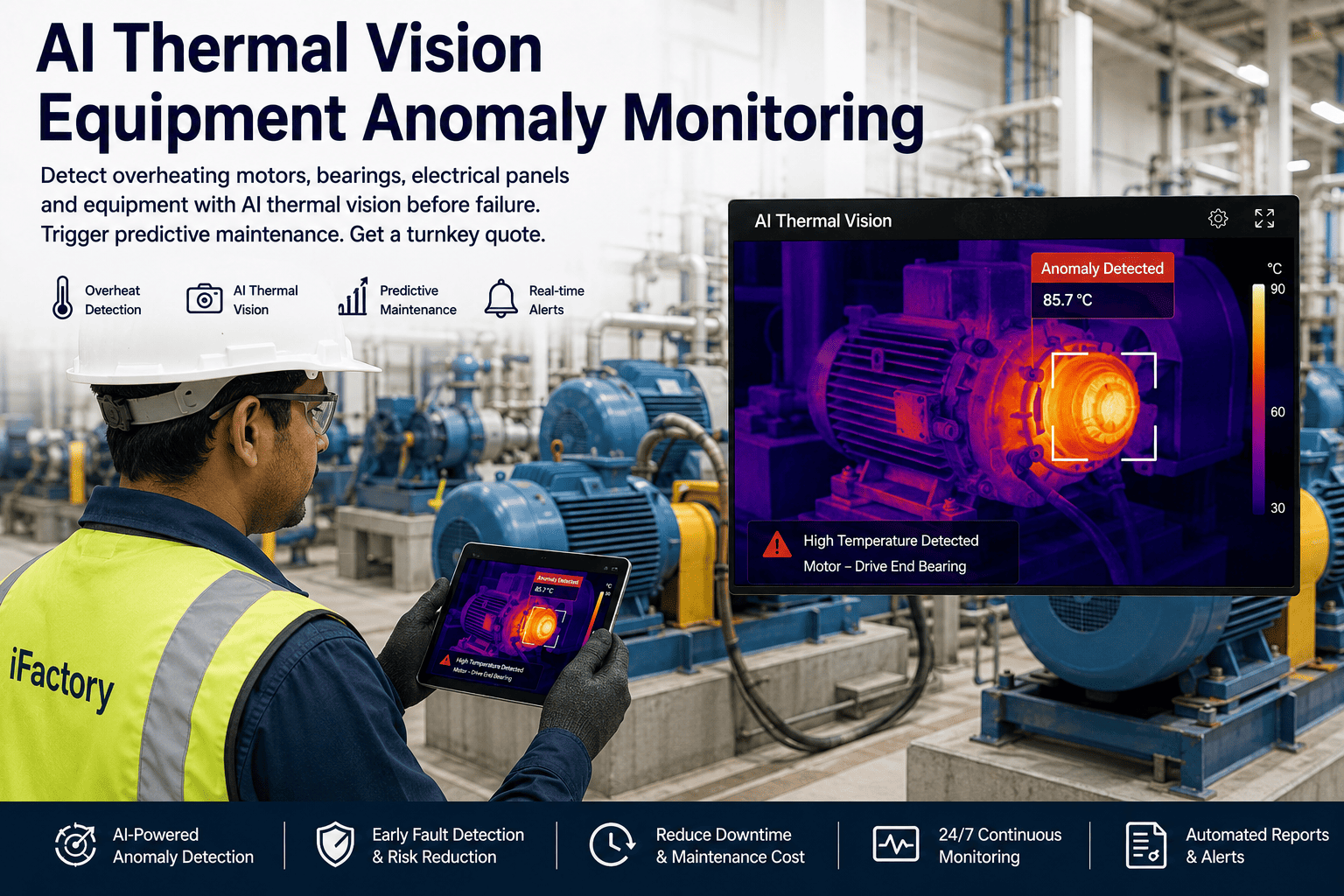
AI Thermal Vision for Equipment Anomalies
Detect overheating motors, bearings, electrical panels and equipment with always-on AI thermal vision — catch the hotspot weeks before failure and trigger predictive maintenance automatically.
0.09%
coverage from quarterly surveys
85-90%
of electrical faults caught early
30-90
days of failure warning
<50ms
edge inference, on-prem
The Periodic Survey Blind Spot
The problem with quarterly thermography is not the camera — it is the calendar. A fault that develops the week after a survey has three months to grow before anyone looks again. Continuous monitoring is not a marginal improvement on periodic inspection; it is a different category of coverage entirely.
Periodic IR survey
A Snapshot Every Quarter
Roughly 2 hours of coverage per quarter
Catches only 10 to 15% of developing faults
Misses anything that starts between visits
Depends on a contractor being there at the right moment
iFactory continuous thermal AI
Always-On Surveillance
24/7 monitoring of every watched asset
Detects 70% more failures in advance
Flags the anomaly the day it appears
No contractor, no scheduling, no gap
Every Asset Has a Thermal Signature
Heat is the universal early symptom of failure. Long before a part breaks, it runs hot in a pattern the eye cannot see — and each asset class has its own telltale signature that AI learns to recognize against baseline.
Motors
Shorted windings, bearing breakdown, and cooling failures show a 20 to 50°C rise on the housing weeks before seizure.
Bearings
Asymmetric thermal patterns on housings and couplings reveal misalignment and wear before vibration even registers it.
Electrical Panels
Loose connections and overloaded terminations create resistance hotspots 15 to 30°C above ambient ahead of failure.
Switchgear
Breaker connections, bus bars, and feeder terminations monitored for the heat that precedes an arc or trip.
Transformers
Winding and core hotspots visible through enclosures flag insulation degradation before a $50K-plus catastrophic failure.
VFDs & Drives
Cooling-fan failure and dust on heat sinks create thermal runaway conditions detectable two to four weeks early.
Why Thermal Sees It First
Thermal is often the earliest signal a machine gives. Many faults produce a heat signature at a stage where vibration analysis has not yet generated an actionable warning — so a thermal eye buys lead time that other condition-monitoring methods cannot.
Earlier Than Vibration
Thermal signatures correlate with internal fault development at stages where vibration analysis is still silent.
Sees the Invisible
Infrared turns temperature differentials the eye cannot perceive into heat maps that expose developing faults.
Non-Contact
Monitoring is fully non-intrusive, reading energized and moving equipment safely without touching it.
Through Enclosures
Heat from sealed panels and transformer cases shows on the surface, revealing faults hidden inside the housing.
Want to see thermal anomaly detection on your own critical assets? Get a turnkey quote and we'll scope a monitoring plan for your plant.
From Hotspot to Work Order in 60 Seconds
Detection only matters if it drives action. iFactory closes the data-to-action gap: the AI sees the anomaly, classifies its severity, and generates a maintenance work order automatically — no manual logging, no finding that gets noted and forgotten.
1
Detect the Hotspot
Continuous thermal vision spots a deviation from the asset's baseline temperature profile the moment it emerges.
2
Classify Severity
The AI rates how serious and how urgent the anomaly is, so attention goes to what matters most first.
3
Generate the Work Order
A maintenance work order is created automatically in around 60 seconds — no manual logging, no missed repair.
4
Fix It as Planned Work
With weeks of warning, the repair is scheduled into planned downtime instead of erupting as an emergency.
Aim Cameras Where Failure Hurts Most
You do not need to watch everything — you need to watch the right things. A small set of critical assets drives most thermal downtime, so monitoring them continuously while surveying the rest periodically captures the value without watching every bolt.
Tier 1 Critical Assets
Main drive motors, critical panels, and high-value bearings — about 15 to 20% of equipment, 60 to 70% of thermal downtime.
Continuous Where It Counts
Fixed cameras go on the highest-consequence, hardest-to-inspect assets, with periodic surveys covering the rest.
Sensible Camera Density
One camera per electrical room, one per three to five motors depending on sightlines — coverage without overkill.
First Alerts in Two Weeks
Most plants generate their first anomaly alerts within about two weeks of installing the thermal sensors.
Turnkey Edge AI, On-Prem
The system ships as a turnkey deliverable, not a science project. It works with the thermal cameras you have, runs inference on an edge server inside your firewall, and needs no cloud or data-science team — fast, private, and live in weeks.
Works With Your Cameras
Integrates with FLIR, InfraTec, Optris, and any ONVIF or RTSP-compatible thermal camera, with dual-spectrum recommended for new installs.
Edge Inference, No Cloud
AI runs on an on-prem edge GPU with sub-50ms inference — all data stays on-premise, nothing leaves the building.
No Data-Science Team
Deployment is not a six-month integration project; it ships pre-configured and starts predicting in weeks.
Cross-Industry
The same thermal intelligence protects motors and panels in any plant, warehouse, or facility with critical equipment.
Curious what a turnkey thermal deployment looks like for your site? Talk to our team and we'll scope cameras, assets, and timeline.
What AI Thermal Vision Delivers
Replacing snapshots with always-on thermal eyes converts directly into fewer failures, less downtime, and lower cost. These reflect outcomes facilities report after deploying continuous AI thermal monitoring on critical equipment.
45-65%
Less electrical downtime
faults caught and planned instead of erupting as outages
30-50%
Lower overall downtime
across electrical and mechanical thermal failures combined
20-40%
Maintenance cost cut
work done when the asset needs it, not on a fixed calendar
300%+
First-year ROI
typical return as prevented failures outweigh the program
Curious what your thermal blind spot is costing right now? Get a turnkey quote and we'll model it against continuous monitoring.
Frequently Asked Questions
Why isn't a quarterly thermal survey enough?
Because it watches your assets for about two hours out of roughly 2,190 operating hours a quarter — a coverage rate of 0.09%. Periodic surveys catch only 10 to 15% of developing thermal faults; the other 85 to 90% start and fail between visits. Continuous AI monitoring detects 70% more failures in advance, identifying 85 to 90% of electrical faults and 70 to 80% of mechanical issues before they cause downtime.
What equipment can it monitor?
Motors, bearings, electrical panels, switchgear, transformers, VFDs and drives, and more. Each has a thermal signature: motors show a 20 to 50°C rise weeks before seizure, loose panel connections run 15 to 30°C above ambient, bearings show asymmetric patterns from misalignment, and transformer hotspots appear through enclosures before catastrophic failure. The AI learns each asset's baseline and flags deviations.
How is thermal better than vibration monitoring?
It is often earlier. Thermal signatures correlate with internal fault development at stages where vibration analysis has not yet produced an actionable signal — so for many faults a thermal eye gives more lead time. It is also non-contact, reads energized and moving equipment safely, and sees heat through sealed panels and transformer enclosures. The two methods complement each other, but thermal frequently sees it first.
What happens when an anomaly is found?
The system closes the data-to-action gap automatically: it detects the hotspot, classifies its severity, and generates a maintenance work order in around 60 seconds — no manual logging. Because the warning comes 30 to 90 days ahead of failure, the repair becomes planned work scheduled into normal downtime rather than an emergency response during peak season at premium cost.
What does deployment involve, and does our data leave the site?
It is turnkey. The system works with FLIR, InfraTec, Optris, and any ONVIF or RTSP-compatible thermal camera, runs inference on an on-prem edge GPU with sub-50ms response, and needs no cloud or data-science team — all data stays inside your firewall. Most plants generate their first anomaly alerts within about two weeks of installation. The fastest way to start is a turnkey quote; tell us your critical assets and we'll scope cameras and timeline.
See the Failure Before It Happens.
Get a Turnkey Thermal Vision Quote
Tell us your critical assets — the motors, panels, and bearings whose failure hurts most. We'll scope continuous thermal coverage, show how a hotspot becomes a work order in 60 seconds, and map the on-prem edge deployment — turnkey, with first alerts in about two weeks.
30-90 day
failure warning

.png)