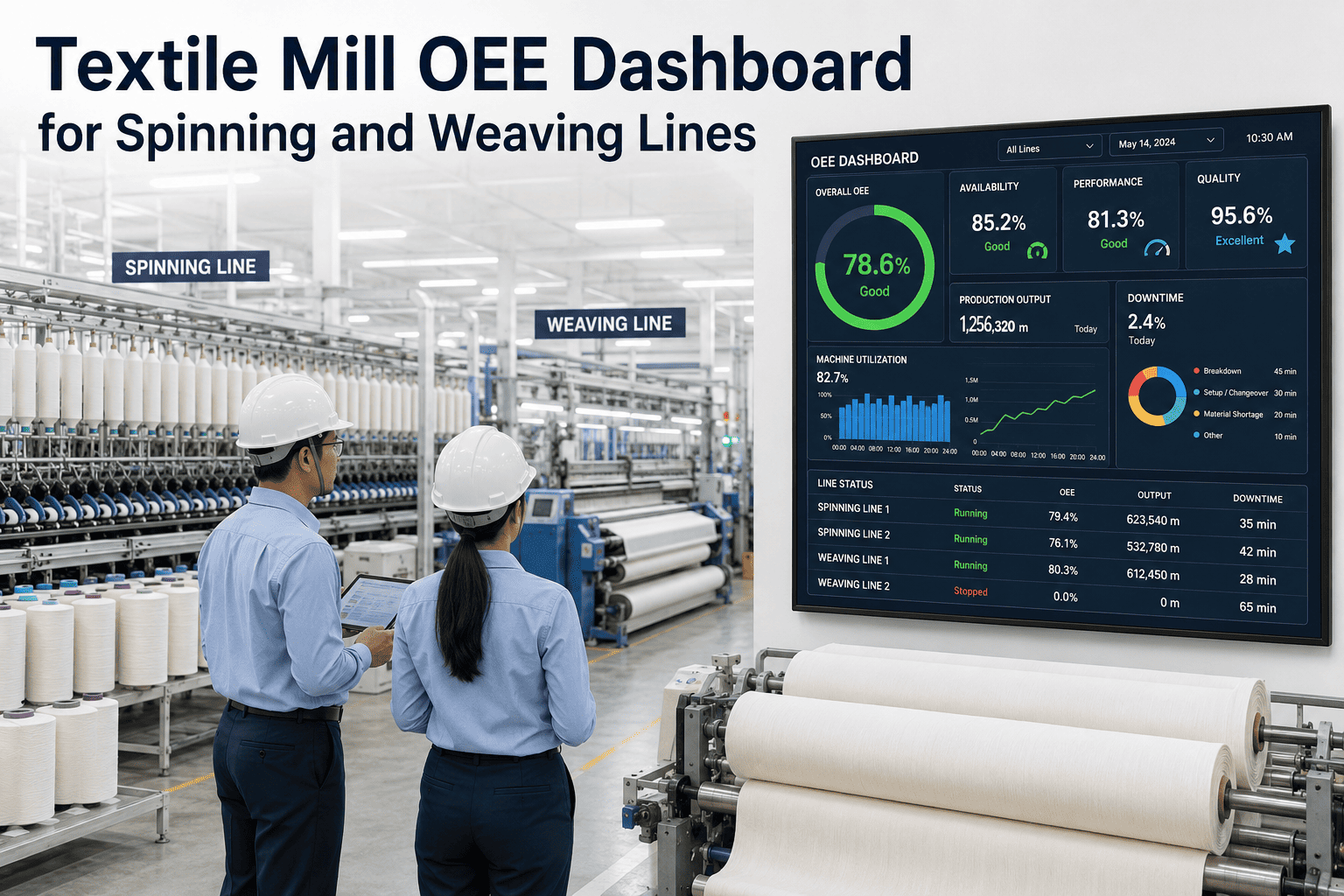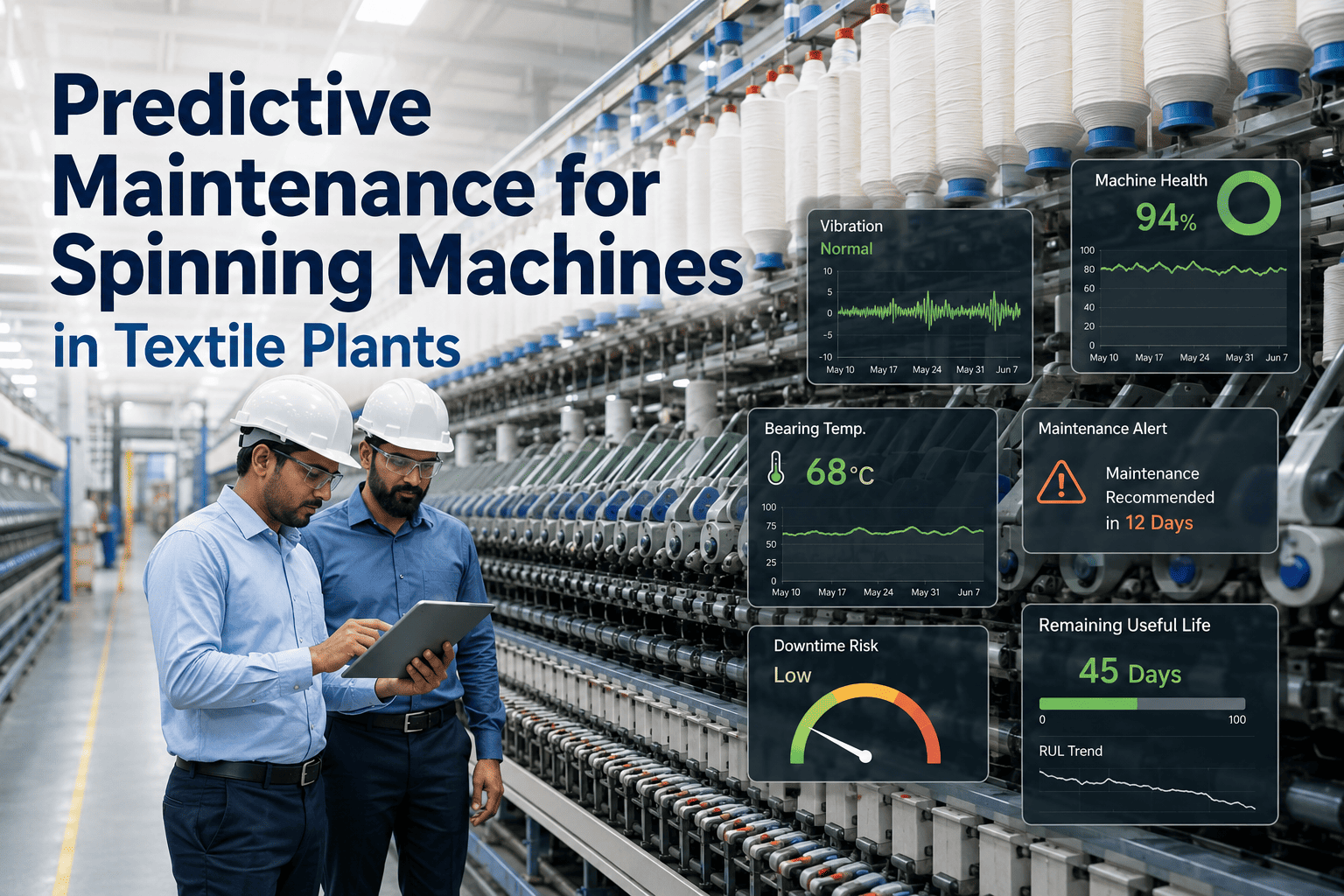
On a typical ring-spinning machine running thousands of spindles at 16,000 to 18,000 rpm, even a modest improvement of one fewer break per 100 spindles per hour translates into meaningful fibre, labour, and downtime savings across a single shift. Yarn breakage remains one of the biggest contributors to spinning line downtime, and most mills still catch a failing spindle, a worn bearing, or a drifting tension setting only after it has already caused a string of breaks. IoT sensors tracking vibration, temperature, and tension continuously can flag a spinning machine drifting out of its normal range days before it starts producing bad yarn or forcing an unplanned stop. Mill managers exploring this shift can book a demo to see live spindle health monitoring running on real production data.
TEXTILE MANUFACTURING · SPINNING MACHINE PREDICTIVE MAINTENANCE
Catch a Failing Spindle Before It Costs You a Shift of Yarn
Continuous sensor monitoring tracks vibration, temperature, and tension across every spinning machine, flagging drift toward failure days before breakage rates climb.
Three Ways Mills Approach Spinning Maintenance
Most mills still run maintenance on a fixed calendar, servicing rings, aprons, and bearings at set intervals regardless of actual condition. Sensor-based monitoring is a step forward, giving visibility into what's happening machine by machine, but it still takes a person watching a dashboard to catch the pattern. AI predictive maintenance closes that gap by learning each machine's own normal signature and flagging deviation automatically.
Fixed-Interval Maintenance
Servicing happens on a calendar, not on actual condition
Healthy machines serviced too often, wasting labor
A failing spindle can go unnoticed between rounds
Sensor-Based Monitoring
Vibration and temperature data collected in real time
Requires manual dashboard review to catch trends
Reduces downtime but still relies on human attention
AI Predictive Maintenance
Each machine's normal signature learned automatically
Deviation flagged and routed to maintenance without review
Servicing scheduled on actual condition, not a calendar
Up to 45%
Reduction in unplanned downtime reported by mills using predictive maintenance
15-20%
Typical drop in yarn defects when machine health is monitored continuously
$10K-$50K
Cost per hour of unplanned downtime reported across textile mills
We used to find out a ring frame was struggling when the break rate on that machine started climbing and the operators noticed. By then we'd already lost a shift of quality yarn. Now we see the vibration signature drift before the break rate even moves, and we schedule the fix instead of chasing it.
Spinning Mill Production Manager
Is Your Spinning Line a Strong Fit
High Spindle Count Across Multiple Lines
Mills running hundreds or thousands of spindles see the fastest payback from automated monitoring at scale.
Documented Break Rate Variability
If break rates already vary noticeably by machine, that variability is exactly what monitoring targets.
Existing Sensor Data Not Fully Used
Mills with sensors already installed but reviewed only manually are the fastest to bring online.
Frequently Asked Questions
Machine-level vibration and temperature sensors are typically sufficient to establish a health signature for the whole spinning position, rather than requiring individual sensors on every spindle. Mills that already have IoT sensors installed on their spinning machines can usually connect that existing data directly rather than adding new hardware. A quick equipment review during onboarding confirms what your specific machines need, and details can be discussed through book a demo.
Yes, health scoring is built around each machine's own historical signature rather than a single fixed threshold, which means older and newer machines, and different manufacturers, can all be monitored on the same platform without needing identical baselines. Mixed-fleet mills are actually a common deployment scenario rather than an edge case.
Alerts and predicted failure signatures are designed to route into your existing maintenance workflow or ERP system, so a flagged machine turns into a scheduled work order rather than a dashboard notification someone has to act on manually. Integration specifics for your current system can be confirmed with support.
Both tend to improve together, since the same drifting bearing or misaligned component that eventually causes an unplanned stop is often already producing marginal yarn quality before the machine fully fails. Mills monitoring machine health continuously commonly report defect reductions alongside downtime improvements, since catching the issue earlier addresses both at once.
Most mills see their model calibrate to individual machine signatures within the first few weeks, with the first flagged and prevented issue often occurring within that same window. A fuller picture of downtime and defect reduction typically builds over the following quarter as more failure patterns are caught and confirmed. A timeline specific to your spindle count can be mapped out during a demo.