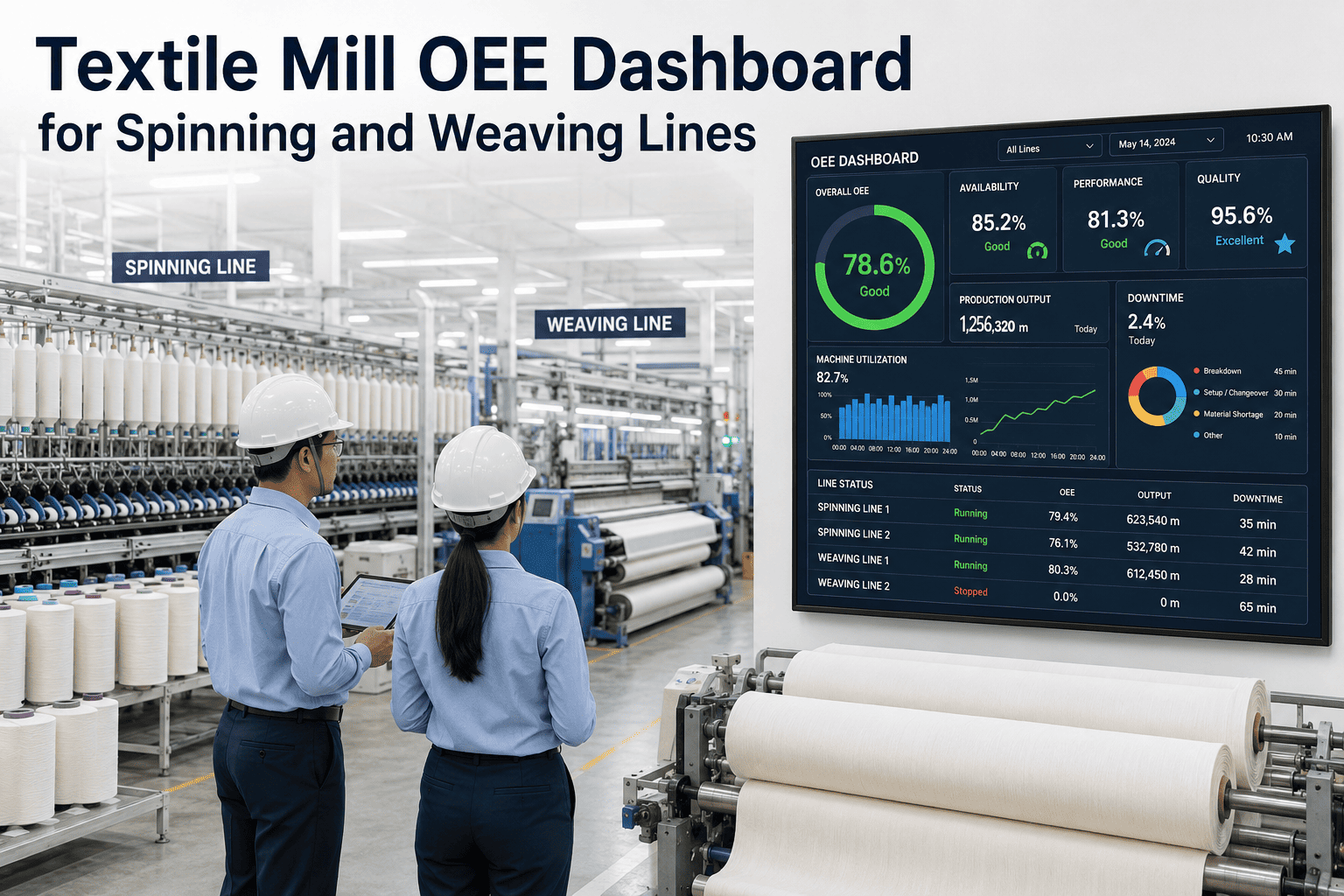
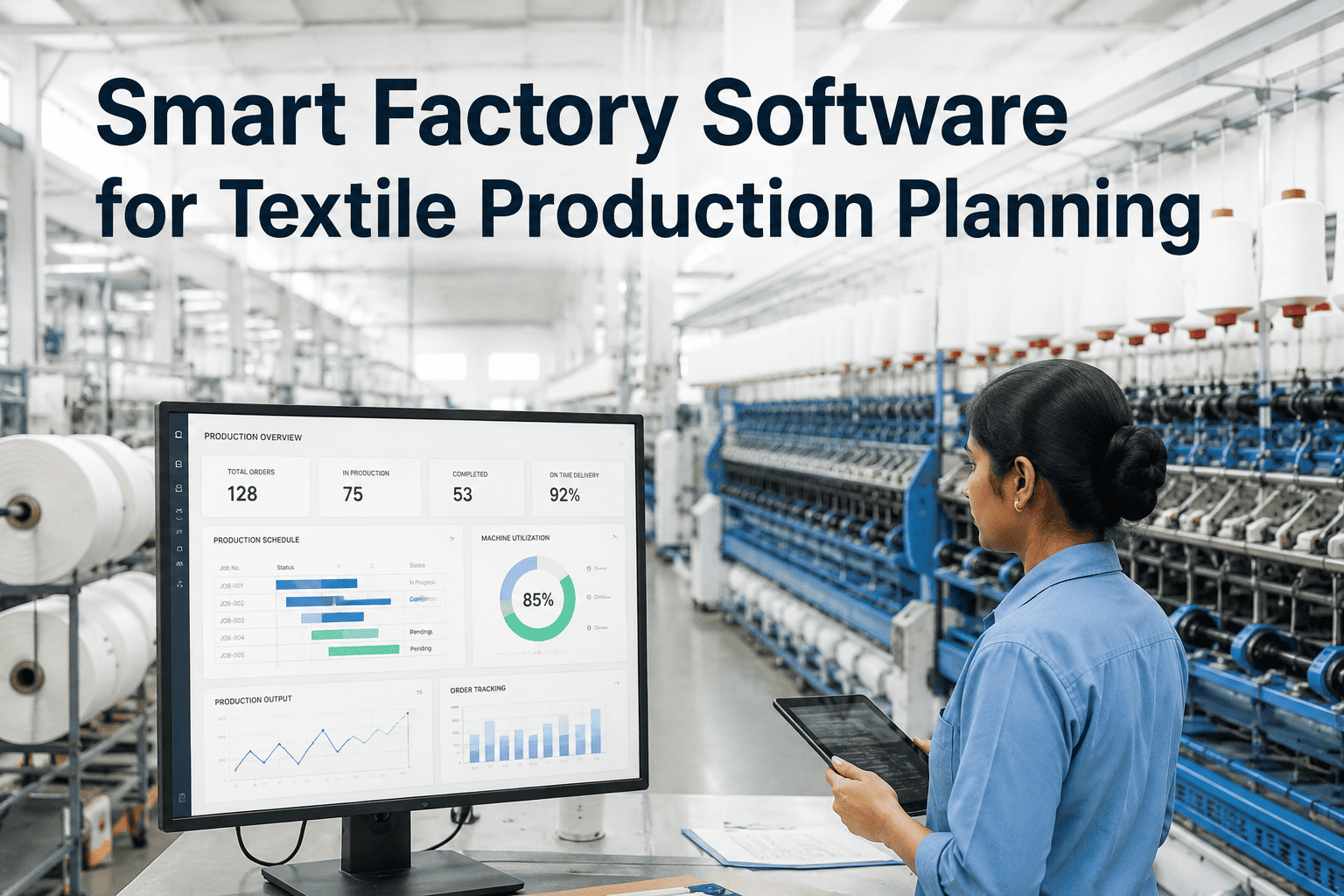
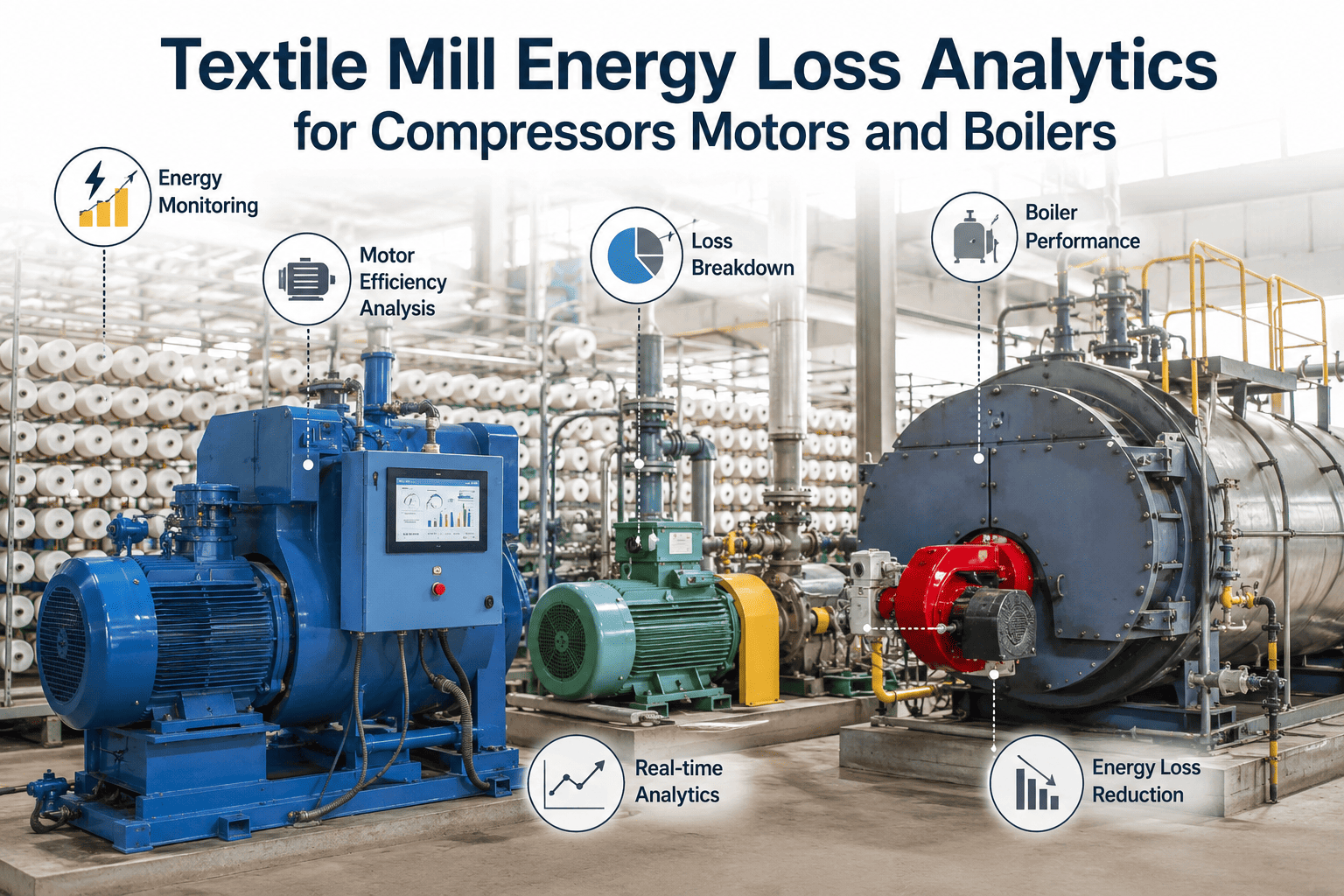
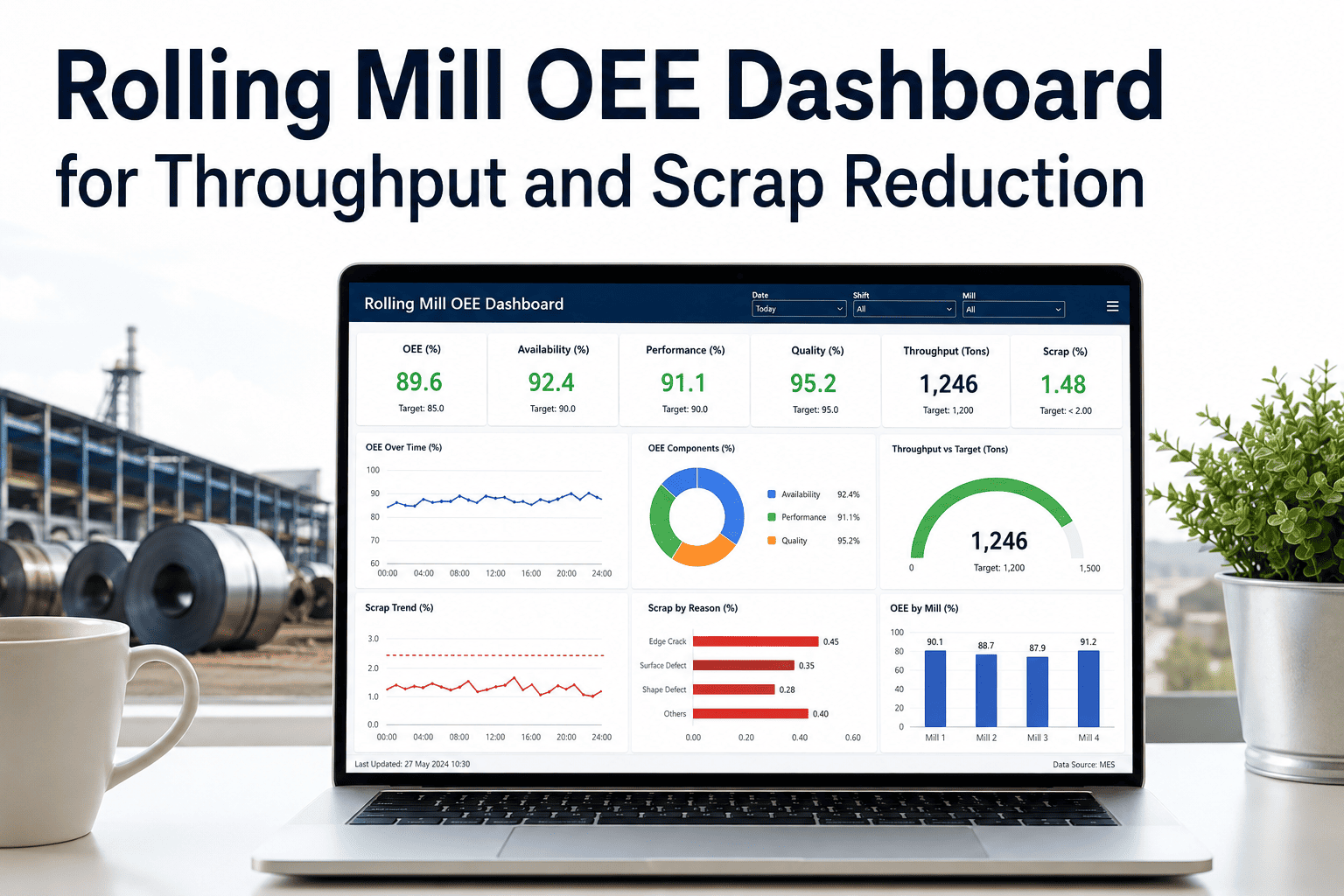
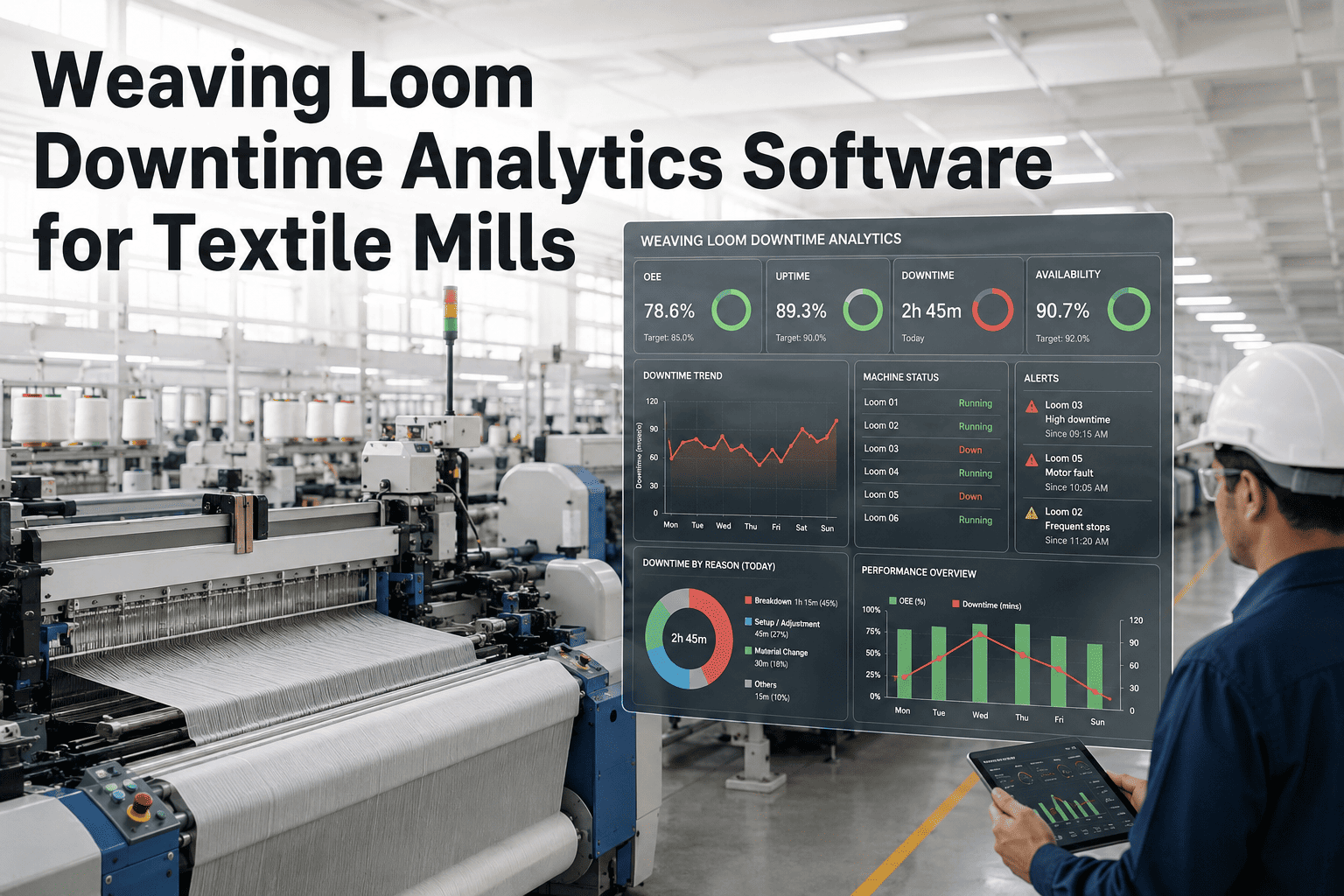
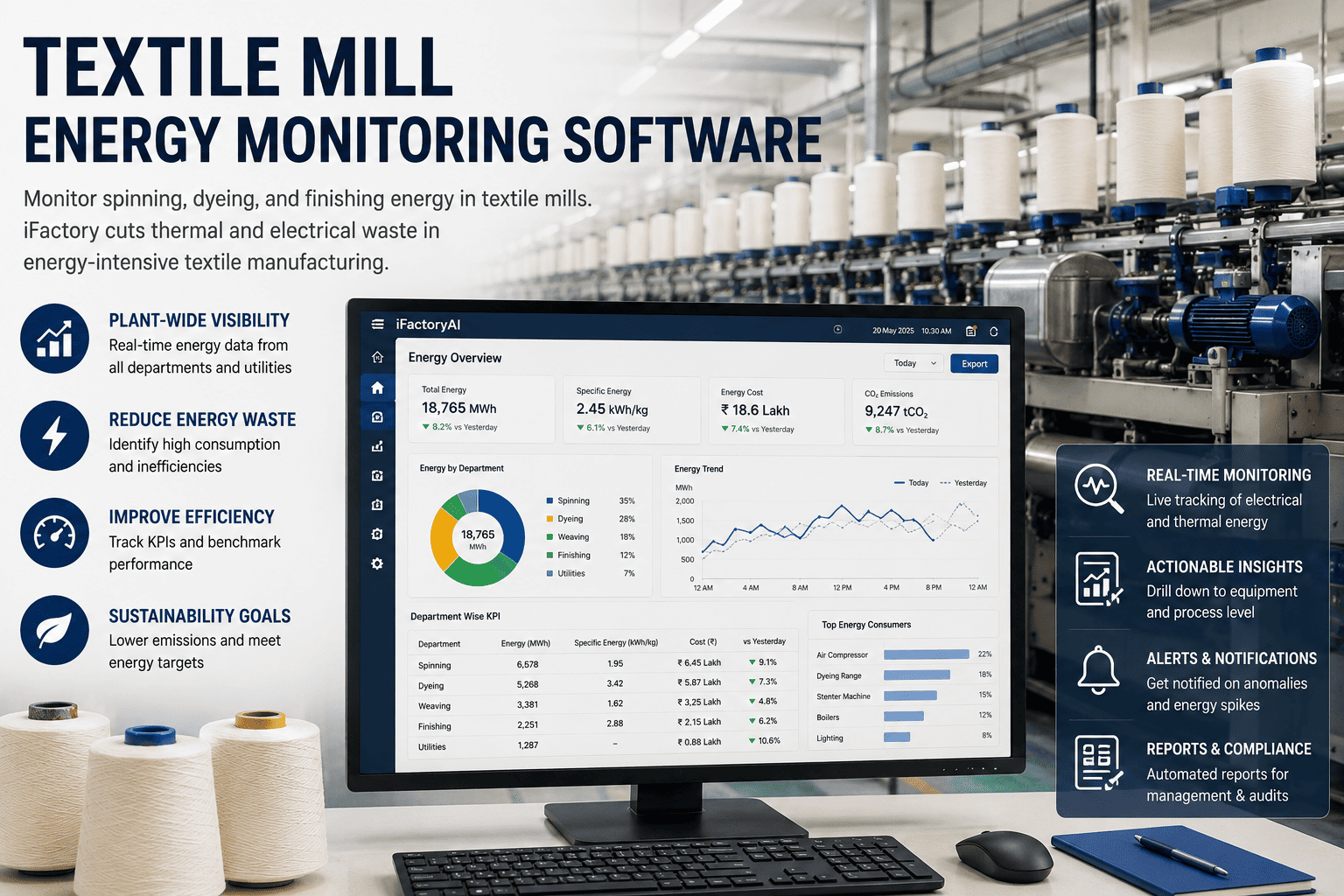
Spinning and weaving line managers often have a rough sense of how their equipment is performing, but a rough sense is not the same as a number leadership can act on. Overall Equipment Effectiveness, or OEE, turns machine availability, speed, and quality into a single figure that shows exactly how much production capacity a mill is actually using versus losing to changeovers, slow running, and rework. Most mills without a live OEE dashboard are running well below their true capacity and do not know it, because the losses hide inside shift-to-shift variation that a manual production log never captures cleanly. A real-time OEE dashboard pulls data directly from spinning frames and looms, turning scattered machine logs into a single view that plant managers can use to find bottlenecks the same day they happen. Production teams ready to see their own OEE numbers can book a demo and explore a live dashboard.
OEE ANALYTICS · TEXTILE MANUFACTURING · 2026
Know Exactly Where Your Spinning and Weaving Lines Lose Time
A live OEE dashboard tracks availability, performance, and quality across every spinning frame and loom, so bottlenecks get fixed the same shift they appear.
40-60%
Typical OEE score for mills without real-time tracking, well below the world-class benchmark
85%
World-class OEE benchmark that top-performing spinning and weaving lines aim to reach
15-25%
Average OEE improvement mills see within the first six months of live dashboard tracking
Real-Time
Data refresh rate that replaces end-of-shift paper logs with immediate bottleneck visibility
Why Paper Logs Hide Your Biggest Losses
Most spinning and weaving lines still rely on operators filling out shift logs by hand, recording downtime reasons and production counts from memory at the end of a long shift. These logs are rarely wrong on purpose, but they are consistently imprecise. A five-minute stoppage that happens three times in a shift often gets rounded down or forgotten entirely, and the actual running speed of a loom rarely matches what gets written on paper. Multiply that imprecision across dozens of machines and multiple shifts, and plant managers end up making capacity decisions based on numbers that do not reflect reality. A live OEE dashboard removes the guesswork by pulling data directly from machine controllers, so every stoppage, speed loss, and quality issue is captured automatically and attributed to its true cause.
Where Spinning and Weaving Lines Lose the Most Time
Not all losses are equal, and mills that track OEE consistently find the same categories showing up as the biggest drains on capacity, in roughly this order of impact.
Changeover Time
32% of loss
Unplanned Stoppages
25% of loss
Reduced Speed Running
18% of loss
Quality Rejects and Rework
14% of loss
Approximate share of total OEE loss by category, based on benchmark data across spinning and weaving mills
OEE ANALYTICS · TEXTILE MILLS · 2026
See Your Own OEE Breakdown Live
Get a personalized walkthrough of how a live OEE dashboard would look across your spinning frames and looms.
What a Live OEE Dashboard Gives Your Team
A dashboard is only useful if it changes what happens on the floor. Here is what shift supervisors and plant managers actually get once machine data starts flowing in real time.
Machine-Level Visibility
Every spinning frame and loom shows its own live OEE score, so underperforming machines are identified instantly instead of buried in a plant-wide average.
Downtime Reason Tracking
Stoppages are automatically categorized by cause, giving maintenance and production teams a clear priority list instead of a vague downtime total.
Shift-to-Shift Comparison
Consistent, automated data makes it possible to compare shifts fairly, surfacing training gaps or process differences that paper logs always hid.
Speed Loss Alerts
Machines running below their rated speed trigger alerts before the slowdown quietly eats into a full shift's output.
Before and After: What Changes on the Floor
| Area |
Without Live OEE Tracking |
With Live OEE Dashboard |
| Downtime Visibility |
Discovered at end of shift via paper log |
Flagged instantly with cause and duration |
| Changeover Time |
Varies widely by operator, untracked |
Benchmarked and standardized across shifts |
| Capacity Planning |
Based on estimated, often inflated output |
Based on real, verified production data |
| Root Cause Analysis |
Reactive, relies on operator memory |
Data-driven, patterns visible across weeks |
Getting Live OEE Running Without Disrupting Production
Mills cannot pause spinning and weaving lines to install new tracking infrastructure. A phased rollout keeps production moving while data accuracy is validated.
Weeks 1-2
Machine Connectivity Audit
Existing machine controllers and sensors are mapped to identify what data is already available and where gaps exist.
Weeks 3-4
Dashboard Configuration
OEE targets, downtime reason codes, and shift structures are configured to match your mill's actual operating patterns.
Weeks 5-6
Pilot Line Validation
Live data runs on a priority line while supervisors compare dashboard numbers against manual logs to confirm accuracy.
Month 2+
Plant-Wide Rollout
Every spinning frame and loom connects to the dashboard, giving plant managers a single, real-time view of total capacity.
What Plant Managers Are Saying
We thought our lines were running around 65% OEE based on our shift reports. Once we had real data, our actual number was closer to 48%, and almost all of the gap was hiding in changeover time nobody was tracking properly. Within four months of fixing changeover procedures based on the dashboard, we picked up nearly a full shift's worth of extra capacity every week without adding a single machine.
Plant Manager, Composite Spinning and Weaving Mill
Frequently Asked Questions
OEE ANALYTICS · TEXTILE MILLS · 2026
Ready to Find Your Hidden Capacity?
Join textile mills already using live OEE dashboards to cut changeover time, reduce unplanned stoppages, and reclaim lost production capacity.