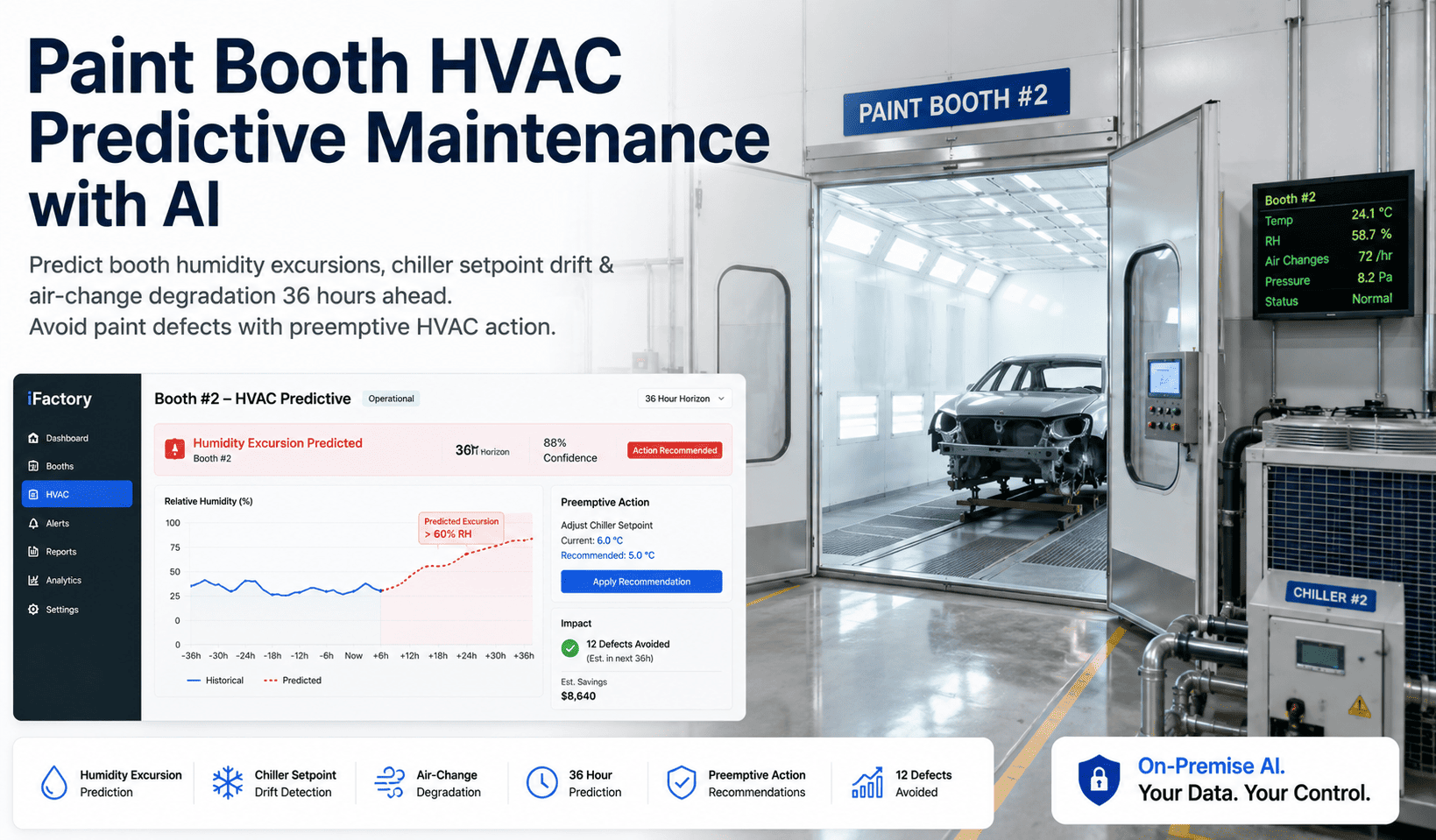
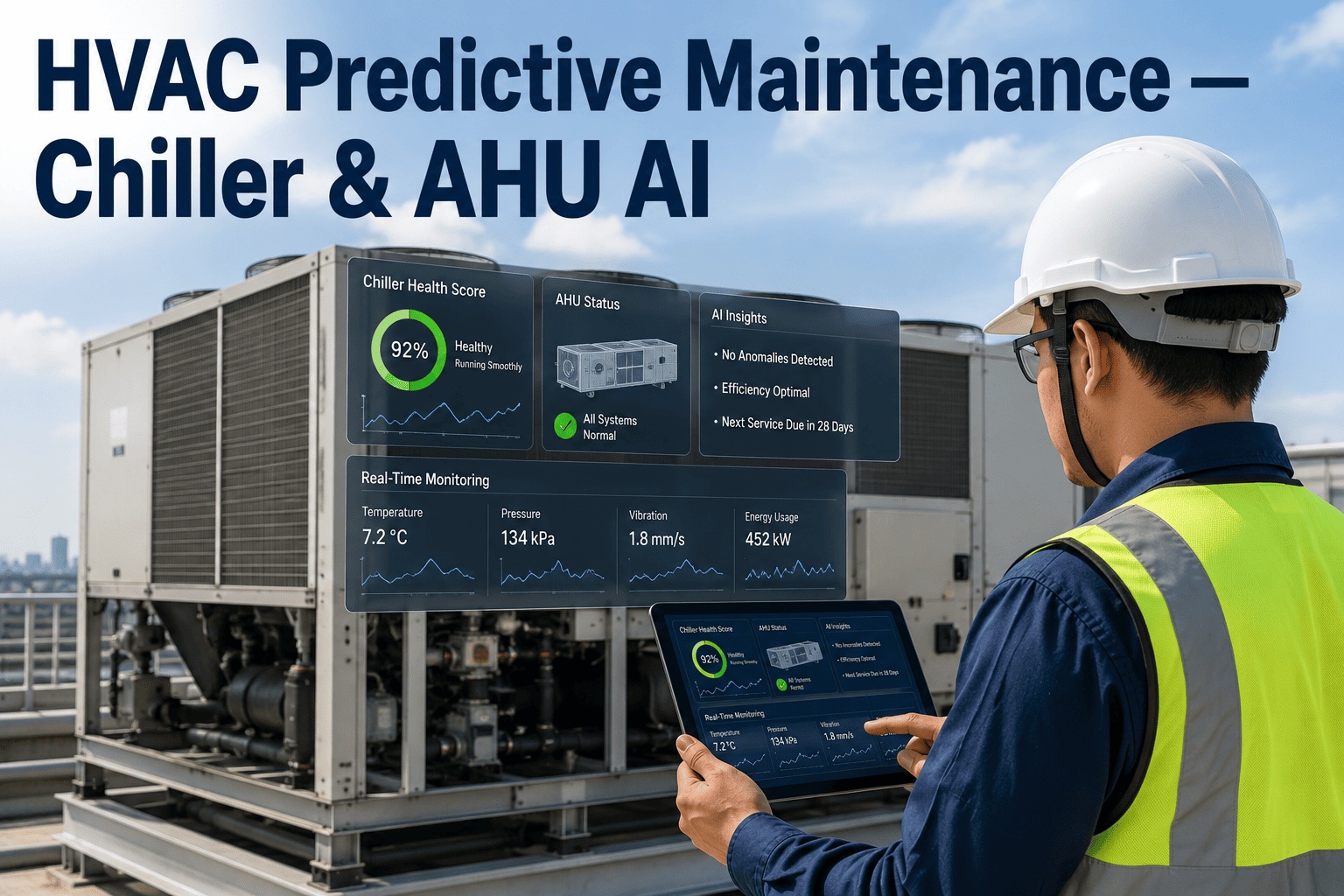
A paint booth is the most environmentally fussy room in the plant. Water-based finishes demand roughly 75°F and 50% relative humidity, hundreds of thousands of CFM of conditioned air, and stable booth pressure — and when any of those drifts, the result isn't a machine alarm, it's a wave of orange peel, runs, sags, and dirt inclusions on Class-A panels that nobody catches until the inspection deck. The trouble is that a building automation system only tells you the humidity is wrong once it's already wrong. By then the booth has been spraying defects for an hour. iFactory's paint booth HVAC predictive engine reads the slow drift in chiller approach temperature, suction pressure, air-change rate, and RH, and forecasts an excursion up to 36 hours before it lands — so the fix is a setpoint nudge on a planned shift, not a rework batch and a scramble.
iFactory · Paint Booth HVAC Predictive
Catch the Humidity Excursion 36 Hours Before the Defects.
AI forecasts booth humidity excursions, chiller setpoint drift, and air-change degradation up to 36 hours ahead — then proposes the preemptive HVAC action, so paint defects are prevented instead of inspected.
36 hr
forecast horizon before excursion
88%
confidence on the Booth #2 alert
12
paint defects avoided this prediction
50% RH
the setpoint a drift quietly breaks
A Building Automation System Reacts. It Doesn't Predict.
Your BAS controls setpoints and alarms when a reading crosses a limit — it tells you what is happening now. By the time it fires, the booth has already drifted out of spec and the panels coming off the line already carry the defect. Prediction is a different job: reading the correlated drift in the signals that precede the excursion, and flagging it while there's still time to act on a planned shift.
BAS / Reactive Control
Alarms after the limit is crossed
Sees one signal at its threshold
Defects already sprayed before alert
Fix is an emergency mid-shift
Drift looks normal until it isn't
AI Predictive Engine
Forecasts up to 36 hours ahead
Reads correlated multi-sensor drift
Preempts before the first bad panel
Fix is a planned setpoint nudge
Slow drift surfaces as a clear trend
The 36-Hour Forecast
This is the live prediction for Booth #2. Relative humidity is creeping up as the chiller's approach temperature drifts — individually within limits, together a signature. The engine projects the crossing of the 55% RH defect threshold roughly 36 hours out at 88% confidence, with a clear window to act before any panel is affected.
Booth #2 — Relative Humidity Forecast
88% confidence
Defect threshold · 55% RH
Now50%
+9h51%
+18h52%
+27h54%
+36h56%
The Signals Behind the Forecast
No single reading triggers the alert. The engine watches the booth's environmental signature as a whole — the same way an HVAC model reads suction pressure and approach temperature together to call a bearing weeks early. Below is the live panel for Booth #2; the drift is in the chiller and air-change rows, even though every value is still technically "in range."
Relative Humidity
50% rising
Target 50% · threshold 55%
Chiller Approach Temp
7.1°F drifting
Baseline 5.5°F · the lead signal
Air-Change Rate
92% degrading
Filters loading · backpressure up
Booth Dry-Bulb Temp
75°F stable
On setpoint · no contribution
Bring your booth's sensor history. Get a turnkey AI quote and we'll show the signature on your own data in the pilot.
Predict, Preempt, Prevent
The value isn't the alert — it's what the alert buys you. A 36-hour horizon converts a reactive rework event into a scheduled, low-cost correction, and every prevented excursion is a batch of panels that never needed inspection, sanding, or repaint.
Predict
Multi-sensor model projects the RH excursion 36 hours out, with a confidence score.
Propose
Engine drafts the preemptive action — a chiller setpoint change, filter swap, or damper trim.
Preempt
Facilities approves and acts on a planned shift — no line stop, no emergency call.
Prevent
The curve flattens; 12 panels that would have carried defects come out clean.
What a Booth Excursion Actually Costs
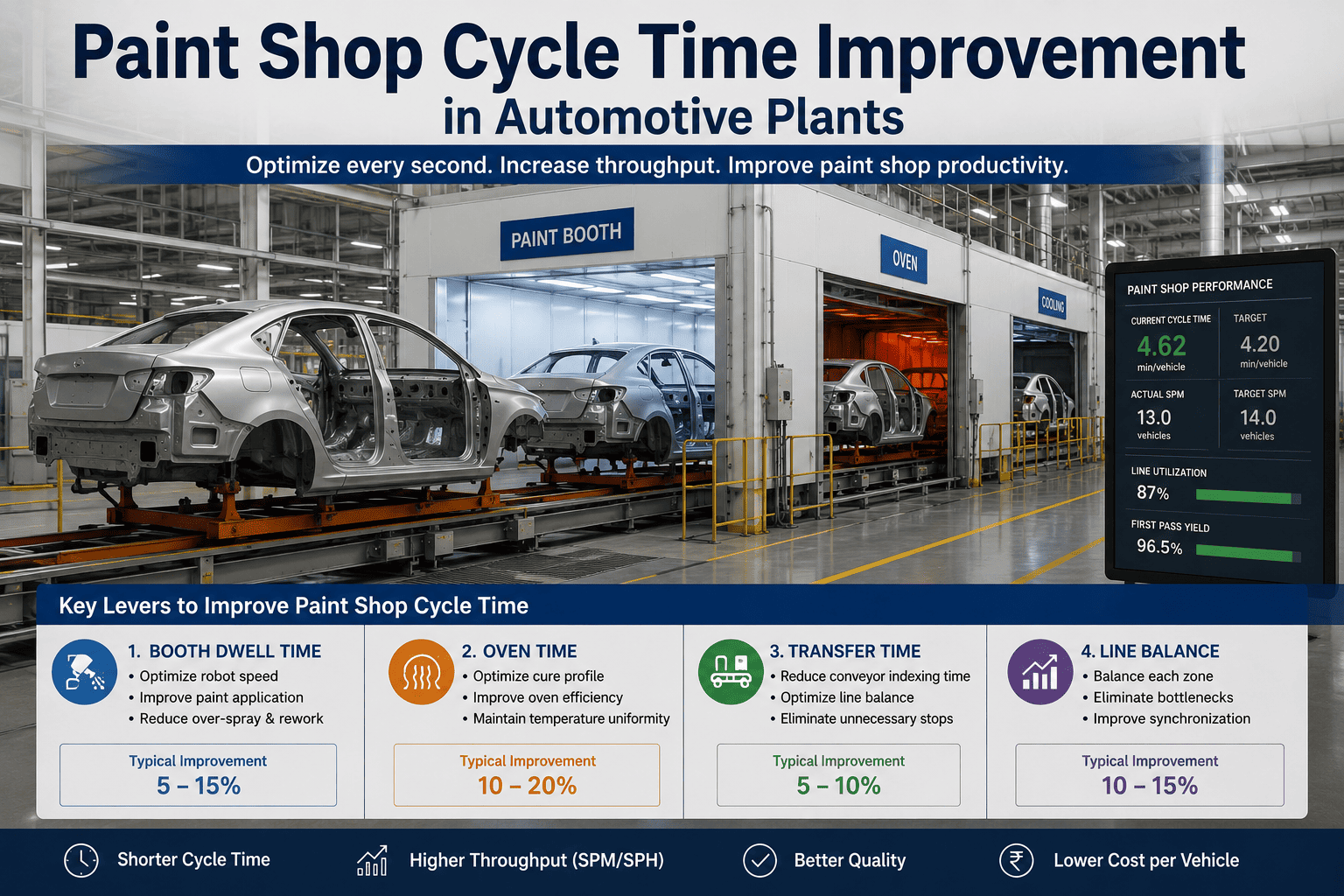
Humidity that drifts out of band is one of the most direct causes of paint defects — orange peel, runs, sags, uneven drying — and 5 to 15% of vehicles already need paint rework at up to $1,000 each. Hold the booth in band and first-pass yield through inspection can rise by as much as 10%. The math favors the 2°F setpoint nudge over the repaint, every time.
75°F / 50%
The spec that defines quality
dry-bulb and RH targets for water-based finish
5-15%
Vehicles needing paint rework
at up to $1,000 per vehicle, much of it humidity-driven
+10%
First-pass yield uplift
when booth humidity is held in band
7-21 days
Lead time on chiller faults
degradation signatures AI catches before failure
How many repaint jobs trace back to a bad booth day? Start a 6-week pilot and put a number on it.
Ask the Copilot
The forecast answers plain language too — for the paint shop engineer or facilities lead checking the booth before a shift.
Plant Copilot — Paint Shop
Paint Engineer
Booth #2 looks fine on the BAS. Why are you flagging it?
Copilot
Every value is in range right now — that's why the BAS is quiet. The concern is the trajectory. Chiller approach temp has drifted from 5.5 to 7.1°F over two days, which is dropping dehumidification capacity, and filter loading has pulled air-change rate down to 92%. Together they're pushing RH up about 1.5 points a shift. Projected to cross the 55% defect threshold in roughly 36 hours, 88% confidence. If it crosses mid-production, expect orange peel and slow-dry defects on Class-A panels.
Paint Engineer
What's the cheapest fix that holds it through Thursday?
Copilot
Drop the chiller setpoint 2°F now and swap the loaded supply filters on the next planned break. That recovers approach temp and air-change rate, and the model re-projects RH holding at 50 to 51% through Thursday's last shift. I've drafted the filter work order and the setpoint change for your approval — neither needs a line stop.
Turnkey: Hardware, Software, Live in 6-12 Weeks
iFactory ships a pre-configured NVIDIA AI server — racked, software pre-loaded. Rack it, plug in power and Ethernet, and the AI is live inside your firewall. The engagement covers cabling, network, PLC/SCADA and BAS integration over BACnet or Modbus, operator training, and 24×7 remote monitoring. Existing booth and chiller sensors are first-class inputs — no rip-and-replace.
Phase 1 · Weeks 1-4
Ship & Connect
Edge server on-prem; booth RH, chiller, air-change, and BAS data connected read-only over BACnet/Modbus.
Phase 2 · Weeks 5-8
Train & Pilot
Models learn each booth's baseline signature; forecasts run in shadow while your team grades the calls.
Phase 3 · Weeks 9-12
Go Live
Live 36-hour forecasts with preemptive action drafts, operator training, and 24×7 monitoring at 99.9% uptime.
1000+
clients running iFactory
6-12 wks
to live operation
On-prem
inside your firewall
What the Paint Shop Gets Back
A 36-hour horizon turns the booth from a source of surprise rework into a controlled environment — fewer repaints, planned HVAC interventions, and a clear record of every excursion caught before it cost a panel.
36 hr
Warning before excursion
enough lead time to fix on a planned shift
Prevented
Repaint batches
defects stopped at the cause, not the inspection deck
Planned
HVAC interventions
setpoint and filter work on schedule, no emergencies
Logged
Excursion record
every forecast, action, and outcome auditable
Frequently Asked Questions
How is this different from our building automation system?
A BAS controls setpoints and alarms when a reading crosses a limit — it reacts to the present. This engine forecasts up to 36 hours ahead by reading correlated drift across humidity, chiller, and air-change signals before any one of them breaches. The BAS is one of its input streams; the two are complementary, not competing.
Does it change HVAC setpoints automatically?
No. It predicts the excursion and drafts the preemptive action — a setpoint change, filter swap, or damper trim — but a person reviews and approves before anything moves. Every forecast, approval, and outcome is logged, so the record shows the human decision, not just the result.
Can it use our existing booth and chiller sensors?
Yes. Most booth and BAS sensors installed in the last two decades expose data over BACnet or Modbus, which connect read-only with no electrical changes. The models learn each booth's own baseline during the pilot, so the forecast reflects your equipment and climate, not a generic curve.
What failure modes can it actually predict?
The degradation-based ones that have detectable signatures — chiller approach-temperature drift, dehumidification capacity loss, filter loading and air-change decline, and the RH excursions they produce. It cannot predict sudden, signature-free events, and any vendor claiming it can should be doubted. Honest scope is the point.
Where does our data live?
Everything runs on-premise inside your firewall on the pre-configured NVIDIA server — read-only and inbound-only. Booth telemetry, chiller data, and quality records never leave the plant, with 24×7 remote monitoring and 99.9% uptime.
Forecast the Drift. Nudge the Setpoint. Skip the Repaint.
See the 36-Hour Forecast on Your Booth
Bring a few months of booth and chiller sensor history. We'll show the environmental signature, the 36-hour humidity forecast, and the preemptive action drafts running on your own data — and scope the 6-to-12-week turnkey deployment, on-prem, inside your firewall.
1000+
clients · 99.9% uptime