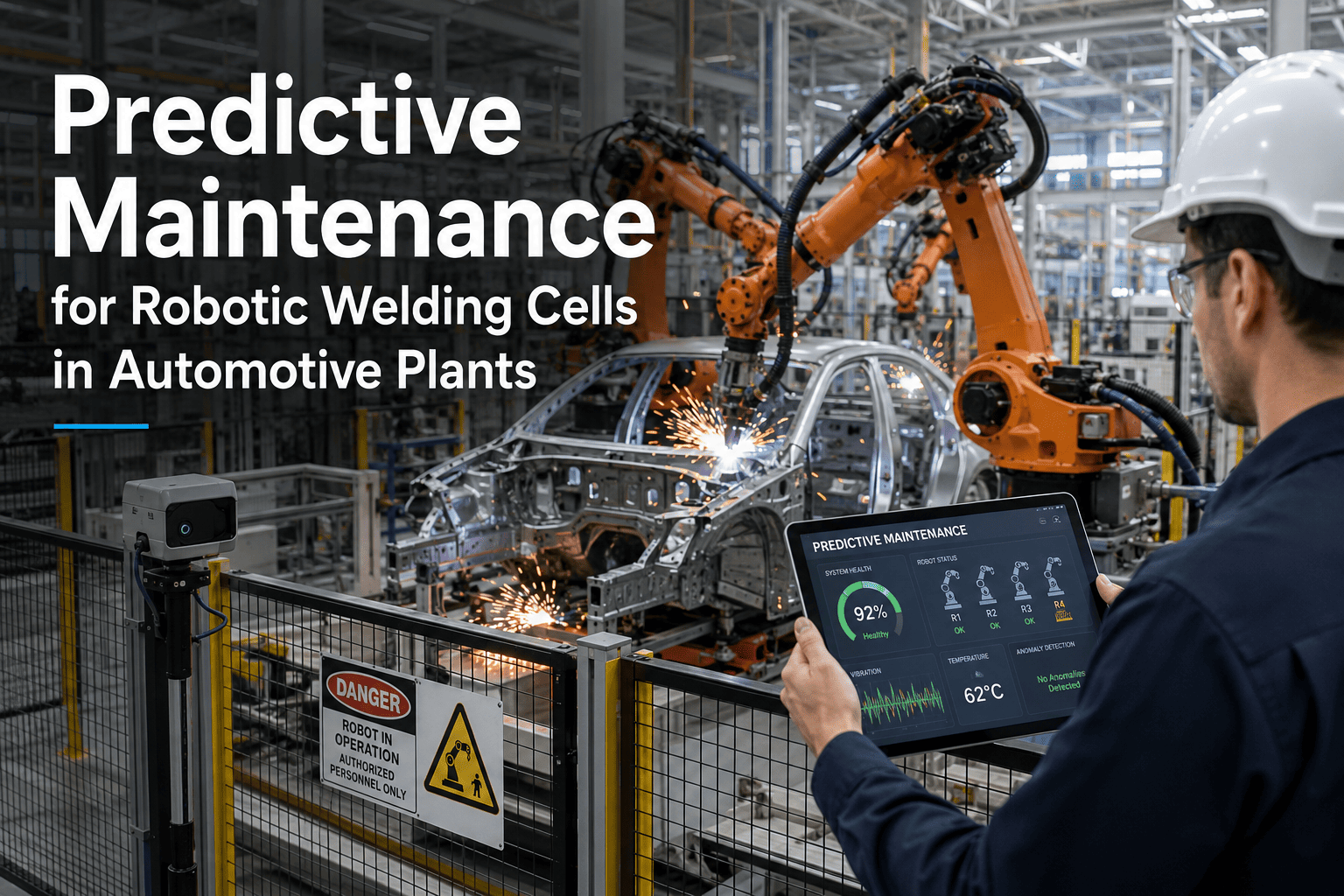
In modern automotive manufacturing, robotic welding cells represent the backbone of high-volume production lines. These cells perform thousands of precise welds per shift on chassis, body panels, and critical structural components. However, even a single unplanned stoppage in a welding cell can cascade into hours of downtime, costing automakers tens of thousands of dollars per minute. Traditional reactive maintenance—waiting for a robot to fail before repairing it—is no longer viable in an industry where just-in-time delivery and lean inventory leave zero buffer for delays. Predictive maintenance, powered by AI-driven analytics and real-time condition monitoring, is transforming how automotive plants maintain their robotic welding assets. By continuously analyzing vibration, temperature, current draw, and cycle time data, predictive systems identify early signs of wear, misalignment, or impending failure. This allows maintenance teams to intervene precisely when needed, scheduling repairs during planned downtime rather than facing emergency shutdowns. For automotive manufacturers producing electric vehicles (EVs) with complex aluminum and high-strength steel welds, the stakes are even higher: weld quality directly impacts crash safety and battery integrity. iFactory's predictive maintenance module integrates seamlessly with existing PLCs, sensors, and MES systems to deliver a unified dashboard that prioritizes alerts, forecasts remaining useful life, and recommends optimal maintenance actions. Book a Demo to see how your plant can achieve zero unplanned downtime in robotic welding.
Eliminate Unplanned Downtime in Your Welding Cells
Stop reacting to failures. Start predicting them with iFactory's AI-powered maintenance platform. Reduce downtime by 60% and extend robot life by 30%.
Downtime Reduction
Automotive plants using AI predictive maintenance report up to 84% reduction in unplanned downtime for robotic welding cells, according to industry benchmarks.
Extended Robot Life
Condition-based maintenance extends the operational life of welding robots by 30%, delaying capital replacement costs and improving ROI.
Faster Root Cause Analysis
Integrated sensor data and AI models cut root cause analysis time by 50%, enabling technicians to pinpoint issues in minutes instead of hours.
Why Robotic Welding Cells Are Critical for Predictive Maintenance
High-Volume, Zero-Tolerance Production
A typical automotive plant operates 50 to 200 robotic welding cells, each performing 2,000 to 5,000 welds per vehicle. At a production rate of 60 vehicles per hour, a single cell failure can stop the entire line within 30 seconds. Predictive maintenance ensures that each robot's servos, welders, and grippers are monitored for abnormal patterns. For example, a gradual increase in motor current may indicate bearing wear, while cycle time drift often signals end-of-arm tool degradation. By catching these early, plants can schedule maintenance during shift changes or weekends, avoiding costly line stops.
EV Manufacturing Complexity
Electric vehicles use lightweight materials like aluminum and ultra-high-strength steel, which require precise welding parameters. Any deviation in weld current, wire feed speed, or gas flow can result in cold welds, porosity, or spatter, compromising battery enclosure integrity and crash safety. Predictive models analyze real-time weld signatures and compare them to golden samples, flagging anomalies before they become defects. This not only reduces scrap but also protects brand reputation and regulatory compliance.
Integration with Existing Automation
iFactory's predictive maintenance platform connects to Allen-Bradley, Siemens, and Mitsubishi PLCs via OPC-UA, MQTT, or Modbus TCP. It ingests data from vibration sensors, thermal cameras, and robot controllers without requiring additional hardware. The system builds digital twins of each welding cell, simulating wear patterns and failure modes. Alerts are pushed to maintenance dashboards, mobile apps, and email, with severity levels that help teams prioritize. A simple traffic-light system (green, yellow, red) allows operators to see at a glance which cells need attention.
Ready to Predict Failures Before They Happen?
iFactory's predictive maintenance suite gives you real-time visibility into your welding cells. Schedule a demo to see how you can reduce downtime and improve quality.
How iFactory Implements Predictive Maintenance in Welding Cells
Sensor Integration and Data Ingestion
iFactory connects to existing sensors on welding robots, including accelerometers, thermocouples, current transducers, and weld monitors. Data is ingested at 10Hz to 100Hz, depending on the parameter. The platform normalizes data from different robot brands (Fanuc, ABB, KUKA, Yaskawa) into a unified schema, enabling cross-cell comparisons and fleet-level analytics.
AI Model Training for Failure Prediction
Using historical maintenance records and sensor data, iFactory trains machine learning models to recognize patterns preceding common failures: servo motor overheating, weld tip wear, wire feed jams, and gas nozzle blockages. Models are retrained weekly to adapt to new production mixes and seasonal variations. Each model outputs a Remaining Useful Life (RUL) estimate with confidence intervals.
Alert Prioritization and Workflow Automation
When a model predicts a failure within the next 72 hours, iFactory generates an alert with severity (critical, warning, advisory). The system automatically creates a work order in the CMMS (e.g., SAP, Oracle, Maximo), assigns it to the appropriate shift team, and suggests replacement parts from inventory. Technicians receive the alert on their mobile devices with a link to the asset's maintenance history and recommended procedure.
Continuous Improvement and Reporting
iFactory provides monthly reports on predictive maintenance performance: how many failures were avoided, average lead time, and cost savings. Plant managers use these insights to optimize spare parts inventory, adjust preventive maintenance schedules, and justify investments in additional sensors. The platform also tracks Mean Time Between Failures (MTBF) and Mean Time To Repair (MTTR) for each cell.
Reactive vs. Predictive Maintenance in Welding Cells
| Metric | Reactive Maintenance | Predictive Maintenance (iFactory) |
|---|---|---|
| Unplanned downtime per month | 12-20 hours | 2-4 hours |
| Weld defect rate | 3-5% | 0.5-1% |
| Maintenance cost per robot/year | $15,000 - $25,000 | $8,000 - $12,000 |
| Spare parts inventory turns | 2-3x per year | 5-7x per year |
| Technician utilization | 40% reactive, 60% planned | 90% planned |
| Asset lifespan | 7-9 years | 10-12 years |
Frequently Asked Questions
What types of failures can predictive maintenance detect in robotic welding cells?
Predictive maintenance can detect a wide range of failure modes including servo motor bearing wear, weld tip erosion, wire feed motor degradation, gas nozzle clogging, and controller overheating. By analyzing vibration signatures, current draw, and temperature trends, the AI models identify anomalies that precede complete failure. For example, a 10% increase in motor current over a week often signals bearing deterioration, while erratic wire feed speed indicates a worn feed wheel. iFactory's platform also flags cycle time creep, which may point to mechanical binding or software issues. Book a Demo to see real-world examples of failure predictions.
How long does it take to implement iFactory's predictive maintenance solution?
Implementation typically takes 4 to 6 weeks for a pilot with 10 to 20 welding cells. The process begins with a site audit to identify available sensors and data sources. iFactory's integration team then configures connectors to existing PLCs and databases. Model training requires 2 to 3 weeks of historical data, though initial alerts can be generated within days using rule-based thresholds. Full deployment across an entire plant (100+ cells) takes 8 to 12 weeks, including technician training and workflow integration with the existing CMMS. Book a Demo to discuss your plant's specific timeline.
Can iFactory integrate with my existing robots and sensors?
Yes, iFactory supports all major robot brands including Fanuc, ABB, KUKA, Yaskawa, and Kawasaki. It connects via OPC-UA, MQTT, Modbus TCP, and direct PLC interfaces. For sensors, the platform works with any standard industrial sensor that outputs analog or digital signals, including vibration sensors (ICP, MEMS), thermocouples (type K, J), current transducers (4-20mA), and weld monitors (WTC, WeldQC). No proprietary hardware is required; iFactory uses edge gateways that can be installed in existing control cabinets. Contact Support for a compatibility checklist.
How accurate are the failure predictions, and how often are false alarms?
iFactory's predictive models achieve 90-95% accuracy in predicting failures within a 72-hour window, with a false positive rate of less than 5%. Accuracy is continuously improved through feedback loops: when a technician finds no issue after an alert, that data is used to retune the model. The platform also uses ensemble methods combining multiple algorithms (random forest, LSTM, gradient boosting) to reduce noise. For critical alerts, the system requires confirmation from two independent sensor streams before escalating. Book a Demo to see accuracy metrics from a live automotive plant.
What is the ROI of implementing predictive maintenance for welding cells?
Most automotive plants achieve a full return on investment within 6 to 12 months. ROI comes from three main sources: reduced unplanned downtime (average savings of $1.5M per year for a mid-size plant), lower maintenance costs (30-40% reduction in emergency repairs), and improved quality (fewer weld defects reduce rework and scrap). Additionally, extended asset lifespan delays capital expenditure on new robots. iFactory provides a detailed ROI calculator during the demo, customized to your plant's production data. Book a Demo to calculate your potential savings.
Start Predicting, Stop Reacting
Transform your welding cell maintenance strategy with iFactory. See how AI-driven insights can save you millions in downtime and quality costs.

.png)
