Real-Time SPC for Injection Molding: Catch Drift Before It Becomes Scrap
By Larry Eilson on July 7, 2026
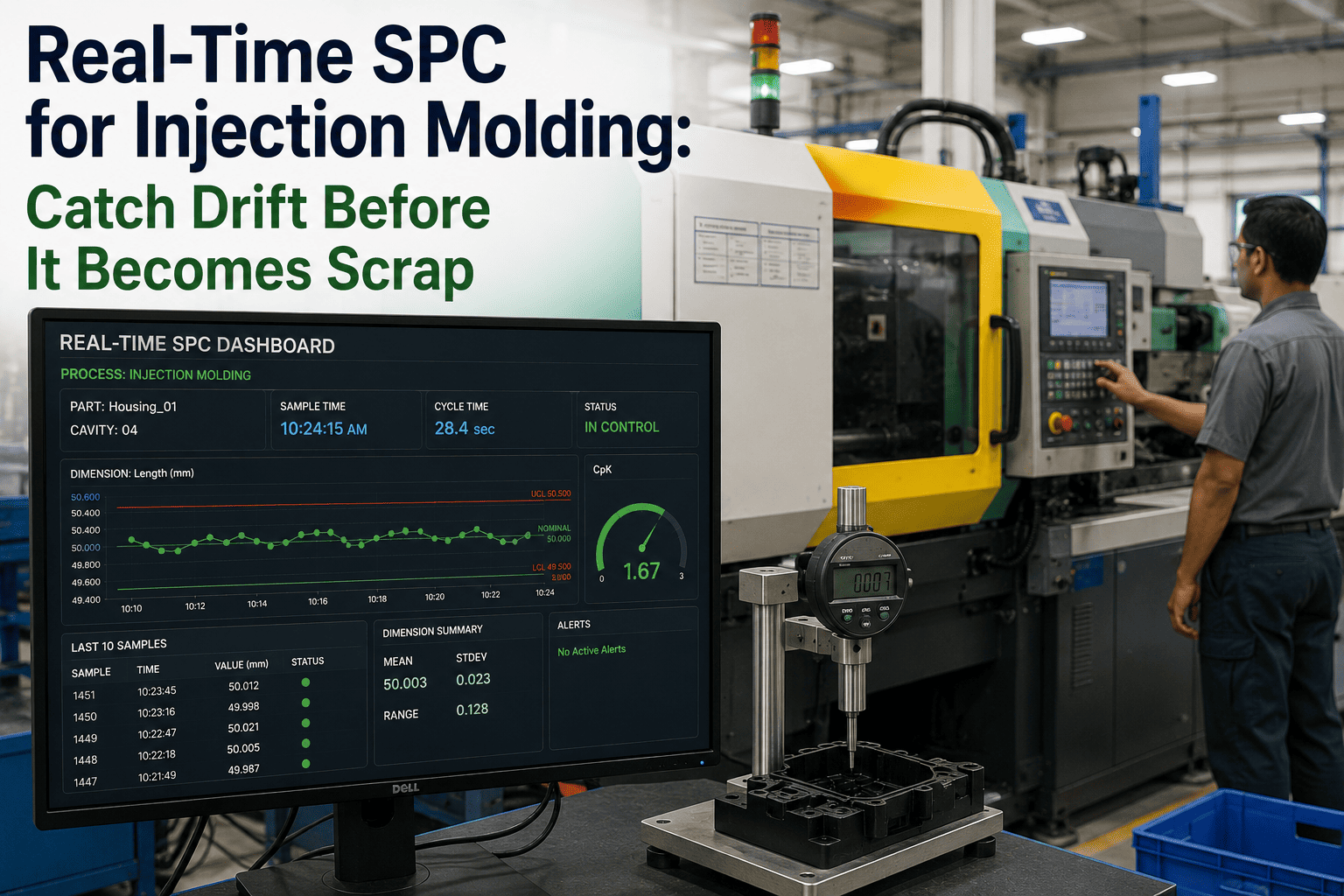
Inside a mold, cavity pressure traces a fingerprint of every shot. The moment that fingerprint drifts, a short shot, a flash line, or a sink mark is already locked into the part — long before it reaches final inspection. iFactory's real-time SPC for injection molding watches cavity pressure, melt temperature, hold pressure, and cycle time live, charting them against Western Electric rules so a process drift trips an alert in seconds, not at the end of the shift.
REAL-TIME SPC FOR INJECTION MOLDING
Catch the drift before the shot becomes scrap
Cavity pressure curves, cycle times, and dimensional data charted live with Western Electric rule detection — running on-prem inside your plant network.
Four process variables decide whether a part is in spec. Each one maps to a specific family of defects, and each one can be measured inside the cycle.
VARIABLE 01Cavity Pressure
The force the melt exerts against the mold walls during pack and hold. Drives short shots, flash, and sink.
Short shot
Flash
Sink mark
VARIABLE 02Melt Temperature
The temperature of the polymer as it enters the mold. Drives burn marks, gloss variation, and warpage.
Burn mark
Warpage
Gloss drift
VARIABLE 03Hold Pressure
Pressure maintained after the mold fills to compensate for shrinkage. Drives dimensional drift and voids.
Dim. drift
Void
Sink
VARIABLE 04Cycle Time
Total seconds per shot. Cooling-phase variation drives warpage and residual stress across a run.
Warpage
Res. stress
Shrinkage
Why end-of-line inspection is too late
A molding cell can produce hundreds of parts between the moment a process drifts and the moment an inspector catches the first defective part. The cost compounds with every cycle.
In control
~340 shots
Drift begins
~120 shots
Scrap produced
~90 shots
Final inspection catch
1 shot
Shot 1Shot 340Shot 460Shot 550Shot 551
End-of-line inspection
210 scrap parts
Drift at shot 340 goes unnoticed until shot 551. By then the hold-pressure deviation has already produced a full bin of short shots and sink marks, plus machine time lost on parts that will never ship.
vs
Real-time SPC
3 scrap parts
Western Electric Rule 2 (two of three points beyond 2-sigma) trips at shot 343. The operator gets an alert, holds the cycle, and adjusts pack pressure before the drift propagates into the next bin.
Data capture from the molding cell
iFactory's edge gateway pulls signals directly from machine controllers, cavity-pressure sensors, and in-mold thermocouples — no manual data entry, no clipboard round.
Cavity pressure sensors
Up to 8 channels per mold, sampled at 1 kHz. Piezoelectric transducers behind the cavity wall capture the full pack-and-hold curve.
Melt & mold temperature
Barrel zones, nozzle, and mold surface thermocouples logged every cycle. Detects heater band degradation and cooling-channel fouling.
Machine controller (OPC UA / SPI)
Screw position, injection speed, hold pressure, and cycle timing pulled directly from the press controller via OPC UA or the SPI machine interface.
In-line dimensional gauging
Laser micrometers and vision CMM feed back critical dimensions per shot or per sample. Correlated against process variables in real time.
Sensors & Controller
Edge Gateway (plant floor)
iFactory AI Server (on-prem)
MES / QMS (via API)
Real-time SPC charts and rules
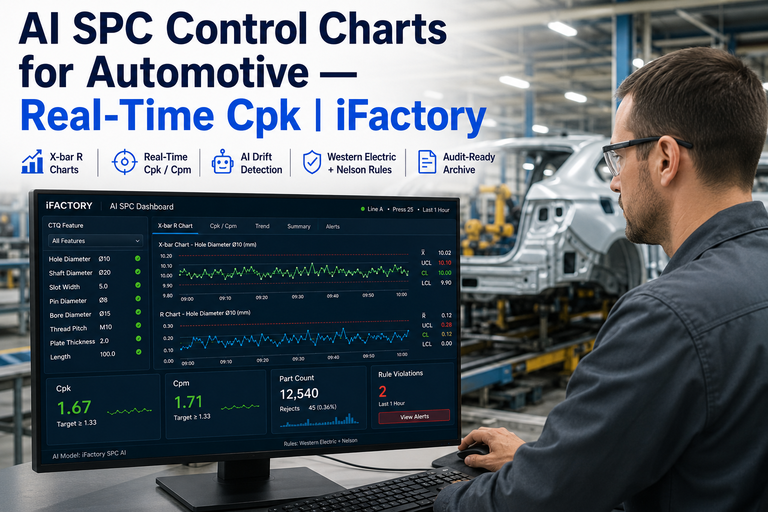
Every cycle feeds an X-bar and R chart. When a point violates a Western Electric rule, the system flags it instantly — no waiting for a shift-end report.
Any single point beyond 3-sigma from the centerline.
Rule 2
Two of three consecutive points beyond 2-sigma on the same side.
Rule 3
Four of five consecutive points beyond 1-sigma on the same side.
Rule 4
Eight consecutive points on one side of the centerline.
Rule 5
Six points in a row steadily increasing or decreasing.
Rule 6
Fourteen points in a row alternating up and down.
Rule 7
Fifteen points in a row within 1-sigma (hugging the centerline).
Rule 8
Eight points in a row beyond 1-sigma on either side.
Process capability (Cp / Cpk) live
Cp tells you how wide the process spread is relative to the tolerance. Cpk tells you whether that spread is centered. iFactory tracks both continuously and flags the moment Cpk drops below your threshold.
Cp — Spread only
Spread fits tolerance with room. Process is capable in principle.
Cpk — Centered spread
Mean has shifted toward LSL. Below 1.33 threshold — alert fired.
Cpk value
Interpretation
Action
above 1.67
Highly capable, well-centered
Continue running
1.33 to 1.67
Capable, minor centering offset
Monitor trend
1.00 to 1.33
Marginal — drift risk
Investigate, trend watch
below 1.00
Not capable — scrap likely
Stop, adjust, re-qualify
From alert to containment
When a rule trips, the system does not just log it. iFactory routes the alert to the operator, recommends a corrective action, and writes the event to your QMS — all inside the plant network.
01
Rule violation detected
Western Electric engine evaluates every subgroup. Rule 2 trips on cavity pressure at shot 343.
02
Operator alert on HMI
Within 0.8 seconds the press HMI shows the violated rule, the drifting variable, and the last good setpoint.
03
AI corrective recommendation
The model correlates the drift with recent machine settings and suggests a hold-pressure adjustment of +3 bar.
04
Auto-hold or manual adjust
Configurable: the system can place the press on hold automatically, or wait for operator confirmation before resuming.
05
QMS record written via API
The event, root-cause variable, corrective action, and affected shot range are posted to your MES/QMS automatically.
Operator-to-AI dialogue — press HMI
OperatorRule 2 tripped on cavity 3. What changed?
iFactory AIHold pressure dropped 4 bar over the last 12 shots. Melt temp is stable. Recommend restoring hold to 385 bar and quarantining shots 335 to 343.
OperatorQuarantine accepted. Adjusting hold pressure now.
iFactory AILogged. Cpk recalculating on next 5 subgroups. QMS event 2024-0847 written.
Rollout and benchmarks
iFactory ships a pre-configured NVIDIA AI server, racked and ready. Most molding lines are live in 6 to 12 weeks across a three-phase rollout.
Phase 1 — Connect
Edge gateway installed. Sensor channels mapped. OPC UA link to press controller validated. 2 to 4 weeks.
Phase 2 — Baseline
30-day baseline run. Control limits calculated. Western Electric rules tuned to your defect modes. 2 to 4 weeks.
Phase 3 — Live SPC
Alerts active on HMI. QMS API live. Auto-hold policy configured. Operator training complete. 2 to 4 weeks.
Defect reduction after 90 days of live SPC — 6 customer molding lines
Want a baseline study on your line? Book a demo and we will scope the sensor mapping with your team.
Frequently asked questions
Does iFactory work with our existing molding machines?
If your press exposes OPC UA or an SPI-compatible interface, the edge gateway can connect directly. For older machines, we add external cavity-pressure and temperature sensors that feed the same pipeline. Most presses manufactured after 2010 connect without hardware modification.
Where does the AI server run — cloud or on-prem?
On-prem. The pre-configured NVIDIA AI server sits inside your plant network. No process data leaves your facility. This matters for IP-sensitive tooling data and for the sub-second alert latency that real-time SPC requires.
How long does it take to calculate control limits?
A 30-day baseline run gives us enough subgroups to set statistically valid limits. If you already have historical process data exported from your SCADA or MES, we can seed the limits faster and spend the baseline period validating them.
Can the system auto-stop the press when a rule trips?
Yes. Auto-hold is configurable per rule and per variable. You can start in alert-only mode, then enable auto-hold once your team is comfortable with the rule sensitivity. The operator always sees what happened and why before resuming.
How does this integrate with our QMS?
iFactory posts event records — rule violation, root-cause variable, corrective action, affected shot range, operator ID — to your QMS via REST API. We have standard connectors for common MES/QMS platforms and can adapt to a custom endpoint.
What uptime can we expect?
The on-prem server is designed for 99.9 percent uptime with redundant storage and automated failover. If the network link to your MES drops, the edge gateway buffers events locally and syncs when connectivity returns — no data loss.
READY TO SEE IT ON YOUR LINE?
Stop inspecting scrap. Start controlling the process.
Book a 30-minute demo. We will walk through a live SPC dashboard on a reference molding line and show you exactly how a Western Electric rule trip becomes a contained event in under a second.