Global AI spending will hit $2.5 trillion in 2026 — a 44% increase from 2025. Yet 42% of companies abandoned most AI projects last year, and more than half of finance executives cannot clearly demonstrate ROI from their AI initiatives. The gap isn't technology — it's financial framework. This guide gives manufacturing CFOs the exact model to evaluate edge AI investments: what to spend, what to expect, how fast you'll see returns, and how to present a boardroom-ready business case that gets approved.
AI-Native Digital Transformation for Smart Manufacturing
Join iFactory's expert-led session covering the financial frameworks, ROI models, and implementation strategies that manufacturing CFOs and plant managers need to justify and execute edge AI investments.
The Edge AI Investment Landscape: What CFOs Need to Know in 2026
Edge AI processes data locally at the machine level — inside your factory, not in a distant cloud server. For manufacturing, this means real-time anomaly detection, predictive maintenance, quality inspection, and energy optimization happening in milliseconds, directly on the production floor. Here's why this matters financially:
The CFO's Edge AI ROI Framework: 4 Financial Pillars
Every successful edge AI business case is built on four measurable financial pillars. Here's the framework CFOs at leading manufacturers use — and the benchmarks your board will want to see:
Cloud-native CMMS platforms like iFactory shift the cost structure from heavy upfront capital to predictable monthly spend — dramatically lowering the approval threshold and financial risk. No on-premise servers, no version upgrades, no IT overhead.
Edge AI in manufacturing pays back faster than any other AI category because the savings are tangible and immediate: avoided downtime ($260K/hour average), reduced energy, less scrap. 82% of enterprises report positive edge ROI within 12 months.
A 1-point OEE improvement on a $50M revenue line = $500K+ annual impact. Edge AI typically delivers 5-15 OEE points in the first year.
Research shows AI leaders achieve 1.6x EBIT margin, 1.7x revenue growth, and 2.7x return on invested capital vs laggards. The financial gap between adopters and non-adopters is widening every quarter.
Need these numbers for your specific plant? iFactory's team builds custom ROI models based on your asset count, downtime costs, and maintenance budget. Book a 30-minute ROI assessment →
The Edge AI Savings Calculator: Where Every Dollar Comes From
CFOs don't approve vague "digital transformation" budgets. They approve investments with clear, line-item financial returns. Here's exactly where edge AI generates measurable savings in a manufacturing environment:
What Would These Savings Look Like for Your Plant?
iFactory builds custom ROI models based on your asset count, downtime history, energy bills, and maintenance budget. Get a plant-specific financial case in 30 minutes — not a generic pitch deck.
Why 42% of AI Projects Fail — And How to Avoid the Financial Trap
MIT research shows 95% of organizations reported zero ROI from generative AI projects in 2025. Meanwhile, manufacturing edge AI tells a completely different story — 82% positive ROI within 12 months. The difference? Financial discipline and operational focus. Here's what separates AI investments that pay off from those that don't:
Expert Perspectives: CFOs & Analysts on Manufacturing AI ROI
Visionary AI adopters achieve 1.7x revenue growth, 3.6x three-year total shareholder return, 2.7x return on invested capital, and 1.6x EBIT margin compared to laggards. The financial gap is accelerating.
Digital twins and edge AI deliver up to 7% monthly cost reduction, 20% consumer fulfillment improvement, 10% labor cost reduction, and 5% revenue increase from optimized operations in manufacturing.
By 2029, 30% of factories will manage control systems centrally through open automation platforms. 40%+ of manufacturers will adopt AI scheduling in 2026. 60% will leverage hyperscaler ecosystems for AI by 2027.
AI infrastructure gets $1.3 trillion of the 2026 investment — nearly 50% of the total uplift. AI will be sold by incumbents rather than bought as moonshots. The trough of disillusionment hits GenAI — but manufacturing edge AI delivers clear, measurable returns.
Frequently Asked Questions
Manufacturing edge AI consistently shows faster payback than general enterprise AI. Focused pilots on critical equipment typically see initial ROI within 3-6 months. Full production-scale deployments achieve payback in 9-14 months. One documented case showed a $215K investment generating $305K in annual savings — a 14-month payback. The key is starting with high-impact use cases: predictive maintenance on your most failure-prone assets. Book a demo and we'll model the payback for your specific plant.
Cloud-native platforms like iFactory shift the model heavily toward OpEx — no on-premise servers, no perpetual licenses, no IT infrastructure investment. The only CapEx component is IIoT sensors and edge gateways (typically $50K-$200K for initial deployment). The CMMS platform runs as a predictable monthly subscription. This structure lowers board approval thresholds and eliminates the financial risk of large upfront capital commitments.
This is the most important distinction for CFOs: generative AI (text, images, chatbots) and industrial edge AI are completely different investment categories. GenAI struggles with ROI because the outputs are qualitative and hard to measure. Edge AI in manufacturing produces quantifiable financial outcomes: avoided downtime in dollars, energy savings in kilowatt-hours, scrap reduction in material costs. 82% of enterprises report positive edge computing ROI within 12 months — a number GenAI can't match.
iFactory is a cloud-native subscription platform — no upfront license fees, no on-premise infrastructure, no IT overhead. Pricing scales with asset count and facility size. In a 30-minute demo, we'll walk through pricing for your specific operation and build a custom ROI model showing expected savings vs. investment. Most plants find the platform pays for itself within the first quarter through maintenance cost reduction alone.
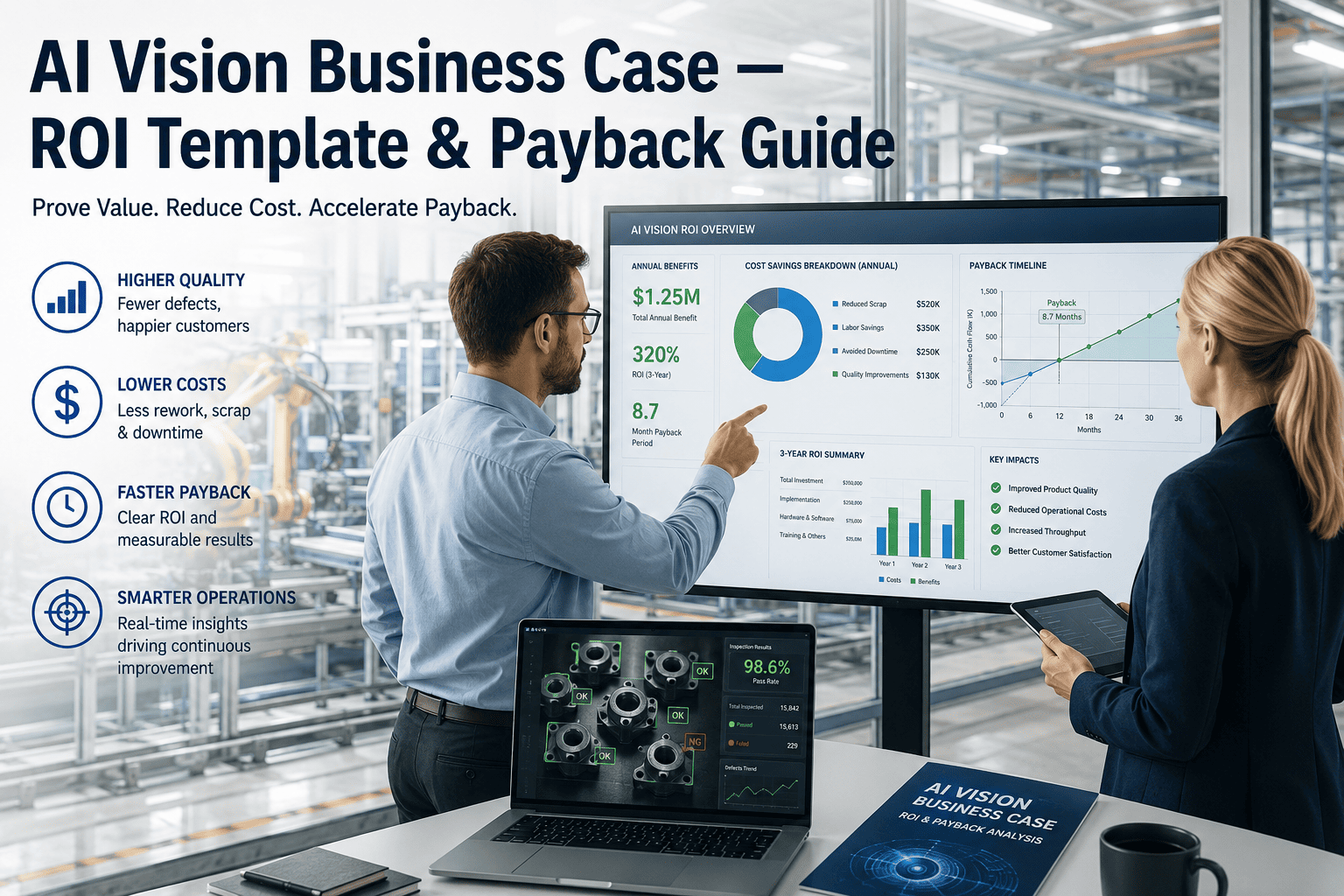
Board presentations that succeed follow a four-part structure: (1) the problem in dollars — current downtime cost, energy waste, scrap rates; (2) the solution in concrete terms — predictive maintenance, automated work orders, real-time asset monitoring; (3) the financial model — CapEx/OpEx breakdown, 12-month payback projection, 3-year NPV; (4) the competitive risk — 97% of CIOs have edge AI on their roadmap, competitors are deploying now. iFactory's team helps build this presentation. Book a demo and we'll start with your numbers.
Get Your Plant-Specific ROI Model in 30 Minutes
Stop guessing at AI ROI. iFactory's team builds custom financial models based on your actual downtime costs, energy bills, maintenance budget, and asset count. Walk away with a boardroom-ready business case — not a generic slide deck.