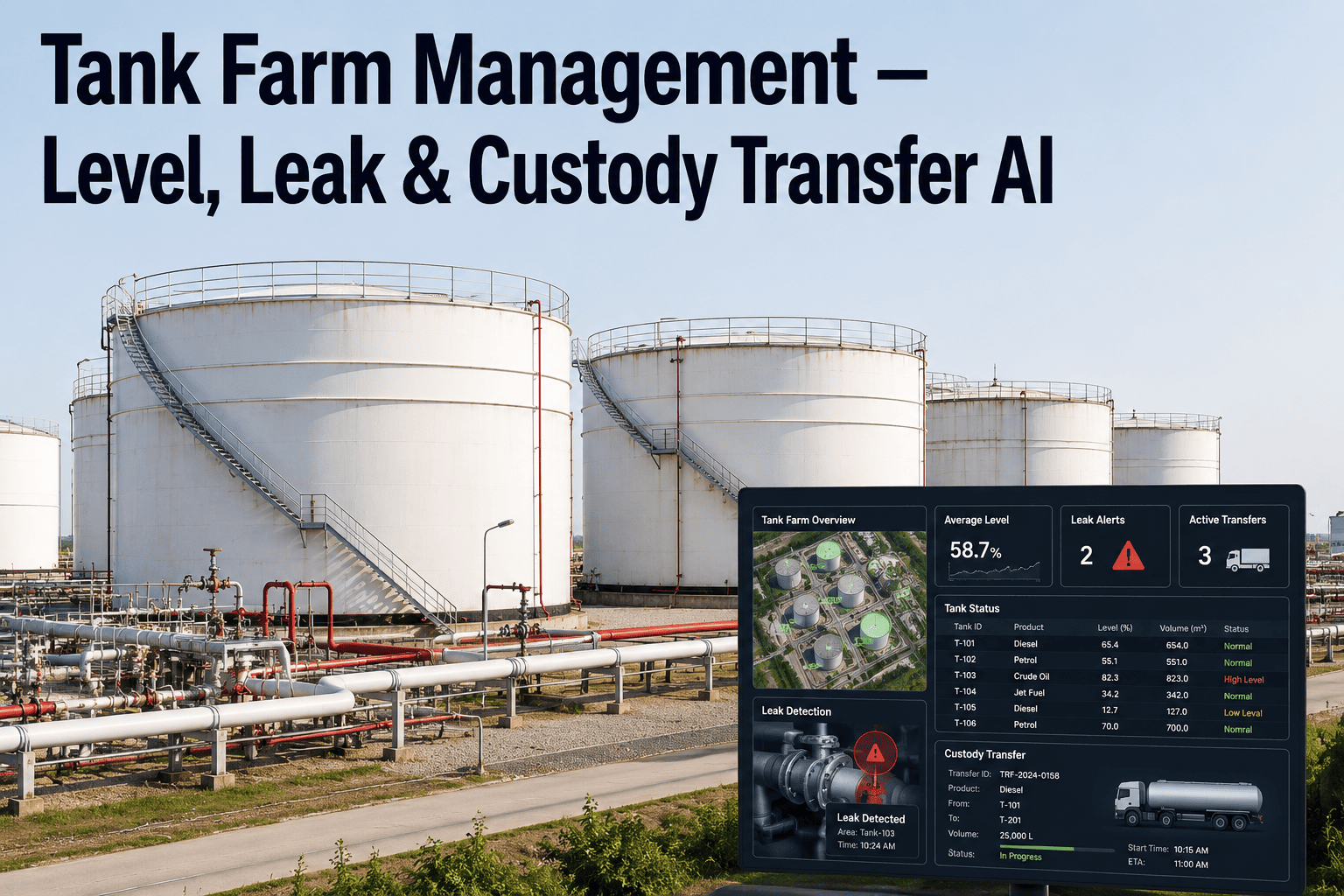
A tank farm is one of the few places in an oil and gas operation where a rounding error in measurement translates directly into a financial dispute. Custody transfer reconciliation depends on tank level readings accurate to a fraction of a percent, yet many farms still run on radar gauges calibrated months ago, manual gauging rounds, and inventory spreadsheets that get reconciled after the fact rather than in real time. The result is inventory discrepancy that shows up at month-end as a number nobody can fully explain — and in the worst cases, a slow leak that goes undetected until a tank bottom inspection finds product loss that has been accumulating for weeks. Operators who want to see how continuous monitoring closes this gap can book a demo with their own tank configuration.
The Real Cost of a 90% Preventable Discrepancy
API MPMS measurement standards exist precisely because tank inventory accounting has historically been a source of dispute between buyers, sellers, and terminal operators. Most inventory discrepancies do not come from a single dramatic failure — they accumulate from small, compounding sources: radar gauge drift, temperature correction errors, incomplete strapping tables, and manual data entry lag between the field and the accounting system. AI-based tank farm inventory management closes each of these gaps individually, which is why operators typically see discrepancy rates fall by as much as 90% within two reporting cycles of deployment.
Four Failure Modes Every Tank Farm Should Be Watching For
Tank leak detection and structural monitoring are often treated as separate concerns from inventory accounting, but the same sensor data feeds both. A platform that watches level, temperature, pressure and vapor readings continuously can flag the earliest signs of each of these four failure modes long before they become a spill report or an insurance claim.
Slow, gradual level anomalies inconsistent with throughput patterns often indicate bottom plate thinning before it becomes a visible leak.
Vapor pressure deviations combined with unexpected evaporative loss point to a compromised primary or secondary seal.
Rate-of-rise monitoring against tank capacity and transfer schedule prevents the single most common cause of tank farm spill incidents.
Small, consistent gauge drift during product movement is the most common — and most preventable — source of billing disputes.
What Continuous Monitoring Adds to a Standard Tank Farm Safety System
Most tank farm safety systems today handle the alarm-level basics — high-high level shutdown, low-low pump protection — but stop short of the predictive layer that catches problems while they're still cheap to fix. Book a demo to see how iFactory layers predictive analytics on top of your existing safety instrumentation without replacing it. The comparison below breaks down what each layer typically covers.
| Monitoring Layer | What It Catches | Response Type | Typical Lead Time |
|---|---|---|---|
| Basic safety instrumentation | High/low level, overfill | Reactive shutdown | Seconds |
| Continuous radar + vapor sensing | Seal and pressure anomalies | Alert-driven inspection | Hours to days |
| AI trend analysis | Corrosion, drift, gradual loss | Scheduled maintenance trigger | Days to weeks |
| Custody transfer reconciliation AI | Billing discrepancies, meter drift | Automated flag before invoicing | Same transfer cycle |
Petroleum Stock Accounting: From Manual Sampling to Automated Reconciliation
Petroleum stock accounting has traditionally required a physical gauging round, a lab sample for density and temperature correction, and a manual entry into an accounting system that may not talk to the terminal's SCADA historian at all. Automated tank sampling and API MPMS-compliant calculation engines remove the lag between physical measurement and recorded inventory value, which matters most during high-frequency custody transfer operations where even a few hours of lag can create a reconciliation gap. The workflow below shows how the process compresses once automation is introduced.
Continuous Level & Temperature Capture
Radar gauges and temperature sensors log readings continuously rather than at scheduled gauging intervals.
Automated Volume Correction
Strapping table and temperature correction calculations run automatically, following API MPMS measurement methodology.
Movement Reconciliation
Product movement tracking cross-references transfer meter data against tank-derived volume in the same reporting window.
Discrepancy Flagging
Any variance beyond tolerance is flagged automatically before the invoice or transfer document is finalized.
Frequently Asked Questions: Tank Farm Monitoring and Inventory Accuracy
How much can AI-based monitoring reduce tank inventory discrepancies?
Operators moving from manual gauging to continuous AI-based reconciliation typically see discrepancy rates drop by 85–90% within the first two reporting cycles, since most of the variance comes from timing and calculation lag rather than actual product loss. Book a demo to see the reduction modeled on your own tank data.
Can tank leak detection work with existing radar gauges?
Yes — most continuous leak detection layers are built to ingest data from existing radar or servo gauges rather than requiring new hardware, adding trend analysis and anomaly detection on top of readings you already collect.
What is API MPMS and why does it matter for custody transfer?
API MPMS is the Manual of Petroleum Measurement Standards, the industry reference for volume correction, sampling and custody transfer calculation. Reconciliation systems that follow MPMS methodology are far more defensible in a billing dispute than ad-hoc spreadsheet calculations.
How does floating roof seal monitoring prevent vapor loss?
Continuous vapor pressure and evaporative loss tracking identifies a degrading primary or secondary seal weeks before a visual inspection would catch it, allowing maintenance to be scheduled rather than triggered by an emissions incident.
Does this kind of monitoring require replacing our existing tank farm safety system?
No — analytics platforms are typically layered on top of existing safety instrumentation and SCADA systems rather than replacing them. Talk to support about your current setup to confirm integration requirements.