In 2025, a mid-size automotive components manufacturing plant in the Midwest was losing an estimated $2.4 million annually to unplanned equipment downtime. Aging machinery, reactive maintenance cycles, and disconnected work order processes had pushed OEE (Overall Equipment Effectiveness) below 68% — well under the 85% industry benchmark. Within nine months of deploying iFactory's AI-driven CMMS platform integrated with AI vision cameras, the plant achieved a 41% reduction in unplanned downtime, restored OEE to 84%, and recovered over $980,000 in annual production value.
The Downtime Problem: Why Traditional Maintenance Was Failing This Plant
The plant operated 140 CNC machines, 22 stamping presses, and a network of conveyor and transfer systems across 380,000 square feet of production floor. Maintenance was handled by a team of 18 technicians working primarily on reactive schedules — responding to failures after they occurred rather than preventing them. Three structural problems compounded every quarter.
First, maintenance records were logged manually on paper work orders and transcribed into a legacy CMMS system with a 24-to-48-hour delay. By the time failure data reached planners, the pattern of recurring faults on specific machine lines was invisible in the noise. Second, visual inspection of equipment condition was conducted monthly at best — too infrequently to catch early-stage bearing wear, hydraulic drift, or thermal anomalies before they progressed to failure events. Third, spare parts inventory was managed reactively, with critical components frequently out of stock at the moment they were needed, extending mean time to repair (MTTR) beyond what the failure itself required.
Four Failure Patterns That Drove 78% of All Unplanned Downtime Events
Before deployment, iFactory's industrial analytics team conducted a 90-day baseline audit using historical maintenance records, production logs, and an initial AI vision camera survey of the plant floor. The audit identified four recurring failure categories responsible for the overwhelming majority of unplanned downtime hours — each addressable through a combination of AI-driven condition monitoring and automated CMMS workflow integration.
— Maintenance Manager, Automotive Components Plant
How iFactory CMMS and AI Vision Cameras Were Deployed to Eliminate Reactive Maintenance
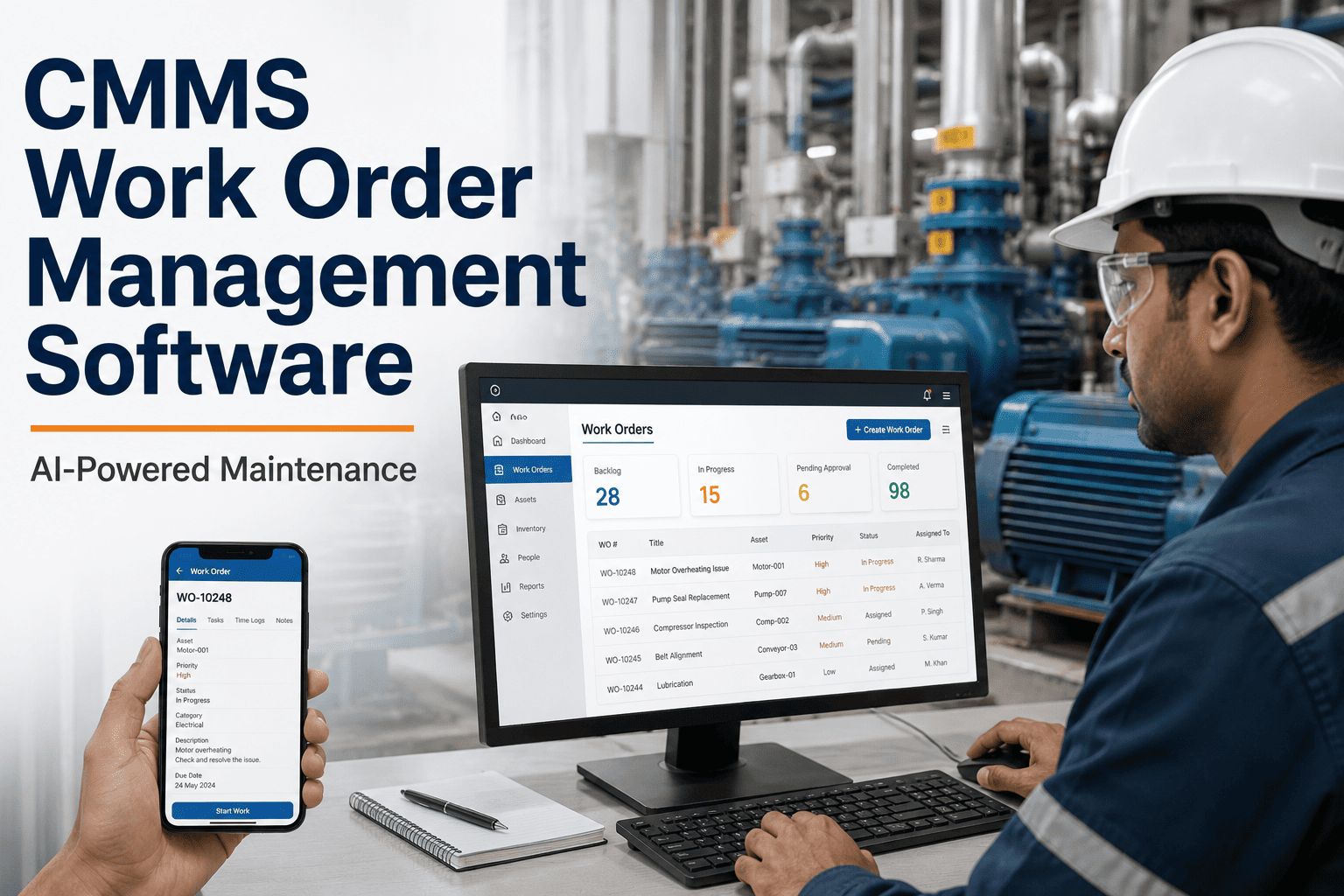
iFactory deployed its AI Vision Camera platform in combination with the iFactory EAM/CMMS system across the plant's four highest-downtime production zones. The deployment was designed to close the three structural gaps identified in the baseline audit: continuous condition visibility, zero-latency work order generation, and integrated spare parts triggering. Reliability and maintenance managers interested in applying this architecture to their own facility can Book a Demo with iFactory's industrial analytics team.
From Baseline Assessment to Full Predictive Operations: The Four-Phase Deployment
The deployment followed iFactory's structured four-phase implementation model, progressing from initial facility assessment through full autonomous predictive maintenance operation. Total time from first camera installation to full autonomous operation was 14 weeks — with measurable downtime reduction beginning in week 6 of the supervised pilot phase.
iFactory's team conducted a full plant walkdown, identifying 38 high-priority monitoring points based on failure history and downtime impact. Asset data — machine specifications, historical failure records, maintenance intervals — was imported into the iFactory CMMS registry. AI vision camera mounting positions were engineered for optimal field of view at each monitoring point.
All 38 AI Vision Camera units were installed and commissioned. Each camera collected continuous condition data during normal production operations to establish asset-specific baseline profiles. iFactory AI models began training on live production data, with initial anomaly thresholds set conservatively to avoid false positive work orders during the calibration period.
iFactory threshold logic was activated with maintenance supervisor review for each AI-generated work order. Within three weeks, the first confirmed predictive interventions were executed — including a spindle bearing replacement on Machine Center 14 that avoided a projected 18-hour unplanned stoppage. Threshold sensitivity was refined based on confirmed detection outcomes versus false positive rate.
Automated work order dispatch activated without supervisor review requirement for standard severity anomalies. Spare parts integration enabled automatic stock level checks on all predictive work orders. 90-day post-deployment performance review confirmed 41% reduction in unplanned downtime events and OEE recovery from 67.4% to 84.1% across monitored production zones.
Measured Outcomes: Nine Months of iFactory CMMS + AI Vision Deployment
The following performance metrics were measured across a nine-month post-deployment period compared to the 12-month baseline period immediately preceding iFactory implementation. All figures reflect documented outcomes from plant maintenance records and iFactory platform analytics. Reliability and EHS teams building business cases for similar deployments can Book a Demo with iFactory to model projected outcomes for their specific asset population.
| Performance Metric | Pre-Deployment Baseline | Post-Deployment (9 Months) | Operational Outcome |
|---|---|---|---|
| Unplanned downtime events (monthly avg) | 34 events/month | 20 events/month | 41% reduction in unplanned stoppages |
| Overall Equipment Effectiveness (OEE) | 67.4% | 84.1% | 16.7-point OEE recovery toward benchmark |
| Mean Time to Repair (MTTR) | 6.8 hours average | 2.9 hours average | 57% MTTR reduction via pre-staged planned interventions |
| Planned vs reactive maintenance ratio | 28% planned / 72% reactive | 71% planned / 29% reactive | Fundamental shift to predictive maintenance posture |
| Work order generation latency | 24–48 hour manual entry delay | Under 3 seconds automated dispatch | Zero-latency corrective action initiation |
| Spare parts stockout delays | 23% of repair events delayed by parts availability | 4% of repair events delayed | 83% reduction in parts-related MTTR extension |
| Annual production value recovered | — | $980,000+ recovered | 40%+ of pre-deployment annual downtime cost recovered |
| Bearing failure events (CNC spindles) | 11 failure events in baseline year | 2 failure events in 9 months | Predictive detection eliminated 82% of spindle failures |
What This Deployment Teaches About CMMS and Predictive Maintenance in Manufacturing
The detection gap is more costly than the failure itself. In this plant, 57% of MTTR reduction came not from faster repairs but from eliminating the unplanned nature of interventions — pre-staged parts, pre-scheduled technician time, and pre-identified scope transformed the same repair from a 6.8-hour emergency into a 2.9-hour planned event. CMMS ROI is often mis-attributed to faster wrench time when the real gain is in planning quality.
AI vision cameras provide condition monitoring coverage that fixed sensor networks cannot economically justify at scale. Instrumenting 140 CNC machines with dedicated vibration and thermal sensors would require capital investment an order of magnitude higher than the vision camera deployment. Strategic placement of AI Vision Camera units at high-risk monitoring points delivers broad-coverage anomaly detection without per-asset sensor infrastructure costs.
The integration between detection and action is where CMMS programs succeed or fail. Operators who deploy sensors or cameras without a connected CMMS layer capable of automated work order generation are collecting condition data with no operational pathway to act on it. The three-second detection-to-dispatch loop that iFactory's platform provides is not an incremental improvement on manual relay — it is the structural requirement for predictive maintenance to function as designed.
Predictive maintenance ROI is compounding, not linear. In the first three months of this deployment, predictive interventions prevented seven confirmed failure events. Each prevented failure reduced not only direct repair cost and downtime hours but also the secondary damage to adjacent components, tooling, and work-in-progress that unplanned failures typically cause. The documented $980,000 recovery figure understates total program value when secondary damage avoidance is included. Maintenance teams evaluating similar programs can Book a Demo with iFactory to model full-scope ROI for their specific asset base.
iFactory AI Vision Camera: Core Capabilities That Drove This Outcome
The iFactory AI Vision Camera platform deployed in this case study is available for manufacturing, refinery, and process industry applications. The platform is designed as a complete condition monitoring and maintenance intelligence solution — not a standalone sensor product. The following capabilities were central to the downtime reduction outcomes documented in this case study.
— Plant Engineering Director, Post-Deployment Review
Manufacturing Downtime Reduction in 2026: The CMMS Intelligence Layer Is the Deciding Factor
This deployment demonstrates that the technology infrastructure required to achieve transformational downtime reduction in manufacturing is available, commercially deployable, and capable of generating ROI within a single fiscal year. The AI vision cameras, IoT sensors, and predictive analytics that identified bearing degradation 14 days before failure are not experimental — they are production-grade tools running on active manufacturing floors in 2026.
What separates plants that achieve 40%+ downtime reduction from those that achieve incremental improvement is not sensor coverage — it is the CMMS intelligence layer that converts detected anomalies into dispatched maintenance actions with zero latency and no manual relay. iFactory provides that layer. To understand how iFactory structures this integration for your specific plant configuration, asset population, and maintenance workflow, Book a Demo with iFactory's industrial analytics team.