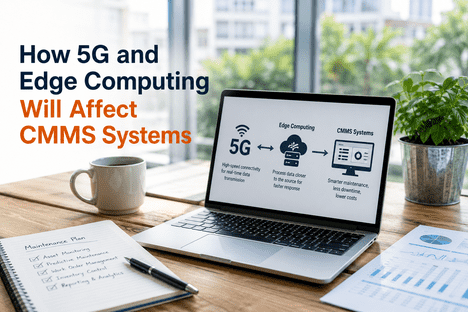
The convergence of 5G connectivity and edge computing is fundamentally reshaping how Computerized Maintenance Management Systems operate in industrial environments. For decades, CMMS platforms have relied on periodic data entry, scheduled inspections, and reactive work orders triggered by operator reports. That model is collapsing under the weight of its own latency. 5G delivers sub-10ms deterministic latency with the capacity to connect over one million devices per square kilometer, while edge computing processes data at the source — eliminating the round-trip to centralized cloud servers that introduces seconds of delay. Together, these technologies transform CMMS from a record-keeping system into a real-time decision engine. Anomaly detection models running on edge gateways can now trigger work orders within milliseconds of a vibration spike, a thermal excursion, or a current signature deviation — before the equipment operator even knows a problem exists. Facilities deploying 5G-connected edge AI for maintenance report 41% faster anomaly detection response times and 28% fewer cloud-dependent failures. iFactory's AI vision camera platform — purpose-built for edge deployment on NVIDIA GPU hardware — delivers sub-50ms inference latency for defect detection, thermal anomaly monitoring, and automated CMMS work order generation, with zero cloud dependency. Book a Demo to see how edge AI integrates with your existing CMMS infrastructure.
Is Your CMMS Ready for Real-Time Edge Intelligence?
iFactory's AI vision, edge inference, and predictive analytics platform is built for high-consequence industrial environments — delivering sub-50ms anomaly detection with automated CMMS integration.
How 5G and Edge Computing Redefine CMMS Performance
The traditional CMMS workflow depends on human detection — an operator hears a noise, fills a form, a planner reviews it, a technician is dispatched hours or days later. By that time, the failure signature that was developing over weeks has already caused collateral damage. 5G and edge computing eliminate this delay by making the CMMS the direct consumer of machine-generated intelligence. Vibration sensors streaming at 25.6 kHz over private 5G networks feed edge-deployed AI models that detect bearing degradation patterns, classify severity, and generate structured work orders — all within milliseconds of the anomaly's first appearance. This is not theoretical. Aramco's autonomous gas plants process 2.5 billion standard cubic feet of raw gas daily with AI-driven control systems that operate on similar edge architectures. iFactory's AI vision camera platform extends this same capability to visual and thermal inspection, detecting cracks, corrosion, overheating components, and PPE violations at 99.4% accuracy with on-premise edge inference.
Real-Time Condition Monitoring
5G enables continuous streaming from thousands of sensors across rotating equipment, conveyors, and electrical infrastructure. Edge AI processes vibration, thermal, and current data locally — triggering CMMS work orders the instant an anomaly crosses its severity threshold.
Predictive Work Order Automation
Edge-deployed machine learning models detect failure patterns weeks before catastrophic breakdown. Anomaly confidence scores above configured thresholds automatically generate prioritized CMMS work orders with attached diagnostic evidence and recommended parts.
Digital Twin Synchronization
5G's high bandwidth enables real-time digital twin updates from live sensor streams. Maintenance teams simulate repair scenarios, stress-test parameters, and forecast replacement timelines on the digital twin before touching physical equipment.
Mobile Workforce Enablement
Technicians with 5G-connected tablets receive instant work order updates, access live condition data, and stream HD inspection video from anywhere in the facility — completing repairs 40% faster through immediate access to technical resources and remote expert collaboration.
Four Ways 5G and Edge Computing Change CMMS Architecture
Understanding how 5G and edge computing alter CMMS architecture is critical for maintenance leaders planning their digital infrastructure investments. The shift is not incremental — it represents a fundamental change in where and how maintenance intelligence is generated, processed, and acted upon.
From Batch Upload to Continuous Streaming
Traditional CMMS platforms receive sensor data in periodic batch uploads — daily or weekly snapshots that create blind windows between readings. 5G enables continuous streaming analytics where every sensor reading immediately feeds into edge inference models. A vibration sensor sampling at 25.6 kHz generates 50 MB of data per hour. Edge processing reduces what reaches the CMMS to structured health packets — anomaly type, severity score, and asset ID — cutting data transmission volume by 95% while preserving real-time detection capability.
Cloud Dependency to Edge Autonomy
Cloud-dependent maintenance systems go blind during internet outages. Edge computing eliminates this failure mode entirely. AI models for anomaly detection, thermal pattern recognition, and defect classification execute on-premise — on edge gateways, local servers, or embedded controllers — with zero network dependency for real-time decisions. A 90% accurate edge model that runs during outages outperforms a 95% accurate cloud model that goes offline when needed most. iFactory's AI vision platform runs entirely on NVIDIA GPU edge hardware inside the facility firewall, with sub-50ms inference and no data leaving the plant.
Calendar-Based to Condition-Based Scheduling
5G-connected sensors report actual machine cycles, runtime hours, and production load to the CMMS in real time. Preventive maintenance schedules trigger based on genuine equipment usage — not calendar intervals. A press completing one million cycles automatically fires its die inspection work order regardless of what day it is. This shift from time-based to usage-based scheduling eliminates unnecessary maintenance while preventing the failures that occur between scheduled intervals.
Reactive Alerts to Prescriptive Actions
The combination of 5G connectivity and edge AI enables CMMS platforms to move beyond predictive alerts to prescriptive recommendations. When a motor shows overheating patterns, the system does not simply notify — it recommends reducing load by 15% for four hours to prevent seizure, automatically schedules replacement during planned downtime, orders the correct replacement bearing, and assigns the technician with the relevant skillset. This shift from what will happen to what should be done represents the next evolution in maintenance intelligence. Book a Demo to see how iFactory's platform closes the loop from detection to prescriptive action.
The Edge-to-Cloud Architecture Powering Next-Generation CMMS
The CMMS systems of 2026 do not operate in isolation — they function as the maintenance execution layer within a broader distributed intelligence architecture spanning edge devices, plant servers, and cloud platforms. Understanding this architecture is essential for any industrial technology leader planning a 5G and edge computing investment.
Three-Layer Architecture for 5G-Enabled CMMS Intelligence
Data acquisition, signal processing, and real-time anomaly detection occur at the machine or gateway. 100% of raw sensor data is processed here; only 1% leaves. Immediate actions — machine shut-off, threshold alerts — execute in under 10ms. iFactory's AI vision cameras process visual and thermal data at this layer with sub-50ms inference on NVIDIA GPU hardware.
A plant-level server aggregates health packets and alerts from edge devices, combines them with SCADA context (speed, load, pressure), and generates structured CMMS work orders for non-emergency anomalies. Stores 30+ days of high-resolution data for local root-cause analysis by reliability engineers.
Receives only metadata, statistical features, and failure snapshots. Retrains AI models on cross-facility data and pushes updated model weights back to edge devices. Enables portfolio-level dashboards comparing asset reliability across global sites without exposing raw operational data.
Private 5G networks deliver sub-10ms deterministic latency, support over one million devices per square kilometer, and provide seamless handover for mobile assets and technicians. Network slicing ensures critical safety and diagnostic data always transmit instantly, even during peak usage periods.
What This Means for Industrial Maintenance Operations
The convergence of 5G and edge computing is not a technology upgrade cycle — it is a competitive discontinuity. Facilities that deploy these technologies achieve 30-50% reduction in unplanned downtime, 25% lower maintenance costs, and 20-30% extension in asset life. Those that delay face widening gaps in reliability, labor efficiency, and production throughput.
5G supports over one million devices per square kilometer, enabling full instrumentation of every bearing, motor, pump, and conveyor. Legacy Wi-Fi networks cannot handle this density without congestion and latency spikes. Facilities limited by connectivity can now achieve complete asset health visibility.
Processing at the edge eliminates cloud round-trip latency and keeps sensitive operational data on-premise. iFactory's platform runs all AI inference on NVIDIA edge hardware — no cloud dependency, no data leaving the facility, full operation during internet outages.
When sensor data streams continuously and edge AI generates structured work orders automatically, the CMMS transforms from a passive database into an active operations hub — prioritizing tasks, scheduling resources, and tracking resolution in real time.
5G and edge enable the leap from what will fail to what to do about it. AI systems recommend specific corrective actions, schedule parts, and assign technicians — closing the loop from detection to resolution without human intermediary steps.
Facilities deploying 5G-connected edge AI for maintenance report full payback within 12 months driven by 30-50% downtime reduction, 25-35% lower emergency repair costs, and 40% faster repair completion through instant data access.
AI handles continuous monitoring that no human team can sustain 24/7, providing technicians with precise diagnostic data and weeks of lead time. Teams shift from reactive firefighting to planned, efficient maintenance execution.
Deploy Edge AI That Transforms Your CMMS Into a Real-Time Intelligence Engine
iFactory's unified AI platform — combining computer vision, digital twin modeling, edge inference, and automated CMMS integration — is designed for the industrial environments where 5G and edge computing are setting a new global standard for maintenance performance.
The CMMS of the Future Is Edge-Native and 5G-Connected
The convergence of 5G and edge computing is not an incremental improvement to existing CMMS workflows — it is a fundamental architectural shift that redefines what maintenance software can achieve. Real-time condition monitoring, automated prescriptive work orders, digital twin synchronization, and mobile workforce enablement are not aspirational features. They are operational capabilities that facilities deploying 5G-connected edge AI are delivering today. Organizations that continue treating CMMS as a record-keeping system rather than a real-time intelligence platform are making a competitive bet that the latency gap does not matter. The evidence from early adopters suggests otherwise: 30-50% fewer unplanned stops, 25% lower maintenance costs, and 40% faster repairs. iFactory's AI vision camera platform — with on-premise edge inference, 99.4% detection accuracy, and automated CMMS integration — provides the technology layer that makes this transformation achievable within weeks, not years. Book a Demo to see how your CMMS can operate at the standard 5G and edge computing now enable.
5G Edge Computing CMMS — Common Questions Answered
How does 5G improve CMMS system performance?
5G delivers sub-10ms deterministic latency, supports over one million connected devices per square kilometer, and provides seamless handover for mobile assets. CMMS platforms connected over 5G receive real-time sensor data streams, enabling instant work order generation for anomalies rather than depending on periodic batch uploads that introduce hours or days of detection delay.
What is the role of edge computing in CMMS maintenance workflows?
Edge computing processes sensor data and runs AI anomaly detection models at or near the equipment — eliminating cloud round-trip latency and ensuring continuous operation during internet outages. Edge-deployed models analyze vibration, thermal, and visual data in milliseconds, generating structured CMMS work orders with diagnostic evidence automatically.
Can existing CMMS platforms integrate with 5G and edge computing?
Yes. Modern CMMS platforms accept webhook and REST API triggers from edge gateways and IIoT platforms. When an edge anomaly event fires above a configured threshold, the system creates a prioritized work order with full asset context — failure mode, severity score, recommended action, and parts list — without manual data entry or protocol lock-in.
What is iFactory's AI vision camera and how does it relate to CMMS?
iFactory's AI vision camera platform combines computer vision, thermal imaging, and edge inference on NVIDIA GPU hardware to detect equipment defects, thermal anomalies, and safety violations in real time. Every detection automatically generates a structured CMMS work order with annotated visual evidence, severity classification, and asset mapping — closing the loop from visual inspection to maintenance action with zero manual intervention.
How quickly can 5G and edge computing for CMMS be deployed?
Most facilities deploy edge gateways and connect sensors to their CMMS within 1-2 weeks for initial coverage on critical assets. AI model training on facility-specific data requires 4-8 weeks of baseline collection. Full predictive capability with automated work order generation is typically operational within 3-6 months, with measurable downtime reduction appearing within the first quarter.