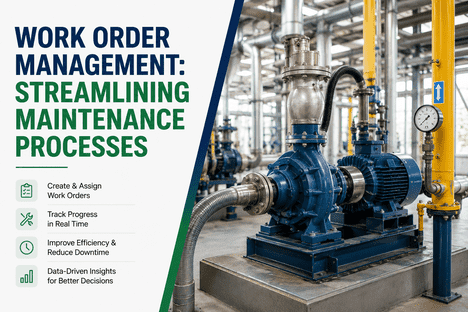
Most industrial facilities are not failing because they lack maintenance resources — they are failing because their maintenance strategy is anchored to a calendar rather than to the actual condition of their equipment. A bearing replaced every 90 days whether it needs it or not, a pump inspected on a fixed schedule while its vibration signature has been deteriorating for three weeks — these are the hallmarks of time-based preventive maintenance, and they represent both an overspend on unnecessary work and an exposure to failures that happen between service intervals. Predictive maintenance with AI closes that gap by replacing calendar logic with continuous condition intelligence: IoT sensors monitor vibration, temperature, pressure, and current draw around the clock, machine learning models identify the patterns that precede failure days or weeks in advance, and CMMS platforms convert those predictions into planned work orders before a breakdown can occur. In 2026, with AI failure prediction reaching 80–97% accuracy at 30–90 day advance windows, and IoT sensor costs falling below levels that make broad deployment economically obvious, the transition from preventive to AI-driven predictive maintenance is no longer a technology question — it is an execution decision. To see how iFactory's AI platform is already closing that gap in industrial operations, Book a Demo with our engineering team.
Why Preventive Maintenance Alone Is No Longer Sufficient in Industry 4.0
The Strategic Gap Between Scheduled Service and Actual Equipment Condition
Time-based preventive maintenance solved a real problem: it replaced the pure chaos of run-to-failure operations with structured, scheduled service intervals that extended equipment life and reduced catastrophic breakdowns. But it introduced its own systematic inefficiency. Studies consistently show that 30–40% of parts replaced under calendar-based PM still have significant useful life remaining — a direct waste of labor, parts spend, and scheduled production time. Simultaneously, failures that occur between service intervals — triggered by abnormal loading, thermal excursion, lubrication degradation, or contamination events — remain invisible to the PM schedule until the equipment stops working. The result is a maintenance program that simultaneously over-services assets that do not need intervention and misses failures that no calendar could have detected.
The Industry 4.0 operational environment amplifies this problem. Higher production throughput demands, tighter quality tolerances, just-in-time supply chains, and reduced buffer inventory mean that an unplanned equipment stoppage carries consequences that compound rapidly across the value chain. A $2,000 bearing replacement becomes a $25,000 emergency repair when the bearing seizes and damages the shaft, housing, and coupling — and that emergency repair is accompanied by unplanned downtime costs that average $260,000 per hour in high-throughput manufacturing. The case for AI-driven predictive maintenance is not philosophical. It is the arithmetic of prevention versus reaction.
The Technology Stack Behind AI Predictive Maintenance
From Sensor Signal to Maintenance Work Order: How the Architecture Works
AI predictive maintenance is not a single product — it is a connected architecture of four interdependent layers that must function together to convert raw equipment data into maintenance action. Understanding this stack is the prerequisite for evaluating any platform vendor and for designing a deployment that delivers measurable ROI rather than another disconnected monitoring tool that no one acts on.
AI Predictive Maintenance vs. Preventive Maintenance: The Performance Comparison
What the Data Shows About Downtime, Cost, and Parts Efficiency
The performance gap between AI predictive maintenance and traditional time-based preventive maintenance has been documented across enough industrial deployments that the comparison is no longer theoretical. The differences are consistent, quantifiable, and large enough to change maintenance budget allocation decisions at the executive level. The table below reflects 2026 industry benchmark data across manufacturing, facilities, and process industry deployments.
| Performance Dimension | Time-Based Preventive Maintenance | AI Predictive Maintenance | Improvement Delta |
|---|---|---|---|
| Unplanned Downtime Reduction | 15–20% vs. reactive baseline | 35–45% vs. reactive baseline | +20–25 percentage points |
| Maintenance Cost vs. Reactive | 10–15% savings | 25–40% savings | 2–3x greater cost reduction |
| Premature Parts Replacement | 30–40% of replaced parts have remaining life | 38% reduction in premature replacements | Direct parts spend reduction |
| Failure Detection Window | None — failures missed between intervals | 30–90 days advance warning | Entire advance warning window created |
| Emergency Repair Premium | Full exposure — undetected failures trigger emergency rates | 70–75% reduction in unexpected breakdowns | 4–6x cost differential avoided |
| Asset Lifespan | Extension from reduced run-to-failure events | 20–40% additional lifespan vs. PM alone | Deferred CapEx replacement value |
| ROI Timeline | Positive at 18–24 months | Positive within 12 months; 10–30x by 18 months | 6–12 months faster payback |
Ready to model the performance gap for your specific assets? Book a Demo with iFactory's platform engineering team to see a custom failure prediction and ROI projection for your facility.
AI Vision: The Predictive Maintenance Frontier That Sensors Alone Cannot Reach
How Computer Vision Extends Condition Monitoring Beyond Vibration and Temperature
Vibration and thermal sensors detect the mechanical and thermal signatures of developing failures — they are the established foundation of condition-based maintenance. But a growing class of industrial failure modes produces visual signatures before they produce measurable vibration or temperature anomalies: surface wear patterns on conveyor components, coating degradation on process rolls, fluid leak formation at connection points, alignment deviations visible in mechanical assemblies, and early-stage structural fatigue visible on weld zones and structural members. These failure precursors are invisible to conventional sensors and traditionally identified only through manual inspection rounds — which introduce a detection lag of hours to days depending on inspection frequency.
iFactory's AI Vision Camera platform applies deep learning computer vision to continuous visual inspection of industrial equipment and process outputs, closing the detection gap that conventional sensor networks leave open. Visual anomaly models trained on asset-specific image libraries identify wear, leak, misalignment, and surface degradation signatures at production speeds with sub-second latency — converting each detection event into a CMMS work order before the anomaly progresses to a failure. For operations where manual inspection cycles create unacceptable detection windows, AI Vision functions as a continuous, tireless inspection resource that operates at camera frame rate rather than human patrol frequency. Explore the iFactory AI Vision Camera to understand how visual intelligence integrates with your predictive maintenance architecture.
Implementing AI Predictive Maintenance: The Phased Approach That Delivers ROI in 90 Days
How to Start Small, Prove Value Fast, and Scale Without Risk
The organizations that achieve the fastest ROI from AI predictive maintenance share a common implementation pattern: they start with a small, focused pilot on five to ten high-criticality assets where the cost of failure is well-documented, they use existing sensor infrastructure where possible to reduce initial investment, and they define success metrics before deployment so that the ROI case writes itself from actual operational data rather than vendor benchmarks. This approach consistently delivers measurable results within 90 days — enough to build internal momentum and budget support for platform expansion — while the alternative of planning an 18-month facility-wide transformation frequently stalls before a single prediction is made.
Condition Monitoring Parameters: What AI Predictive Maintenance Actually Measures
The Sensor Signals That Reveal Equipment Degradation Before Failure Occurs
Effective AI predictive maintenance requires selecting the right monitoring parameters for each asset class — a selection driven by the dominant failure modes of that equipment type, not by sensor availability. Vibration analysis is the most widely deployed technique, accounting for nearly 40% of all predictive maintenance implementations, because rotating equipment failure modes — bearing degradation, imbalance, misalignment, looseness — all produce characteristic vibration signatures that appear weeks before mechanical failure. But vibration alone is insufficient for asset classes where thermal, electrical, or chemical degradation mechanisms dominate.
| Asset Class | Primary Monitoring Parameters | Key Failure Modes Detected | Advance Warning Window | AI Vision Supplement |
|---|---|---|---|---|
| Rotating Machinery (pumps, motors, fans) | Vibration (RMS, FFT), bearing temperature, current signature | Bearing spall, imbalance, misalignment, rotor bar cracking | 4–12 weeks | Seal leak, coupling wear, structural corrosion |
| Hydraulic Systems | Pressure, flow rate, fluid temperature, particle count | Seal wear, pump cavitation, valve bypass, contamination | 2–6 weeks | External leak detection, hose condition |
| Conveyor & Drive Systems | Belt tension, vibration, motor current, thermal imaging | Belt wear, roller bearing failure, drive chain elongation | 2–4 weeks | Belt surface condition, splice integrity, roller marking |
| Electrical Equipment (transformers, switchgear) | Oil dissolved gas analysis, partial discharge, thermal imaging | Insulation breakdown, winding fault, bushing degradation | 4–16 weeks | Hot spot detection, enclosure integrity |
| Process Rolls & Forming Equipment | Vibration, roll force load cells, surface roughness | Bearing failure, surface wear, chatter pattern development | 1–3 weeks | Surface defect pattern, roll mark detection, coating anomalies |
| Furnaces & Thermal Systems | Temperature profile, combustion efficiency, refractory thermocouples | Refractory hot spot, burner degradation, tube wall thinning | 2–8 weeks | Refractory surface cracking, flame pattern anomalies |
Not sure which monitoring parameters apply to your critical assets? Book a Demo with iFactory's platform team to map your asset portfolio to the right condition monitoring and AI Vision configuration.
Maintenance Strategy Transformation: From Reactive to Reliability-Centered
How AI Reframes the Entire Maintenance Management Function
The full impact of AI predictive maintenance is not captured in prevented failures alone — it extends to a structural transformation of how the maintenance function operates and how it is perceived within the organization. Maintenance departments that operate on reactive and calendar schedules are cost centers: their performance is measured by how much they spend, and their budget justification is historical spend patterns with no forward-looking analytics. Maintenance departments that operate on AI predictive platforms become reliability functions: their performance is measured by uptime delivered, failure cost avoided, and asset life extended — metrics that translate directly into production output and capital expenditure deferral.
This reframing matters for organizational investment decisions. When a maintenance team can present the CFO with a dashboard showing $2.3 million in avoided failure costs, 41 prevented emergency repair events, and 18 months of deferred equipment replacement value — all quantified from actual operational data with full traceability to sensor events and work orders — the maintenance budget conversation changes fundamentally. The platform is no longer a cost line; it is a documented ROI driver. iFactory's analytics layer is designed specifically to produce this financial narrative automatically, so maintenance engineers spend their time on equipment rather than assembling spreadsheets for budget presentations.
Conclusion
The maintenance strategy transformation that AI predictive maintenance enables is not incremental — it is structural. Moving from time-based service intervals to condition-driven intervention changes the economics of maintenance from a fixed-cost schedule to a variable-value function where every dollar spent is justified by equipment condition data and every avoided failure is quantified against a pre-deployment baseline. The technology to achieve this is no longer experimental or reserved for large enterprises with specialist data science teams: IoT sensors cost under $500 per asset, AI models achieve failure prediction accuracy above 90% within the first year of deployment, and platforms like iFactory integrate condition monitoring, AI Vision inspection, CMMS work order automation, and executive ROI reporting into a single operational layer that deploys without hardware replacement or extended implementation projects.
The 73% of facilities still operating without predictive maintenance are not behind because the technology is unavailable or unaffordable. They are behind because the transition has not yet been framed as the execution decision it actually is. The first five high-criticality assets monitored, the first prevented failure event, and the first quantified ROI figure presented to a CFO are the proof points that convert organizational skepticism into budget commitment. The facilities that make that first step in 2026 will be compounding the reliability and cost advantages of AI-driven maintenance for years before their competitors reach the same starting line.