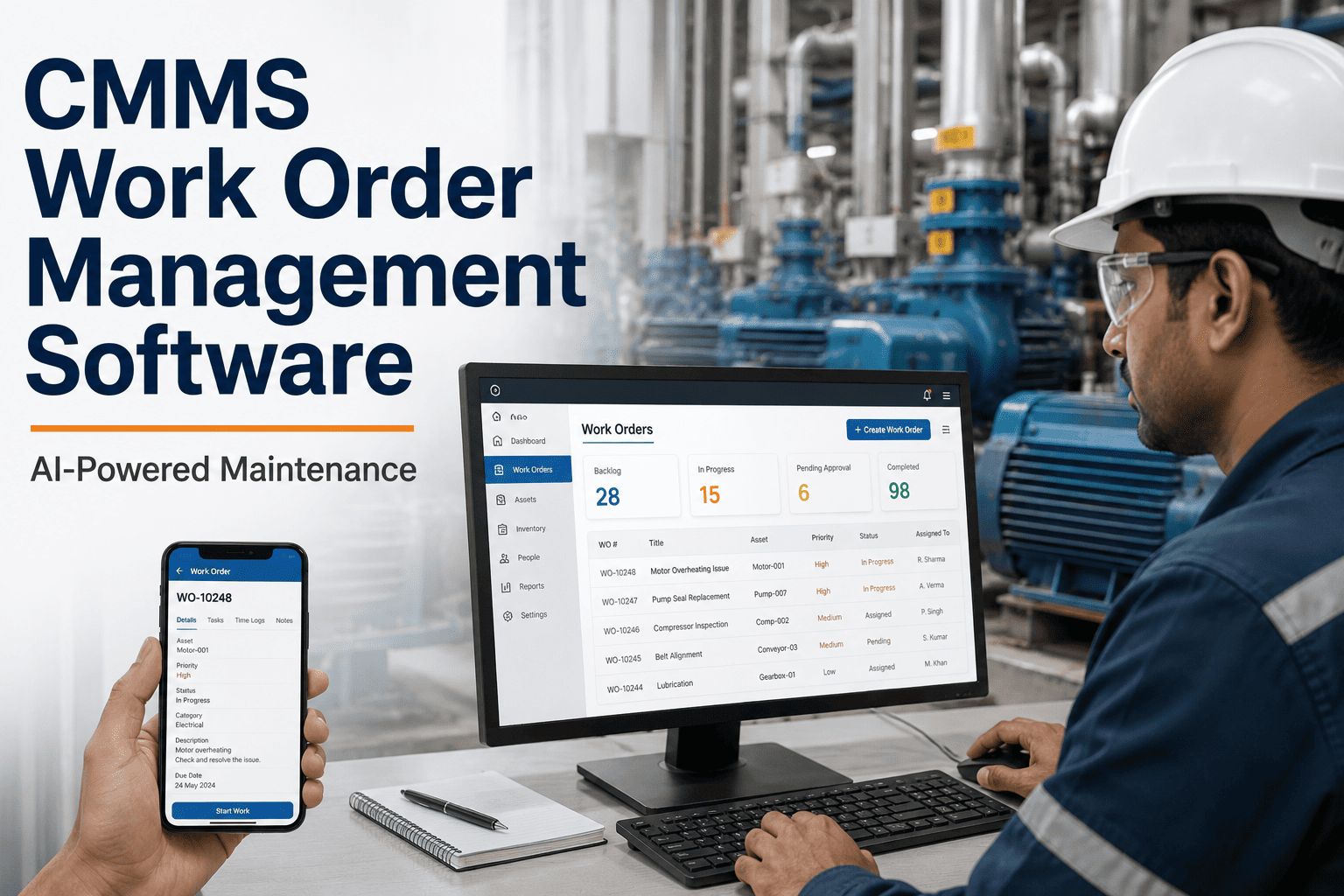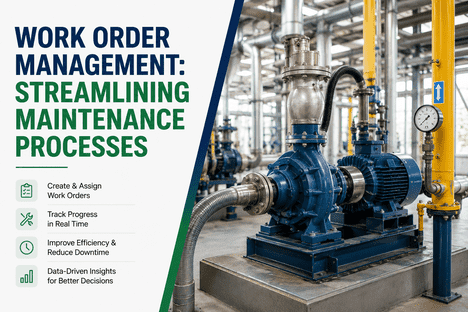
Maintaining data quality in your Computerized Maintenance Management System (CMMS) is the foundation of reliable asset management and operational excellence. Inaccurate equipment records, inconsistent work order data, and incomplete maintenance histories erode the trust that planners, technicians, and reliability engineers place in the system — turning what should be a decision-support tool into a source of operational noise. For industrial and facility teams managing complex equipment environments, the quality of CMMS data directly determines the quality of every maintenance decision that follows. As IoT sensor networks and AI-powered inspection systems become standard across modern facilities, the volume and velocity of maintenance data have increased exponentially, making systematic data quality management not just a best practice but an operational necessity. Maintenance and reliability teams ready to evaluate their current CMMS data quality can Book a Demo with iFactory and receive a facility-specific data quality assessment.
Achieve CMMS Data Integrity Across Your Industrial Maintenance Environment
iFactory's AI-powered platform delivers continuous data validation, automated asset data capture through AI vision cameras, and intelligent work order quality enforcement — purpose-built for industrial teams who cannot afford maintenance decisions built on bad data.
Why CMMS Data Quality Determines Maintenance Outcomes
Modern maintenance environments face four structural challenges that make data quality the single highest-leverage variable in operational performance. First, the proliferation of IoT sensors and connected equipment has created an exponential increase in data volume — but without validation, sensor drift and transmission errors silently corrupt the datasets that predictive models depend on. Second, multi-site organizations struggle with inconsistent data entry standards: the same pump model recorded as P-101 in one plant and PUMP-101 in another makes cross-facility reliability analysis impossible. Third, legacy asset registers contain decades of accumulated errors — misplaced equipment, obsolete spare parts links, and incomplete maintenance histories that propagate into every work order and every planning decision. Fourth, manual data entry at scale introduces human error rates of 3-5% across work order fields, creating a compounding accuracy problem that worsens with every transaction. AI-powered data quality enforcement, including automated capture through iFactory's AI vision camera, addresses each of these vulnerabilities at the source.
Inconsistent Asset Master Data
Duplicate equipment records, non-standard naming conventions, and missing hierarchy relationships create a maintenance environment where planners cannot reliably identify which assets need attention — wasting 15-25% of planning time on data reconciliation.
Work Order Data Decay
Missing labor hours, unrecorded parts usage, and incomplete failure codes make it impossible to calculate accurate maintenance KPIs — MTBF, MTTR, and cost-per-unit become unreliable metrics that erode confidence in reliability programs.
Sensor & IoT Data Integrity Gaps
Calibration drift, transmission packet loss, and data normalization errors introduce systematic bias into condition-based and predictive maintenance models — causing false alarms, missed failure predictions, and degraded model accuracy over time.
Cross-System Synchronization Failures
When CMMS, ERP, and asset health platforms operate on different data standards, equipment identifiers, and update cadences, critical maintenance information falls through integration gaps — creating safety and compliance exposure.
The Six Pillars of CMMS Data Quality Management
iFactory's data quality framework maps directly to six core pillars adapted from ISO 14224 and ISO 55000 standards, engineered for industrial environments where maintenance continuity is non-negotiable alongside data integrity. Teams looking to begin pillar-by-pillar deployment can Book a Demo to receive a phased rollout plan mapped to their existing CMMS infrastructure.
Asset Master Data Governance
Every asset in the CMMS is governed by standardized naming conventions, hierarchical classification per ISO 14224, and mandatory attribute completeness rules. AI validates new asset records against existing hierarchies in real time, flagging duplicates and structural inconsistencies before they enter the system.
Work Order Data Completeness
Every work order — whether corrective, preventive, or predictive — is subject to mandatory field requirements calibrated by work type. AI monitors work order completion patterns and automatically enforces data quality rules: labor hours, parts consumed, failure codes, and resolution notes must meet defined completeness thresholds before closure.
Automated Data Capture & Entry
iFactory's AI vision cameras and IoT integrations capture maintenance data at the source — reading equipment tags, recording meter values, documenting inspection results — eliminating manual data entry errors. The moment a defect is detected, a complete work order with annotated evidence, asset mapping, and AI-suggested repairs is generated automatically.
Data Consistency Across Sites
Multi-facility organizations maintain consistent data standards through centralized governance rules enforced at the platform level. Same equipment types use identical classification schemas across all sites, enabling accurate fleet-wide reliability analysis, benchmarking, and corporate-level KPI reporting without manual data normalization.
Continuous Data Quality Monitoring
Every CMMS transaction is scored against data quality dimensions — accuracy, completeness, consistency, timeliness, and uniqueness. AI correlates micro-patterns across millions of records to identify systemic data quality degradation before it impacts operational decisions, surfacing data quality health scores for each facility and asset class.
Automated Data Remediation & Enrichment
When AI identifies data quality issues — missing critical fields, orphaned asset records, inconsistent failure code usage — it executes pre-approved remediation actions: flagging records for review, enriching incomplete entries from connected systems, and routing complex quality issues to the appropriate data steward with a full context package.
CMMS Data Quality Implementation Roadmap: Four Phases
Successful CMMS data quality deployments follow a phased sequence that never requires a system migration or operational shutdown. iFactory's implementation model is additive — each phase layers data quality controls onto the existing CMMS environment without disrupting live maintenance operations. Reliability and maintenance leads frequently map this roadmap against their specific facility architecture before any deployment begins.
CMMS Data Audit & Baseline Assessment
AI-powered passive analysis scans the entire CMMS database — asset master records, work order history, spare parts inventory, and preventive maintenance schedules — measuring data quality across accuracy, completeness, consistency, timeliness, and uniqueness dimensions. The result is a quantified baseline with prioritized remediation targets.
Data Standards Definition & Governance Framework
Role-based data governance policies are defined for all data domains: asset master data, work order records, inventory items, and preventive maintenance definitions. AI-calibrated validation rules and mandatory field policies are configured per data domain, establishing what quality means for each record type in the CMMS.
Automated Capture & Validation Deployment
AI vision cameras are deployed at critical equipment locations for automated asset identification, meter reading capture, and inspection documentation — directly populating CMMS records without manual entry. Data validation rules are activated across all CMMS transactions, enforcing quality standards at the point of data creation.
Continuous Quality Monitoring & Improvement
AI operates continuously — monitoring every CMMS transaction, correlating data quality trends across sites, and refining quality rules as the maintenance environment evolves. Policy adjustments are AI-recommended and human-approved, creating a self-improving data quality posture without manual policy maintenance.
AI-Enforced Data Quality vs. Traditional CMMS Data Management: Performance Comparison
Quantifying what changes when AI-enforced data quality replaces manual CMMS data management across the dimensions that matter most to maintenance and reliability operations teams.
| Performance Dimension | Manual Data Management | AI-Enforced Data Quality |
|---|---|---|
| Data Entry Error Rate | 3-5% of all transactions | Under 0.1% (automated capture) |
| Asset Record Accuracy | 60-75% estimated | 95%+ with AI validation rules |
| Work Order Completeness | 40-60% of required fields | 90%+ with enforced completion |
| Data Quality Audit Cadence | Quarterly manual spot checks | Continuous real-time scoring |
| Cross-Site Data Consistency | Inconsistent — manual normalization | Standardized — AI-enforced governance |
| Data Remediation Speed | Backlog-driven — weeks to months | AI-automated — hours to days |
| Predictive Model Data Quality | Degraded — sensor drift unmanaged | Validated — AI data integrity layer |
"Before iFactory, our CMMS data quality was the silent bottleneck in every reliability initiative we launched. After deployment, the AI flagged 1,247 duplicate asset records across three facilities — equipment that had been maintained under two separate identifiers for years. It also identified that 34% of our work orders were missing failure codes, making root cause analysis statistically meaningless. Six months later, our data quality score went from 58% to 94% — and for the first time, our MTBF and MTTR numbers actually represent reality. The automated AI vision camera capture alone eliminated 18 hours of manual data entry per week at our primary facility."
Conclusion: CMMS Data Quality Is the Foundation of Industrial Maintenance Excellence
The digitization of maintenance operations is irreversible — and so is the data quality challenge it creates. AI-enforced data quality management supported by automated capture through technologies like iFactory's AI vision camera is not an optional upgrade for forward-thinking reliability teams; it is the baseline architecture required to operate a data-driven maintenance organization without accepting decision risk built on inaccurate information. The six pillars — asset master data governance, work order completeness, automated capture, cross-site consistency, continuous monitoring, and automated remediation — work as a system, each reinforcing the others in a way that no manual data management process can replicate. The four-phase implementation roadmap ensures that even facilities with complex legacy CMMS environments can achieve data quality excellence without disrupting live maintenance operations. Maintenance and reliability teams ready to move from hope-based data management to genuine AI-enforced data quality are encouraged to Book a Demo with iFactory and receive a facility-specific CMMS data quality readiness assessment before any deployment commitment is made.
CMMS Data Quality — Frequently Asked Questions
Q: Can CMMS data quality be improved without migrating to a new system?
Yes — iFactory's data quality model applies controls at the transaction and validation layer, integrating with existing CMMS platforms including SAP PM, Oracle, IBM Maximo, and Infor EAM without requiring system migration or data export.
Q: How does AI improve on rule-based data quality enforcement?
AI detects data quality patterns that static rules structurally miss — subtle naming convention drift across sites, systematic sensor calibration degradation, or emerging work order incompleteness patterns that no fixed rule threshold could identify.
Q: Which compliance frameworks does CMMS data quality support?
iFactory's data quality architecture generates continuous audit evidence aligned to ISO 55000, ISO 14224, FDA 21 CFR Part 11, NERC CIP, and OSHA recordkeeping requirements — reducing audit preparation time by up to 70%.
Q: Does AI vision camera integration require changes to existing equipment?
No — iFactory's AI vision cameras work with your existing camera infrastructure or can be installed as standalone units. They integrate directly with your CMMS via REST API, MQTT, or OPC-UA with zero changes to PLCs or controllers.
Q: How long does a full CMMS data quality deployment take across multiple facilities?
The four-phase deployment typically spans 14-18 weeks from initial data audit through full AI continuous monitoring activation, with measurable data quality improvements delivered at each phase.
Ready to Transform Your CMMS Data Quality with AI?
iFactory's data quality team maps your existing CMMS architecture, data domains, and compliance requirements to a phased data quality deployment roadmap — before any platform commitment.