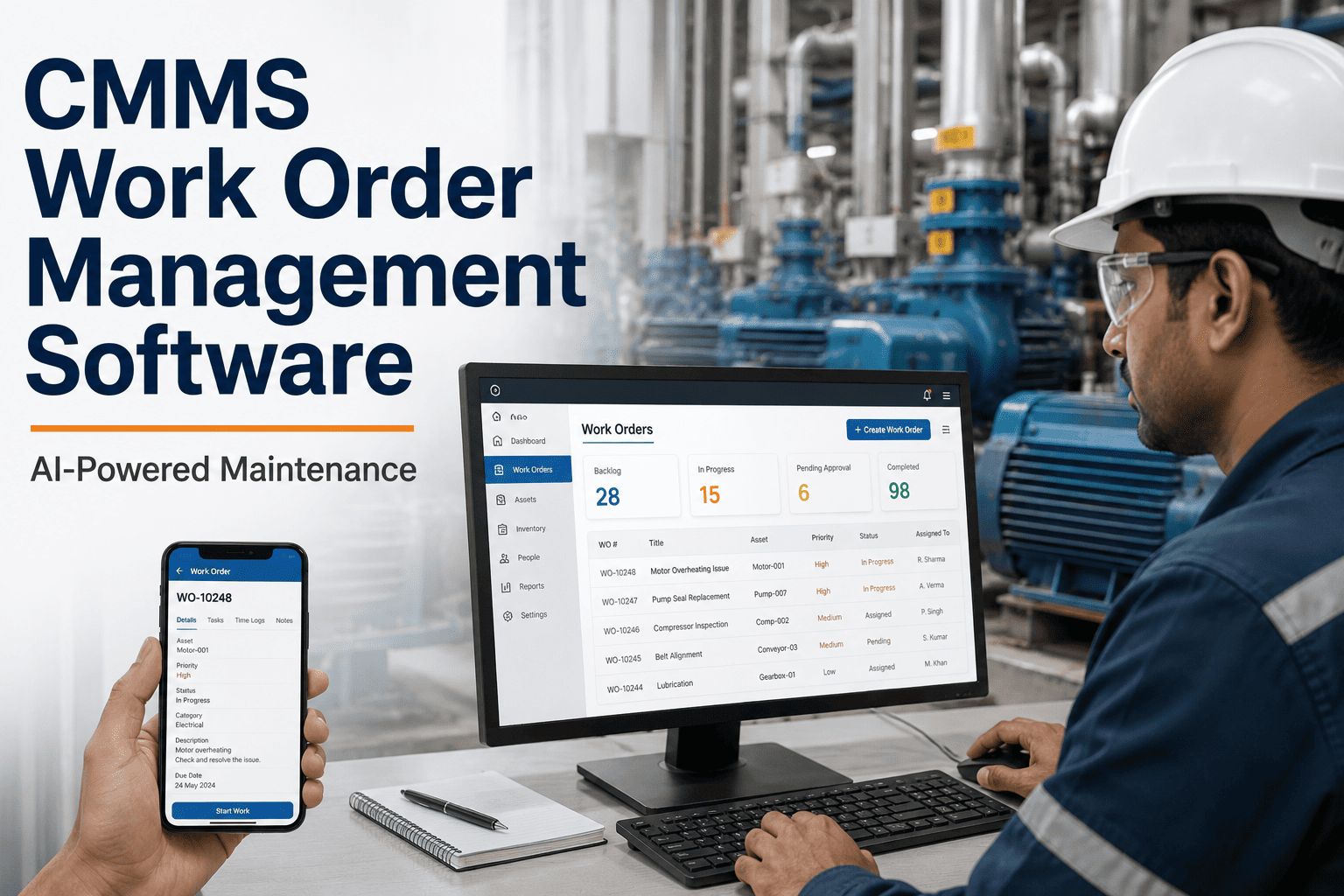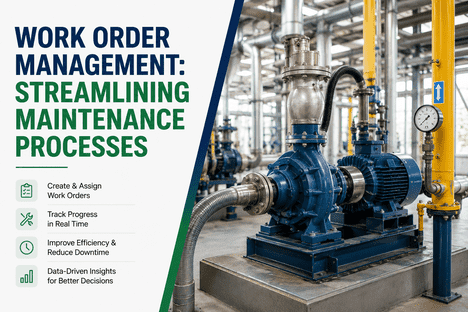
CMMS user training is the critical bridge between software investment and operational return. A computerized maintenance management system contains the tools to schedule preventive maintenance, track work orders, manage spare parts inventory, and generate data-driven reliability insights — but these capabilities only translate into improved asset performance when maintenance teams are trained to use them effectively. Without structured CMMS user training, organizations typically operate at 30-40% of the system's functional capacity, relying on manual workarounds that defeat the purpose of digitizing maintenance operations. The most successful maintenance organizations treat CMMS training not as a one-time onboarding event but as a continuous competency development program aligned with role-specific responsibilities, system updates, and evolving maintenance strategies. iFactory's AI vision camera platform — purpose-built for semiconductor and electronics manufacturing inspection — demonstrates the same principle: advanced technology delivers maximum return only when the teams using it are trained to interpret its outputs and integrate them into decision workflows.
Why CMMS User Training Determines Maintenance Maturity
The maintenance maturity model — from reactive to preventive to predictive to prescriptive — depends on data quality at every stage. A CMMS is the data infrastructure that supports each maturity level, but the data entering the system is only as reliable as the users entering it. When maintenance technicians bypass the CMMS to close work orders on paper, or when planners enter incomplete asset histories, the analytics layer produces misleading recommendations. Root cause analysis becomes guesswork. Spare parts optimization fails because consumption data is missing. Predictive maintenance algorithms trained on incomplete or inaccurate data generate false signals that erode trust in the system entirely. Effective CMMS user training addresses these failure modes by ensuring every user — from the technician in the field to the reliability engineer — understands how their data entry decisions affect the organization's maintenance decision quality. The goal is not feature fluency in the software interface. The goal is data literacy applied to maintenance operations. Organizations that achieve this see average work order compliance rates above 90%, spare parts inventory turns improve by 25-40%, and unplanned downtime decrease by 30-50% within 12 months of structured training implementation. Industries from semiconductor manufacturing to heavy industrial processing have documented these outcomes when CMMS training is treated as a core operational competency rather than an administrative checkbox.
Building a CMMS Training Program That Delivers Results
A high-impact CMMS training program is structured around role-specific curricula, progressive skill levels, and measurable competency milestones. The most effective programs avoid the common mistake of training every user on every system feature — maintenance technicians, planners, supervisors, and reliability engineers interact with fundamentally different parts of the CMMS and need correspondingly different training content. A technician's workflow centers on receiving assigned work orders, viewing asset history, recording time and materials, and documenting findings. A planner's workflow involves scheduling preventive maintenance routes, managing spare parts reservations, and analyzing backlog. A reliability engineer's workflow depends on querying failure history, running pareto analyses on asset downtime, and configuring predictive model thresholds. Designing separate training tracks for each role, rather than a single generic session, increases retention and reduces the time from training to productive system use. The best practice is a three-tier structure: foundational training covering system navigation and data entry standards for all users, role-specific training focused on the workflows and reports each function requires, and advanced training for power users who maintain the system's configuration, asset hierarchy, and integration points with other enterprise systems such as ERP and condition monitoring platforms. iFactory's AI vision camera platform follows the same role-based design principle — delivering defect classification data in the format each stakeholder needs, from technician-level lot disposition alerts to engineer-level yield pareto reports and executive-level OEE dashboards.
The Five Pillars of Effective CMMS Training
The content of CMMS user training must cover five functional domains to produce competent, confident system users. Each pillar requires a distinct training approach and assessment method.
| Training Pillar | Key Competencies | Training Method | Assessment Metric |
|---|---|---|---|
| Asset Hierarchy & Data Standards | Asset tagging conventions, criticality classification, hierarchy structure | Interactive workshop with live CMMS sandbox | Data entry accuracy audit — target 98%+ |
| Work Order Management | Creation, assignment, execution, closure workflow | Simulated work order drills with supervisor review | Work order cycle time & completion rate |
| Preventive Maintenance Execution | PM schedule adherence, checklist completion, finding documentation | On-the-job shadowing with corrective feedback | PM compliance % and finding capture rate |
| Inventory & Spare Parts | Stock issue, receipt, transfer, min-max management | Hands-on practice with inventory transactions | Inventory accuracy — bin count vs. system |
| Reporting & Analytics | Dashboard navigation, KPI interpretation, export and share | Case study analysis using real maintenance data | Report accuracy and insight quality assessment |
Each pillar should be trained incrementally, with mastery of one domain required before advancing to the next. Organizations that sequence training in this order report 40% faster time-to-competency compared to feature-based training that jumps between unrelated modules. Assessment at each stage should be practical — a trainee demonstrates competency by completing a real or simulated task in the CMMS, not by passing a multiple-choice quiz on interface terminology.
Overcoming Common CMMS Training Challenges
Resistance to CMMS adoption is rarely about the software itself. It is almost always about workflow disruption and perceived administrative burden. Maintenance technicians who have spent years managing work with paper systems, verbal handoffs, and personal knowledge see CMMS data entry as an additional task that slows them down. This perception is valid when training is inadequate — a technician who has not learned efficient data entry patterns will naturally take longer to close work orders. The solution is not more training hours. It is better training design focused on workflow efficiency. Teaching technicians keyboard shortcuts, mobile app entry patterns, and template-based finding documentation reduces data entry time to under 60 seconds per work order — faster than the paper-based alternative when account for handwriting and filing. Another common challenge is leadership that does not model CMMS use. When supervisors and managers bypass the system for approvals and status updates, the message to the team is that CMMS compliance is optional. Training programs must include leadership sessions that demonstrate how CMMS data improves decision making at the management level — showing supervisors how to use the system to balance crew workloads, identify recurring failure patterns, and justify capital replacement requests with data rather than anecdotes. The most durable training programs also include a continuous improvement feedback loop: a quarterly review of common data entry errors, system usage gaps, and feature requests that feeds into training content updates. When users see their feedback reflected in training improvements, engagement and system adoption increase measurably. For organizations integrating advanced inspection technology with their CMMS — such as iFactory's AI vision camera system that automatically generates work orders from defect detection events — training must cover not just the CMMS interface but the new data streams flowing into it and the maintenance response protocols those data streams trigger.
Measuring Training Effectiveness and CMMS Adoption
Training effectiveness is measured by behavior change in the CMMS, not by training attendance or test scores. The leading indicators of successful CMMS training are data quality metrics: work order completion rate above 90%, work order data completeness score above 95% (all required fields populated), PM compliance rate at or above the target threshold, and inventory transaction accuracy above 98%. These metrics should be tracked at the individual, team, and facility levels to identify where additional training is needed. A technician with a work order completion rate of 70% while peers are above 90% needs targeted coaching, not a repeat of the generic training program. Leading organizations also track the correlation between CMMS training completion and maintenance KPIs such as mean time between failure, planned maintenance percentage, and overtime hours. When training is working, these metrics improve. When they do not improve despite training investment, the issue is likely not training content but system configuration, workflow design, or management reinforcement. Training audits conducted at 30, 60, and 90 days post-training provide the feedback needed to close the gap between system capability and actual usage patterns. The Book a Demo with iFactory's maintenance integration team to see how AI-driven defect detection data integrates with your CMMS training workflow and creates closed-loop maintenance response processes.
Organizations that connect CMMS training with adjacent operational technology training achieve higher overall system adoption than those that train on the CMMS in isolation. When maintenance teams understand how condition monitoring data, IoT sensor alerts, and AI vision inspection results generate work orders automatically in the CMMS, they trust the system more and respond faster. iFactory's AI vision camera platform demonstrates this integration: defect detection events on wafer surfaces, packaging lines, or assembly stations are classified by the AI model, and when defect density exceeds the SPC threshold, a work order is automatically created in the connected CMMS with the defect image, location map, and tool correlation data attached. Training maintenance teams on this closed-loop workflow — from AI detection to CMMS work order to technician response — produces faster excursion containment and higher first-time-fix rates than training on either system separately. Teams that want to see this integrated workflow in action can Book a Demo with iFactory's engineering team for a live walkthrough of the detection-to-maintenance response pipeline.
Best Practices for Sustaining CMMS Proficiency Long Term
The half-life of CMMS training knowledge without reinforcement is approximately 60 days. After two months without structured practice or follow-up, users revert to previous work patterns and the CMMS adoption gains erode. Sustaining proficiency requires a deliberate reinforcement strategy built into the operational rhythm. Monthly 15-minute toolbox talks focused on a single CMMS workflow — closing a work order efficiently, searching asset history, running a backlog report — maintain skill currency without requiring dedicated training sessions. Quarterly data quality audits published at the team level create positive peer accountability for data entry standards. A designated CMMS champion within each maintenance crew serves as the first-line support resource and escalates systemic issues to the training team. Annual refresher training should focus not on re-teaching fundamentals but on new features, updated processes, and advanced capabilities that the team has not yet adopted. Organizations that embed CMMS proficiency into job descriptions and performance reviews — making data entry quality a factor in technician competency assessments — see sustained adoption rates above 90% year over year. The principles of sustained competency development apply equally to advanced technology platforms. iFactory offers dedicated training programs for maintenance teams deploying its AI vision camera system, covering defect classification interpretation, SPC alert response protocols, and CMMS integration troubleshooting — ensuring that the inspection-to-maintenance closed loop operates at maximum efficiency from deployment day one. Book a Demo to discuss how iFactory's training support accelerates technology adoption in semiconductor and electronics manufacturing environments.
Frequently Asked Questions About CMMS User Training
A structured CMMS training program can be developed and deployed within 4-8 weeks for most organizations. The initial phase involves role discovery and workflow mapping to identify what each user group needs from the system. Curriculum development follows, with separate tracks for technicians, planners, supervisors, and reliability engineers. The foundational training sessions are typically delivered over 2-3 days per role group, followed by 30-60-90 day follow-up assessments that reinforce learning and address gaps. Organizations that stage training in alignment with a phased CMMS rollout — rather than training all users before the system is fully configured — achieve higher retention because users can immediately apply what they have learned in the live system environment.
Blended learning — combining instructor-led workshops with hands-on practice in a sandbox environment and just-in-time reference materials — consistently outperforms single-format approaches. Instructor-led sessions establish the conceptual framework and workflow logic. Sandbox practice allows users to make mistakes without affecting production data, building confidence before they work in the live system. Quick-reference guides and video tutorials accessible from the CMMS interface itself provide reinforcement at the moment of need. Mobile-optimized training content is increasingly important as maintenance teams adopt mobile CMMS applications for field work. The specific mix depends on team size, geographic distribution, and prior system experience, but the common thread across effective programs is that users spend at least 60% of training time interacting with the CMMS directly rather than watching demonstrations.
Resistance to CMMS use is almost always rooted in workflow friction — the system adds time to the technician's day without providing a compensating benefit. Addressing this requires three actions: streamline the data entry process by configuring templates, defaults, and mobile entry patterns that minimize keystrokes; demonstrate the personal value by showing technicians how the CMMS makes their job easier, such as by providing asset history at their fingertips for faster diagnosis; and create positive peer pressure by publishing team-level adoption metrics and recognizing top performers. The most resistant users often convert when they see a peer use the system to quickly find the correct spare part for a repair or access the maintenance history that reveals a recurring failure pattern. Training that focuses on these practical, job-specific benefits rather than abstract system capabilities is far more effective at overcoming resistance.
CMMS training ROI is measured through operational metric improvement before and after training implementation. The primary metrics are planned maintenance percentage (ratio of planned to total work), work order compliance rate, mean time between failure trend, spare parts inventory turns, and overtime hours. A typical high-ROI scenario: a facility at 55% planned maintenance before training moves to 80% within six months, reducing emergency work and associated downtime. The value is calculated by multiplying the reduction in downtime hours by the production value per hour of each affected asset. Training cost includes curriculum development, instructor time, and trainee hours away from normal duties. Most organizations report a training payback period of three to six months based on downtime reduction and spare parts optimization alone — before counting the longer-term benefits of extended asset life, improved regulatory compliance, and reduced maintenance overtime.
The standard cadence is monthly micro-learning sessions of 10-15 minutes focused on a single workflow, quarterly data quality audits published at the team level, and annual full refresher training that covers system updates, new feature adoption, and advanced capabilities. Monthly sessions maintain skill currency between formal training events. Quarterly audits provide accountability and identify specific users who need additional coaching. Annual refreshers ensure the entire team stays current with system changes and organizational process evolution. For organizations using integrated platforms like iFactory's AI vision camera system connected to the CMMS, refresher training should also cover updates to the inspection models, new defect classification categories, and changes to the automated work order generation rules — ensuring the closed-loop workflow remains optimized as production conditions evolve.