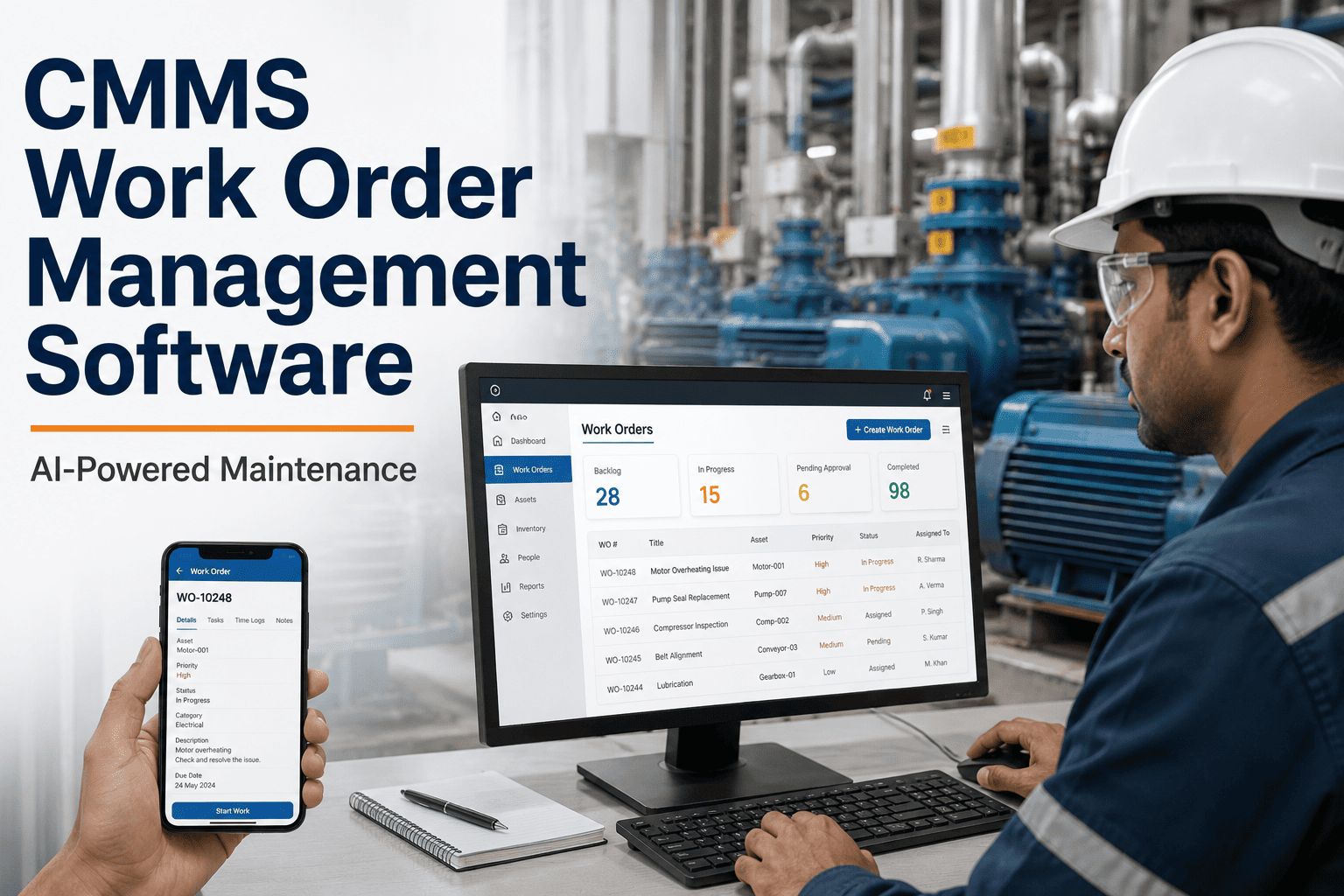
Maintaining equipment reliability across multiple facilities is one of the most complex operational challenges modern manufacturers face. A Computerized Maintenance Management System (CMMS) deployed in isolation at each site produces fragmented asset histories, inconsistent work order practices, and blind spots that compound into unplanned downtime and ballooning maintenance budgets. The organizations closing this gap are those deploying unified CMMS integration strategies that connect every site, every asset class, and every data stream — IoT sensors, ERP financials, production scheduling, and AI-driven predictive models — into a single operational intelligence layer. Understanding how to architect, deploy, and govern a multi-site CMMS integration in 2026 is the foundation of any serious maintenance excellence program in Industry 4.0 manufacturing environments.
See AI-Powered Maintenance Intelligence Working Across Your Facilities
iFactory's AI vision system integrates with your CMMS to deliver real-time asset condition data, automated work order triggers, and predictive maintenance alerts — across every site, at production line speed.
Why Single-Site CMMS Deployments Fail Multi-Site Operations
Each facility maintains its own asset register with no cross-site synchronization. Identical equipment at different plants carries different IDs, naming conventions, and maintenance histories — making portfolio-level reliability benchmarking impossible and procurement leverage invisible.
A master asset hierarchy synchronized across all sites gives corporate maintenance teams real-time visibility into equipment health, work order backlogs, and spare parts inventory at every facility from a single dashboard — enabling cross-site benchmarking and portfolio-level optimization decisions.
Without standardized work order templates and approval workflows, maintenance data collected at Site A is incompatible with Site B records. Root cause analysis across the fleet becomes manual, error-prone, and weeks behind the failure event — when corrective action still matters.
Centralized work order templates, escalation rules, and completion criteria propagate to every site automatically. Cross-site failure pattern analysis runs on comparable data, and best-practice maintenance procedures developed at one facility are deployed fleet-wide without manual replication effort.
Sites independently buffer high-value spare parts against stockout risk, creating redundant inventory across the network. Emergency transfers between facilities are slow because no cross-site visibility exists. Total inventory carrying cost routinely exceeds fleet-wide demand by 40–60%.
Integrated inventory management pools spare parts visibility across all sites, enabling dynamic reorder points based on fleet-wide consumption rates and criticality. Emergency lateral transfers between facilities happen in hours rather than days, reducing both stockout events and total inventory investment simultaneously.
Predictive models trained on single-site sensor data have insufficient failure examples to achieve reliable accuracy on rare but costly failure modes. Each site rebuilds models independently, duplicating data science effort and producing inconsistent confidence thresholds that lead quality teams to distrust automated alerts.
Failure data aggregated across all sites provides the labeled dataset volume that makes accurate predictive models viable for rare failure modes. A model trained on 50 motor failures across a 10-site fleet outperforms a model trained on 6 failures at a single plant — reducing false positives and missed predictions simultaneously.
Deploying a multi-site CMMS integration without a structured architecture strategy creates integration debt that compounds with every new facility added and every new data source connected. The following integration architecture models represent the current proven approaches in industrial maintenance operations.
5 Core CMMS Integration Architecture Models for Multi-Site Operations
Centralized Hub-and-Spoke Architecture
Recommended Starting PointThe hub-and-spoke model establishes a single central CMMS instance as the data authority for the entire multi-site network. Each facility operates a local node synchronized bidirectionally with the central hub — enabling site-level work order creation and real-time local access while consolidating all asset history, maintenance records, and KPI reporting at the corporate level. This architecture is the most common starting point for organizations integrating 3–20 sites because it provides full portfolio visibility without requiring complex peer-to-peer synchronization logic. Implementation typically follows a phased rollout: piloting the integration architecture at one or two facilities, validating data quality and synchronization latency, then propagating the model across remaining sites with the configuration already proven.
IoT Sensor Integration Layer
Condition-Based TriggeringConnecting IoT condition monitoring — vibration sensors, thermal cameras, ultrasonic detectors, current signature analyzers — directly to the CMMS via an integration middleware layer transforms maintenance scheduling from calendar-based to condition-based. When a vibration sensor on a critical pump crosses a configured threshold, the CMMS automatically generates a predictive work order, assigns it to the next available technician, and reserves the required spare parts — all before the equipment fails. At the multi-site level, this integration architecture routes sensor data from all facilities through a common IoT platform (Azure IoT Hub, AWS IoT Greengrass, or equivalent), which applies standardized alert logic and creates work orders in the appropriate site's CMMS queue. The result is condition-based maintenance at scale without custom integration development at each facility.
ERP and Financial System Integration
Cost Visibility and ControlCMMS integration with enterprise ERP systems — SAP, Oracle, Microsoft Dynamics — closes the loop between maintenance execution and financial accountability. Work orders in the CMMS trigger purchase requisitions in the ERP when spare parts are required, eliminating the manual data re-entry that produces procurement delays and cost allocation errors in siloed environments. At the multi-site level, this integration enables corporate finance teams to see maintenance cost per asset, per facility, and per equipment class in real time — identifying facilities where maintenance spending is disproportionate to asset value or production output. Organizations with mature CMMS-ERP integration report 15–25% reductions in total maintenance cost within 18 months of deployment through improved parts procurement, reduced emergency purchasing, and elimination of duplicate vendor relationships across sites.
AI Vision and Quality System Integration
Equipment Health from Production DataAI vision cameras deployed on production lines generate defect classification data that encodes equipment health information invisible to traditional condition monitoring. A sudden increase in surface defect rate on parts processed by a specific machine is often the earliest detectable signal of tooling wear, alignment drift, or mechanical degradation — appearing in quality data before any vibration or current signature anomaly crosses a threshold. Integrating AI vision quality outputs directly with the CMMS enables equipment health scoring driven by production quality trends, not just sensor readings. iFactory's AI vision system is designed to connect to CMMS platforms via standard API integration, routing quality-derived maintenance signals into work order queues alongside IoT condition alerts — giving maintenance teams a complete picture of equipment health at every production stage across all sites. This integration is particularly valuable in precision manufacturing environments where equipment degradation first manifests as subtle quality drift rather than observable mechanical symptoms.
Production Scheduling Bidirectional Integration
Maintenance Without Downtime PenaltyMaintenance and production scheduling have historically operated on separate systems with limited coordination — resulting in preventive maintenance windows that conflict with production commitments, or deferred maintenance that compounds into unplanned downtime during peak production periods. Bidirectional CMMS integration with production scheduling systems (MES, APS) allows maintenance windows to be negotiated dynamically: when a predictive alert fires, the CMMS queries the production schedule for the next available low-impact window and proposes a maintenance slot to both the maintenance planner and the production scheduler. At multi-site scale, this integration enables corporate operations teams to dynamically shift production to higher-capacity facilities during planned maintenance windows at constrained sites — reducing the total operational impact of maintenance across the network rather than managing it in isolation at each plant.
Evaluating CMMS integration architecture for your production facilities? Book a Demo to see how iFactory's AI vision system connects with your existing CMMS to add quality-derived maintenance intelligence across all sites.
Multi-Site CMMS Integration: Measured Outcomes by Industry
A global Tier 1 automotive supplier unified CMMS operations across 12 assembly and stamping facilities using a centralized hub architecture with IoT condition monitoring integrated across 4,200 critical assets. Standardized preventive maintenance scheduling and cross-site spare parts pooling reduced total maintenance spend by 22% in the first year, while unplanned downtime across the fleet fell from 4.7% to 1.9% of available production hours.
A multi-national food processing company integrated IoT sensor data from critical packaging and processing lines across 8 facilities into a unified CMMS predictive maintenance workflow. Fleet-wide failure data enabled AI models to reliably predict compressor and conveyor failures 72–96 hours in advance, eliminating 87% of unplanned downtime events on covered assets and reducing spare parts emergency purchasing by 63% across the network.
An electronics contract manufacturer integrated AI vision defect classification outputs from production lines at 5 facilities directly into their CMMS work order system. Equipment health scoring based on real-time defect rate trends identified tooling and alignment issues an average of 34 hours before traditional sensor-based alerts — reducing scrap costs by 31% and eliminating 4 unplanned line stoppages per quarter across the integrated facilities.
A pharmaceutical manufacturer operating across 6 regulated facilities integrated CMMS, ERP, and quality management systems to create a unified maintenance and compliance record across the network. Electronic work order completion records with full calibration traceability reduced audit preparation time from 3 weeks to 4 days per facility, while cross-site preventive maintenance compliance improved from 71% to 96% through automated scheduling and escalation workflows.
What Industry Research Says About Multi-Site CMMS Integration
Multi-site CMMS integration — particularly architectures that consolidate IoT condition data, production quality signals, and ERP financial records into a unified maintenance intelligence layer — consistently delivers 15–30% reductions in total maintenance cost and 40–60% reductions in unplanned downtime across the covered asset base. The critical differentiator between deployments that achieve these outcomes and those that plateau at partial adoption is data governance: organizations that invest in standardized asset taxonomies, work order templates, and cross-site KPI definitions before technical integration begin see full ROI realization 2–3x faster than those that treat it as a purely technical project. In 2026, the fastest-growing capability layer is AI-driven integration — connecting machine learning models trained on fleet-wide failure histories to CMMS work order automation, enabling maintenance decisions at a speed and accuracy that calendar-based PM programs cannot match. Manufacturers deploying these integrated architectures now are building a compounding reliability advantage as their multi-site failure datasets grow and their predictive models improve with every additional observation.
6 Implementation Principles for Multi-Site CMMS Integration Success
Establish a Universal Asset Taxonomy Before Technical Integration Begins
The most common cause of multi-site CMMS integration failure is attempting technical connectivity before resolving data governance. Identical equipment at different facilities carries different names, categories, and criticality ratings — making cross-site benchmarking meaningless even after technical synchronization is achieved. A universal asset taxonomy that standardizes equipment naming conventions, asset hierarchies, criticality classifications, and maintenance category definitions across all sites must be agreed upon and documented before the first API connection is built. Organizations that complete this governance step first consistently reach full integration ROI 2–3x faster than those that treat it as a downstream task.
Pilot Integration Architecture at a Single Representative Facility
Multi-site CMMS integration programs that attempt simultaneous fleet-wide deployment experience significant scope management failures and schedule overruns. A single pilot facility — chosen to represent the complexity of the broader network — validates the integration architecture, exposes unexpected data quality issues, and produces the implementation playbook that accelerates all subsequent site rollouts. Pilot-to-fleet rollout cycles typically compress from 12+ months to 3–4 months per site when the pilot delivers a fully documented configuration and data mapping template the rollout team can replicate without re-architecting from scratch.
Integrate IoT and AI Vision Data Streams Before Expanding PM Scope
Organizations that expand preventive maintenance scope without first integrating condition data sources create scheduling overhead without reliability benefit. The correct sequencing connects IoT sensors and AI vision quality outputs to the CMMS first — establishing condition-based maintenance triggers that can rationalize PM frequency rather than arbitrarily increasing it. Once condition data is flowing, PM schedules at each site can be optimized based on actual equipment behavior rather than manufacturer recommendations or conservative engineering estimates, typically reducing total PM labor hours by 20–35% while improving reliability outcomes simultaneously.
Configure Cross-Site Spare Parts Pooling and Lateral Transfer Workflows
Spare parts inventory optimization is consistently the fastest-payback element of multi-site CMMS integration and the most frequently deferred. Connecting each facility's parts inventory to a centralized visibility layer reveals redundant stocking across the network and enables lateral transfer workflows that reduce emergency procurement from external suppliers. For a 10-site network, cross-site parts pooling typically reduces total spare parts inventory investment by 30–40% while simultaneously reducing stockout-driven downtime — both outcomes that are impossible in siloed inventory environments regardless of reorder point sophistication at the individual site level.
Train Fleet-Wide Predictive Models on Aggregated Failure Data
The reliability compounding effect of multi-site CMMS integration comes from fleet-wide AI training. Failure events that occur only twice per year at an individual facility appear 20 times per year across a 10-site fleet — providing the labeled dataset volume that makes accurate predictive models viable for rare but high-consequence failure modes. Predictive models trained on aggregated fleet data achieve false positive rates 60–70% lower than site-specific models on comparable failure types, improving technician trust in automated alerts and driving the adoption rates that determine whether predictive maintenance delivers operational value or remains a dashboard exercise.
Build Continuous Improvement Loops with Cross-Site Benchmarking
The long-term value of multi-site CMMS integration is not the initial efficiency gains — it is the continuous improvement engine that cross-site benchmarking enables. When the same KPIs (MTBF, MTTR, PM compliance rate, maintenance cost per unit produced) are measured consistently across all facilities on comparable data, underperforming sites are visible immediately and best practices from top-performing facilities can be transferred with documented evidence rather than anecdotal knowledge. Organizations with mature cross-site benchmarking programs report 3–5% annual maintenance performance improvement compounding year over year — an advantage that grows wider relative to competitors as the reliability intelligence layer deepens with each additional year of integrated data.
Frequently Asked Questions
Connect AI Vision Quality Intelligence to Your CMMS Across Every Site
iFactory's AI vision system integrates with your CMMS to deliver defect-rate-derived equipment health signals, automated maintenance work order triggers, and fleet-wide quality trend data — at production line speed, at every facility, with complete audit traceability from day one.