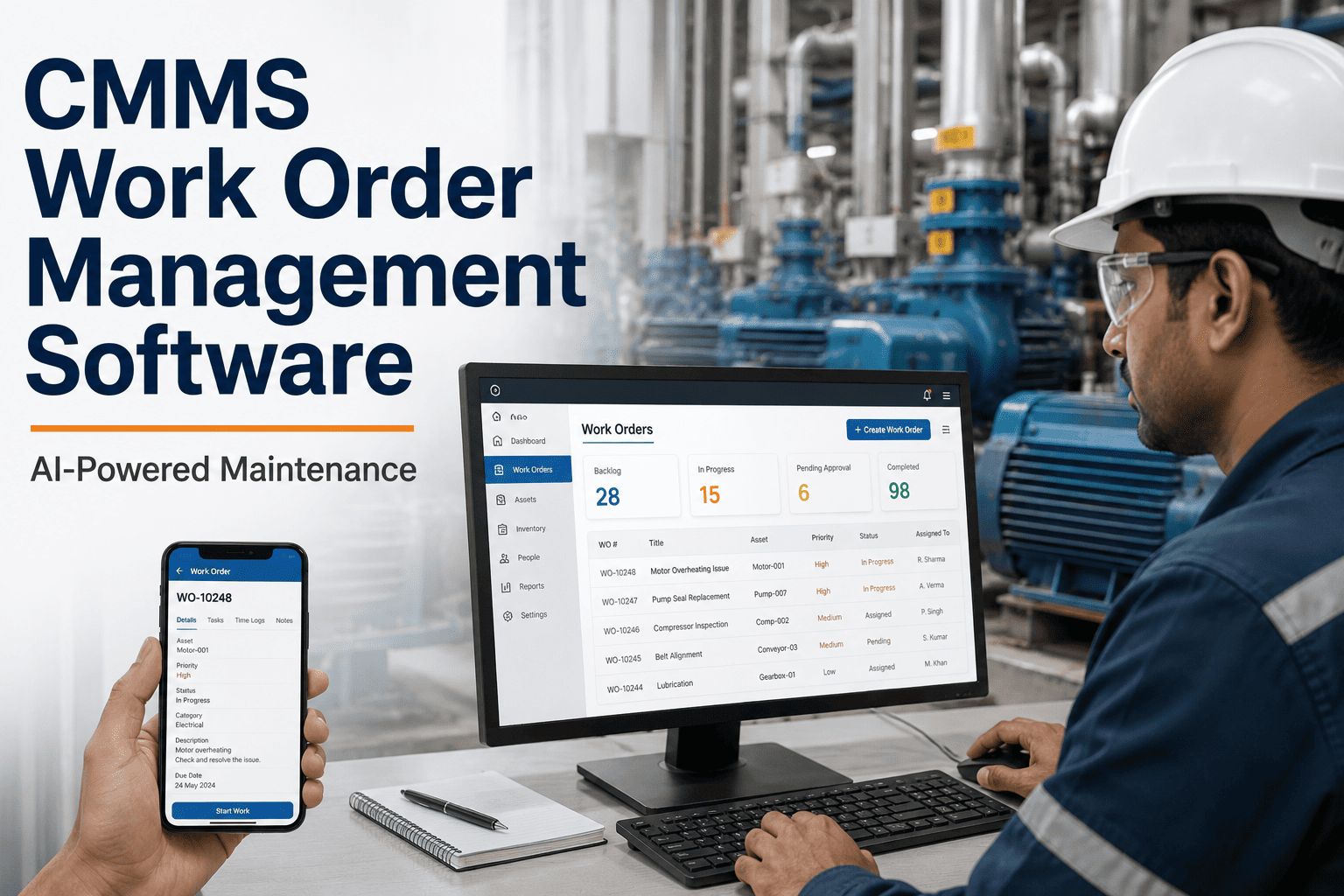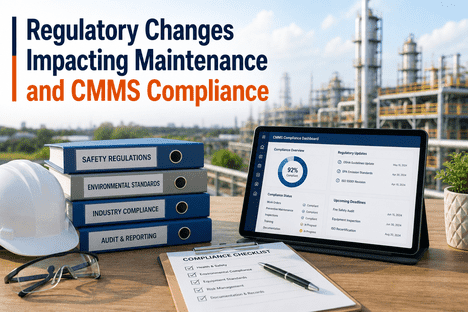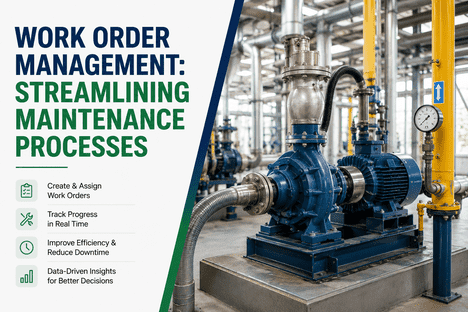
The industrial maintenance landscape is undergoing a fundamental transformation in 2026. Computerized Maintenance Management Systems (CMMS) have evolved from simple work order trackers into AI-powered platforms that integrate IoT sensor networks, predictive analytics, and real-time asset intelligence. Yet the biggest barrier to unlocking this value is not technology — it is change. Book a Demo to see how iFactory's AI-powered CMMS platform eliminates the adoption friction that derails most digital maintenance transformations.
Ready to Transform Your Maintenance Operations?
iFactory delivers AI-powered CMMS with predictive maintenance, IoT integration, and digital twin simulation — purpose-built for Industry 4.0 asset management. Go live in 4 weeks.
The Real Reason CMMS Projects Stall — And How to Fix It
Most CMMS implementations do not fail because the technology is wrong. They fail because the people side of the transition is underestimated. Only 16% of digital transformation efforts achieve sustained improvements, and poor change management is consistently identified as the primary cause. When maintenance technicians are handed a new platform without sufficient context, training, or input, the result is parallel paper systems, inconsistent data entry, and work order completion quality that erodes the platform's value within months. The organizations that drive CMMS adoption to 90% usage rates — rather than the industry average of 30% — treat change management as a first-class workstream alongside technical implementation, not an afterthought.
iFactory is engineered to reduce the change management burden itself. Direct SCADA, DCS, and historian integration means maintenance teams encounter familiar data in a unified interface rather than a foreign system demanding manual re-entry. Pre-trained AI models activate from day one on real asset data, so technicians see value immediately rather than waiting months for the platform to learn. Book a Demo to see how iFactory's purpose-built CMMS reduces adoption friction while delivering predictive maintenance accuracy exceeding 94%.
Resistance from Maintenance Teams Without Buy-In
A sudden CMMS rollout without technician involvement creates immediate resistance. Teams resort to shadow systems and manual workarounds that undermine data quality across the entire platform. Involving maintenance staff in selection, piloting, and feedback loops before go-live transforms potential resistors into active advocates who accelerate peer adoption across shifts.
Leadership Mandating Without Demonstrating Value
Executive directives to adopt a CMMS without connecting the system to operational outcomes visible to frontline technicians breed compliance without commitment. Leaders who frame CMMS adoption around real pain points — missed preventive maintenance tasks, emergency call-out rates, unplanned downtime costs per shift — create conditions where technicians understand why the change serves them, not just the business.
Training That Doesn't Match How People Actually Work
Traditional classroom training achieves only 15% knowledge retention. Microlearning, mobile-first hands-on practice, and role-specific training pathways achieve 70–90% retention by meeting technicians in their actual workflow context. Modern CMMS platforms designed for Industry 4.0 environments prioritize intuitive interfaces and mobile-first work order management that reduce training time and accelerate confident daily use.
Six Change Management Strategies That Drive CMMS Adoption in 2026
The following strategies are drawn from documented CMMS adoption programs across industrial, manufacturing, and asset-intensive operations. They address the organizational, leadership, and technical dimensions of adoption simultaneously — because each dimension can block success independently.
Build the Urgency Case with Operational Data
Frame CMMS adoption around measurable operational pain rather than technology capability. Quantify missed preventive maintenance tasks, emergency repair cost premiums, downtime hours per quarter, and compliance exposure. When leadership and frontline teams see the same data, the case for change becomes shared rather than imposed.
Secure Executive Sponsorship Tied to KPIs
Executive buy-in does more than unlock budgets. When leaders include CMMS adoption metrics in departmental performance reviews and reference platform outcomes in leadership meetings, middle management enforces accountability. Link CMMS success metrics — work order completion quality, mean time to repair, asset availability — to executive-level operational priorities reported quarterly.
Identify and Empower Team Champions
Identifying two to three maintenance team champions who receive early platform access and deep training creates a peer influence network that drives adoption more effectively than management directives alone. Champions answer floor-level questions, model correct work order behavior, and reduce help desk burden during the critical first 90 days of live operation.
Phase the Rollout — Start with Priority Assets
Phased rollouts improve adoption rates by 33% compared to big-bang implementations that overwhelm users with system complexity. Start with the highest-criticality assets where predictive maintenance value is most visible — compressors, pumps, turbines. Early wins on priority assets build confidence, generate case study data, and create organizational momentum for broader deployment.
Connect CMMS to IoT and AI — Make the Data Work for Technicians
CMMS platforms that surface IoT sensor alerts, AI-generated maintenance recommendations, and digital twin insights directly in work order workflows eliminate the manual data-gathering burden that consumes 40–60% of engineer time in traditional operations. When technicians arrive at a job with complete asset health context already loaded, the CMMS becomes the tool that makes their work easier — not harder.
Measure Adoption Quality, Not Just Login Frequency
True CMMS adoption is measured by work order completion quality, data accuracy in asset histories, and reduction in reactive maintenance events — not login frequency. Establishing these outcome-based adoption metrics from the first week creates accountability structures that distinguish genuine platform use from compliance theater, and surface coaching opportunities before poor habits become entrenched.
iFactory's CMMS integrates directly with existing SCADA, DCS, and historian infrastructure. Pre-trained AI models activate on priority assets within 4 weeks, giving maintenance teams immediate predictive intelligence that makes adoption self-reinforcing. Book a Demo and see how iFactory reduces the change management burden while delivering measurable downtime reduction from the first month.
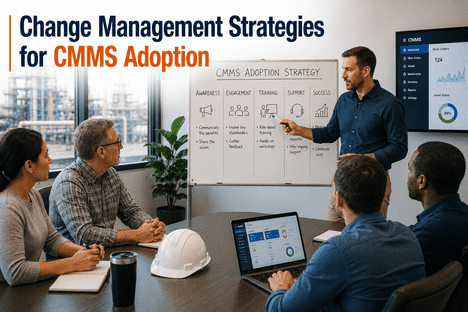
Change Management Strategies for CMMS Adoption
From stakeholder buy-in to phased rollout and IoT-enabled predictive maintenance — a complete operational guide to driving successful CMMS adoption across your maintenance organization in 2026.
How Predictive Maintenance and IoT Integration Change the CMMS Adoption Equation
In Industry 4.0 environments, CMMS adoption is no longer purely an organizational challenge — it is also a technology design challenge. When a CMMS requires technicians to manually enter sensor readings, translate alarms from separate SCADA screens, and reconcile data across disconnected systems, resistance is a rational response to added workload. When a CMMS automatically ingests real-time IoT sensor data, generates AI-powered work orders based on detected equipment degradation, and presents digital twin context alongside every maintenance task, technicians perceive the platform as a productivity tool rather than an administrative burden.
iFactory's predictive maintenance models detect compressor, pump, and turbine degradation signatures 3–4 weeks before mechanical failure using vibration, temperature, and pressure sensor data. Work orders are generated automatically with full asset health context, recommended maintenance actions, and parts requirements pre-populated — reducing technician data entry to confirmation rather than creation. This architecture turns CMMS adoption into a value-delivery mechanism that maintenance teams want to use, rather than a compliance requirement they tolerate. Explore iFactory's AI Vision capabilities to see how computer vision monitoring further extends this intelligence layer to visual anomaly detection across your asset portfolio.
| Change Management Challenge | Traditional CMMS Response | iFactory AI-Powered Approach |
|---|---|---|
| Technician Resistance | Extended classroom training programs before go-live | Intuitive mobile-first UI; AI pre-populates work orders, minimizing manual input |
| Slow Value Realization | 6–12 months building training datasets before predictions activate | Pre-trained models on 500,000+ hours of sensor data deliver predictions from day one |
| Data Silo Friction | Manual data consolidation across SCADA, DCS, and CMMS | Direct OPC-UA, MQTT, REST integration unifies all operational data automatically |
| Integration Complexity | Multi-year IT integration projects with custom data plumbing | First sensors operational in 4 weeks without replacing existing control infrastructure |
| Adoption Measurement | Login frequency as proxy for adoption success | Outcome-based KPI dashboards tracking downtime reduction, OEE, and work order quality |
| Compliance Reporting | Manual data consolidation for ESG and regulatory reporting | Automated ESG report generation from IIoT sensor networks with zero manual work |
A Phased CMMS Adoption Roadmap for Industry 4.0 Operations
Successful CMMS adoption combines technical deployment milestones with change management activities that run in parallel from the first day of the project. The roadmap below reflects best practices from phased CMMS rollouts across manufacturing, energy, and process industries in 2026.
Assessment and Stakeholder Alignment
Map existing maintenance workflows, document current SCADA and DCS integration points, and quantify operational pain with real downtime and cost data. Identify executive sponsors, department champions, and technician representatives. Establish baseline KPIs for downtime, MTTR, and preventive maintenance compliance before deployment begins.
Pilot Deployment on Priority Assets
Connect the CMMS to highest-criticality assets first — compressors, pumps, turbines — where predictive maintenance value is most visible and measurable. Run a 30–60 day pilot that generates documented outcomes including early failure detection events, avoided downtime hours, and maintenance cost comparisons between reactive and predictive interventions.
Scaled Rollout with Role-Based Training
Use pilot outcomes as internal case studies that build organizational credibility for broader deployment. Deploy role-specific mobile training for technicians, work order configuration training for supervisors, and KPI dashboard training for operations managers. Activate IoT sensor integration and AI predictive models across the full asset portfolio segment by segment.
Continuous Improvement and ESG Compliance
Activate digital twin simulation for scenario testing and maintenance decision optimization. Enable automated ESG and emissions compliance reporting from the consolidated IIoT sensor network. Establish monthly adoption quality reviews tracking work order data accuracy, predictive alert response rates, and OEE improvement trends against pre-deployment baselines.
What Successful CMMS Adoption Delivers in AI-Powered Operations
These outcomes reflect documented results from iFactory deployments where change management and technical implementation were executed together as a unified program — not technical deployments where adoption was treated as an afterthought.
What Operations and Change Management Leaders Say About CMMS Adoption
The shift from preventive to predictive maintenance in asset-intensive industries is no longer a technology question — it is a financial discipline question. The organizations that have achieved real CMMS adoption success in 2026 are those that quantified the cost of not changing first. When a maintenance manager can show that 12% of scheduled maintenance tasks were missed last quarter and connect that directly to emergency repair costs, the conversation moves from technology adoption to operational necessity.
One of the most underappreciated drivers of CMMS adoption failure is the data consolidation burden placed on maintenance engineers. In operations running SCADA, DCS, and maintenance CMMS in separate silos, engineers spend 40–60% of their time gathering data before they can begin analysis. A unified AI platform that eliminates that burden does not just accelerate adoption — it changes what decisions are possible and how quickly they can be executed. Book a Demo to see how iFactory unifies your operational data into a single analytics layer.
In Industry 4.0 environments, CMMS adoption and IoT integration are inseparable. A CMMS that requires manual sensor reading entry will always face adoption resistance because it adds work. A CMMS that automatically ingests real-time IoT data, generates AI-recommended work orders, and presents digital twin context alongside every maintenance task becomes a platform maintenance teams actively want to use. The technology architecture is a change management strategy in itself.
CMMS Change Management — Common Questions Answered
Change Management and AI-Powered CMMS: Building the Maintenance Operation That Outperforms
Successful CMMS adoption in 2026 requires treating change management and technical implementation as equally weighted workstreams. Organizations that build stakeholder buy-in before deployment, phase rollouts around priority assets, empower frontline champions, and measure adoption quality rather than login frequency consistently achieve 70–90% active usage rates — while those that focus exclusively on technical configuration rarely exceed 30%. The compounding effect is decisive: every month of high-quality CMMS usage refines predictive models, deepens asset history, and shifts the maintenance organization further from reactive cost absorption toward proactive margin protection.
iFactory accelerates this trajectory by removing the technology barriers that amplify change management difficulty. Direct OT integration without system replacement, pre-trained AI models that deliver 94%+ failure prediction accuracy from day one, and an intuitive mobile-first interface that reduces training burden all work together to make adoption the path of least resistance rather than an uphill organizational effort. For operations leaders evaluating CMMS platforms in 2026, the platform choice is itself a change management decision — and iFactory is purpose-built to make that decision pay off faster than any alternative. Book a Demo to assess where iFactory delivers the fastest measurable ROI across your specific asset management and preventive maintenance requirements.
500+ Facilities Trust iFactory. Predictive Maintenance Live in 4 Weeks.
See how iFactory's unified AI CMMS platform delivers predictive maintenance, IoT sensor integration, digital twin simulation, and automated ESG compliance across your entire asset portfolio — with change management support built into the deployment methodology.