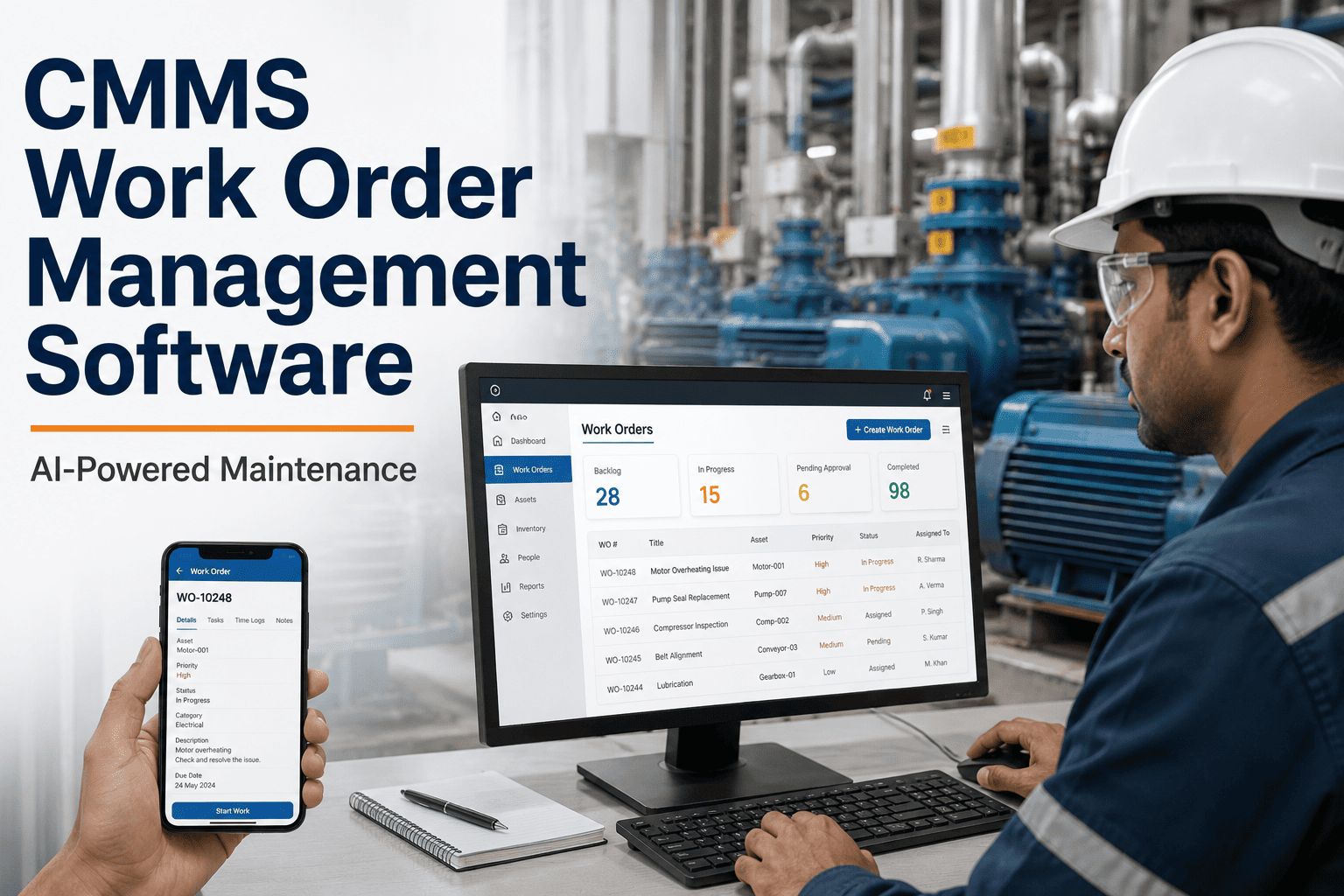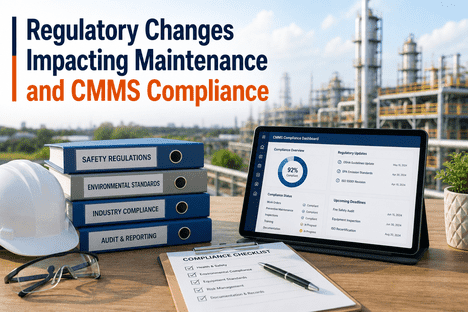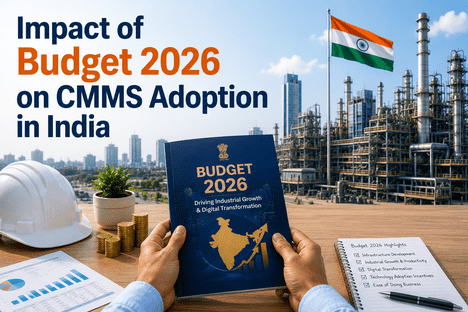
India's Union Budget 2026–27, presented on February 1, 2026 by Finance Minister Nirmala Sitharaman, has set the stage for a decisive shift in how Indian manufacturers approach asset maintenance and operational efficiency. With a record capital expenditure outlay of ₹12.22 lakh crore — an 11.5% increase over the previous year — and targeted policy thrust around Make in India, PLI schemes, MSME scaling, and digital infrastructure, the Budget has directly and indirectly accelerated the adoption of Computerised Maintenance Management Systems (CMMS) across Indian industry. For plant managers, reliability engineers, and operations leaders, understanding how this budget reshapes the maintenance technology landscape is no longer optional — it is a strategic imperative.
See How iFactory AI Transforms Maintenance Management
iFactory's AI Vision Camera connects to your existing equipment in weeks — delivering predictive maintenance, real-time anomaly detection, and CMMS-ready data streams for Indian factories of every size.
How Budget 2026-27 Creates the Conditions for CMMS Adoption
India's Budget 2026–27 is not a maintenance technology budget in name, but its provisions create four powerful structural tailwinds for CMMS adoption. The ₹10,000 crore SME Growth Fund is designed to move high-potential enterprises from survival-mode operations to scaled, technology-driven models — and maintenance digitalisation is one of the clearest levers available to qualifying MSMEs seeking to demonstrate operational maturity. The proposal to revive 200 legacy industrial clusters through targeted technology upgradation signals that even older manufacturing facilities will come under direct pressure to modernise asset management practices. Simultaneously, the National Mission on Manufacturing (NMM), targeting a 25% manufacturing GDP share by 2035, demands asset reliability rates that manual maintenance logs simply cannot sustain. CMMS is no longer an enterprise luxury — it is the baseline infrastructure for competing under PLI incentive structures, which reward production volumes and penalise unplanned downtime. Taken together, these budget provisions represent the most favourable policy environment for CMMS adoption that Indian industry has ever seen.
PLI Schemes Demand Uptime Performance
Production Linked Incentive schemes across 14 sectors tie financial rewards directly to production volume targets. Unplanned downtime is the single largest threat to PLI incentive capture — making predictive maintenance and CMMS work-order discipline a direct financial priority for qualifying facilities. With PLI pharmaceutical sales already crossing ₹2.63 lakh crore and auto-component investments at ₹35,657 crore, the stakes for asset uptime have never been higher.
SME Growth Fund Unlocks Maintenance Tech Investment
The new ₹10,000 crore SME Growth Fund addresses the equity gap that has historically prevented smaller manufacturers from investing in digital maintenance infrastructure. For the first time, MSMEs seeking "Champion" designation have structured access to the capital required for CMMS deployment — covering software licences, IoT sensor integration, and operational training without disrupting working capital cycles.
Legacy Cluster Revival Programme
The Budget's proposal to revive 200 legacy industrial clusters through technology upgradation represents a direct mandate for modernising maintenance management in India's oldest and most asset-intensive manufacturing hubs. Clusters in textiles, engineering, chemicals, and food processing — where equipment is frequently operating beyond design life — are primary candidates for CMMS-led asset lifecycle management programmes.
IndiaAI Mission & Digital Infrastructure
With ₹1,000 crore allocated to the IndiaAI Mission and significant investment in digital public infrastructure, the Budget accelerates the underlying connectivity and AI capability stack that modern CMMS platforms depend on. AI-powered CMMS systems that leverage IoT sensor data, machine learning anomaly detection, and edge computing are now operating within a national digital infrastructure framework specifically designed to support their deployment at scale.
Capital Goods Sector Strengthening
The Budget's focus on Hi-Tech Tool Rooms and capital goods manufacturing strengthens the precision engineering and heavy equipment sectors that are the primary users of advanced CMMS capabilities. As Indian capital goods manufacturers compete for global supply chain positions, asset traceability, predictive maintenance records, and digital work-order histories become mandatory documentation for international OEM qualification processes.
Tier II & III Industrial Expansion
The Budget's emphasis on Tier II and III city infrastructure development and manufacturing parks creates a new wave of greenfield facilities where CMMS can be deployed from day one rather than retrofitted. These facilities — built with modern PLCs, SCADA connectivity, and IoT-ready equipment — provide the ideal environment for deploying AI-powered CMMS platforms without the integration challenges of legacy brownfield sites.
CMMS Adoption Impact: Traditional vs. AI-Powered Approach
Indian manufacturers transitioning from manual maintenance logs to AI-driven CMMS platforms under Budget 2026's policy framework see measurable improvements across every critical maintenance KPI.
| Maintenance KPI | Manual / Traditional | AI-Powered CMMS | Improvement |
|---|---|---|---|
| Unplanned Downtime (hrs/month) | 120–160 hrs | 20–30 hrs | ~82% reduction |
| Maintenance Cost as % of Asset Value | 4.8–6.5% | 2.1–3.4% | ~40% reduction |
| Work Order Completion Rate | 55–65% | 88–94% | +35% improvement |
| Anomaly Detection Accuracy | ~42% (manual rounds) | 91–96% (ML model) | 2× improvement |
| PLI Audit Readiness | Manual, quarterly | Automated, continuous | Always audit-ready |
Bridging CMMS Data Gaps with AI Vision Intelligence
The most significant limitation of traditional CMMS deployments in Indian factories is data quality: work orders and maintenance logs are only as accurate as the technicians manually entering them, and equipment health data between scheduled rounds is effectively invisible. The iFactory AI Vision Camera eliminates this blind spot by continuously monitoring equipment condition through industrial computer vision, feeding real-time anomaly data directly into CMMS work-order queues without any manual intervention. In the context of Budget 2026's manufacturing push, this integration is particularly relevant for PLI-participating facilities where production continuity is tied to financial incentives and where equipment failures carry both operational and regulatory consequences. The AI Vision Camera integrates with existing PLCs and SCADA systems via standard OPC-UA and Modbus protocols, making it deployable within the two-to-four-week timelines that Indian manufacturers operating under PLI production targets require. Facilities participating in the legacy industrial cluster revival programme, where equipment may lack native IoT sensors, benefit specifically from the vision-based approach — as it requires no equipment modification to deliver predictive maintenance intelligence. Book a Demo to see how the AI Vision Camera feeds your CMMS with the continuous, asset-level data that manual rounds cannot provide.
Vision-Based Asset Fingerprinting
iFactory AI Vision Cameras establish a unique visual and thermal baseline for every monitored asset — motors, compressors, conveyors, pumps, and processing equipment — within the first two to four weeks of deployment. This baseline forms the reference against which all subsequent anomaly detection is measured, with no manual data entry required at any stage.
Automated CMMS Work Order Generation
When the AI model detects a deviation from established baseline — vibration signature changes, thermal hotspots, abnormal current draw, or visual deterioration — it automatically generates a prioritised CMMS work order, complete with asset ID, anomaly description, severity rating, and recommended intervention. Technicians receive actionable maintenance tasks without the latency of manual inspection rounds.
Predictive Maintenance Scheduling
Rather than time-based preventive maintenance schedules — which either over-service healthy assets or miss deteriorating ones — iFactory's ML engine drives condition-based maintenance scheduling. Service intervals are adjusted dynamically based on actual asset health, reducing unnecessary maintenance labour by 25–35% while ensuring interventions happen before failures occur.
PLI & Compliance Documentation
For facilities operating under PLI schemes, ISO 50001, or ESG reporting frameworks, iFactory continuously generates audit-ready maintenance records linked to production batch IDs, equipment serial numbers, and timestamped visual evidence. This immutable maintenance history satisfies OEM qualification documentation requirements and supports claims under government incentive programmes without any manual report aggregation.
Industry-Wise CMMS Adoption Outlook Under Budget 2026
Budget 2026's sectoral policies create differentiated CMMS adoption pressures across Indian manufacturing. The following table maps budget provisions to maintenance management priorities by sector.
| Sector | Budget 2026 Trigger | CMMS / Maintenance Priority |
|---|---|---|
| Automotive & Auto-Components | ₹35,657 crore PLI investment base; EV transition requirements | Predictive maintenance for high-precision CNC and stamping assets; OEM traceability documentation. |
| Pharmaceuticals & Chemicals | ₹2.63 lakh crore PLI sales; dedicated chemical parks | GMP-compliant maintenance records; real-time equipment qualification monitoring; batch-level asset history. |
| Electronics & Semiconductors | ₹40,000 crore ECMS; Semiconductor Mission 2.0 | Zero-defect cleanroom equipment maintenance; vision-based contamination and tool-wear monitoring. |
| Textiles | Mega Textile Parks; legacy cluster revival | Loom and spinning machinery uptime optimisation; energy-integrated maintenance scheduling for MSME units. |
| MSMEs (Cross-Sector) | ₹10,000 crore SME Growth Fund; Champion MSME programme | Cloud-based CMMS with mobile-first technician interfaces; IoT sensor retrofits on legacy machinery; affordable SaaS deployment models. |
From Budget Policy to CMMS Deployment: A 5-Week Path for Indian Manufacturers
Indian manufacturing facilities that act on Budget 2026's policy signals in the current fiscal year will complete their CMMS learning curve before competitors who wait for the next budget cycle. iFactory's structured five-week deployment programme is specifically designed for the operational realities of Indian factories — no infrastructure overhaul, no operational shutdown, and integration with the PLCs and SCADA systems already present on the floor. Sites completing the programme report an average of ₹1.48 crore in avoided maintenance costs in the first three weeks alone. For facilities seeking to qualify for the SME Growth Fund or demonstrate operational maturity under the Champion MSME programme, an active, AI-powered CMMS deployment provides exactly the kind of verifiable operational excellence evidence that programme administrators evaluate. Book a Demo and receive a site-specific ROI estimate based on your asset base and PLI participation status.
Gateway Installation & System Integration
iFactory AI Vision Cameras and IoT gateways are installed and connected to existing PLCs, SCADA systems, and smart meters. No operational shutdown is required. Integration covers all priority assets — compressors, motors, conveyors, pumps, and HVAC systems across the facility.
AI Baseline Learning & Asset Fingerprinting
ML models establish unique visual, thermal, and electrical fingerprints for every monitored asset. Initial anomaly detection thresholds are validated against known equipment states. First CMMS work order alerts are reviewed with your maintenance team to confirm accuracy and calibrate severity thresholds to your operational context.
Predictive Interventions & Work Order Automation Live
First actionable predictive maintenance work orders are automatically generated and dispatched to technicians. Condition-based scheduling replaces calendar-based PM rounds. ROI evidence — measured in avoided failures, reduced reactive maintenance hours, and deferred parts spend — begins accumulating from this point forward.
Full Analytics, Compliance Dashboard & Team Handover
The complete iFactory platform is operational — including digital twin asset models, ISO 50001 EnPI dashboards, PLI production-linked maintenance records, and executive reporting. Your maintenance team is fully trained and autonomous. Audit-ready documentation for government schemes and OEM qualification is live from day one of full deployment.
"After the Budget 2026 announcements, our management made the decision to accelerate CMMS deployment as part of our PLI compliance programme. iFactory's AI Vision Camera gave us continuous equipment health data that our manual rounds simply could not provide. In the first four months, we reduced unplanned downtime by 78%, our PLI production targets became achievable, and we had the maintenance documentation our OEM qualification audit required. The platform paid for itself before our first quarterly review."
CMMS Adoption Under Budget 2026: Common Questions
Q: How does Budget 2026's SME Growth Fund apply to CMMS investment?
The ₹10,000 crore SME Growth Fund provides equity support to qualifying MSMEs demonstrating a clear path to scaling. CMMS deployment — particularly AI-powered platforms that reduce downtime and improve production consistency — directly strengthens the operational maturity case required for fund eligibility. Facilities should document maintenance performance improvements as part of their qualification evidence package.
Q: Can PLI-participating facilities use iFactory for production and maintenance reporting?
Yes. iFactory generates continuous, timestamped maintenance and production records linked to asset IDs and batch identifiers — precisely the documentation format required for PLI performance verification and OEM qualification audits. The platform's immutable audit trail satisfies both government incentive programme administrators and international OEM documentation standards.
Q: How does iFactory AI Vision Camera differ from a standard CMMS deployment?
A standard CMMS manages work orders and schedules but depends on manual data input for equipment health status. iFactory's AI Vision Camera continuously feeds real-time, AI-analysed equipment condition data directly into CMMS work-order queues — eliminating the human latency that allows equipment deterioration to compound between inspection rounds. This integration is particularly valuable for Indian factories where technician bandwidth is constrained and equipment populations are large.
Q: Is iFactory suitable for legacy industrial clusters covered by Budget 2026's revival scheme?
Yes — iFactory's vision-based monitoring approach requires no modification to existing equipment, making it ideal for legacy assets that lack native IoT sensors. Edge computing architecture processes analytics locally at the gateway, supporting facilities with limited connectivity. Integration with existing PLCs and SCADA systems via standard industrial protocols is typically complete within one to two weeks.
Q: What is the typical payback period for an Indian manufacturing facility?
Most Indian manufacturing facilities achieve full platform cost recovery within six to nine months through combined avoided maintenance costs, reduced unplanned downtime, and lower reactive repair spend. For PLI-participating facilities, the additional value of protected production incentives often compresses payback to three to five months. Positive ROI evidence typically appears within the first three weeks of full deployment, making it visible within the same quarter as deployment.
Budget 2026 Has Reset the Baseline for Maintenance Management in India
The Union Budget 2026–27 has fundamentally altered the competitive environment for Indian manufacturers. PLI incentives tied to production performance, the SME Growth Fund for operational scaling, the legacy industrial cluster revival programme, and the National Mission on Manufacturing's 25% GDP target have collectively made asset reliability a board-level priority across sectors. CMMS platforms — and specifically AI-powered systems that eliminate the manual data entry gap at the heart of traditional maintenance management — are no longer a future investment. They are the operational foundation required to perform under the policy framework Budget 2026 has created. iFactory's AI Vision Camera and CMMS integration platform is built for exactly this environment: deployable in five weeks, operational without infrastructure overhaul, and capable of generating the continuous, audit-ready maintenance intelligence that PLI programmes, OEM qualifications, and ISO 50001 frameworks demand. For Indian manufacturing facilities serious about capturing Budget 2026's incentive landscape, the window to establish a CMMS performance baseline before the next audit cycle is now. Book a Demo with an iFactory specialist and receive a site-specific ROI estimate benchmarked against your production targets, PLI obligations, and asset base.
Ready to Align Your Maintenance Strategy with Budget 2026's Manufacturing Vision?
Connect with an iFactory specialist today. Get a site-specific ROI estimate, a CMMS readiness assessment, and a clear five-week deployment roadmap for your facility — no obligation, no pressure.