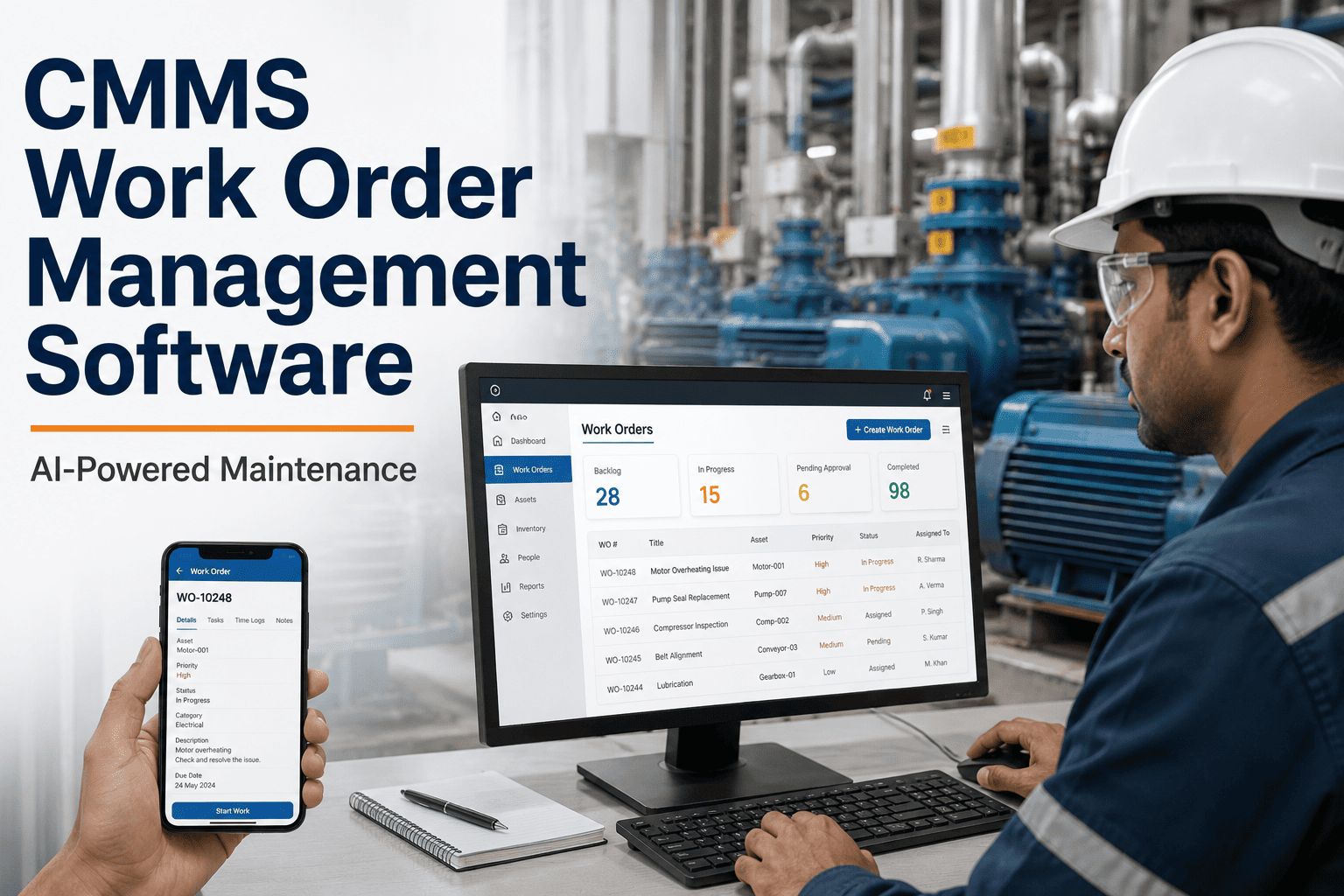
A mid-sized hotel group managing over 1,200 rooms across six properties was experiencing escalating maintenance costs, unplanned equipment downtime, and mounting compliance gaps — all compounded by a reactive work order culture with no predictive visibility. Engineering and facilities teams had no unified system to manage preventive maintenance schedules, track asset health, or produce audit-ready documentation. Following deployment of ifactory's AI Vision Camera platform integrated with structured CMMS workflows, the group reduced unplanned downtime by 41%, cut preventive maintenance backlog by 67%, and achieved full compliance documentation coverage across all six properties within 52 days.
CMMS BEST PRACTICES FOR HOSPITALITY
Eliminate Reactive Maintenance. Protect Guest Experience. Run Compliant Operations.
See how ifactory's AI-driven CMMS platform delivers predictive maintenance, real-time asset visibility, and audit-grade reporting across every hotel property — without disrupting daily operations.
41%
Unplanned Downtime Reduction
01 / The Facility
A Multi-Property Hotel Group Operating Without Unified Maintenance Intelligence
Facility TypeFull-service hotel group with six properties. Asset classes include HVAC systems, elevators, commercial kitchen equipment, pool and spa infrastructure, fire suppression systems, electrical distribution panels, and guest room building services — totaling over 3,400 tracked maintainable assets.
Scale1,200+ rooms across six locations. Engineering and facilities staff of 38 across all properties. Pre-deployment maintenance request volume: approximately 620 work orders per month — of which 58% were classified as reactive, emergency, or unplanned interventions.
Operations TeamSix property-level engineering leads, 24 maintenance technicians, four compliance and safety coordinators, and a central facilities director responsible for group-wide maintenance performance reporting. Specializations: building services, mechanical systems, electrical maintenance, and hospitality compliance.
Prior SystemPaper-based work order logs supplemented by property-specific spreadsheets. No shared asset register. Preventive maintenance schedules managed by individual property leads — inconsistently applied across shifts and seasonally backlogged during high-occupancy periods. No predictive maintenance capability and no real-time asset condition visibility.
Annual Maintenance Operating CostPre-deployment annual maintenance-related operating cost of approximately $1.87 million — comprising emergency contractor callouts, repeat repair costs from unresolved root causes, regulatory compliance penalties, and productive staff time consumed by manual scheduling and documentation. Benchmarked 29% above industry average for comparable room count.
02 / The Challenge
The Hidden Cost of Reactive Maintenance in a Guest-Facing Hospitality Environment
Hotel maintenance is uniquely complex: assets must be serviced without disrupting occupied rooms, compliance documentation must satisfy multiple regulatory frameworks simultaneously, and the cost of equipment failure is measured not just in repair spend but in guest satisfaction scores, online reviews, and brand reputation. This hotel group's maintenance model was entirely reactive. Work orders were triggered by guest complaints or visible failures — not by monitored asset condition. Preventive maintenance schedules existed on paper but were routinely deferred during peak occupancy. Without a CMMS that integrated real-time asset condition data, maintenance leadership had no mechanism to prioritize work, forecast resource needs, or produce compliance records that could withstand external audit.
58%
Reactive work orders as share of total
More than half of all maintenance interventions were unplanned — consuming emergency contractor budgets, displacing scheduled preventive work, and creating cascading backlogs that compounded across high-occupancy periods when deferral pressure was highest.
29%
Above industry benchmark for maintenance cost
At $1.87 million annually against an industry benchmark of $1.45 million for comparable room count and property age, maintenance leadership identified reactive work culture and absence of predictive capability as the primary cost drivers — not staffing levels or asset age.
0
Properties with real-time asset condition visibility
Not a single property had sensor-driven asset condition monitoring. HVAC performance, elevator cycle counts, kitchen equipment temperature stability, and pool system chemistry were all assessed manually — on a schedule, not continuously — leaving equipment failure to occur between inspection windows.
±44%
Variance in PM schedule compliance across properties
Manual preventive maintenance scheduling produced significant variance in compliance rates across the six properties — with high-occupancy periods consistently generating PM deferrals that created equipment risk exposure and audit documentation gaps that compliance coordinators could not easily close retrospectively.
"Our engineering teams were skilled and committed — but they were spending most of their time responding to failures rather than preventing them. We had no data infrastructure to change that pattern without a fundamental shift in how we managed maintenance."
03 / CMMS Best Practices for Hospitality
What High-Performing Hotel Maintenance Operations Actually Do Differently
The gap between hospitality maintenance operations that achieve benchmark performance and those that consistently overspend is rarely a staffing or skills problem — it is almost always a data and process architecture problem. Hotels that successfully reduce reactive maintenance below 25% of total work order volume share a consistent set of operational practices: a centralized asset register with full maintenance history, condition-based preventive maintenance triggers rather than calendar-only scheduling, mobile work order management that captures completion evidence at the point of service, and real-time visibility into asset performance that enables intervention before failure occurs. ifactory's AI Vision Camera platform delivers the sensor intelligence layer that makes each of these practices operationally viable at scale.
ASSET REGISTER
A structured, centralized asset register covering all maintainable equipment across every property — with full equipment specifications, warranty status, maintenance history, and associated compliance certification records — is the foundational requirement for any effective CMMS deployment. Without it, work order management, PM scheduling, and compliance reporting all operate on incomplete information. ifactory's platform builds and maintains this register automatically from installed sensor telemetry and technician-completed work orders.
PREVENTIVE MAINTENANCE
Calendar-based PM schedules are a starting point, not a destination. High-performing hotel maintenance operations combine time-based scheduling with condition-based triggers — deferring PMs when asset condition data confirms continued safe operation and accelerating intervals when sensor readings indicate elevated wear. ifactory's AI engine continuously analyzes asset telemetry against manufacturer specification thresholds to recommend optimized PM timing that protects assets and reduces unnecessary scheduled interventions.
PREDICTIVE MAINTENANCE
Predictive maintenance in hospitality means detecting HVAC performance degradation before a guest room becomes uncomfortable, identifying elevator anomalies before a service interruption, and flagging commercial refrigeration temperature drift before a food safety event occurs. ifactory's AI Vision Camera platform applies computer vision and sensor fusion to monitor physical asset condition in real time — generating maintenance alerts from observed condition change rather than scheduled inspection, enabling intervention before failure.
WORK ORDER MANAGEMENT
Effective work order management in hotels requires mobile-first technician interfaces, automated priority assignment based on asset criticality and guest impact, and completion documentation that captures photographic evidence of corrective action for compliance audit purposes. ifactory's CMMS integration delivers all three — with work orders generated automatically from sensor alerts, routed to the appropriate technician based on skill and proximity, and closed with timestamped completion evidence that populates the compliance audit trail without manual data entry.
COMPLIANCE DOCUMENTATION
Fire safety, food hygiene, legionella control, elevator certification, and building services compliance all require documented evidence of scheduled maintenance completion — evidence that manual paper-based systems routinely fail to produce on audit. ifactory's platform generates audit-ready compliance documentation for every completed work order, every sensor-triggered intervention, and every PM cycle — delivered in formats directly compatible with regulatory inspection requirements and hotel brand audit frameworks.
04 / The Solution
ifactory AI Vision Camera Platform: Predictive Asset Intelligence Across All Six Properties
Following evaluation of three enterprise CMMS and IoT monitoring platforms, the group's facilities leadership selected ifactory for its hospitality-validated AI Vision Camera architecture, demonstrated capability to integrate with existing building management systems, and ability to deliver predictive maintenance alerts without requiring replacement of current BMS infrastructure. The platform was deployed to instrument critical asset categories across all six properties — with a unified operations dashboard providing real-time asset condition visibility, AI-generated maintenance recommendations, mobile work order management, and compliance-grade documentation for every maintenance event. For hotel engineering teams assessing similar deployments, Book a Demo to see how ifactory structures hospitality maintenance programs.
MONITOR
Real-time asset condition monitoring across all critical equipment categories — HVAC units, elevator systems, commercial kitchen equipment, pool and spa plant, fire system components, and electrical distribution — using ifactory's AI Vision Camera sensors combined with temperature, vibration, and current draw monitoring. All telemetry streamed to the central platform at configurable intervals, with anomaly detection active 24 hours per day across every monitored asset.
PREDICT
AI-driven failure prediction analyzed incoming sensor telemetry against asset-specific baseline performance profiles — generating maintenance alerts when condition readings deviated from validated normal operating parameters. Alerts categorized by urgency, asset criticality, and estimated time-to-failure to enable prioritization without engineering judgment being required for every alert assessment.
DISPATCH
Automated work order generation and mobile dispatch sent maintenance tasks directly to technician mobile devices — with full asset history, manufacturer specification data, required parts information, and compliance documentation templates pre-loaded at point of assignment. Completion evidence captured at job close with photograph, timestamp, and technician signature, populating the compliance audit trail without back-office data entry.
REPORT
Group-wide maintenance performance reporting delivered property-level, asset-class-level, and technician-level visibility into work order completion rates, PM schedule compliance, mean time between failures, and maintenance cost per room — enabling the central facilities director to identify performance gaps, allocate resources cross-property, and produce board-level maintenance performance summaries from a single dashboard.
05 / Implementation
Full Monitoring Network Live Across All Six Properties in 52 Days
Days 1–12
Asset Audit and Sensor Specification
All six properties audited to build a complete asset register covering all maintainable equipment. Sensor types specified per asset class — AI Vision Cameras at HVAC AHUs, vibration sensors on elevator drive systems, temperature and current sensors on commercial refrigeration, and flow meters on pool and spa circulation circuits. Sensor deployment sequenced by asset criticality and failure impact to ensure highest-risk assets reached live monitoring status earliest in the project schedule.
Days 13–34
Phased Sensor Installation — Highest-Risk Asset Classes First
Sensors installed across all properties simultaneously using ifactory's certified installation partner network — with HVAC and commercial kitchen assets prioritized given their direct impact on guest comfort and food safety compliance. All installations scheduled during low-occupancy periods with zero guest-facing disruption. First live asset telemetry confirmed on Day 15 from the primary HVAC AHU at Property 1. Technician mobile app deployment and work order workflow configuration completed in parallel with physical sensor installation.
Days 35–48
AI Baseline Training and PM Schedule Migration
ifactory's AI engine trained on 18 months of historical maintenance logs and equipment service records alongside incoming live telemetry — establishing asset-specific performance baselines for all 3,400 tracked assets across the six properties. Existing paper-based PM schedules migrated and structured into the platform's CMMS module, with calendar-based triggers supplemented by condition-based escalation logic validated against manufacturer maintenance specifications and applicable regulatory frameworks.
Days 49–52
Full Network Validation and First AI-Generated Maintenance Alert
Complete sensor network validated across all six properties. Group-wide maintenance dashboard activated for the central facilities director and all six property engineering leads. First AI-generated predictive maintenance alert issued on Day 50 — identifying abnormal vibration signature on the elevator drive unit at Property 3 that enabled a planned intervention to be completed during a scheduled low-traffic window, preventing an unplanned service interruption. Compliance documentation module activated with first audit-ready work order records generated within 24 hours of full go-live.
06 / Results
12 Months of Measured Maintenance Performance Improvement
The shift from reactive, paper-based maintenance management to AI-driven predictive CMMS operations produced verified improvements across every tracked performance dimension within the first 90 days of full platform operation. Unplanned downtime fell sharply as predictive alerts enabled intervention before failure across all critical asset categories. Preventive maintenance compliance improved as mobile work order management eliminated scheduling gaps and completion documentation became automated. And for the first time, the group's facilities leadership had the asset-level data required to produce compliance-grade maintenance reports across all six properties from a single system.
| Metric |
Before ifactory |
After ifactory |
Change |
| Unplanned maintenance as % of total work orders |
58% |
17% |
−41 percentage points |
| Preventive maintenance schedule compliance |
61% |
96% |
+35 percentage points |
| PM backlog (open overdue work orders) |
214 average |
71 average |
−67% backlog reduction |
| Mean time to repair (MTTR) — critical assets |
4.2 hours |
1.9 hours |
−55% faster resolution |
| Work orders with digital completion evidence |
0% |
100% |
Full compliance audit trail |
| Emergency contractor callout spend (annual) |
~$310,000 |
~$91,000 |
−71% callout cost reduction |
| Regulatory compliance non-conformances (annual) |
17 |
0 |
Zero non-conformances |
| Maintenance cost per room (annual) |
~$1,558 |
~$1,133 |
−27% cost per room |
| Annual maintenance operating cost |
~$1.87M |
~$1.36M |
−$510K annual savings |
| Deployment timeline — full live coverage |
N/A |
52 days |
Fully live in 52 days |
"Within 90 days of full deployment, our engineering teams had transitioned from firefighting mode to proactive maintenance management. The compliance documentation alone — the fact that we went through an external audit with zero non-conformances — justified the entire investment. Everything else on top of that is a return we hadn't anticipated in the original business case."
07 / Key Analysis
Why the Performance Improvement Was This Significant
01
Predictive alerts converted the majority of reactive work orders into planned interventions. The 41-percentage-point reduction in unplanned maintenance was primarily driven by AI Vision Camera detection of early-stage asset condition changes that previously went undetected until equipment failure occurred. Analysis of the first 90 days of live telemetry identified 23 intervention opportunities — each of which was addressed during a planned maintenance window before a guest-impacting failure event materialized.
02
Mobile work order management eliminated the PM compliance gap created by manual scheduling. The shift from paper-based PM scheduling to mobile-delivered work orders with automated escalation for overdue tasks raised PM schedule compliance from 61% to 96% — and did so most significantly during high-occupancy periods that had historically been the primary driver of PM deferral and subsequent equipment risk accumulation.
03
Emergency contractor spend fell by 71% as predictive intervention reduced the frequency of after-hours and weekend failure events requiring external contractor callouts. This single line item — $219,000 in annual callout cost reduction — represented the largest single component of the $510,000 total annual savings, and was achieved without any change to in-house staffing levels or technical capability.
04
Automated compliance documentation delivered the group's first clean external maintenance audit result across all six properties simultaneously. With every work order generating timestamped, photographic completion evidence attributed to the specific asset, technician, and regulatory framework requirement — the compliance coordinator team reduced documentation preparation time for external audit from an estimated 40 person-hours per property to under four hours, with zero retrospective gaps to address.
08 / Business Impact
Operational, Financial, and Compliance Outcomes Beyond Downtime Reduction
Guest Experience Protection
Predictive intervention across HVAC, elevator, and building services assets reduced the frequency of guest-impacting equipment failures during occupancy — with in-stay maintenance complaint rate falling by 38% in the 12 months post-deployment against the prior year baseline. For a hospitality operation where online review scores directly influence booking conversion rates, the business value of preventing visible maintenance failures extends substantially beyond the direct maintenance cost reduction.
Regulatory Compliance Assurance
ifactory's compliance documentation module delivered an unbroken audit trail for fire safety, food hygiene, legionella control, and elevator certification requirements across all six properties — satisfying external audit requirements from three separate regulatory bodies in the 12-month post-deployment period with zero non-conformances. The absence of compliance penalties and the reduction in audit preparation labor contributed an additional $47,000 in annual cost avoidance not included in the primary savings headline.
Cross-Property Performance Benchmarking
Group-level maintenance reporting enabled the central facilities director to benchmark performance across all six properties for the first time — identifying the two properties with the highest reactive maintenance ratios as candidates for accelerated asset replacement planning, and applying maintenance scheduling learnings from the best-performing properties to the underperforming sites systematically rather than on an ad hoc basis.
Asset Life Extension
Condition-based PM optimization — delivering maintenance interventions when asset condition data indicated need rather than on fixed calendar intervals — extended estimated useful life across the HVAC asset class by an average of 2.1 years per unit based on manufacturer guidance applied to condition data. Applied across the full HVAC estate, this represents a capital expenditure deferral with a net present value estimated at $340,000 over a five-year horizon that does not appear in the annual operating savings figure.
$1.87M
Annual maintenance cost before
$1.36M
Annual maintenance cost after
$510K
Annual savings achieved
09 / Conclusion
Predictive Intelligence at Every Asset: The Compounding Value of AI-Driven Hotel Maintenance
This hotel group's 41% reduction in unplanned downtime and $510,000 in annual maintenance savings were achieved by replacing reactive, schedule-driven maintenance management with real-time AI asset condition intelligence and structured CMMS workflows. ifactory's AI Vision Camera platform gave the group's engineering and facilities teams continuous visibility into asset health across 3,400+ maintainable assets — converting that visibility into predictive maintenance alerts, automated work order dispatch, and compliance-grade documentation that satisfied regulatory and brand audit requirements across all six properties simultaneously.
The compounding value extends beyond the first year. Every AI-monitored asset cycle adds to the performance baseline that sharpens predictive accuracy. Every completed work order adds to the compliance audit trail that reduces regulatory risk. Every deferred equipment failure extends asset life and delays capital expenditure. And every percentage point reduction in reactive maintenance frees engineering time for the planned, systematic work that actually improves long-term operational resilience. To assess what this deployment model would deliver for your hotel maintenance operation, Book a Demo with ifactory's hospitality engineering team or visit our AI Vision Camera product page to understand the full platform capability.
41% Less Downtime. $510K in Annual Savings. Full CMMS Visibility in 52 Days.
See how ifactory's AI Vision Camera platform and CMMS integration delivers predictive maintenance, compliance documentation, and group-wide asset visibility across every hotel property.
10 / FAQ
Frequently Asked Questions
What is a CMMS and why is it essential for hotel maintenance management?
A Computerized Maintenance Management System (CMMS) is the operational platform that centralizes work order management, preventive maintenance scheduling, asset tracking, and compliance documentation for a maintenance operation. In a hotel context, CMMS is essential because maintenance activities span multiple asset classes, shift teams, regulatory frameworks, and properties — complexity that paper-based or spreadsheet systems cannot manage reliably. A CMMS integrated with real-time sensor data from ifactory's AI Vision Camera platform adds predictive capability that prevents failures before they occur, rather than simply managing the response after they do.
How does predictive maintenance differ from preventive maintenance in a hospitality setting?
Preventive maintenance is time-based: it schedules interventions at fixed intervals regardless of actual asset condition. Predictive maintenance is condition-based: it monitors asset health in real time and triggers interventions when sensor data indicates approaching failure — reducing unnecessary scheduled maintenance on assets in good condition and accelerating intervention on assets showing early-stage degradation. In a hotel environment, predictive maintenance prevents the guest-facing failures — HVAC failure in an occupied room, elevator outage during peak check-in — that calendar-based PM cannot reliably prevent because failures do not respect fixed service intervals.
How long does CMMS and sensor deployment take across a multi-property hotel group?
Deployment timelines depend on property count, asset volume, and existing BMS infrastructure. This six-property group achieved full sensor coverage across 3,400+ assets and complete CMMS configuration within 52 days — with all sensor installations completed without guest-facing disruption. ifactory's phased deployment model prioritizes highest-criticality assets first, so predictive maintenance capability begins generating value before full network completion.
Book a Demo to discuss deployment planning for your specific property portfolio.
Can ifactory's platform support compliance documentation for hotel regulatory frameworks?
Yes. ifactory's compliance module generates audit-ready documentation for every work order, PM completion, and sensor-triggered maintenance event — with timestamping, photographic evidence capture, technician attribution, and asset linkage that satisfies fire safety, food hygiene, legionella control, elevator certification, and building services regulatory requirements. Documentation is produced automatically at point of work order completion, eliminating the retrospective gap-filling that manual systems require before external audit.
What is the typical ROI timeline for AI-driven CMMS deployment in hotel operations?
Hotel maintenance operations with high reactive work order ratios and no predictive capability typically recover platform investment within the first two quarters of full operation. This group achieved payback within approximately 14 weeks of full deployment — driven primarily by emergency contractor callout cost reduction and compliance penalty avoidance. Annual savings of $510,000 represent a sustained return from a one-time sensor and platform deployment that continues to improve as AI baseline accuracy increases with accumulated asset telemetry.
How does ifactory's AI Vision Camera work for hotel asset monitoring?
ifactory's AI Vision Camera uses computer vision combined with thermal and vibration sensing to monitor physical asset condition in real time — detecting visual indicators of wear, overheating, fluid leakage, and mechanical anomaly that traditional point sensors miss. In a hotel context, this means monitoring HVAC unit condition, elevator mechanical components, commercial kitchen equipment, and building services infrastructure continuously — generating maintenance alerts from observed condition change before failure occurs. Full product details are available at
ifactoryapp.com/ai-vision-camera.
READY TO TRANSFORM YOUR HOTEL MAINTENANCE OPERATION?
See How Much Downtime and Cost Your Reactive Maintenance Model Is Generating Right Now
ifactory's AI Vision Camera platform and CMMS integration gives your engineering and facilities teams real-time asset intelligence — across predictive alerts, mobile work order management, and compliance-grade documentation across every property.