In 2026, maintenance teams can no longer afford to manage assets from a desktop workstation. A Mobile Computerized Maintenance Management System (CMMS) puts every work order, asset record, and real-time sensor alert directly into a technician's hand—on the shop floor, in the field, or anywhere equipment demands attention. Unlike legacy desktop-based systems, a mobile CMMS closes the gap between when a problem is detected and when a qualified technician acts on it. For industrial facilities running continuous operations, that gap is where downtime, cost overruns, and quality failures are born. To see how iFactory's mobile-ready CMMS integrates with AI vision cameras and IoT sensor networks to eliminate unplanned downtime, Book a Demo with our platform engineering team.
MOBILE CMMS INTELLIGENCE
Is Your Maintenance Team Still Working From a Desk?
iFactory's Mobile CMMS connects field technicians, IoT sensors, AI vision cameras, and work order management into a single real-time intelligence layer—reducing unplanned downtime and eliminating reactive maintenance for good.
25–40%Reduction in unplanned downtime after mobile CMMS deployment with preventive tracking
45 minAverage daily time saved per technician by eliminating paper-based data entry
82%Of typical asset failures preventable with effective predictive maintenance analytics
90 daysTypical time to measurable ROI from a phased mobile CMMS deployment
What Is a Mobile CMMS and Why It Matters in 2026
From Desktop-Bound Records to Field-First Maintenance Intelligence
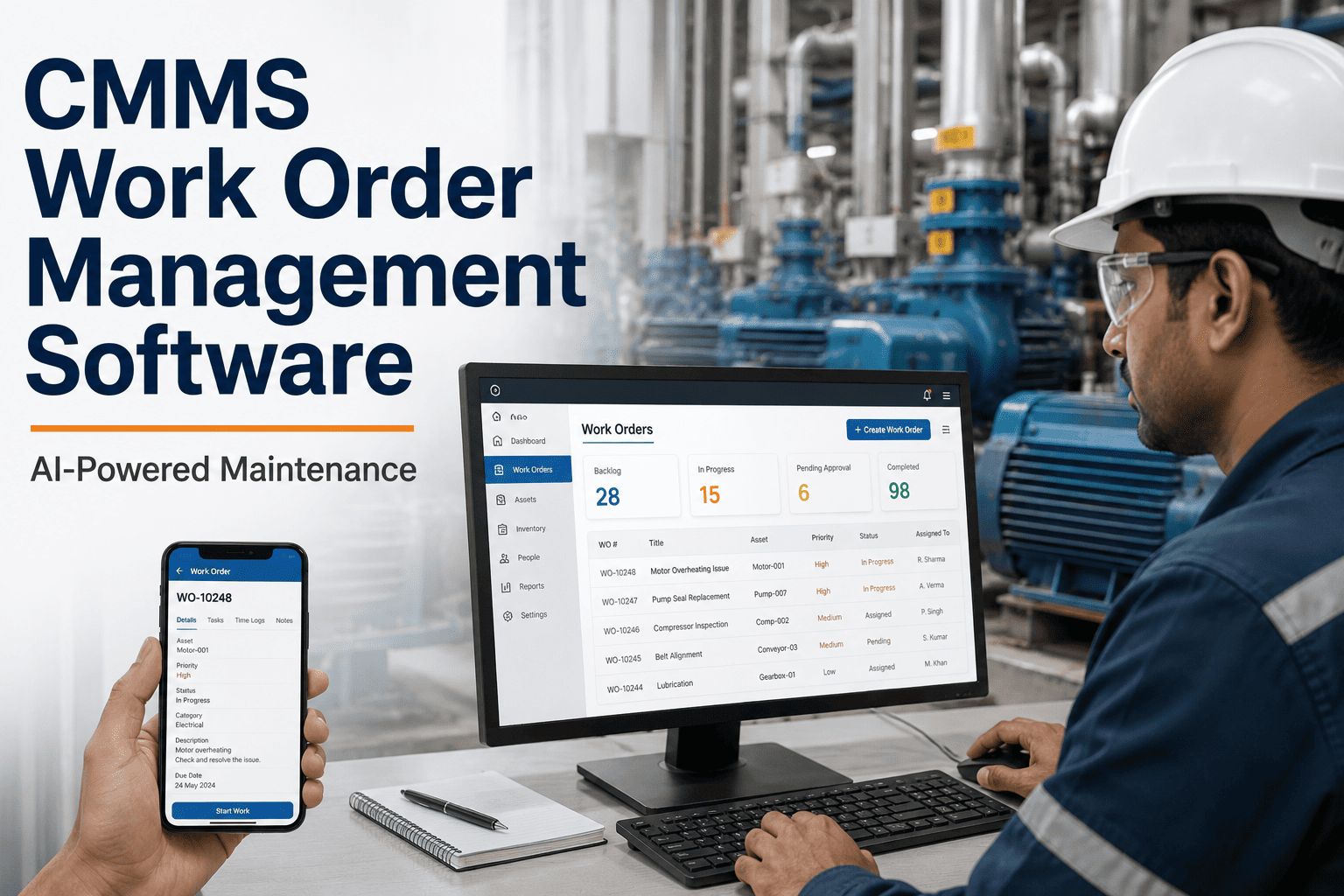
A Mobile CMMS is a software platform that gives maintenance technicians and reliability engineers full access to work orders, asset histories, spare parts inventory, and predictive alerts via smartphone or tablet—even in offline environments without reliable connectivity. It is not simply a desktop CMMS with a responsive layout. A purpose-built mobile CMMS is architected around the workflow of a field technician: quick work order acceptance, barcode or QR-based asset identification, photo-documented fault capture, and real-time synchronization with back-office systems the moment connectivity is restored.
The distinction matters because traditional CMMS implementations fail at the field level. Technicians work around systems that require them to walk back to a terminal to log a completed task, resulting in data gaps, delayed work order closure, and a maintenance record that reflects administrative convenience rather than operational reality. When the system goes mobile, the data follows the work—and the analytics that drive predictive maintenance become accurate enough to act on.
Core Benefits of a Mobile CMMS for Industrial Operations
Seven Operational Advantages That Separate Mobile-First from Desktop-Legacy Systems
01
Real-Time Work Order Management
Technicians receive, accept, and close work orders in the field without returning to a workstation. Every status update is time-stamped and immediately visible to planners and supervisors. This eliminates the 2–8 hour reporting lag common in paper-based and terminal-dependent maintenance workflows, giving planners accurate live visibility into what is in progress, what is overdue, and what requires escalation.
02
Predictive Maintenance Enablement
A mobile CMMS connected to IoT sensors and AI vision cameras continuously ingests asset health data—vibration, temperature, pressure, current draw—and generates corrective work orders automatically when thresholds are breached. Field technicians receive the alert on their device before the failure occurs, with the asset location, fault description, and recommended intervention pre-populated. This transforms maintenance from a calendar-based schedule into a condition-driven response model.
03
Accurate Asset and Inventory Tracking
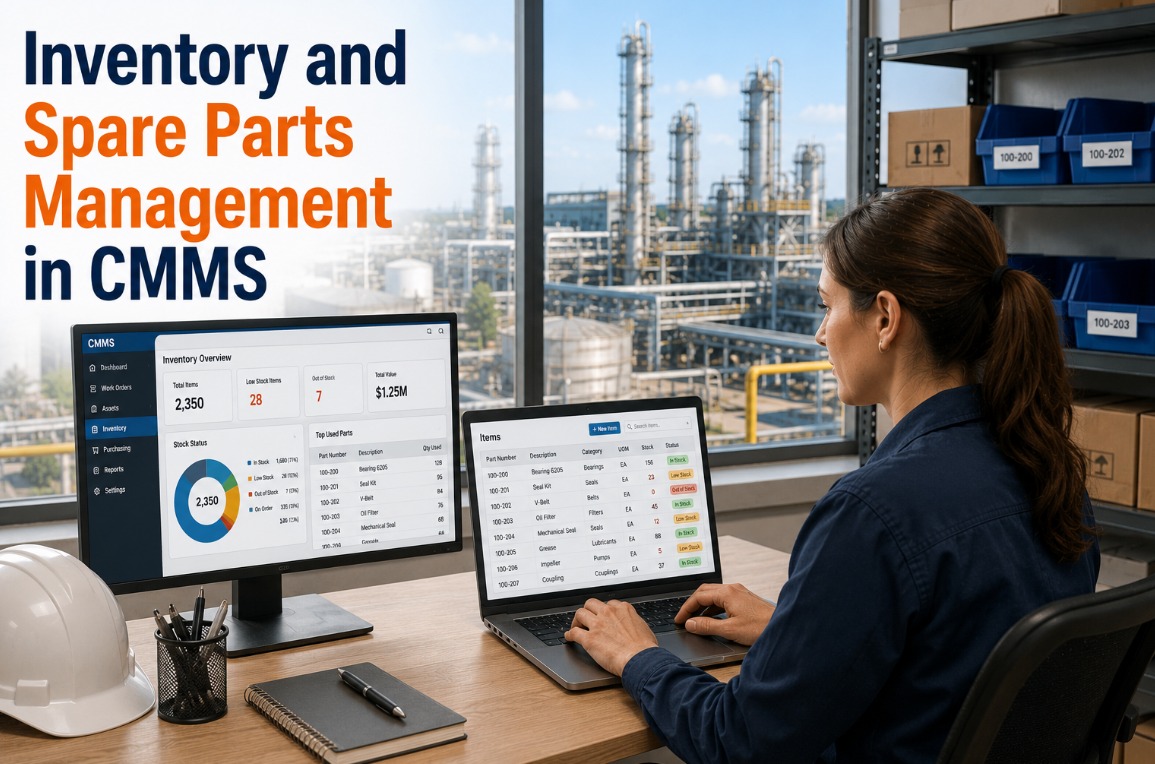
Technicians scan asset QR codes or barcodes directly from their mobile device, instantly pulling up the full maintenance history, open work orders, and spare parts requirements for that specific asset. Inventory consumption is logged at the point of use rather than retrospectively, producing accurate parts usage data that drives procurement decisions and eliminates both stockouts and excess inventory costs.
04
Photo and Video Fault Documentation
Field technicians attach photos, videos, and voice notes directly to work orders at the time of inspection. This documentation becomes part of the permanent asset record and gives remote engineers and reliability analysts the visual context needed to diagnose failure modes without being physically present. Over time, this visual history becomes a training dataset for AI defect detection models integrated with iFactory's vision camera platform.
05
Compliance and Audit Readiness
Regulatory compliance in industrial operations depends on complete, timestamped maintenance records that can be produced on demand. A mobile CMMS creates an immutable audit trail for every inspection, work order, and parts replacement—accessible from any device, in any location. Compliance gaps that once required manual record reconstruction are eliminated because the data is captured at source, by the technician, at the time of the intervention.
06
Reduced Mean Time to Repair (MTTR)
When a technician arrives at a fault with the asset's full history, previous repair records, and parts requirements already on their device, diagnostic time collapses. Studies across industrial sectors consistently show MTTR reductions of 20–35% following mobile CMMS implementation, because technicians spend less time gathering information and more time executing the repair with the right tools and parts on hand.
07
Cross-System Integration and Data Unification
A production-grade mobile CMMS integrates with ERP systems, MES platforms, IoT sensor historians, and AI vision camera networks via standard protocols including OPC-UA, REST, and MQTT. This integration means that a work order generated by a vision camera detecting a surface defect on a production line automatically appears on the relevant technician's mobile device, with the production context, asset location, and defect image already attached. No manual hand-off required.
Each of these benefits compounds over time. An accurate maintenance record enables better predictive models. Better predictive models generate earlier alerts. Earlier alerts reduce repair complexity and parts consumption. Reduced repair complexity improves first-time fix rates. First-time fix rate improvement is one of the highest-leverage metrics in maintenance operations because every repeat visit to the same fault carries the full labor, parts, and downtime cost of the original failure.
Mobile CMMS and IoT Integration: How iFactory Connects the Field to the Data
From Sensor Signal to Technician Action in Minutes
The most significant evolution in mobile CMMS capability in 2026 is the depth of integration with IoT sensor networks and AI-powered vision systems. iFactory's platform connects directly to connected sensors monitoring vibration, temperature, pressure, and energy consumption across asset fleets. When a sensor reading crosses a configurable threshold—indicating early bearing degradation, abnormal thermal signature, or hydraulic pressure loss—the platform automatically generates a work order, assigns it to the appropriate technician, and delivers it to their mobile device with the sensor reading, threshold breach detail, and asset history pre-loaded.
iFactory's AI vision camera system adds a visual dimension that sensor data alone cannot provide. Cameras positioned at critical inspection points continuously analyze surface quality, component alignment, and process conformance. When a defect or anomaly is detected, the vision system passes the detection event—including a timestamped image of the defect—directly to the CMMS, generating a prioritized work order with visual evidence already attached. Technicians arrive at the fault location with the context they need to act immediately rather than beginning a diagnostic process from scratch.
This sensor-to-technician workflow is the operational definition of predictive maintenance at scale. It is not a scheduled inspection program with a mobile interface—it is a continuously monitored asset environment where every deviation from normal operating condition triggers a specific, documented, assignable maintenance action. To see how iFactory's AI vision and sensor integration works in a live facility environment, Book a Demo with our engineering team.
Maintenance Approach
Trigger
Average Downtime Cost
Work Order Lead Time
Data Capture Quality
Reactive (Breakdown)
Equipment failure
Highest — unplanned production stop
Hours to days
Minimal — post-failure logging
Calendar-Based Preventive
Fixed schedule
Moderate — unnecessary interventions
Planned in advance
Moderate — scheduled inspection logs
Condition-Based (IoT-Triggered)
Sensor threshold breach
Low — early intervention
Minutes via mobile CMMS alert
High — sensor + work order linked
AI Predictive (Vision + Sensor)
Anomaly pattern detection
Lowest — pre-failure action
Auto-generated work order
Highest — visual + sensor + history
Mobile CMMS Best Practices for Industrial Facilities
Implementation Principles That Determine Whether Your Platform Delivers Value or Collects Dust
01
Start With Your Highest-Consequence Assets
Phased deployment consistently outperforms big-bang implementations. Begin with the five to ten assets whose unplanned failure causes the most production disruption, quality loss, or safety risk. Connect those assets to IoT monitoring, establish baseline sensor readings, and configure alert thresholds before expanding the program. A focused pilot on critical assets typically delivers measurable ROI within 90 days and builds organizational confidence in the platform before broader rollout.
02
Enforce Work Order Closure at the Asset, Not the Office
The most common data quality failure in mobile CMMS deployments is technicians completing repairs in the field and closing work orders later at a terminal—often hours after the fact, with degraded recall of what was actually done. Configure your CMMS to require work order closure at the asset location, enforced by GPS verification or QR scan confirmation. This single practice transforms maintenance record quality from a compliance exercise into an accurate operational dataset that drives meaningful analytics.
03
Standardize Failure Codes and Fault Descriptions
Predictive maintenance models are only as good as the failure event data they are trained on. If every technician describes the same bearing failure differently—"loud noise," "vibration," "overheating," "bearing gone"—the historical data cannot be used to train failure pattern recognition models. Define a standardized failure code taxonomy within your CMMS and enforce its use at work order closure. This practice converts qualitative technician observations into structured data that powers machine learning models over time.
04
Integrate Inventory Management From Day One
Mobile CMMS deployments that treat inventory management as a phase-two integration consistently underperform because technicians cannot confirm parts availability before committing to a repair timeline. Configure spare parts inventory within the CMMS from the initial deployment, linked to the specific assets each part serves. When a technician accepts a work order on their mobile device, the required parts and their current stock levels should be visible before they leave the storeroom—eliminating the wasted time and extended downtime caused by arriving at a fault location without the right parts.
05
Use Maintenance KPIs to Drive Continuous Improvement
A mobile CMMS generates a continuous stream of performance data: work order completion rate, planned versus unplanned maintenance ratio, MTBF by asset class, first-time fix rate, and PM compliance percentage. Configure automated reporting against these KPIs and review them on a structured cadence—weekly at the supervisory level, monthly at the operations director level. The facilities that extract the most long-term value from their CMMS are those where maintenance KPIs drive capital allocation decisions, technician training priorities, and vendor performance evaluations.
Cross-System Integration: Connecting Mobile CMMS to Your Existing Technology Stack
Why Integration Depth Determines Analytics Value
A mobile CMMS operating as a standalone work order system captures roughly 30% of its potential value. The remainder is unlocked through integration with the broader technology stack: ERP for cost accounting and procurement, MES for production context, IoT sensor historians for asset health data, and AI vision systems for visual defect detection. When these systems share data through a unified integration layer, the CMMS becomes a decision intelligence platform rather than a task management tool.
Standalone CMMS (Isolated)
Work orders disconnected from production data
No IoT or sensor alert integration
Manual spare parts reconciliation with ERP
Vision inspection results logged separately
Maintenance cost data unavailable to finance
Predictive models impossible without unified data
VS
iFactory Integrated Mobile CMMS
Work orders auto-linked to production run and shift data
IoT sensor alerts generate mobile work orders in real time
Parts consumption synced with ERP on work order closure
AI vision detections auto-create visual work orders with images
Maintenance cost per tonne visible in executive dashboards
Historical failure patterns train predictive ML models continuously
iFactory's platform is built on open integration standards—OPC-UA for PLC and DCS connectivity, REST and GraphQL APIs for enterprise system integration, and MQTT for edge device communication. This means your existing historian, ERP, and MES investments are not replaced; they are connected to a unified intelligence layer that makes every data stream queryable and actionable through a single mobile interface. Maintenance engineers stop spending six hours aggregating data before they can ask a question and start receiving the answer before the question forms. To see the full integration architecture in action, Book a Demo and bring your current system inventory.
Ready to Connect Your Field Teams to Real-Time Asset Intelligence?
iFactory's integrated Mobile CMMS combines IoT sensor monitoring, AI vision camera defect detection, and field-first work order management into a single platform—delivering predictive maintenance at scale without replacing your existing technology investments.
Mobile CMMS and Preventive Maintenance: Building a Proactive Maintenance Culture
How Mobile Access Transforms PM Compliance From a Paperwork Exercise to a Data Asset
Preventive maintenance programs fail for one consistent reason: the data required to execute them correctly is not available to the technician at the point of execution. A technician performing a lubrication round on a rolling mill bearing needs to know the last lubrication date, the specified lubricant grade, the quantity applied at each previous interval, and whether any anomalies were noted at the last inspection. Without a mobile CMMS, that information sits in a paper logbook that may or may not be at the asset location. With a mobile CMMS, it is on the technician's device before they pick up the grease gun.
The compliance improvement that follows mobile CMMS adoption is not primarily a behavioral change—it is a friction reduction. When it is easier to record what was done than to skip the record, PM compliance rates rise. Facilities that implement mobile work order capture with mandatory checklist completion at the asset location consistently report PM compliance rate improvements of 15–30 percentage points within the first six months. And because that compliance data now lives in a time-stamped, structured format within the CMMS, it becomes the foundation for identifying which preventive intervals are correctly calibrated and which are generating either over-maintenance or under-protection.
Mobile CMMS KPI Framework — Maintenance Performance Dashboard
Work Order Performance
Work order completion rate by technician and shift
Average time from alert to work order acceptance
First-time fix rate by asset class and failure type
Overdue work orders by priority and department
Asset Reliability
MTBF by asset class (rolling 12-month)
MTTR by fault type and technician
Planned vs. unplanned maintenance ratio
Repeat failure rate within 30-day window
Predictive Maintenance
Active predictive alerts by severity tier
Alert-to-intervention lead time trending
False positive rate by sensor and asset type
PM compliance rate by route and technician
Cost & Inventory
Maintenance cost per tonne or production unit
Parts consumption vs. budget by asset class
Stock-out incidents and production impact cost
Downtime cost attributed by failure category
Conclusion
The industrial facilities that will sustain competitive maintenance performance through 2026 and beyond are not those with the largest maintenance teams—they are those whose teams are best informed at the point of action. A mobile CMMS is the operational infrastructure that makes that possible: putting work order history, asset data, IoT alerts, and AI vision detections in the hands of the technician standing in front of the fault, rather than on a terminal back in the maintenance office.
The implementation path is well-defined: start with critical assets, enforce field-level data capture, standardize failure codes, integrate inventory from day one, and use KPI dashboards to drive continuous improvement. When that discipline is applied to a platform with deep IoT and AI vision integration—like iFactory's unified maintenance intelligence platform—the compound effect is a maintenance operation that improves measurably every quarter: better data, better models, earlier interventions, lower costs. The gap between data generated and data acted upon closes permanently, and the organization moves from a reactive maintenance culture to a predictive one.
MOBILE CMMS INTELLIGENCE
Get a Mobile CMMS Architecture Assessment for Your Facility
Our platform engineering team will map your current maintenance workflows, identify IoT and AI vision integration opportunities, and deliver a structured roadmap showing exactly how iFactory's Mobile CMMS transforms your maintenance operations from reactive to predictive.
A traditional desktop CMMS requires technicians to access the system from a fixed workstation, which means maintenance data is typically logged after the fact—often hours after a repair is completed. A mobile CMMS is designed for field-first access: technicians receive work orders, access asset histories, capture fault photos, log parts usage, and close work orders directly from a smartphone or tablet at the asset location. This distinction matters operationally because field-level data capture produces a maintenance record that reflects what actually happened, when it happened, rather than what a technician remembered to type at end of shift. That data quality difference is the foundation of reliable predictive maintenance analytics.
Integration between a mobile CMMS and IoT sensors works through configurable threshold monitoring: when a sensor reading—vibration level, temperature, hydraulic pressure—crosses a defined threshold, the CMMS automatically generates a work order and delivers it to the assigned technician's mobile device. AI vision camera integration works similarly: when a camera system detects a surface defect, misalignment, or process anomaly, it passes the detection event with a timestamped image directly to the CMMS, generating a visual work order with the photographic evidence already attached. iFactory's platform supports OPC-UA, MQTT, and REST-based integration with both sensor historians and vision systems, eliminating manual hand-offs between detection and action.
A focused single-department or critical-asset pilot typically reaches operational status in 6–10 weeks. Full facility deployment covering all asset classes, IoT integrations, ERP connectivity, and cross-department reporting typically takes 12–18 months, with measurable ROI visible within the first 90 days of the pilot phase. The critical path in most implementations is not platform configuration but data preparation: asset hierarchy documentation, tag list validation, and failure code taxonomy definition. Facilities with well-structured existing CMMS data or documented OPC-UA tag lists complete integrations significantly faster than those migrating from paper-based or undocumented legacy systems.
The most direct ROI indicators for a mobile CMMS deployment are: planned-to-unplanned maintenance ratio (target: 70%+ planned within 12 months); first-time fix rate (measures whether technicians arrive with the right information and parts); MTTR by asset class (reduction indicates that mobile information access is accelerating diagnosis and repair); PM compliance rate (field-level capture typically improves compliance 15–30 percentage points); and maintenance cost per production unit (the aggregate measure of whether the program is reducing total maintenance spend). Tracking these KPIs monthly against pre-deployment baselines provides the quantified ROI narrative needed to justify program expansion and continued platform investment.
A purpose-built industrial mobile CMMS must support offline operation, because many plant floor environments—particularly in underground, enclosed, or remote locations—have unreliable connectivity. Offline mode allows technicians to access pre-synced work orders, asset histories, parts lists, and inspection checklists without network access. Any data captured offline—work order updates, parts consumption logs, fault photos, checklist completions—is stored locally on the device and automatically synchronized to the central platform the moment connectivity is restored. This offline-first architecture is essential for data completeness: if technicians cannot log data in the field, the maintenance record defaults to post-hoc reconstruction, and the predictive analytics built on that record become unreliable.