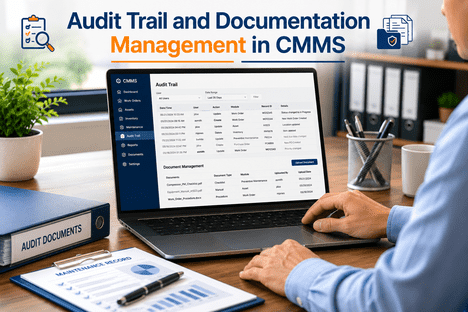
Audit trails and documentation management form the backbone of any credible Computerized Maintenance Management System. In industrial environments where maintenance activities must be traceable for regulatory compliance, quality assurance, and operational accountability, a CMMS without structured audit and documentation capabilities creates unacceptable risk. Every work order lifecycle — from creation and approval to execution and closure — generates records that must be preserved, timestamped, and linked to the specific asset, technician, and parts involved. Documentation management extends beyond work order records to include equipment manuals, safety data sheets, inspection certificates, calibration records, and compliance filings that must remain accessible and version-controlled across the asset lifecycle. Organizations that implement comprehensive audit trail and documentation management within their CMMS reduce compliance exposure, accelerate audit response times, and build the data foundation required for predictive maintenance and AI-driven reliability programs. Book a Demo to see how iFactory AI's platform delivers audit-ready documentation and automated compliance tracking for your maintenance operations.
The Compliance Case for Audit Trails in CMMS
Regulatory frameworks governing maintenance documentation continue to tighten across OSHA PSM, EPA RMP, and ISO 55001 asset management standards. Each framework requires auditable evidence that maintenance was performed according to schedule, that equipment inspections occurred at prescribed intervals, and that any deviations from standard procedures were documented and approved. A CMMS with native audit trail capabilities automatically captures this information at every step of the maintenance process — eliminating the manual documentation burden that leads to gaps in compliance records. Automated audit trails record who created or modified each work order, what changes were made, when they occurred, and what approval workflow was followed.
The financial consequences of inadequate audit trails are substantial. OSHA PSM citations for recordkeeping violations routinely exceed six figures per incident, and EPA enforcement actions under the Risk Management Program carry penalties that scale with the duration of non-compliance. Beyond regulatory risk, the absence of structured audit trails makes it impossible for reliability engineers to reconstruct the sequence of events leading to equipment failures — eliminating the primary data source for root cause analysis and continuous improvement programs. Book a Demo to understand how iFactory AI's audit trail module maps to specific regulatory requirements across OSHA, EPA, and ISO standards.
| Compliance Framework | Audit Trail Requirement | CMMS Automation Capability | Risk of Non-Compliance |
|---|---|---|---|
| OSHA PSM (1910.119) | Maintenance records for process equipment must document date, personnel, and nature of each maintenance activity | Automatic timestamped work order history with technician attribution and parts tracking | Citations up to $145K per violation; increased inspection frequency |
| EPA RMP (40 CFR Part 68) | Equipment inspection and testing records must be retained for at least 5 years with complete change history | Documented inspection workflows with automated retention scheduling and version-controlled records | Enforcement penalties scaling with duration of non-compliance; public disclosure requirements |
| ISO 55001 | Asset management system must demonstrate traceability of decisions and actions across the asset lifecycle | Full decision lineage from condition assessment through work order completion and cost capture | Certification lapse; inability to demonstrate continuous improvement |
Core Capabilities of Documentation Management in CMMS
Documentation management within a CMMS encompasses the systematic storage, version control, access management, and retrieval of all documents related to asset maintenance. The scope includes equipment technical manuals, standard operating procedures, safety data sheets, inspection and testing records, calibration certificates, warranty documentation, and regulatory filings. Each document type has distinct lifecycle requirements — calibration certificates must be tracked to expiration, safety data sheets must reflect the latest chemical formulation, and equipment manuals must be updated when engineering changes are made.
A production-grade CMMS documentation module provides version control with complete revision history, role-based access controls that restrict sensitive documents to authorized personnel, automated document expiry notifications, and full-text search across all document types. Integration with the work order system ensures that technicians can access relevant documentation directly from the work order interface — eliminating the productivity loss of searching separate file shares or physical filing systems. iFactory AI's documentation management extends these capabilities with AI-powered document classification, automated metadata extraction, and computer vision inspection documentation through the AI vision camera integration that links visual inspection records directly to asset documentation.
Phased Implementation Methodology for Audit Trail and Documentation Systems
Implementing audit trail and documentation management within a CMMS follows a structured methodology that prioritizes the highest-compliance assets first. The approach mirrors the phased deployment patterns used across industrial digital transformation programs, adapted for the specific documentation requirements of maintenance operations. Book a Demo to walk through iFactory AI's implementation methodology and see how it applies to your facility's current documentation infrastructure.
Catalog all existing maintenance documentation across equipment files, digital repositories, and regulatory records. Identify compliance gaps where required documentation is missing, outdated, or inaccessible. Establish document priority tiers based on regulatory criticality and asset consequence severity.
Configure audit trail capture rules, document version control settings, and role-based access permissions in the CMMS. Migrate priority-tier documents with metadata tagging for searchability. Establish automated expiry tracking for time-sensitive documents such as calibration certificates and safety data sheets.
Link documentation access to work order workflows so technicians retrieve relevant documents automatically during maintenance execution. Deploy document amendment workflows with approval chains for engineering change management. Train maintenance teams on audit trail navigation and document retrieval procedures.
Implement automated compliance reporting that generates audit-ready documentation packages on demand. Deploy document quality scoring to identify records requiring updates. Establish closed-loop feedback where audit findings trigger automated document review and remediation workflows.
Operational Benefits of Automated Audit Trail and Documentation Management
Organizations that deploy comprehensive audit trail and documentation management within their CMMS report measurable improvements across compliance, operational efficiency, and maintenance reliability. Audit response times drop from weeks to hours when all maintenance documentation is structured, version-controlled, and searchable within a single system. The automation of documentation workflows eliminates the manual filing, retrieval, and reconciliation tasks that consume an estimated 15–25% of maintenance administrative labor in facilities operating without integrated document management. Book a Demo to see how iFactory AI customers have reduced audit preparation time and improved maintenance documentation accuracy.
Beyond compliance and efficiency, structured audit trails create the data foundation required for predictive maintenance programs. Machine learning models trained on maintenance history with complete audit context — including work order duration, technician attribution, parts consumption, and equipment condition at time of repair — produce significantly more accurate failure predictions than models trained on incomplete maintenance records. iFactory AI's platform connects CMMS audit trail data with IoT sensor streams and AI vision camera inspection records to create a unified data layer that drives both compliance documentation and predictive analytics from the same infrastructure.
Frequently Asked Questions
An audit trail in a CMMS is a chronological record of every action taken within the system — work order creation, modification, approval, closure, and any changes to asset records. It is important because it provides the traceability required for regulatory compliance, enables root cause analysis of maintenance failures, and establishes accountability for maintenance decisions across the organization.
Documentation management centralizes all compliance-related records — inspection reports, calibration certificates, safety data sheets, and maintenance histories — in a single version-controlled repository with automated expiry tracking and role-based access. This structure ensures that required documentation is always current, accessible during audits, and linked to the specific assets and work orders it supports.
Equipment technical manuals, standard operating procedures, safety data sheets, inspection and testing records, calibration certificates, warranty documentation, engineering change notices, regulatory filings, and visual inspection records — including images and video from AI vision cameras — should all be managed within the CMMS documentation module for maximum accessibility and compliance integrity.
A phased implementation targeting highest-compliance assets first typically delivers initial audit trail capture and document management capabilities within 3–4 weeks. Full enterprise deployment across all asset classes and document types generally requires 3–5 months, depending on the volume of existing documentation and the complexity of regulatory requirements.
Conclusion: Audit Trail and Documentation Management as a Competitive Advantage
The organizations that treat audit trail and documentation management as a strategic capability rather than a compliance checkbox are building the maintenance data infrastructure required for the next generation of industrial operations. Complete, structured, version-controlled maintenance documentation enables faster regulatory audits, more accurate root cause analysis, higher technician productivity, and — most importantly — the clean historical data sets that make predictive maintenance AI reliable. Every work order executed without a structured audit trail is a data point lost to future reliability analysis. Every document stored outside the CMMS is a compliance exposure waiting to surface during the next regulatory inspection. Book a Demo today to see how iFactory AI's CMMS platform delivers production-grade audit trail and documentation management for industrial maintenance operations.