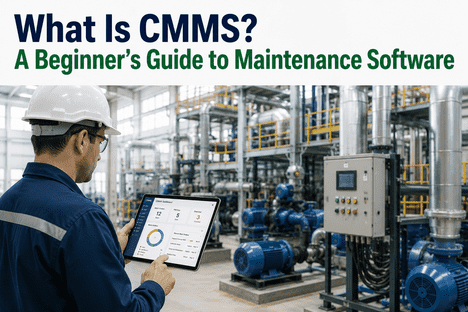
A Computerized Maintenance Management System (CMMS) is a software platform that centralizes maintenance operations, work order management, asset tracking, and preventive maintenance scheduling into a single digital environment. For industrial and manufacturing facilities, a CMMS replaces the spreadsheet-based or paper-based maintenance tracking methods that leave organizations vulnerable to unplanned downtime, reactive maintenance cycles, and compliance documentation gaps. Modern CMMS platforms have evolved from simple work order databases into comprehensive maintenance intelligence systems that integrate with IoT sensors, AI-based visual inspection tools such as the iFactory AI Vision Camera, and real-time equipment monitoring — creating a connected maintenance ecosystem where data from multiple sources informs every repair decision, every inspection interval, and every spare part order. This guide covers what a CMMS does, the core features that define a modern maintenance platform, how AI and computer vision technologies extend CMMS capabilities, and the criteria for selecting the right CMMS architecture for your operation.
What Is a CMMS and Why Does It Matter for Modern Maintenance Operations?
A CMMS is a centralized database and workflow engine that manages all aspects of equipment maintenance — work order creation and assignment, asset history tracking, preventive maintenance scheduling, spare parts inventory management, and maintenance performance reporting. The fundamental value of a CMMS is that it converts maintenance from a reactive, event-driven function into a structured, data-driven discipline. Without a CMMS, maintenance teams operate on institutional knowledge stored in individual technicians' experience, undocumented repair histories, and manual work order logs that cannot be analyzed for root cause patterns or maintenance optimization opportunities. With a CMMS, every asset has a complete digital maintenance record — every repair, every part replacement, every lubrication cycle, every inspection result — that can be queried, trended, and acted upon systematically. For facilities running continuous or high-speed production operations, the difference between a CMMS-enabled maintenance program and a paper-based program typically measures in the range of 15 to 30 percent reduction in unplanned downtime, 20 to 40 percent reduction in maintenance overtime labor, and a measurable extension of asset service life through consistent preventive maintenance execution.
Core CMMS Features That Define a Modern Maintenance Platform
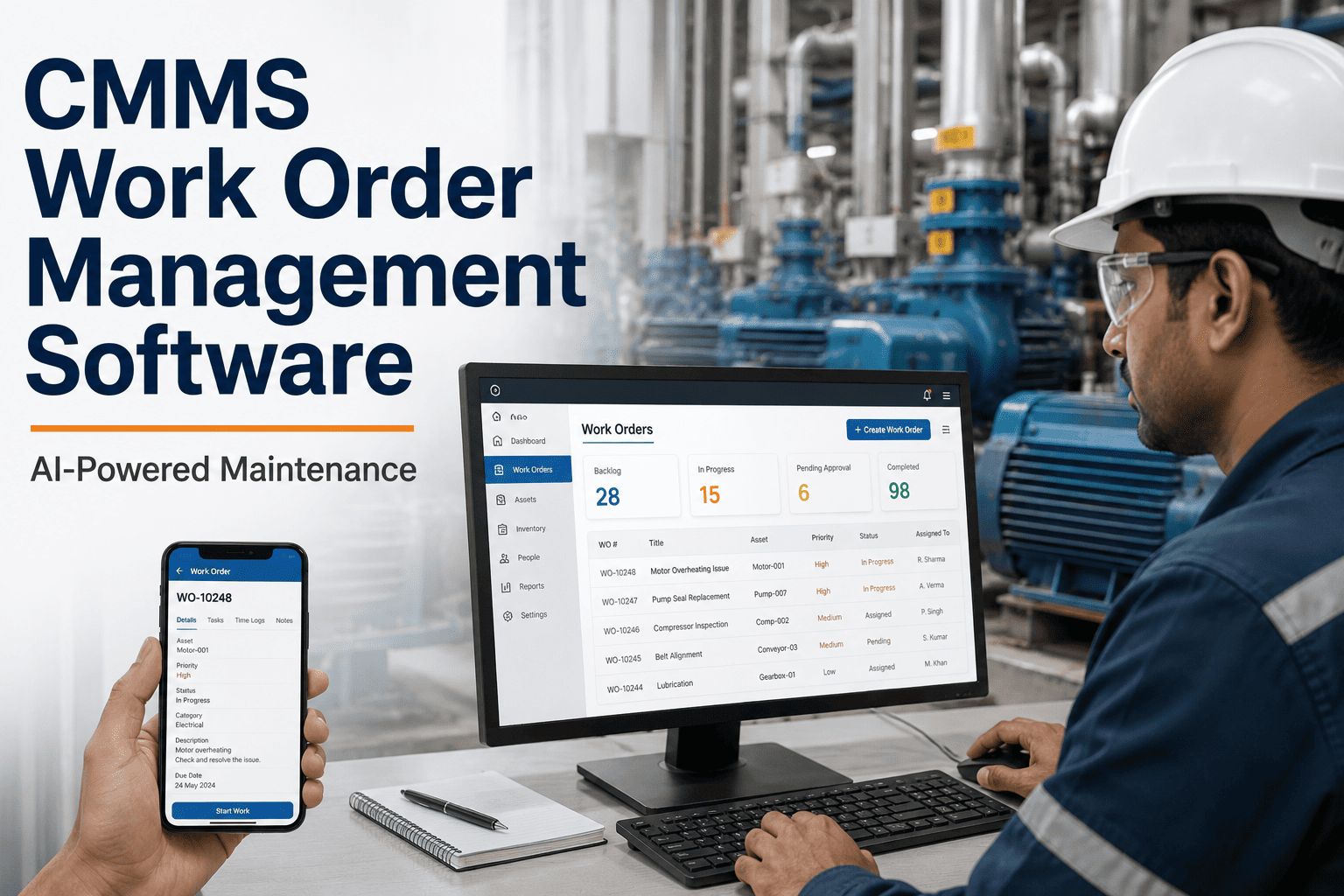
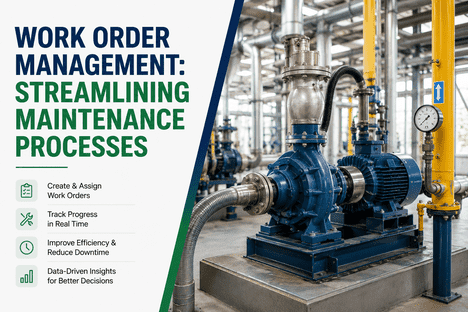
The work order is the fundamental transaction unit of a CMMS. A modern work order management module supports creation from multiple trigger sources — scheduled preventive maintenance due dates, operator-reported equipment issues, IoT sensor threshold breaches, automated inspection results from AI vision systems such as the iFactory AI Vision Camera and inventory reorder point alerts. Each work order captures the asset identification, problem description, priority level, assigned technician, estimated and actual labor hours, parts used, downtime duration, and resolution notes. The work order lifecycle — from open to assigned to in-progress to completed to reviewed — provides the visibility that maintenance supervisors need to balance workload across shifts, identify recurring failure patterns on specific assets, and measure technician productivity and repair quality. Advanced work order systems also support mobile access, enabling technicians to view assignments, document repairs with photos, and close work orders from the shop floor without returning to a maintenance office terminal.
Preventive maintenance scheduling is the feature that most directly reduces unplanned downtime. A CMMS enables maintenance teams to define PM tasks by time interval, operating hours, cycle count, or condition-based triggers such as vibration level, bearing temperature, or oil analysis results. The scheduling engine automatically generates work orders when a PM due date or condition threshold is reached, assigns them to the appropriate technician or crew, and tracks completion against the scheduled due date. Predictive maintenance capabilities extend this further by integrating with IoT sensor platforms and AI analytics — when a vibration sensor detects a bearing frequency shift indicating early-stage wear, the CMMS can automatically generate a predictive maintenance work order before the bearing fails during production. This integration between real-time condition monitoring and automated work order creation is the architectural difference between a CMMS that schedules maintenance and a CMMS that predicts and prevents failures. Book a Demo to see how iFactory connects AI condition monitoring data directly to your CMMS work order engine.
Asset management in a CMMS goes beyond a simple equipment list. Each asset record should capture manufacturer specifications, installation date, warranty information, serial numbers, spare parts cross-references, maintenance history, and attached documentation such as OEM manuals, electrical schematics, and PM procedures. The asset hierarchy — which pieces of equipment are part of which production line, which systems they feed, and which spares they share — enables failure impact analysis and criticality ranking. Lifecycle cost tracking aggregates all maintenance labor, parts, and contractor costs against each asset over its service life, providing the data needed to make repair-or-replace decisions based on actual cost history rather than budget availability. When an asset's maintenance cost curve crosses the replacement cost threshold, the CMMS provides the quantitative evidence for the capital expenditure justification.
Spare parts inventory management within a CMMS prevents the two most costly inventory failures in maintenance operations: stockouts that extend equipment downtime waiting for parts delivery, and overstock that ties up working capital in parts that may never be used. The CMMS tracks part quantities, storage locations, reorder points, lead times, supplier information, and cost data, with automatic reorder notifications when stock falls below the minimum threshold. Part cross-referencing to the assets that use each component ensures that when a maintenance work order is created for a specific machine, the required parts are automatically reserved and the inventory impact is visible before the technician begins the repair. Integration with procurement systems enables automatic purchase order generation from reorder alerts, reducing the administrative overhead of maintaining accurate inventory levels across hundreds or thousands of line items.
AI Vision Integration: How Computer Vision Extends CMMS Capabilities Beyond Traditional Maintenance
The iFactory AI Vision Camera represents the next evolution of maintenance intelligence — a computer vision system that continuously monitors equipment condition, process parameters, and visual quality indicators, then feeds detected anomalies directly into the CMMS work order engine. Traditional CMMS platforms rely on human observation and manual data entry for equipment condition reporting, which introduces delays between the onset of a failure condition and the creation of a maintenance response. AI vision inspection eliminates this latency by detecting visual indicators of equipment degradation — oil leaks, belt misalignment, surface cracks, worn tooling, debris accumulation, or thermal anomalies visible in the visual spectrum — and generating CMMS work orders automatically when an anomaly is detected and confirmed. This integration creates a closed-loop maintenance response where the time between a detectable condition change and a technician assignment is measured in seconds rather than shifts, which is the difference between a minor adjustment and a major equipment failure for assets that degrade rapidly at operating speed.
| CMMS Feature | Traditional Approach | With AI Vision Integration | Impact |
|---|---|---|---|
| Work order creation trigger | Operator observation and manual entry | AI-detected anomaly generates work order automatically | Response time reduced from hours to seconds |
| Equipment condition data | Manual inspection logs and checklists | Continuous vision monitoring with anomaly tagging | Condition data available for every production minute |
| Inspection frequency | Scheduled rounds — daily to weekly | Continuous real-time inspection | Degradation detected at onset, not at next round |
| Parts and deterioration tracking | Visual wear assessment at inspection | Automated wear measurement from camera data | Predictive replacement before failure |
| Compliance documentation | Manual inspection sign-off forms | Timestamped image records linked to work orders | Audit-ready documentation without manual effort |
Key Performance Indicators a CMMS Should Track for Maintenance Excellence
Overall Equipment Effectiveness
OEE measures the percentage of planned production time that is truly productive, calculated from availability, performance, and quality. A CMMS with OEE tracking links maintenance downtime events directly to their root cause, enabling teams to prioritize maintenance activities that have the highest impact on production throughput.
Planned Maintenance Percentage
The ratio of planned maintenance hours to total maintenance hours is the single strongest indicator of a mature maintenance program. Top-quartile facilities operate above 85 percent planned maintenance; facilities below 50 percent are in a reactive maintenance cycle that a properly configured CMMS can systematically break.
Mean Time Between Failure
MTBF measures the average operating time between equipment failures for a given asset or asset class. Trending MTBF by asset category, manufacturer, operating condition, and maintenance history reveals which assets are underperforming their design life and whether maintenance or operating practice changes are improving reliability over time.
Mean Time to Repair
MTTR measures the average time required to restore an asset to operating condition after a failure. A CMMS that tracks MTTR by asset, failure type, technician, and shift provides the data needed to identify training gaps, parts availability issues, and procedural improvements that reduce repair duration.
CMMS Implementation Considerations for Industrial Operations
Expert Perspective: What Differentiates High-Performance CMMS Programs
Facilities that achieve the highest return on their CMMS investment share four practices that distinguish them from organizations that use their CMMS primarily as a work order logging system. First, they configure automated work order creation from multiple data sources — PLC alarms, IoT sensor thresholds, AI vision anomaly detection, and inventory reorder points — so the CMMS generates work orders without requiring human observation and manual entry. This automation eliminates the detection-to-response gap that is the primary source of unplanned downtime in facilities relying on operator-reported maintenance requests. Second, they integrate their CMMS with their production scheduling system so that preventive maintenance tasks are scheduled during planned production windows rather than competing with production for equipment availability. This integration converts PM compliance from a maintenance metric to a joint production-maintenance metric that both departments own equally. Third, they use their CMMS asset history data to perform systematic root cause analysis on repeat failures — using the maintenance record to identify the assets, failure modes, and operating conditions that generate the highest maintenance cost per production hour, and investing reliability improvement resources where the data shows the highest return. Fourth, they deploy mobile CMMS access for all maintenance technicians and require digital work order closure with parts usage recording and failure code assignment before the work order is considered complete. This data discipline creates the high-quality maintenance history that enables the root cause analysis, cost tracking, and reliability improvement programs described above.
— Industry Benchmark Analysis, CMMS Program Performance, iFactory Analytics Reference 2026Frequently Asked Questions
A CMMS focuses on maintenance operations — work order management, preventive maintenance scheduling, spare parts inventory, and maintenance history tracking. An Enterprise Asset Management system encompasses all of the CMMS functionality plus additional capabilities for asset lifecycle financial management, capital project tracking, supply chain integration, and enterprise-level asset portfolio management. For most single-site or multi-site industrial operations, a modern CMMS provides the necessary functionality for maintenance excellence. EAM systems are typically deployed by organizations managing large, geographically distributed asset portfolios where financial and capital planning integration is required. Many mid-market CMMS platforms now include enough asset lifecycle cost tracking that the practical distinction has narrowed significantly for most industrial users.
AI vision integration with a CMMS follows a detect-classify-respond architecture. The AI vision system — such as the iFactory AI Vision Camera — continuously monitors equipment through camera feeds, detecting visual anomalies including oil leaks, surface cracks, belt wear, debris accumulation, thermal hotspots, and position changes. When a detected anomaly exceeds the configured confidence threshold, the vision system sends an API payload to the CMMS containing the asset identifier, anomaly type, severity score, and a timestamped image of the condition. The CMMS automatically creates a work order with this data pre-populated, assigns the work order based on the anomaly type and severity, and notifies the appropriate technician through the mobile application. The technician receives the work order with the visual evidence of the condition change, enabling an informed response before arriving at the equipment. This automated workflow eliminates the manual inspection round gap that leaves equipment unmonitored between scheduled checks.
Industrial facilities implementing a properly configured CMMS typically report a 15 to 30 percent reduction in unplanned downtime within the first 12 to 18 months, driven by preventive maintenance compliance improvement from reactive levels below 40 percent to planned maintenance levels above 75 percent. Maintenance overtime labor typically decreases by 20 to 40 percent as scheduled PM execution reduces the volume of emergency repairs that require after-hours call-ins. Spare parts inventory carrying costs decrease by 10 to 25 percent through accurate reorder point management and elimination of duplicate or obsolete stock. Asset service life extends measurably — typically 15 to 30 percent longer between major rebuilds or replacement — because consistent preventive maintenance execution reduces the accelerated wear patterns that reactive-only maintenance programs produce. Compliance documentation for regulatory and customer audit requirements shifts from labor-intensive manual file assembly to automated retrieval of timestamped maintenance records linked to specific assets and work orders. Book a Demo to discuss your facility's specific maintenance improvement targets.
CMMS implementation timeline depends on facility size, asset count, data availability, and deployment scope. For a single-site industrial facility with several hundred assets, the typical implementation timeline is 6 to 12 weeks from software selection to go-live. The first two weeks focus on asset data collection and CMMS configuration — asset hierarchy setup, criticality ranking, PM procedure definition, and spare parts inventory upload. The next two to four weeks cover preventive maintenance schedule setup, work order template creation, and user role configuration. Weeks four through six involve team training — typically two to four hours per user role — followed by a two-week parallel run where the CMMS operates alongside existing tracking methods. Full transition to CMMS-only maintenance tracking typically occurs at week eight to twelve. Cloud-based CMMS platforms offer faster deployment than on-premise installations because server procurement, network configuration, and IT infrastructure setup are eliminated. Talk to an Engineer for a specific implementation timeline estimate for your operation.
Yes — system integration capability is the primary architectural requirement for a modern CMMS. The most valuable integrations for industrial operations are with ERP systems for parts procurement and asset financial data synchronization, with PLC and SCADA systems for automated work order creation from process alarms and equipment status changes, with IoT sensor platforms for condition-based maintenance trigger data, with AI vision systems for visual anomaly detection and automated inspection records, and with quality management systems for linking maintenance activities to product quality outcomes. Before selecting a CMMS, verify that the platform offers documented API endpoints, pre-built connectors for your existing ERP and control system platforms, and a configuration structure that supports the data mapping required for automated work order creation from external systems. The integration architecture should support both real-time API communication and batch data synchronization depending on the data source and use case requirements.