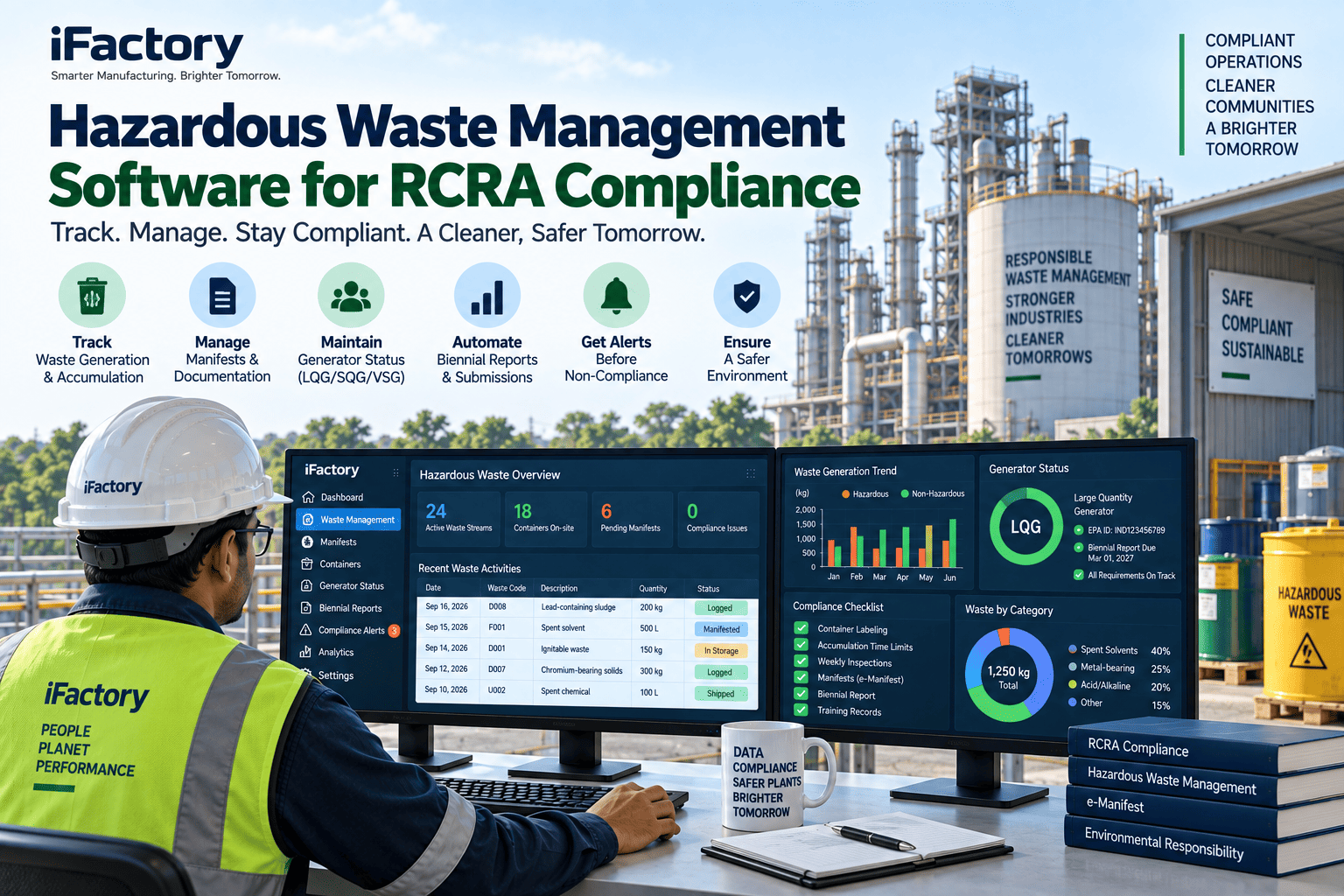
RCRA hazardous waste compliance turns on three things done right: correct waste characterization at the point of generation, correct generator status based on monthly volumes, and correct manifest handling from cradle to the treatment, storage, or disposal facility (TSDF). Get the generator status wrong and you're operating under the wrong rule set for accumulation time, personnel training, and biennial reporting. Get the manifest wrong and the chain-of-custody the CWA and RCRA both require is broken. EPA's e-Manifest system (in production since June 2018) closed the paper-manifest era but did not simplify the underlying discipline. Software that tracks generation, accumulation, and manifests as one system is what makes RCRA defensible.
iFactory / RCRA hazardous waste compliance
Cradle-to-Grave Waste Discipline — Generation, Accumulation, and e-Manifest in One System
Track waste characterization, generator status (VSQG, SQG, LQG), container accumulation with clock alerts, e-Manifest submission through EPA's system, and biennial reporting under 40 CFR 262 Subpart D — with the alerting that keeps you inside the accumulation-time envelope.
VSQG
≤100 kg/mo
No time limit
SQG
100–1000 kg/mo
180 days
VSQG · SQG · LQG
status tracked monthly
e-Manifest
EPA system integrated
The Problem in Hazardous Waste Compliance
A manufacturing site generating hazardous waste operates under a strict rule set that scales with monthly volumes. VSQG (≤100 kg/month) has no accumulation time limit but tight monthly ceilings. SQG (100-1000 kg/month) accumulates up to 180 days. LQG (≥1000 kg/month) has 90 days and additional personnel-training, contingency-plan, and biennial-reporting obligations. A site whose generation drifts between categories — common with campaign production — has to track monthly and shift its operating rule set accordingly. When containers sit past accumulation limits, when manifests aren't reconciled against TSDF receipt, or when the biennial report submitted through RCRAInfo doesn't reconcile against site records, each is a citable RCRA violation.
Where the RCRA Chain Actually Breaks
RCRA hazardous waste compliance fails in the same predictable places across manufacturing sites. Each maps to a specific 40 CFR 262 or 265 citation category.
Generator status drift
Monthly generation crosses the LQG threshold in a single month during a production campaign. Site continues operating under SQG rules. Discovery at agency inspection three months later.
Accumulation clock
Satellite accumulation container filled and moved to the 90-day accumulation area — but not date-marked on arrival. Discovery at accumulation-area inspection shows date unknown.
Manifest not received
Manifest submitted with the shipment. TSDF receipt copy never returned. 35-day (LQG) exception-report clock passes unnoticed. Chain of custody broken on the record.
Biennial reporting gap
Biennial hazardous waste report (Form 8700-13A/B) submitted on generation numbers pulled from monthly logs. Numbers don't reconcile against manifest volumes shipped. Site is now on the exception review list.
What Good Looks Like in RCRA
A working RCRA system holds four disciplines together — waste characterization and generator status determination, container tracking with accumulation clock, e-Manifest submission and receipt tracking, and biennial report assembly.
Characterization + Status
Every waste stream characterized per 40 CFR 261 (D listed, F listed, K listed, P/U listed, or characteristic). Monthly generation totals rolled per stream. Generator status determined each month with alerts on threshold approach.
Status determined monthly
Container Tracking
Every satellite and 90-day container with waste code, date started, date moved to accumulation, and volume. Clock alerts before 90-day (LQG) or 180-day (SQG) expiry. No container out of compliance.
Clock alerts before expiry
e-Manifest Loop
Manifest generated and submitted through EPA's e-Manifest system. TSDF receipt tracked to close. 35-day exception report auto-drafted if receipt is not returned.
Receipt tracked to close
Biennial Assembly
RCRA biennial report (LQG requirement, Form 8700-13A/B) assembled from period generation and manifest records. Reconciled to manifest volumes before submission through EPA's RCRAInfo.
Reconciled to manifests
How iFactory AI Fits
iFactory AI overlays your existing waste-service vendor system (Clean Earth, Veolia, Republic, Waste Management), lab characterization records, and EHS platform — adding the RCRA-specific generator status, accumulation, and e-Manifest workflow.
Waste Registry
Compliance Layer
Every waste stream with 40 CFR 261 code, LDR requirements, and monthly generation volume. Generator status calculated per month with threshold alerts.
Container Log
Compliance Layer
Every container with date started, waste code, volume, location, and accumulation clock. Alerts at 60/75/85 days for LQG; 150/170 days for SQG.
e-Manifest
Compliance + EPA
Manifest generation, TSDF selection, e-Manifest submission through EPA's system, and receipt tracking with 35-day exception report drafting.
Biennial Package
Compliance + Reporting
Form 8700-13A/B assembly from period records with reconciliation against shipped manifest volumes. Submission through RCRAInfo with archive.
Ask your environmental coordinator to produce three accumulation containers in the 90-day area with their date-started marks and the corresponding manifest that closed them out. If any container is undated or any manifest is unreconciled, the RCRA inspection is going to find it. Book a waste compliance audit.
12-Week Rollout on One Site
One manufacturing site, twelve weeks. The pilot loads waste streams, activates container tracking, runs an e-Manifest cycle, and produces a reconciled biennial-report package for the pilot period.
Weeks 1–2
Waste Load
Load every waste stream with 40 CFR 261 code, LDR profile, and typical volumes. Calculate current generator status. Identify streams that drive threshold risk.
Weeks 3–4
Containers Live
Container tracking active. Existing accumulation containers registered with best-known start dates. Alerting configured. Weekly walk with environmental coordinator to validate records.
Weeks 5–8
e-Manifest Cycle
e-Manifest submission for at least one shipment. TSDF receipt tracked to close. Exception-report workflow tested. Container clock across the pilot enforces zero over-age.
Weeks 9–12
Reconciled Report
Biennial-format report assembled from pilot-period generation and manifest records. Reconciliation to shipped volumes verified. Full-site rollout scoped.
Who Owns the KPI
RCRA compliance crosses environmental coordination, operations, warehouse/logistics, and EHS. Each function owns a specific KPI or the accumulation and manifest chain fragments.
Environmental Coordinator
Generator status accuracy month-over-month
Owns the status discipline — monthly determination correct, threshold-approach alerts acted on, operational rule set matched to determined status.
Warehouse / Ops
Containers within accumulation clock
Owns the daily discipline — every container date-marked at start, moved to 90-day area within satellite rules, and shipped before the clock expires. Zero over-age is the target.
EHS Manager
Manifests reconciled to TSDF receipt
Owns the chain-of-custody — every manifest with matching TSDF receipt inside the 35-day window, or exception report submitted. Broken chains are citations waiting.
Plant Manager
Biennial report reconciled to manifests
Owns the reporting outcome — the biennial report volumes reconciled to shipped manifest volumes at submission. Reconciliation gaps are the RCRA equivalent of financial restatement.
FAQ
What if our site's generation crosses the LQG threshold in one month — do we operate as LQG going forward?
Under federal RCRA, generator status is determined monthly. A single month above 1000 kg triggers LQG rules for that month and the wastes generated in it — the 90-day accumulation clock, LQG personnel training, contingency plan, and biennial reporting obligations attach to that month's waste. The 2016 Generator Improvements Rule (federal, adopted by most states) created the episodic-generator provision that allows a facility with a planned or unplanned event pushing it into a higher category to notify and revert if it meets specific conditions. The tracker calculates monthly status and prompts the episodic-notification workflow when it applies.
How does e-Manifest integration actually work — do we still print copies?
EPA's e-Manifest system supports fully electronic manifests, hybrid (electronic-with-print-signature), and paper. Full-electronic requires all parties on e-Manifest and CROMERR-compliant signatures; hybrid is the most common today because transporters and TSDFs are at varying adoption levels. The workflow supports all three modes with the same underlying record — the manifest is generated, exported for paper if needed, and closed against the TSDF receipt (electronic or scanned) when returned. As of 2024, EPA fee schedules make full-electronic the lowest-cost path per manifest, so the workflow highlights when a full-electronic option is available with the selected TSDF.
Book a demo to see e-Manifest submission live.
What about state programs that are more stringent than federal — California, Michigan, Washington?
Authorized state RCRA programs (all states except Iowa and Alaska for the base RCRA program) add requirements above federal. California's non-RCRA hazardous waste categories, Michigan's more-stringent LQG training rules, Washington's dangerous-waste designation criteria — all configure as state overlays on the federal generator-status logic. When federal and state disagree, state governs for that site. The registry approach means the state-specific rules propagate as a state-configuration layer on the same site record.
Stop letting containers age out unnoticed.
Walk One Site's Waste Streams and e-Manifest Cycle — Live
Bring your site's waste-stream list, current-month generation totals, and the last three manifests. We'll load the streams, calculate the generator status, walk one manifest through e-Manifest, and quantify the accumulation-clock exposure your current tracking is carrying.
40 CFR 261
characterization
Clock alerts
before expiry