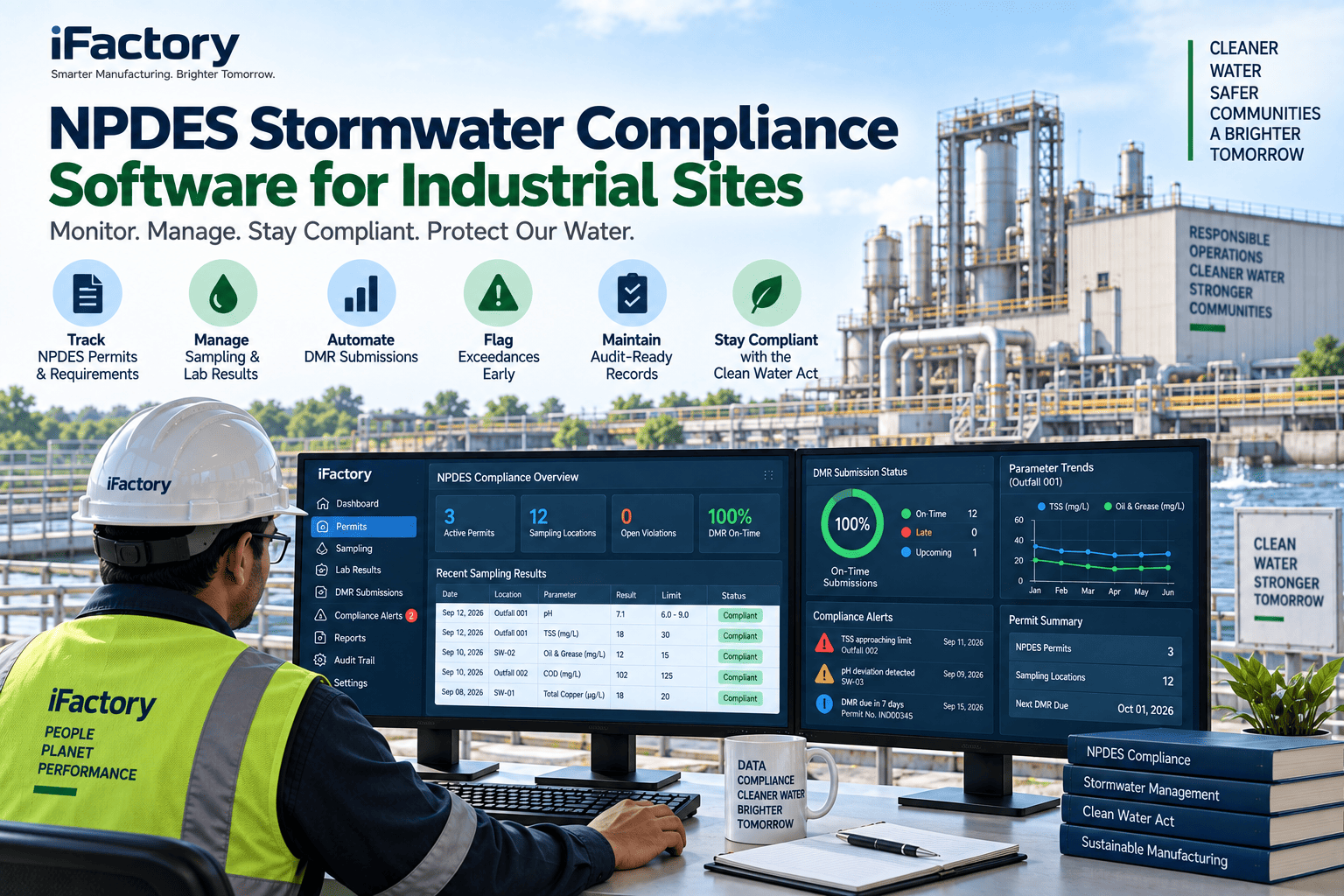
NPDES compliance is where the Clean Water Act meets the industrial site — one of the most common enforcement categories in EPA Region 5, 6, and 9 data. Every industrial facility discharging stormwater or process wastewater to waters of the United States operates under either an individual NPDES permit or the Multi-Sector General Permit (MSGP). Each specifies monitoring parameters, sampling frequency, benchmark or effluent limits, DMR submission via NetDMR, and often a SWPPP that has to be current and implemented. Missing a quarterly sample, submitting a DMR late, or exceeding a benchmark without corrective action are each separate Clean Water Act violations. Software that runs the sampling schedule and DMR workflow prevents most of them.
iFactory / NPDES stormwater compliance
Sampling Schedule, Exceedance Alerts, and DMR Submissions — One Water Compliance Platform
Manage NPDES individual permits and MSGP coverage, stormwater and process wastewater sampling, DMR assembly and NetDMR submission, SWPPP currency, and corrective-action tracking on benchmark exceedance.
SAMPLE
Outfall · storm event · rep
↓
LAB
COC · analytical results
↓
EVAL
vs benchmark / effluent limit
↓
SUBMIT
NetDMR to EPA / state
NPDES + MSGP
individual and general permits
NetDMR
EPA + state submission
SWPPP
currency + implementation
The Problem in Water Discharge Compliance
An industrial facility with a mid-sized site typically has multiple stormwater outfalls under MSGP, one or more process wastewater discharges under individual NPDES, sometimes a pretreatment agreement with a POTW, and SPCC obligations under 40 CFR 112. Each has its own sampling regime — quarterly benchmark, annual comprehensive site inspection, storm-event-triggered sampling, effluent monitoring — and its own reporting deliverable. Most sites track it in a spreadsheet the environmental coordinator maintains, with lab results emailed from the contract lab and DMRs assembled by hand into NetDMR near the due date. When a storm-triggered sample is missed, when a benchmark exceedance goes unnoticed, or when NetDMR submission slips, each is a citable CWA violation.
Where the NPDES Chain Actually Breaks
NPDES compliance failure modes are consistent across manufacturing, chemical, and heavy-industry sites. Each maps to a specific EPA enforcement finding category.
Storm event missed
MSGP requires sampling within specified conditions of a qualifying storm event. Weekend or off-hours storm passes; sampling window closed; missed sample logged as no-data for the quarter.
Benchmark exceedance late
Lab result shows an exceedance above sector benchmark. Discovery not logged until DMR assembly two months later. Corrective action clock started late; deadline missed.
DMR submission slip
NetDMR submission for a monitoring period due on the 28th. Coordinator on vacation. Backup unaware of the deadline. Late submission — separate CWA violation regardless of the underlying data.
SWPPP outdated
SWPPP not updated after site change (new material storage, new drainage). Comprehensive site inspection identifies the gap. Permit compliance in question until SWPPP is current.
What Good Looks Like in Water Compliance
A working NPDES compliance system holds four disciplines together — sampling schedule per outfall and permit, lab integration for results, exceedance alerts with corrective-action tracking, and DMR assembly with NetDMR submission.
Sampling Schedule
Every outfall, every parameter, every frequency captured. Storm event triggers based on precipitation feed. Field-crew assignments and results-due tracking with escalation on approaching miss.
Nothing missed
Lab Integration
COC generated per sample. Contract lab (Eurofins, Pace, ALS, TestAmerica) results flow directly to the record. Discrepancy or missing-analyte flags surface before the coordinator sees them.
Lab loop closed
Exceedance Alerts
Result vs benchmark or effluent limit evaluated at receipt. Exceedance triggers corrective-action workflow with the clock started. SWPPP amendment prompt where the exceedance category calls for one.
Clock starts on receipt
DMR Submission
DMR pre-assembled from period results. Coordinator reviews and Responsible Official certifies. NetDMR submission tracked to confirmation. Late-submission risk flagged 7 days out.
On time, every time
How iFactory AI Fits
iFactory AI overlays your existing lab contract, precipitation feed, and EHS platform — Cority, Intelex, Locus, Enablon — adding the NPDES-specific sampling schedule, exceedance workflow, and NetDMR submission layer.
Sample Registry
Compliance Layer
Every outfall, every parameter, every required sampling event with due date, assignment, and result-linkage. Storm-triggered sampling with precipitation-feed integration.
Lab Loop
Compliance + Lab EDD
COC generated, sample tracked to contract lab, EDD results imported to record automatically. Missing-analyte and QA-fail flags surfaced before submission.
Exceedance Workflow
Compliance Layer
Result-vs-limit evaluation at receipt. Corrective action tracked with deadline. SWPPP amendment prompted where required. Documentation held for permit-cycle audit.
DMR + NetDMR
Compliance + Reporting
DMR pre-assembled from period data. Responsible Official review workflow. NetDMR submission with confirmation archive per EPA CROMERR-compliant e-signature.
Ask your environmental coordinator when the next quarterly benchmark sample is due, when the last one was submitted, and whether any exceedance from the last year has an open corrective-action record. If any answer is a hesitation, the CWA compliance posture is thin. Book a water compliance review.
12-Week Rollout on One Site
One industrial site (typically MSGP + one individual NPDES or pretreatment), twelve weeks. The pilot loads permits, runs the sampling schedule, and processes a full monitoring period end-to-end.
Weeks 1–2
Permit Load
Load NPDES permit and MSGP coverage. Catalogue outfalls, parameters, sampling frequencies, effluent limits, and benchmarks. Baseline current-state schedule and lab flow.
Weeks 3–4
Lab & Precip
Contract lab EDD integration configured. Precipitation feed for storm-triggered sampling connected. First test samples run through the loop to validate the record chain.
Weeks 5–8
Live on Site
Sampling schedule live. All scheduled and storm-triggered samples run through the workflow. Exceedance alerts active. Weekly review with environmental coordinator.
Weeks 9–12
DMR Cycle
Full monitoring period closes on the pilot site. DMR assembled and submitted through NetDMR. Rollout to additional sites scoped based on missed-sample rate and DMR cycle time.
Who Owns the KPI
NPDES compliance crosses environmental coordination, operations, EHS, and the certifying signer. Each function owns a specific KPI or the chain reverts to spreadsheet-and-hope.
Environmental Coordinator
Samples on schedule vs required
Owns the sampling discipline — the share of required samples completed on schedule. Storm-triggered samples measured against qualifying storm events, not against the calendar.
EHS Manager
Exceedances with corrective action closed
Owns the exceedance loop — every benchmark or effluent-limit exceedance with root cause and corrective action documented and closed inside the permit-required window.
Operations Lead
Exceedance count and severity
Owns the operational outcome — the count and severity of exceedances against the permit. Rising early during pilot as detection improves; declining as operational fixes take hold.
Certifying Signer
DMR submissions on time %
Owns the submission liability — every DMR submitted through NetDMR before the due date, certified under 40 CFR 122.22. Late submission is separately citable regardless of data.
FAQ
What about the MSGP renewal in 2026 — the parameter list changed for several sectors?
The MSGP 2026 (issued by EPA in early 2026) updated sector-specific monitoring parameters, added PFAS benchmark monitoring for certain sectors, and modified corrective action triggers. The registry approach means updates propagate as a permit-refresh rather than a system rebuild — the sector-benchmark tables update, and any facility on that sector re-inherits the current requirements without manual re-configuration. State delegated programs that add requirements above federal MSGP configure as add-on conditions on the same outfall records.
How does this handle process wastewater under individual NPDES with more complex effluent limits?
Individual NPDES permits with pollutant-specific effluent limits (BOD, TSS, ammonia, metals, temperature, or effluent guideline limits per 40 CFR subpart) are treated as separate condition sets on the outfalls they cover. Continuous monitoring where required, daily-average and monthly-average calculation, technology-based vs water-quality-based limits — all captured as condition attributes with the correct averaging rules applied. Where the permit incorporates a WET (whole effluent toxicity) requirement, the sampling and reporting schedule tracks as its own permit condition.
Book a demo to see individual NPDES condition tracking.
What about SPCC — is that part of the NPDES scope or separate?
SPCC (Spill Prevention, Control and Countermeasure per 40 CFR 112) is technically CWA but a distinct rule from NPDES. Facilities that need SPCC often need NPDES too, so many sites run both programs in one water-compliance function. The overlay treats SPCC as a companion module — the SPCC plan, inspection schedule, and reportable-spill workflow live alongside NPDES on the same site record. Where the SPCC plan and the SWPPP overlap (drainage, spill response), the linkage is direct so an update to one prompts a review of the other.
Stop assembling DMRs from lab emails and calendar reminders.
Walk One Site's Sampling Cycle and NetDMR Submission — Live
Bring one site's NPDES permit, last quarter's lab results, and the last submitted DMR. We'll load the permit conditions, walk the sampling schedule through the pilot period, and demonstrate the DMR-to-NetDMR submission with the exceedance workflow.
MSGP + NPDES
permits tracked
Corrective action
clock started