A Title V operating permit is a single enforceable document that consolidates every applicable Clean Air Act requirement for a major source into one file. Major sources — 100 tons per year of any regulated pollutant, 10 TPY of any single HAP, or 25 TPY of combined HAPs — are required to hold one, and the requirements touch every operating day: continuous or periodic monitoring per condition, deviation self-reporting within 10 days, semi-annual monitoring reports due March 31 and September 30, and an annual compliance certification signed by the Responsible Official under penalty of law. Software that tracks the permit conditions in one place is not administrative overhead; it is what makes the certification defensible.
iFactory / Air emissions compliance
Every Title V Condition, Every Deviation, Every Certification — On One Audit-Ready Platform
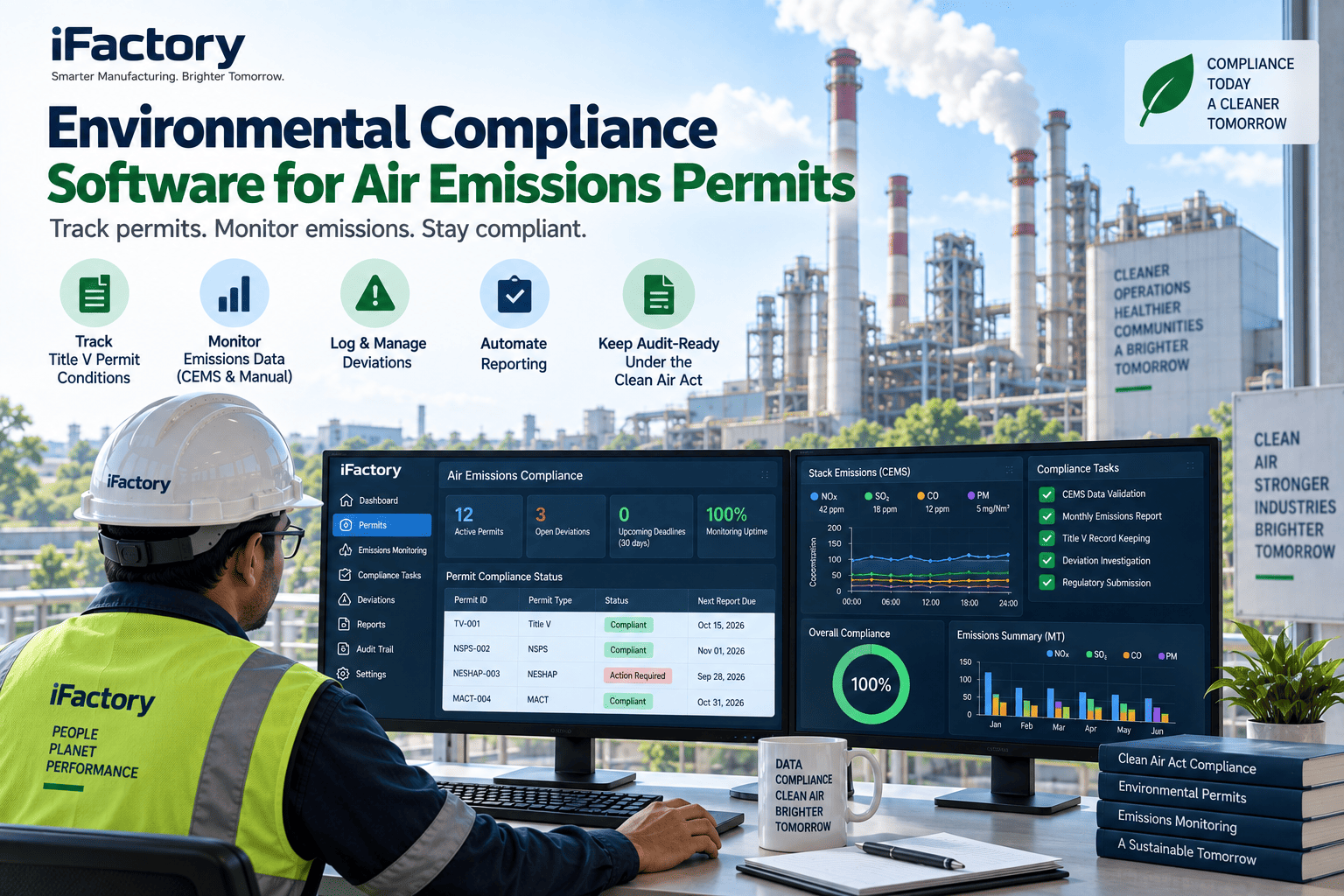
Track Title V permit conditions, NSPS and NESHAP applicable requirements, CEMS and CPMS monitoring, deviations, and semi-annual and annual reports — with the Responsible Official certification package assembled on schedule.
Monitoring
CEMS · CPMS · records
Deviation reports
Within 10 days
Semi-annual SAM
Mar 31 · Sep 30
Annual ACC
Responsible Official cert.
Title V
+ NSPS + NESHAP tracked
10-day
deviation self-report
Mar 31 · Sep 30
SAM report due
The Problem in Air Permit Compliance
A typical Title V permit runs 100-plus pages of conditions across dozens of emission units — boilers, kilns, thermal oxidizers, coating operations, storage tanks. Each condition has its own monitoring requirement, frequency, recordkeeping trigger, and report path. Most facilities track it in spreadsheets, a shared drive of PDFs, and the memory of the air quality engineer. When a deviation happens — a CEMS goes out on QA, a CPMS parameter drifts outside range, a reading is missed — the 10-day self-report clock starts immediately, and the same event has to reconcile into the semi-annual SAM report and the annual compliance certification. Miss one thread and the missed condition becomes a separate CAA violation on top of the underlying deviation.
Where the Permit Chain Actually Breaks
Air permit compliance fails at the same handoffs at almost every facility. Each one shows up as a specific citation category in EPA and state enforcement actions.
Condition not tracked
A NESHAP or NSPS applicable requirement embedded in the permit gets missed at annual review. Monitoring never runs. Discovered at agency inspection two years later.
Deviation 10-day slip
CEMS goes out of QA at 4:30 on a Friday. Discovery documented Monday. 10-day clock started at discovery — but the report is drafted for two weeks later. Now late.
SAM reconciliation gap
Deviations self-reported through the year don't all show up in the semi-annual monitoring report. Reconciliation done by hand from email archive. Missed deviations are their own citations.
ACC certification risk
Responsible Official (usually the plant manager) signs the ACC certification 'based on information and belief formed after reasonable inquiry.' If the reasonable inquiry didn't happen because data was scattered, personal criminal liability attaches.
What Good Looks Like in Air Compliance
A working air compliance system holds four disciplines together — permit-condition registry, monitoring capture per condition, deviation workflow with 10-day clock, and SAM/ACC assembly on the regulatory schedule.
Condition Registry
Every Title V permit condition, every NSPS/NESHAP applicable requirement, and every state-added condition catalogued with the monitoring, recordkeeping, and reporting obligation attached.
Nothing untracked
Monitoring Capture
CEMS validated data, CPMS parameter readings, VOC records, opacity observations, and work-practice logs captured per condition on the schedule the permit requires.
Per condition, on cadence
Deviation Workflow
Deviations flagged at detection with the 10-day self-report clock started automatically. Draft report generated from the deviation record. Submission tracked to close.
10-day clock, tracked
Report Assembly
Semi-annual monitoring report assembled from the year's deviation and monitoring records. Annual compliance certification package prepared for Responsible Official review and signature.
Mar 31 · Sep 30 · ACC
How iFactory AI Fits
iFactory AI works as an overlay on your CEMS DAS (Rata, ESC, Uniformance), plant historian, and existing EHS platform — Enablon, Cority, Intelex, Sphera — adding the permit-condition and deviation workflow layer without replacing the systems your air quality engineer already trusts.
Permit Registry
Compliance Layer
Every Title V, NSPS, NESHAP, and state-added condition with monitoring, recordkeeping, and reporting obligations mapped and dated.
Monitoring Log
Overlay + CEMS
Validated monitoring data per condition — from CEMS DAS, CPMS, and manual capture — with data availability and quality flags per permit rule.
Deviation Workflow
Compliance Layer
Deviations flagged, 10-day clock started, root cause and corrective action captured, and self-report submitted to the permitting authority. Nothing untracked.
Report Package
Compliance + Reporting
Semi-annual monitoring report and annual ACC package assembled from source records with Responsible Official review workflow and submission archive.
Ask your air quality engineer to produce the source-data trace for one deviation from last year — from CEMS reading to 10-day report to SAM report to ACC. If any of those four is a spreadsheet or an email chain, the reasonable-inquiry defence for the Responsible Official is already thin. Book an air compliance audit.
12-Week Rollout on One Major Source
One major-source facility (or one large emission unit within a facility), twelve weeks. The pilot loads the permit registry, captures monitoring against every condition, and produces a mock SAM report for the pilot period.
Weeks 1–2
Permit Load
Load the current Title V permit, applicable NSPS/NESHAP subparts, and state-added conditions into the registry. Baseline the current monitoring approach per condition.
Weeks 3–4
Data Integration
Connect CEMS DAS, CPMS sources, and manual log entries per condition. Validation rules configured per permit. First-week data capture verified against the current-state spreadsheet.
Weeks 5–8
Deviation Live
Deviation workflow live. First deviations during pilot period flow through 10-day clock, corrective action, and submission archive. SAM assembly draft produced weekly.
Weeks 9–12
Mock SAM + ACC
Mock semi-annual monitoring report and annual compliance certification produced from pilot-period data. Reviewed with Responsible Official. Full-facility rollout scoped.
Who Owns the KPI
Air permit compliance crosses environmental engineering, operations, EHS, and the Responsible Official. Each function owns a specific number or the certification chain fragments back into spreadsheet reconciliation.
Air Quality Engineer
Permit conditions with current monitoring
Owns the technical completeness — the share of permit conditions with monitoring data current per required cadence. Anything less than 100% is a citation waiting.
EHS Manager
Deviations self-reported within 10 days
Owns the self-report discipline — every deviation submitted to the authority within the 10-day window from discovery. Late self-reports are separately citable.
Operations Lead
Excess emission events per quarter
Owns the operational outcome — count and severity of excess emission events. The number that drives whether Title V drives real risk reduction or just paperwork.
Responsible Official
ACC signed with defensible inquiry
Owns the certification liability — the annual ACC signed 'based on reasonable inquiry.' The workflow record is what makes the inquiry defensible if questioned.
FAQ
How does this handle CEMS data availability requirements — the 95% quarterly rule?
CEMS data availability per 40 CFR 60/63 Appendix F rules is tracked as a condition attribute. The system calculates quarterly data availability, flags shortfall risk before quarter-close, and flags missing-data substitution rules that apply. If a CEMS goes off-line for QA or repair, the workflow tracks the downtime, applies the correct substitution methodology per permit, and reflects the substituted values in monitoring records with clear provenance. The ACC and SAM outputs distinguish measured from substituted data as required.
What about GHG reporting under 40 CFR Part 98 — is that in scope?
Yes. Part 98 GHG Mandatory Reporting Program obligations are treated as a parallel reporting stream — sources report annually by March 31 through EPA's e-GGRT — with the same source-data linkage the Title V program uses. Subpart C (stationary combustion), Subpart D (electricity generation), Subpart P (hydrogen), Subpart AA (pulp and paper), and other applicable subparts configure as separate report packages with their own calculation methodology. The underlying activity data — fuel use, throughput, emission factors — flows from the same source captures as the Title V monitoring.
Book a demo to see the Part 98 alongside Title V.
Does it work with our existing EHS platform — we already have Enablon or Cority?
Yes, as an overlay. Enterprise EHS platforms (Enablon, Cority, Intelex, Sphera, VelocityEHS) handle a broad EHS scope well but are often thin on the specific Title V permit-condition, deviation, and SAM/ACC workflow. This layer sits alongside them — pulling activity data, incident records, and inspection findings from the EHS platform and adding the permit-condition registry and reporting workflow. What you gain is Title V-specific discipline; what you keep is the EHS platform your team already knows.
Stop assembling SAM and ACC from spreadsheets.
Load One Permit and Walk the SAM Assembly Live
Bring your current Title V permit, last SAM report, and the deviations from the pilot period. We'll load the permit registry, walk one deviation through the 10-day workflow, and produce a mock SAM report from the pilot data.
CEMS + CPMS
monitoring capture