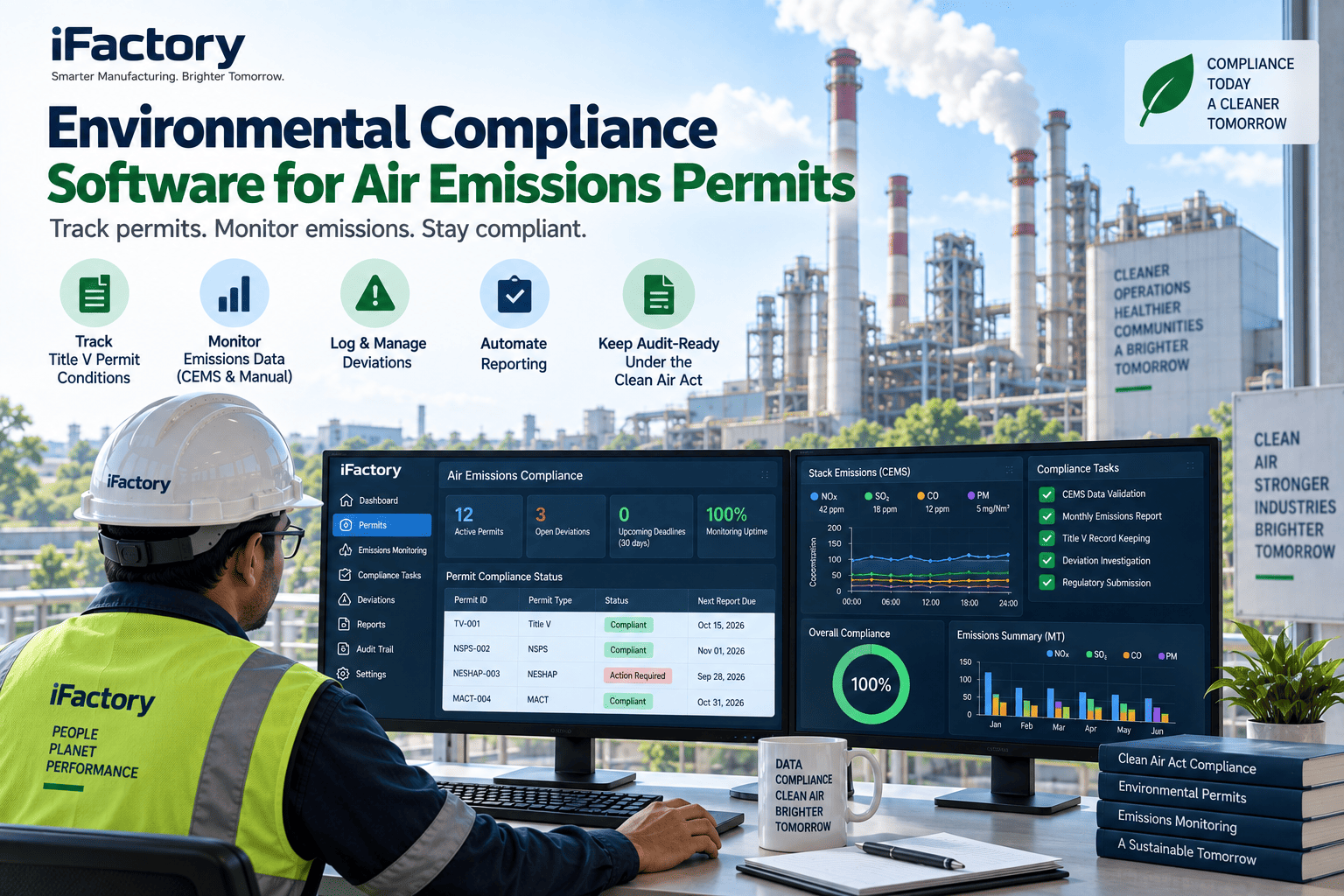
A cement plant is one of the most heavily inspected industrial operations there is — a mid-size two-kiln plant faces 14 to 18 formal inspections a year across OSHA, the EPA, MSHA, and state agencies, and a single missing document can turn a routine visit into a citation. What makes cement harder than almost any industry is that the hazards are inherent to the process, not contaminants you can clean away. Silica is a natural component of the raw material — you can't housekeep it out. The kiln is a furnace near 1,450°C that is at once a serious worker-safety hazard and the biggest source of the air toxics the EPA regulates. So the same physical thing triggers both OSHA and EPA obligations at once, and silica records must be kept for thirty years. One platform mapping each hazard to both its OSHA and EPA duties, fed by shared monitoring data, is how a plant stays compliant. You can book a demo to see it on your plant.
The Same Kiln, the Same Dust — Two Regulators, One Platform
Manage silica dust, kiln and thermal hazards, and air emissions in one system that unifies OSHA and EPA compliance — because in a cement plant the hazards are inherent to the process and one physical event answers to both agencies at once.
The Hazards Are Built Into the Process, Not Added to It
Most industries can reduce a hazard by cleaning it up or removing a source. Cement can't — its defining risks come from the raw material and the process itself, and the same physical hazard almost always answers to more than one regulator. That's the specific difficulty a consolidated platform is built to solve. These are the realities that make cement EHS distinct.
Crystalline silica is a natural component of limestone, clay, and sand — the raw materials themselves, not a contaminant better cleaning removes. What separates a compliant plant from a cited one isn't the presence of silica but how tightly exposure is measured, controlled, and documented.
The rotary kiln is simultaneously a worker-safety hazard — extreme heat, confined preheaters, energy isolation — and the single biggest source of the air toxics the EPA regulates. One asset sits squarely in both OSHA's and the EPA's jurisdiction at the same time.
A single undetected baghouse bag rupture spikes stack particulate emissions, raises worker dust exposure, and increases kiln fan energy draw all at once — one physical failure that is simultaneously an EPA problem, an OSHA problem, and a cost problem.
OSHA, the EPA, MSHA at the quarry, state agencies, and insurers all inspect the same plant with overlapping mandates. A gap visible to one is exposure to all, and a program kept in separate binders per agency leaves a seam at every overlap.
A Silica Program Measured, Controlled, and Documented for 30 Years
Respirable crystalline silica is the defining occupational hazard of a cement plant — the driver of silicosis and lung-cancer risk — and OSHA's standard sets a permissible exposure limit that most plants cannot meet through housekeeping alone. Compliance is an exposure program with one of the longest recordkeeping obligations in all of OSHA. This is what it takes.
The 29 CFR 1910.1053 standard sets a PEL of 50 µg/m³ as an 8-hour time-weighted average and an action level of 25 µg/m³. Regular air monitoring has to demonstrate exposures below the action level — or trigger the control obligations above it — with crusher and raw-mill zones routinely running several times the limit without engineering controls.
When exposures reach the action level, a written control plan is required — prioritizing engineering controls before respirators, documenting the control measures in place, and covering every job role that works near raw mills, kilns, and finish grinding. The plan is the program, and it has to be current, not a document written once.
Workers exposed at or above the action level require medical surveillance, and those records — like the exposure data — have to be maintained and retrievable. Tying surveillance to the exposure monitoring keeps the two in sync so an affected worker is never missed.
Silica exposure records must be retained for thirty years — among the longest retention requirements in OSHA recordkeeping — and produced when an inspector asks. Archiving three decades of monitoring data so it's queryable, not boxed in storage, is exactly where paper programs fail.
Build a Silica Program That Holds Up for Decades
iFactory ties silica exposure monitoring, the written control plan, and medical surveillance into one record with a 30-year archive that's queryable on demand — so a silica citation, the industry's most expensive, doesn't happen.
The Six OSHA Risk Categories That Cluster in Cement Citations
Beyond silica, cement plants present a specific set of elevated worker-safety risks that appear consistently in citation records — driven by the kiln, the towers, the rotating equipment, and the confined spaces. Each one requires maintained, auditable records, not just a program that exists on paper. These are the categories the platform manages.
Silos, preheater towers, and mill compartments are permit-required confined spaces with atmosphere testing and rescue-plan obligations. The platform manages the permits and entries so a routine cleaning never becomes an unpermitted entry.
Crushers, mills, and rotating kiln equipment are energy-isolation-intensive, and inspectors request LOTO procedure versions by machine. Machine-specific procedures and their annual inspections are tracked and certified per asset.
Kiln, preheater, and silo structures create fall hazards that demand documented protection plans. Tying the plan to the structure keeps the requirement provable for the elevated work the plant can't avoid.
Extreme-heat burn hazards, machine guarding on conveyors and mills, and process safety management for the pyroprocessing system round out the cluster — each a maintained program with its own records an inspector will ask to see.
NESHAP, Continuous Monitoring, and the Kiln Stack
The kiln stack is where the plant answers to the EPA, and the obligations are continuous and unforgiving. The Portland Cement NESHAP governs the air toxics the kiln emits, with real-time monitoring and periodic reporting whose deadlines carry per-day penalties. This is the emissions program the platform keeps current.
Subpart LLL of 40 CFR 63 limits particulate matter to 0.04 lb per ton of clinker and regulates mercury, acid gases, organic HAP, and dioxin/furan from the kiln — the plant's principal air-toxics source. The standard is the framework everything else reports against.
The standard mandates continuous opacity monitoring and CEMS providing real-time stack data. The platform ingests that data so an exceedance is caught and logged as it happens, not discovered in a quarterly reconciliation.
Quarterly excess-emission reports and an annual compliance certification to the EPA are hard-deadline obligations, and one missed deadline can trigger a cascade. The platform runs the reporting calendar so the filings are prepared from monitoring data that's already current.
Kiln temperature, feed rate, and oxygen limits, plus baghouse and bag-filter efficiency records, are part of the emissions envelope. Monitoring differential pressure and cleaning function ties bag health directly to the stack emissions it controls.
Map Each Hazard to Every Agency It Answers To
The reason to unify OSHA and EPA compliance isn't neatness — it's that the hazards genuinely span both, and separate systems can't handle the overlap. The dust that's a silica exposure to OSHA is a particulate emission to the EPA; the baghouse that protects workers also protects the stack. One system holds each hazard against all its obligations at once. This is what only consolidation delivers.
Baghouse and bag-filter performance is simultaneously a worker-exposure control and a stack-emissions control. Monitoring it once, in one system, satisfies both the OSHA silica program and the EPA emissions program instead of maintaining the same data twice.
Because each hazard maps to every regulator it triggers, the cross-program gap — the finding nobody owned because it belonged to two agencies — can't open. The seam that catches plants running separate binders per regulator is closed by design.
Every exposure exceedance, emissions deviation, and safety deficiency opens a corrective action with an owner and a deadline, tracked to closure — the same discipline for a silica overexposure as for a stack excursion.
With one live record and a compliance calendar spanning every framework, the evidence any inspector asks for — OSHA on silica, the EPA on emissions, MSHA at the quarry — is retrievable on demand rather than assembled per visit.
Because the Bag That Fails Is a Safety, Emissions, and Maintenance Event
A quiet advantage of running cement EHS on a platform that also runs maintenance is that the same physical failures drive all three concerns at once — and splitting them across separate systems is how the connection is lost. When they're unified, the compliance obligation and the work order are the same thing.
A ruptured filter bag spikes emissions, raises exposure, and draws more fan energy. Detected in one system, it opens a single corrective action that closes the emissions, the safety, and the energy consequence together rather than in three disconnected tools.
Daily differential-pressure checks, weekly pulse-jet inspections, and quarterly bag inspections are both maintenance tasks and the proof of emissions control. Running them as one means the PM that keeps the stack clean is the record that proves it.
Machine-specific lockout procedures and mechanical-integrity inspections sit with the equipment they protect on the same schedule as every other PM, so a safety-critical inspection can't slip through a gap between a safety binder and the maintenance system.
The authorized employees for LOTO, the confined-space entrants, the workers cleared for silica-exposed roles — their qualifications live alongside the tasks, so work only goes to someone certified for it.
Silica, Kiln Safety, and Emissions in One Compliant System
iFactory runs the cement plant's EHS and emissions compliance on one platform: the silica exposure program with its 30-year archive, the kiln and plant safety programs, and the NESHAP emissions obligations — each hazard mapped to both OSHA and EPA, findings driving corrective action, and the whole record audit-ready for any of the plant's many inspections, with safety, emissions, and maintenance as one system.
What Cement Plant EHS Teams Ask
Pass Any of Your 18 Inspections, on Any Day
iFactory unifies silica, kiln safety, and NESHAP emissions compliance in one platform — each hazard mapped to both OSHA and EPA, fed by shared monitoring data, findings tracked to closure, and the whole record audit-ready whichever regulator walks in.