A food and beverage plant sits under more overlapping safety and environmental regulators than almost any other operation. OSHA governs worker safety, the EPA governs environmental risk, the FDA and FSMA govern the product and process — and each one can cite the others. The real burden isn't any single program; it's that the same physical hazard often falls under several regulators at once. Cross 10,000 pounds of ammonia and you owe OSHA Process Safety Management and EPA's Risk Management Program simultaneously. A sanitation crew washing down a line is doing food-safety work and high-risk lockout/tagout in the same shift. Run flour or sugar and you carry a combustible-dust explosion hazard on top. Managing that in a separate binder per regulator guarantees a gap — a failure in one shows up in all of them. One EHS platform that maps each hazard to every regulator it triggers is the way out. You can book a demo to see it on your programs.
OSHA, EPA, and FDA Demands in One Platform — Because the Hazards Don't Respect the Org Chart
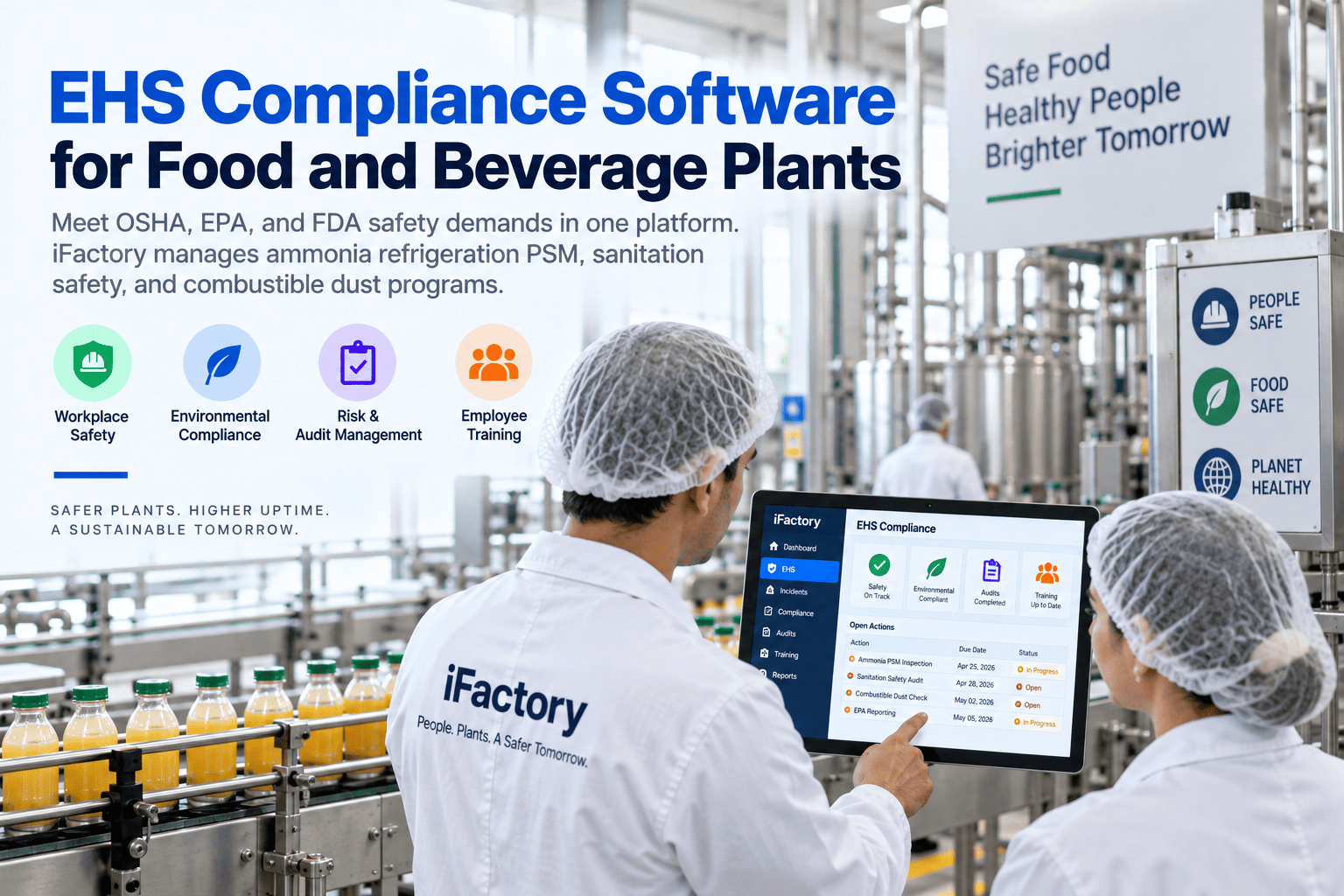
A food plant's biggest risks each answer to several regulators at once. iFactory manages ammonia refrigeration PSM and RMP, sanitation safety, and combustible-dust programs together — so one hazard, one record, satisfies every agency it triggers.
It's That One Hazard Answers to Several Regulators at Once
Most EHS trouble in a food plant doesn't come from a single missed rule — it comes from the overlap. A plant is inspected by multiple authorities with different mandates over the same equipment, and a program organized as one binder per agency inevitably leaves a seam where two mandates meet. Understanding that overlap is the whole point of consolidating EHS into one system.
Ammonia above 10,000 pounds triggers OSHA PSM for worker safety and EPA RMP for community risk at the same time — overlapping frameworks on the same system. Above the threshold, you're effectively writing one program to satisfy both.
FSMA sanitation and OSHA worker safety run in parallel and meet on the floor — a sanitation crew doing lockout/tagout, cleaning chemicals that are both a food-safety input and an OSHA hazardous material. The two programs share the same shift and the same people.
FDA, USDA, OSHA, the fire marshal, and the insurer each inspect the plant, and a failure visible to one is visible to all. A gap isn't contained to the regulator who owns it — it's exposure across every authority that walks the floor.
When each program lives in its own binder maintained by its own owner, the overlaps — the hazard that spans two — fall between the binders. The most common food-plant EHS finding is the gap nobody owned because it belonged to two programs at once.
PSM and RMP: the Highest-Consequence Program in the Plant
Anhydrous ammonia is the backbone of food-plant cold chain and the most heavily regulated system a plant will run. Above 10,000 pounds it triggers OSHA's 14-element Process Safety Management standard and EPA's Risk Management Program together, creating a documentation burden that is continuous rather than periodic. This is where a compliance gap is most expensive, and where a platform earns its place first.
Every pressure vessel, heat exchanger, pump, and piping segment in the covered process, individually identified with its inspection history, acceptable limits, and qualified-inspector records — with inspection intervals automated per IIAR, ASME, and NBIC standards, so mechanical integrity is provable on any day, not reconstructed for the audit.
Process hazard analysis on its five-year cycle, written operating procedures, management of change, incident investigation, and the rest — each element tracked to its due date and linked so a change flows through the PHA and the procedures rather than being logged in isolation.
EPA's Risk Management Program — release scenarios, prevention program, accident history, LEPC coordination — draws from the same inspection and incident records, so the overlap between PSM and RMP is handled once instead of maintained twice in parallel.
An inspection deficiency or a leak-detector calibration miss opens a tracked corrective action, so the finding is closed and provable — the loop an inspector checks, and the one that turns a $500,000-plus citation into a routine fix.
Make Ammonia Compliance a Daily State, Not an Audit Scramble
iFactory keeps the covered-process registry, the 14 PSM elements, and the overlapping RMP obligations in one live record — so your ammonia program is compliant every day and provable the moment an inspector arrives.
Where Food Safety and Worker Safety Are the Same Shift
Sanitation is the collision zone of a food plant's two safety worlds — the crew cleaning the line is doing FSMA food-safety work and some of the plant's highest-risk worker-safety work at the same time, often at 2 a.m. on a wet floor around energized and moving equipment. It's where the two regulatory worlds most directly meet, and where a platform that spans both prevents the gap.
Sanitation crews performing LOTO must be trained to authorized-employee standard, on machine-specific energy-control procedures — and OSHA requires an annual certification of those procedures, performed by someone other than the user, an independent-verification requirement many plants never formalize.
High-pressure washdown around energized equipment is a signature food-plant hazard the general safety world rarely faces. The platform ties the sanitation task to its energy-control and guarding requirements so the two are never handled apart.
The caustics and sanitizers that make the plant food-safe are OSHA hazardous materials that demand hazard communication, SDS management, and exposure control. One chemical, two programs — food safety and worker safety — managed as one record.
Cleaning tanks, silos, and vessels is confined-space work with its own permit, atmosphere-testing, and rescue requirements. Tying it into the sanitation program keeps a routine cleaning task from becoming an unpermitted entry.
The Flour and Sugar That Can Level a Building
Combustible dust is the food industry's signature catastrophic hazard — flour, sugar, starch, and powdered ingredients form explosive dust clouds, and a dust explosion is among the few plant events that can kill workers and destroy a building outright. It's regulated by OSHA and the relevant NFPA standards, and it's a program that has to be actively managed, not assumed away.
Identifying where combustible dust accumulates and the ignition sources near it is the foundation, and it has to stay current as the process changes. The platform tracks the analysis and the reassessment cadence so it never goes stale.
Controlling dust accumulation through scheduled, documented housekeeping is the single most important preventive control — and the one an inspector checks. Tracking it as a recurring task with records turns "we clean regularly" into proof.
Bonding and grounding, explosion venting, and dust-collection maintenance all have to be inspected and maintained on schedule. The platform manages those as tracked programs, so an ignition control that lapsed is caught before it matters.
The people working around combustible dust need training specific to it, documented and current. Linking that training to the dust program keeps qualification provable and the workforce genuinely aware of a hazard that gives little warning.
Map Each Hazard to Every Regulator, Once
The reason to consolidate isn't tidiness — it's that a single system can do the thing separate binders structurally cannot: hold one hazard against all the regulators it triggers, so nothing falls in the seam between programs. These are the capabilities that only exist when EHS lives in one place.
A single ammonia inspection record satisfies the PSM and RMP obligations it feeds; a single chemical entry serves food-safety and HazCom needs. The overlap is handled once, so the same work isn't maintained twice and can't drift out of sync.
Because hazards are mapped to all their regulators rather than filed under one, the cross-program gap — the finding nobody owned because it belonged to two programs — simply can't open. The seam that catches most food plants is closed by design.
Every inspection deficiency, incident, and near-miss across all three pillars opens a corrective action with an owner and a deadline, tracked to closure — the same CAPA discipline your quality system uses, applied to safety.
Because it's one live record, the evidence any of the agencies asks for is retrievable on demand — whether it's OSHA on PSM, EPA on RMP, or FDA on sanitation — instead of assembled per-inspector under pressure.
Because Mechanical Integrity Is Both a Safety and a Maintenance Job
A quiet advantage of running EHS on a platform that also runs maintenance is that many compliance obligations are literally maintenance tasks — and splitting them across a safety binder and a maintenance system is how they lapse. When they're one system, the safety requirement and the work order are the same thing.
An ammonia mechanical-integrity inspection is both a PSM element and a maintenance task. Running them as one means the inspection that keeps the vessel safe is the same record that proves compliance — never one done and the other forgotten.
A safety deficiency and the maintenance action to fix it are the same loop, so a finding automatically becomes scheduled, tracked corrective work rather than a note in a binder waiting for someone to translate it into a job.
Leak-detector calibrations, dust-collector maintenance, and safety-device checks all live on the same preventive-maintenance schedule as the rest of the plant, so a safety-critical PM can't slip through a gap between two systems.
The authorized employees for LOTO, the trained dust-hazard workers, the qualified inspectors — their qualifications live alongside the tasks, so a task is only assigned to someone actually certified for it, the same discipline safety and quality both require.
Three Hazard Programs, Every Regulator, One Live System
iFactory runs the food plant's EHS on one platform: ammonia PSM and RMP, sanitation safety, and combustible dust managed together, each hazard mapped to every agency it triggers, findings driving tracked corrective action, and the whole record audit-ready for whichever authority arrives — with safety and maintenance as one system rather than two.
What Food Plant EHS Teams Ask
Close the Seam Between Your Regulators
iFactory manages ammonia PSM and RMP, sanitation safety, and combustible-dust programs in one live platform — each hazard mapped to every agency it triggers, findings tracked to closure, and the record audit-ready for OSHA, EPA, and FDA alike.