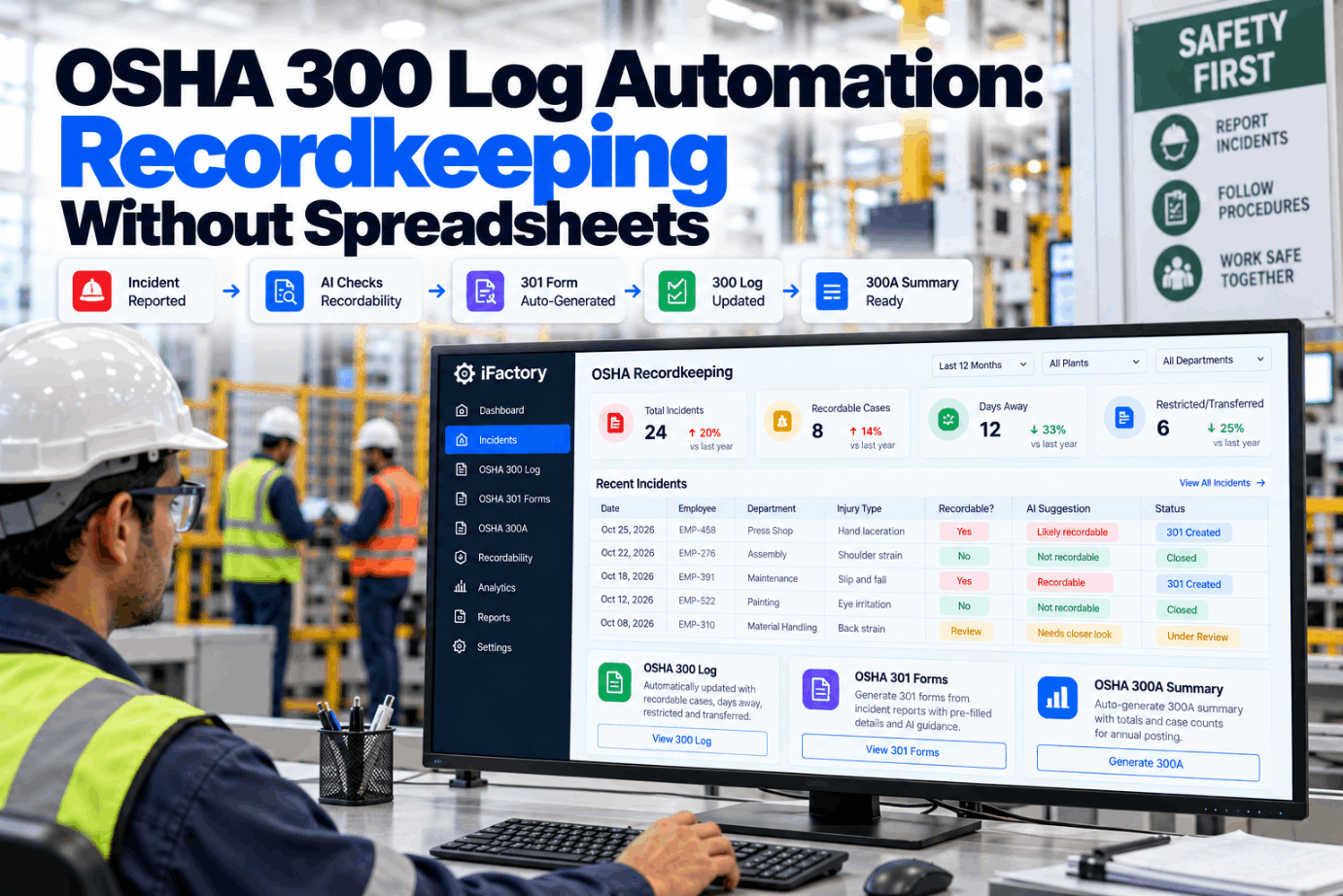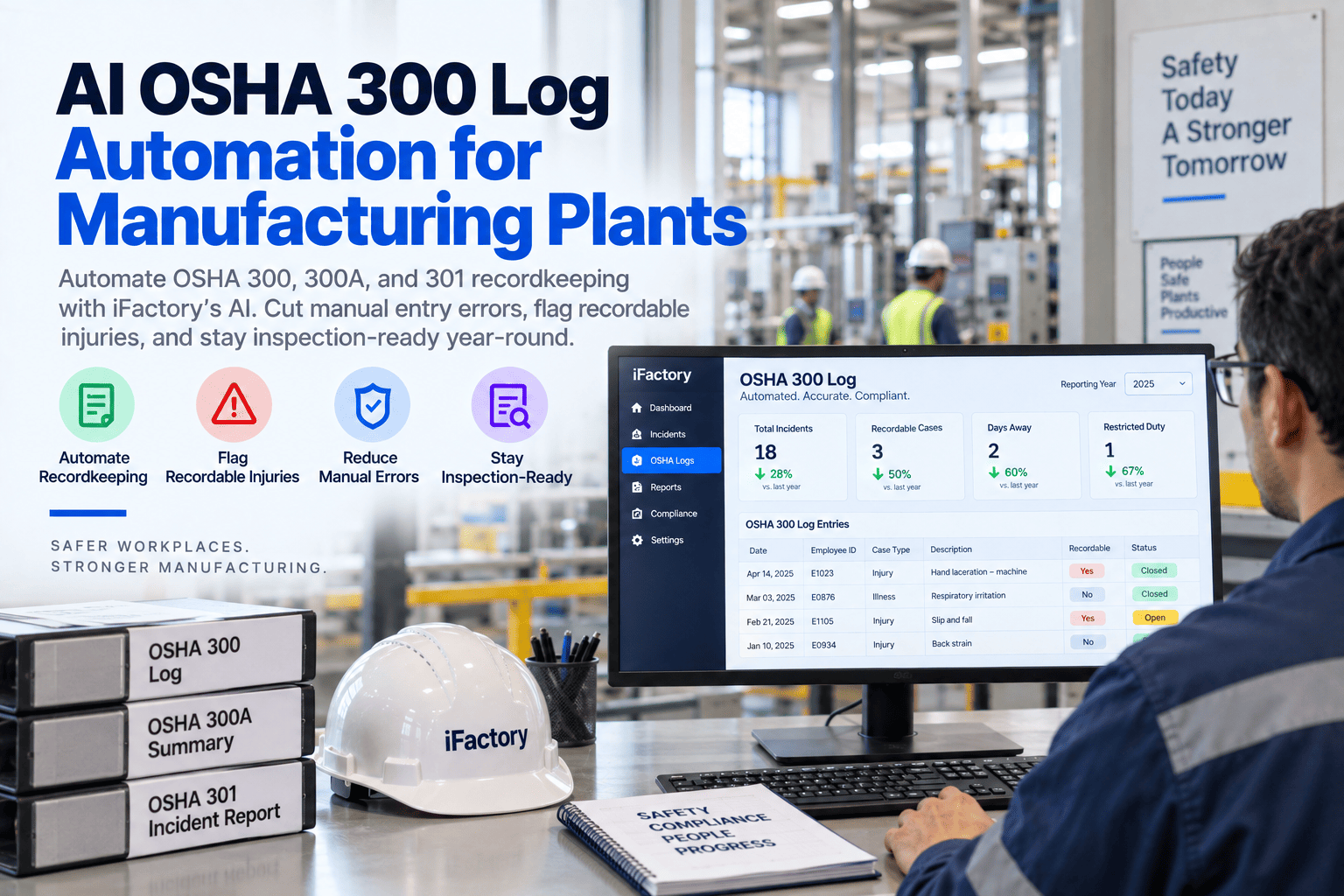
OSHA recordkeeping looks like paperwork, but its hard part isn't typing — it's a judgment call made over and over: is this case recordable? The most common and most expensive substantive error in the whole system isn't a typo; it's misclassifying medical treatment as first aid, and getting that wrong on repeat quietly distorts every safety number you report. It gets harder, because the log is never finished. A case treated as first aid today can become recordable weeks later when the worker needs a prescription or lands on restricted duty, and day counts keep accumulating whether anyone updates them or not. And since the 2024 electronic-submission rule, that data is transmitted to OSHA and made public, so accuracy is now under federal scrutiny. AI recordkeeping enforces the recordability test consistently, keeps every case live as outcomes change, runs the deadline clock, and generates the 300, 300A, and 301 from one dataset. You can book a demo to see it on your incidents.
The Hard Part of the OSHA 300 Log Isn't Typing — It's the Recordability Call
Automate the 300, 300A, and 301 from the incident data you already capture — with a consistent recordability test, cases kept live as outcomes change, and the deadline clock running — so you're inspection-ready year-round, not scrambling in February.
The 300, 300A, and 301 Are Not Interchangeable
OSHA recordkeeping under 29 CFR 1904 is really three separate obligations that people blur together at their peril — recording, posting, and electronic reporting — each with its own form, timing, and rules. Getting them straight is the foundation, because an automation that treats them as one thing gets all three subtly wrong. Here's what each actually is.
The year's log of every recordable injury and illness, one line per case, updated continuously as outcomes evolve. It's the live record an inspector reads first, and the source everything else is derived from.
The detailed report for each individual recordable case — the worker, the circumstances, the injury — completed within seven days of the incident. Many plants use the workers'-comp first report as a 301-equivalent, an accepted practice.
The year-end summary certified by a company executive and posted where employees can see it from February 1 through April 30 — required even in a year with zero injuries. There are no exceptions for a clean year.
The separate obligation to submit the data electronically through OSHA's Injury Tracking Application by March 2 — for many manufacturers now including case-level 300 and 301 data, not just the 300A summary, and made public once submitted.
Recordability Is a Test, Applied the Same Way Every Time
The heart of recordkeeping — and where the costly mistakes live — is the recordability determination under 29 CFR 1904.7. A case is recordable when it's work-related and results in any one of a defined set of outcomes. The rule is precise, but applying it consistently across dozens of cases and different supervisors is exactly what humans do inconsistently. This is the test an engine applies the same way every time.
A case is recordable if it's work-related and involves death, days away from work, restricted duty or job transfer, medical treatment beyond first aid, loss of consciousness, or a significant injury or illness diagnosed by a physician. Every case runs through that exact test — no gut calls, no shortcuts.
Misclassifying medical treatment as first aid is the single most common substantive error. First aid is a specific, finite list; anything beyond it — prescription medication, sutures, physical therapy, prescription-strength treatment — is medical treatment and records. The engine checks the treatment against the actual first-aid list, not against a supervisor's guess.
A frequent trap: the treating physician's characterization does not determine recordability — that determination belongs to the employer. And the decision belongs with the recordkeeper, not the floor supervisor who reported it. The engine enforces that ownership so the call is made by the right party, consistently.
Many plants wrongly assume a prior condition makes a new incident non-recordable. If the work environment significantly worsened a pre-existing condition, the case is work-related and likely recordable — a nuance the test captures so it isn't missed by assumption.
OSHA's own guidance and every seasoned safety manager converge on the same rule for the genuinely ambiguous case: record it. You can always remove a case later with documentation if you determine it wasn't recordable, but an unrecorded case that should have been on the log is the finding that draws penalties. The engine's default leans the safe way and flags the borderline case for a documented decision, so ambiguity becomes a tracked judgment call rather than a silent omission.
Apply the Recordability Test the Same Way, Every Case
iFactory runs every incident through the 29 CFR 1904.7 test, checks treatment against the real first-aid list, and flags the borderline call — so the error that distorts your whole safety record stops happening.
A Case Can Change Its Classification Weeks After It Happened
The mistake that catches even diligent teams is treating a recorded case as final. It isn't — a case's classification can change as its outcome evolves, and the log has to change with it. This is where manual recordkeeping quietly goes wrong, and where keeping cases live matters most.
An injury treated with first aid today becomes recordable if the worker later needs a prescription, restricted duty, or days off — even surgery weeks on. The case has to be reopened and reclassified, which a static log never prompts anyone to do.
Days-away and restricted-duty counts climb for as long as the condition lasts, and freezing them at an early number is a common error. The count has to track the actual outcome, updating as the worker's status changes.
A case can shift from restricted-duty to days-away, or a classification can be corrected — and each change ripples into the 300A totals and the rates derived from them. The summary is only right if every underlying case is current.
Records must be retained for five years and updated throughout that period as previously recorded cases change. The obligation to keep the log accurate doesn't end when the year closes — it runs for years afterward.
Recordkeeping Runs on Dates With Real Penalties Attached
Beyond the classification, recordkeeping is governed by a calendar of hard deadlines, and missing one is its own citable violation regardless of whether the underlying records are perfect. An engine that runs the clock turns these from things to remember into things that are simply handled.
A recordable case must be entered on the 300 Log and its 301 completed within seven calendar days of the incident. The clock starts at the incident, so a report that sits on a supervisor's desk is already burning the window.
A fatality must be reported to OSHA within 8 hours, and an inpatient hospitalization, amputation, or eye loss within 24 hours. These are separate, urgent obligations distinct from the log, and the engine surfaces them the moment such an event is entered.
The certified 300A must be posted by February 1 and stay up through April 30 — every year, including zero-injury years. The engine generates the certified summary and tracks the posting obligation so it's never the thing that slipped.
The prior year's data must be submitted through the ITA by March 2. Missing the electronic-submission deadline is a distinct violation, so the engine prepares the submission file on schedule rather than leaving it for a February scramble.
The Costly Mistakes Are Predictable — and Automatable Away
OSHA and safety professionals name the same handful of recordkeeping failures over and over, with penalties reaching $16,550 for a serious violation and $165,514 for willful or repeat. Every one of them is a place a disciplined engine removes the error rather than relying on someone to remember. These are the failures automation is built to prevent.
The recordable/first-aid misjudgment, applied inconsistently across cases and supervisors. A consistent test applied to every case removes the single most common substantive error at its source.
A 300 entry with no link to the incident investigation that justifies it is a classic finding. When the log entry, the 301, and the investigation are one connected record, each entry carries its own justification.
Inspectors compare the 300 Log against workers'-comp records, and a mismatch triggers deeper scrutiny. Driving both from the same incident data keeps them consistent instead of drifting into a contradiction an inspector will find.
The 300A requires certification by a company executive, and a summary certified by the wrong person is a defect. The engine routes the certification to the right signer and records that it happened, on time.
Your Injury Data Is Now Electronic, Submitted, and Public
Recordkeeping used to be a mostly internal exercise reviewed only if an inspector arrived. The 2024 electronic-submission rule changed that: for covered manufacturers the data now goes to OSHA every year and is published for anyone to see. That shift makes accuracy a matter of federal scrutiny and public reputation, not just internal tidiness.
Establishments with 100 or more employees in high-hazard industries — manufacturing among them — must now submit case-level Form 300 and 301 data, not only the 300A summary. Far more of your record is now transmitted and examined.
OSHA makes the submitted data — establishment names, industries, and injury data — publicly available. Your recordkeeping is now visible to competitors, customers, job seekers, and journalists, so an error isn't just a compliance risk but a reputational one.
Because the data is submitted electronically and comparable across establishments, inconsistencies and outliers are easier for OSHA to spot and act on. The margin for a sloppy log has narrowed sharply.
Because the engine maintains accurate case-level data all year, the ITA submission is generated from records that are already correct — not assembled and reconciled under deadline pressure each March.
One Incident In, Every Form and the ITA File Out
iFactory turns the incident data you already capture into complete, consistent, always-current OSHA recordkeeping: a recordability engine that applies the test the same way every time, cases that stay live as outcomes change, the deadline clock running, and the 300, 300A, 301, and ITA submission generated from one dataset.
What Safety and HR Teams Ask About OSHA Log Automation
Stop Scrambling in February — Be Inspection-Ready All Year
iFactory automates the 300, 300A, and 301 with a consistent recordability engine, keeps every case live as outcomes change, runs the deadline clock, and generates your ITA submission from data that's already correct — so a sloppy log and a missed deadline stop being risks.