Audit Management Software for ISO 45001 and 14001 Systems

By Josh Brook on September 10, 2026

audit-management-software-iso-45001-14001-systems

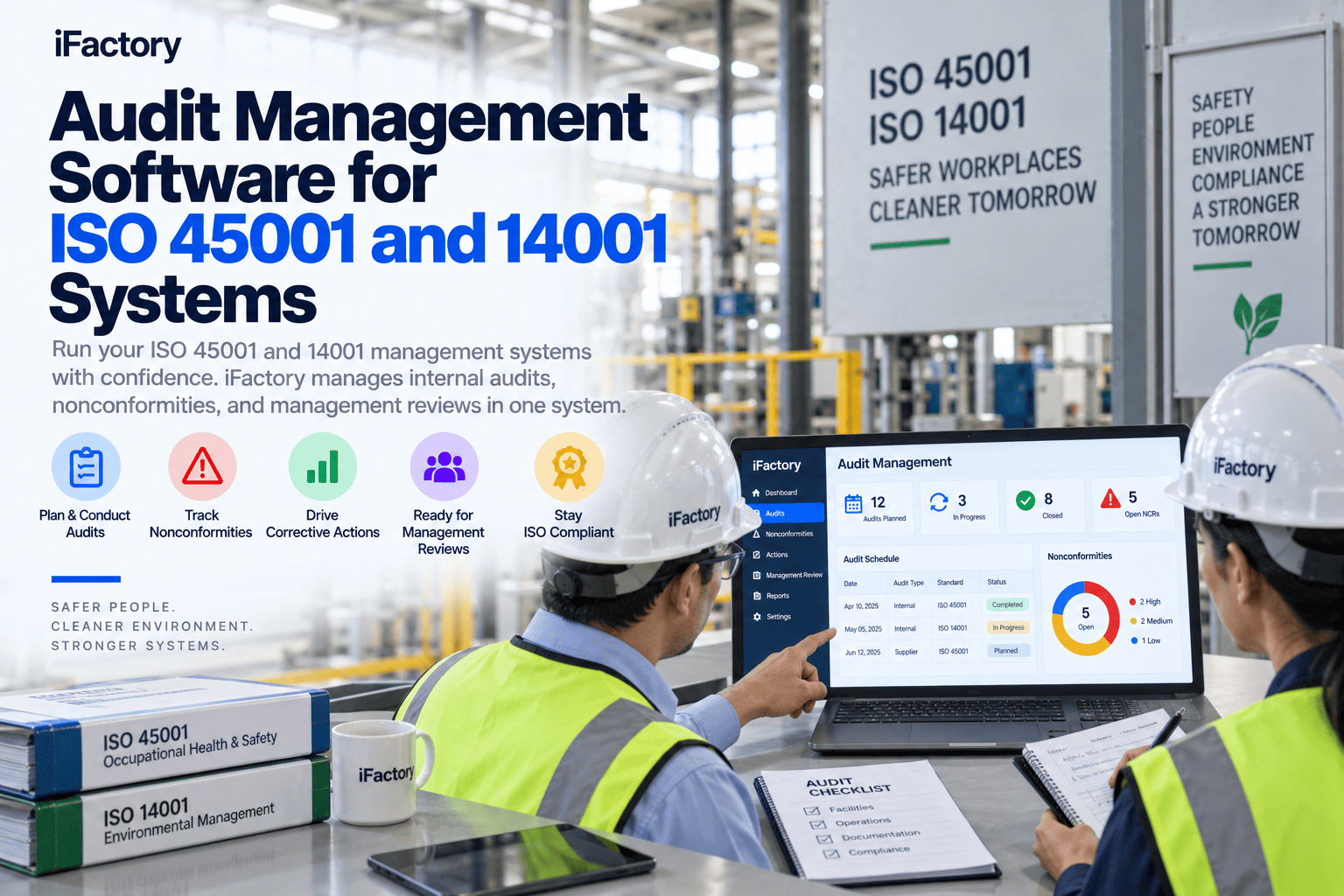
Most plants treat ISO 45001 and ISO 14001 as two separate certifications to maintain — two audit programs, two sets of documentation, two management reviews. That's the expensive way, and it exists mostly out of habit. Both standards were built on the same Annex SL High-Level Structure, so they share an identical skeleton: the same clause numbering and core text for context, leadership, planning, support, performance evaluation, and improvement. So the governance machinery — internal audit under clause 9.2, management review under 9.3, nonconformity and corrective action under 10.2 — is literally the same requirement in both. Running it twice is pure duplication. The only genuinely different parts are the Clause 8 operational controls, where 14001 handles environmental aspects and 45001 handles hazard elimination. The smart move isn't two systems; it's one integrated system with a shared audit program, a single management review, and one CAPA engine. You can book a demo to see it on your system.

ISO MANAGEMENT SYSTEM & AUDITS · MANUFACTURING · MANAGEMENT SYSTEMS

Run ISO 45001 and 14001 as One System — Because They're Built on the Same Skeleton

Manage internal audits, nonconformities, and management reviews for both standards in one integrated system — because Annex SL makes their governance identical, so running them separately is duplicating the work that matters least.

40-50%
Of documentation shared across the standards
30-40%
Lower cost for integrated vs. separate audits
Clauses 4-10
Identical structure across both standards
THE INSIGHT THAT CHANGES EVERYTHING

Annex SL Made the Two Standards Share One Skeleton

The reason integration is now not just possible but obviously correct is Annex SL — ISO's High-Level Structure that every modern management-system standard must follow. It defines identical clause numbering, titles, core text, and terminology across Clauses 4 through 10, so ISO 45001 and ISO 14001 are the same shape. Understanding what's shared and what isn't is the whole basis for running them as one. Here's how the standards actually line up.

The Governance Framework Is Shared

Context, leadership, planning, support, performance evaluation, and improvement — the strategic core of both standards — use identical clause structure. Context analysis, competence records, communication, and documentation can be genuinely shared, not just cross-referenced.

Internal Audit Is One Clause

Clause 9.2 governs internal audit in both standards with the same requirement, so one combined audit schedule and the same auditors satisfy both — an auditor works through the Annex SL clauses once, assessing both standards, rather than running two separate clause-by-clause passes.

Management Review Is One Meeting

Clause 9.3 is a single requirement, so one integrated management review covers OH&S and environmental performance together — one agenda, one leadership meeting, one set of outputs, instead of two separate reviews on two calendars.

Only Clause 8 Is Genuinely Different

The shared structure is the framework, not the content. Clause 8 — operational controls — is where the standards diverge: 14001 covers environmental controls and aspects, 45001 covers hazard elimination, risk reduction, and emergency preparedness. That's the part that needs standard-specific attention.

ONE AUDIT PROGRAM, NOT TWO

A Single Audit Program Covering Both Standards at Once

The clearest win from integration is the audit program. Because clause 9.2 is shared, a single risk-based schedule can cover both standards, audited by the same team in the same visit — and a certification body sends one lead auditor competent in both to work through the clauses once. This is what a unified audit program does.

01
One Risk-Based Schedule for Both

A single audit program schedules every clause and process once, structured as combined audits — assessing both standards simultaneously for a given process — or sequenced across the year with a combined review. The program is risk-based, so high-risk areas and those with prior nonconformities are audited more often regardless of which standard the requirement sits under.

02 The Auditor Works the Clauses Once

For the shared Annex SL clauses, an auditor assesses conformity with both standards in a single pass rather than conducting two separate clause-by-clause audits — with standard-specific attention reserved for the Clause 8 operational controls that genuinely differ.

03 Findings Classified and Routed Consistently

Every finding — major or minor nonconformity, observation, opportunity for improvement — is captured against its clause and standard with its evidence, and routed into the same corrective-action process, so an environmental finding and a safety finding are handled with one consistent discipline.

04 One Trail for the Certification Audit

Because the program is integrated, the external certification body — accredited across both standards — conducts one combined Stage 1 and Stage 2 audit against a single, coherent record, which is what drives the 30-to-40-percent cost saving over two separate certifications.

Audit Both Standards in One Program, One Visit

iFactory runs a single risk-based audit schedule covering ISO 45001 and 14001, works the shared clauses once, and routes every finding into one CAPA — cutting audit burden and cost while making the whole system provable.

ONE CAPA ENGINE FOR BOTH DISCIPLINES

Nonconformities and Corrective Actions in a Single System

Clause 10.2 — nonconformity and corrective action — is identical across both standards, which means a single CAPA engine can handle every finding whether it's an environmental issue or a safety one. A unified corrective-action system is where integration pays off day to day, long after the certification audit. This is what one CAPA engine delivers.

One Process, Both Standards

An environmental nonconformity and an OH&S nonconformity flow through the same capture, root-cause, corrective-action, and verification process — so the team runs one discipline rather than learning and maintaining two parallel systems.

Every Finding Tracked to Closure

Each nonconformity gets an owner, a deadline, and a corrective action tracked to verified closure — the open-loop finding that auditors cite most is closed by construction, not by someone remembering to follow up.

Fed From Every Source

Audit findings, incidents, environmental deviations, near-misses, and inspection results all feed the same CAPA queue, so the corrective-action system sees the whole picture of both management systems rather than a slice of each.

Trends That Feed the Review

Because all nonconformities live in one place, recurring issues surface as trends across both standards, and those trends become a required input to the management review rather than being reconstructed for the meeting.

ONE MANAGEMENT REVIEW, PROPERLY FED

A Single Leadership Review Covering Safety and Environment Together

Clause 9.3 asks top management to review the management system on required inputs and drive it with tracked outputs — and because it's shared, one integrated management review covers both standards. The failure mode is the same as any management review: inputs missing, discussion instead of data, outputs never closed. An integrated system fixes all three at once for both standards.

Inputs Compiled Automatically

The required inputs — audit results, nonconformity and CAPA status, objectives progress, incidents and environmental performance, legal-compliance status — are compiled from the live system for both standards, so the review runs on current data rather than a scramble the week before.

One Agenda, Both Standards

A single leadership meeting reviews OH&S and environmental performance together against one agenda, so the strategic oversight the standards require happens once with the whole picture, not twice in fragments.

Objectives Tracked to Metrics

Auditors expect measurable objectives tracked through concrete metrics whose results feed back into the review. The system holds the objectives, their metrics, and their owners, so the loop from objective to result to review decision is intact and visible.

Outputs Tracked to Closure

Every review output — a resource decision, an improvement action, a system change — gets an owner and a deadline and is tracked like any corrective action, so the review drives change rather than producing minutes that gather dust.

SHARED SKELETON, STANDARD-SPECIFIC MUSCLE

Integration Doesn't Mean Ignoring What's Different

A serious integrated system shares everything Annex SL makes shareable and keeps proper focus on what each standard genuinely requires — the Clause 8 operational controls that are specific to each discipline. Integration is about eliminating duplicated governance, not blurring the two standards' distinct technical demands. These are the standard-specific parts the system keeps distinct.

14001: Aspects, Impacts, and Controls

The environmental side needs its aspects and impacts identified, its legal and other requirements registered, its environmental objectives set, and its operational controls documented — the standard-specific work that's genuinely new and requires proper attention.

45001: Hazards, Risk, and Emergency Response

The OH&S side needs hazard identification, risk assessment and the hierarchy of controls, worker consultation and participation, and emergency preparedness and response under Clause 8 — distinct requirements the shared framework doesn't cover.

Separate Registers, One System

The environmental-aspects register and the hazard/risk register are standard-specific, but they live in the same platform and feed the same audit, CAPA, and review machinery — distinct content on shared infrastructure.

One Certification, or Add Later

Integration works for any combination — run 45001 and 14001 together now, and the same infrastructure absorbs ISO 9001 later if quality certification becomes strategic, because it's the same Annex SL skeleton underneath.

HOW iFACTORY DOES ISO MANAGEMENT SYSTEMS

One Integrated System From Audit to Review

iFactory runs ISO 45001 and 14001 as one integrated management system: a single risk-based audit program covering both standards, one CAPA engine for every nonconformity, one management review fed automatically from the live system, and the standard-specific registers kept distinct on shared infrastructure — so certification is easier and the system actually gets run between audits.

1
One audit program for both standards. A single risk-based schedule covers the shared Annex SL clauses once and the Clause 8 controls with standard-specific depth, so the same team audits both in one program — the basis of the 30-to-40-percent integrated-audit saving.
2
One CAPA engine, every source. Environmental and OH&S nonconformities from audits, incidents, and inspections flow through one corrective-action process tracked to verified closure, so the open-loop finding auditors cite most simply doesn't persist.
3
One management review, auto-fed. A single integrated review compiles its required inputs from the live system for both standards, tracks objectives to metrics, and drives outputs to closure — one leadership meeting with the whole picture.
4
Shared governance, distinct registers. The environmental-aspects and hazard/risk registers stay standard-specific while the audit, CAPA, and review machinery is shared — integration where it helps, separation where the standards genuinely differ.
1000+
Industrial clients running iFactory across operations
45001 · 14001
One integrated system, Annex SL aligned
+ 9001
Quality absorbs into the same system later
FREQUENTLY ASKED QUESTIONS

What EHS and Quality Teams Ask About Integrated ISO Systems

Why run ISO 45001 and 14001 as one system instead of two?
Because they share the same skeleton, so running them separately duplicates exactly the work that's identical between them. Both standards were built on Annex SL — ISO's High-Level Structure — which gives them identical clause numbering, titles, and core text across Clauses 4 through 10. That means the governance machinery is literally the same requirement in both: internal audit under clause 9.2, management review under 9.3, and nonconformity and corrective action under 10.2 are shared, and roughly 40 to 50 percent of the documentation can be shared directly, including context analysis, competence records, and the audit and review procedures. Running two separate systems means two audit programs, two management reviews, two CAPA systems, and two sets of documentation for processes that the standards define identically — pure duplication. An integrated system shares all of that shared infrastructure while keeping proper focus on the genuinely different parts, which are the Clause 8 operational controls. The benefits are concrete: certification bodies estimate integrated audits cost 30 to 40 percent less than two separate ones, documentation and training are streamlined, and — the deeper benefit — a single coherent system actually gets maintained between audits, where two parallel binders tend to drift. Book a demo to see the integrated structure.
If the structure is shared, do the standards cover the same things?
No — and this is the most important nuance to get right, because integration done carelessly blurs two genuinely distinct disciplines. The shared structure is a framework, not the content. Annex SL harmonizes the strategic and governance clauses — context, leadership, planning, support, performance evaluation, improvement — so those can be genuinely shared. But Clause 8, operational controls, is highly specific to each standard's discipline and does not overlap: ISO 14001's Clause 8 covers environmental operational controls tied to your significant environmental aspects and impacts, while ISO 45001's Clause 8 covers hazard elimination, the hierarchy of risk controls, worker consultation, and emergency preparedness and response. Those are different technical requirements that each need proper, standard-specific attention — identifying environmental aspects is not the same activity as assessing occupational hazards. So a good integrated system shares the governance and audit machinery while keeping the environmental-aspects register and the hazard/risk register distinct, each feeding the shared audit, CAPA, and review processes. The mistake to avoid is assuming that because the clause numbers match, the work is the same; the framework is shared, the operational content is not, and the system has to reflect both facts at once. Support can map your shared and standard-specific requirements.
How do combined audits actually work?
A combined audit assesses both standards at once for the shared clauses, conducted by an auditor competent in both, working through the Annex SL clauses a single time rather than doing two separate clause-by-clause passes. In practice the audit program defines a scope for each audit event — which clauses and which processes or sites — and can be structured either as combined audits, where all applicable standards are assessed simultaneously for a given process, or sequentially, spreading standards across the year with a combined management review at the end. The program should be risk-based: high-risk processes and areas with previous nonconformities get audited more frequently regardless of which standard the requirement relates to, which focuses effort where it matters rather than treating every clause equally. On the certification side, a combined certification audit is conducted by a lead auditor who holds qualifications across both standards, following the same Stage 1 and Stage 2 structure as a single-standard audit but assessing conformity with both standards in one pass. The result is fewer audit days, one coherent evidence trail, and the substantial cost reduction over two separate certification audits. The software's job is to hold the single schedule, the scopes, and the findings so the combined audit runs off one organized system rather than assembled paperwork.
Can we start with 45001 and 14001 and add ISO 9001 later?
Yes — integration works for any combination, and adding a standard later is straightforward precisely because they all sit on the same Annex SL skeleton. Many organizations start with the two EHS standards, 45001 and 14001, because they're closely related and often owned by the same team, and add ISO 9001 for quality when it becomes strategically useful. Because ISO 9001:2015 shares the identical High-Level Structure, absorbing it later means extending the internal audit program to cover its clauses using the same audit cycle, adding a quality section to the management review agenda, and routing quality nonconformities through the existing CAPA engine — the shared governance infrastructure is already in place. The genuinely new work is the standard-specific content: ISO 9001's Clause 8 operational controls for product and service delivery, its quality objectives, and its customer-focus requirements. So the effort of adding a third standard is much smaller than certifying it from scratch, because you're extending a working system rather than building a parallel one. This is a strong argument for choosing an integrated platform even if you only run two standards today: the architecture that unifies 45001 and 14001 is the same one that will absorb 9001 without a rebuild, so you're not painting yourself into a corner by starting integrated.
Does this connect to our incident, inspection, and EHS data?
Yes, and that connection is what makes the management system a live thing rather than a certification artifact maintained for the auditor. A management system is only as good as the data feeding its audits, its CAPA engine, and its management review, and that data comes from the operational EHS activity happening every day — incidents and near-misses, environmental monitoring and deviations, safety inspections and observations, corrective actions, and objective metrics. When the audit, nonconformity, and review machinery draws from that live operational data rather than a separately maintained set of management-system documents, several things follow: management review inputs are current and compiled automatically instead of assembled before the meeting, nonconformities from any source flow into one CAPA queue, and audit evidence reflects the real state of the system. It also means the management system genuinely governs operations rather than sitting beside them — the near-miss captured on the floor becomes a nonconformity trend in the review, the environmental deviation becomes a corrective action, and the audit assesses what's actually happening. iFactory's ISO management system sits on the same platform as the EHS, incident, and inspection data it depends on, so the integration is real rather than a set of import steps. Integration is scoped to the EHS and operational systems you already run.

Stop Maintaining Two Systems for Standards Built on One Structure

iFactory runs ISO 45001 and 14001 as one integrated management system — a single audit program, one CAPA engine, one management review, and distinct standard-specific registers — so certification costs less, the paperwork halves, and the system stays alive between audits.
Share This Story, Choose Your Platform!