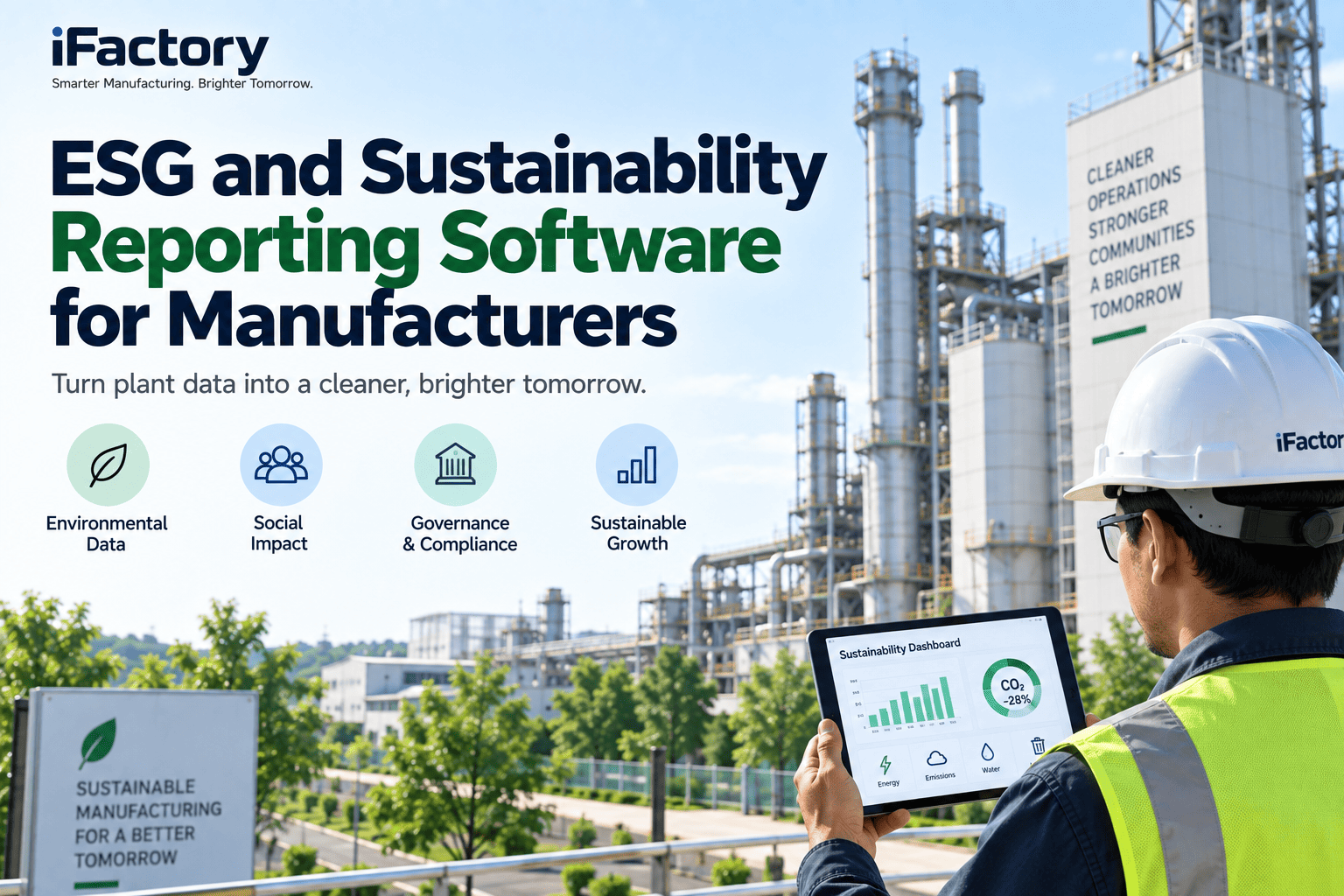
ESG reporting for a manufacturer has moved past the annual sustainability PDF. CSRD requires reasonable-assurance reporting under ESRS for large EU-operating groups from FY2024 onward. The SEC climate rule (issued in 2024, subject to litigation) established Scope 1 and 2 disclosure requirements for larger US registrants. CDP responses grow in scope every year. Customer scorecards from EcoVadis, Sedex, and direct OEM assessments pull the same underlying data with different framings. What every one of these needs is auditor-defensible plant data on energy, emissions, water, and waste — traceable to source metering and lab records. Software that aggregates plant data into a single ledger is what makes framework proliferation manageable.
iFactory / ESG and sustainability reporting
One Source-Data Ledger, Every Framework Disclosure
Aggregate energy, emissions (Scope 1/2/3), water, and waste metrics from every site into one ledger — with framework mapping for CSRD ESRS E1, GHG Protocol, TCFD, CDP, SEC climate rule, GRI, and SASB, plus reasonable-assurance audit trail.
WATER
withdraw · discharge
→ GHG Protocol · CSRD · TCFD · CDP · SEC · GRI · SASB
Scope 1 + 2 + 3
GHG Protocol aligned
CSRD · TCFD · CDP
framework outputs ready
Reasonable
assurance-defensible
The Problem in ESG Data
A manufacturing group with multiple sites currently produces ESG data through a mix of plant-level spreadsheets, utility invoices, waste-vendor reports, and lab records — assembled quarterly or annually by the sustainability team into whatever framework is due. When CDP asks a new question, the team re-derives from source. When CSRD assurance arrives, the auditor asks to trace one number back to source and finds a five-tab spreadsheet with no version control and no source-system linkage. When SEC climate rule finalises, the disclosure needs Scope 1 and 2 with the same defensibility as financial reporting — a bar the current process cannot clear. Every cycle is manual, error-prone, and slow.
Where the ESG Chain Actually Breaks
ESG reporting fails in the same handoffs across manufacturing groups. Each is a defensibility gap that reasonable-assurance auditors under CSRD are increasingly finding.
Site-level silo
Each site produces its ESG data in its own spreadsheet on its own schedule. Group-level aggregation done by copying values manually. Version drift between site and group numbers.
Emission factor lag
Scope 2 electricity emissions calculated with last year's grid factor. Scope 1 combustion with factors from the wrong methodology (IPCC vs GHG Protocol vs EPA). Numbers reported don't match current published factors.
Scope 3 estimates
Scope 3 categories (particularly purchased goods, upstream transport, use of sold products) estimated with generic averages. CSRD assurance provider flags the methodology as inadequate.
Framework re-derivation
CDP, CSRD, TCFD, and customer scorecards each re-assembled from the same source data, separately, by hand. Numbers between frameworks drift. Reconciliation eats the sustainability team.
What Good Looks Like in ESG
A working ESG reporting system holds four disciplines together — one source-data ledger, live emission accounting, framework-agnostic mapping, and reasonable-assurance audit trail across every reported number.
Source Ledger
Every energy, emission, water, and waste metric from every site captured with source-system reference. One canonical dataset that every framework output pulls from.
One truth per metric
Live Accounting
Scope 1, 2, and 3 emissions calculated with current emission factors and consistent methodology. Location-based and market-based Scope 2 both tracked per GHG Protocol Scope 2 Guidance.
Current factors, both S2
Framework Mapping
CSRD ESRS E1, GHG Protocol, TCFD, CDP climate, SEC climate rule, GRI 305, SASB — each framework's specific disclosure line pulled from the same source ledger, formatted per framework rule.
Every framework from one source
Assurance Trail
Every reported number linked to source reading, calculation methodology, and version — the trail a reasonable-assurance auditor under CSRD ISA 3410 asks for.
Reasonable assurance-ready
How iFactory AI Fits
iFactory AI overlays your utility meters, SCADA and plant historian, EHS system, and procurement platform — Enablon, Cority, Sphera, Intelex, SAP — adding the aggregation, calculation, and framework-mapping layer without replacing the systems your operations team already trusts.
Metric Ledger
Reporting Layer
Every ESG metric per site with source-system reference, unit, timestamp, and validation status. The single ledger every framework output pulls from.
Emission Engine
Reporting + Factors
Scope 1/2/3 calculation with current-year emission factors from IPCC, EPA, DEFRA, IEA, and supplier-specific sources. Methodology tagged per calculation.
Framework Output
Reporting Layer
Same source data mapped to CSRD ESRS E1, TCFD, CDP, SEC, GHG Protocol, GRI, SASB. Each framework's specific line output with disclosure-ready formatting.
Assurance Pack
Reporting Layer
Auditor-ready package with source extracts, calculation traces, factor references, and version history — the evidence pack for ISA 3410 or equivalent reasonable assurance.
Ask your sustainability lead to trace one CDP-reported Scope 2 number back to source meter reading and grid emission factor. If the trace takes more than 10 minutes or crosses more than two spreadsheets, the reasonable-assurance auditor will find that same gap. Book an ESG reporting review.
12-Week Rollout on One Site
One manufacturing site (or one operating segment across a small group), twelve weeks. The pilot loads the source ledger, activates emission accounting, and produces framework-ready outputs for the primary reporting obligation.
Weeks 1–2
Source Mapping
Map utility meters, SCADA points, EHS records, and procurement feeds. Baseline the current spreadsheet reporting path. Identify where source-to-report drift exists.
Weeks 3–4
Ledger Load
Metric ledger loaded for the pilot period. Emission factors sourced. Scope 1/2 calculations validated against known historic period. Scope 3 categories scoped based on data availability.
Weeks 5–8
Framework Output
Primary framework output produced (CSRD ESRS E1 or CDP climate) from the source ledger. Reviewed with sustainability team and internal audit. Data traceability tested.
Weeks 9–12
Assurance Ready
Full assurance package produced. Reconciled against parallel spreadsheet-based report for the same period. Rollout to remaining sites and frameworks scoped based on gap closure.
Who Owns the KPI
ESG reporting crosses sustainability, plant operations, finance, and internal audit. Each function owns a specific KPI or the reporting chain fragments back into disconnected spreadsheets.
Sustainability Lead
Framework outputs on schedule
Owns the reporting velocity — every required framework output produced on the required schedule with source data current. CDP annual, CSRD annual, TCFD annual, CDP supply chain, customer scorecards.
Plant EHS
Source data completeness %
Owns the site-level data quality — the share of expected data points captured for the reporting period. Utility invoices, meter readings, waste manifests, lab records all reconciled.
Internal Audit / Finance
Assurance opinion level
Owns the assurance outcome — the opinion (limited or reasonable) the external assurance provider issues on the report. Reasonable assurance is where CSRD is heading and where boards are already asking.
Executive Sponsor
ESG scores at customer / rating scorecards
Owns the market-facing outcome — the EcoVadis, CDP, Sedex, and OEM-scorecard results that translate ESG effort into customer, capital, and reputation impact.
FAQ
How does the CSRD reasonable-assurance requirement actually change what we need?
CSRD phases in reasonable assurance from limited assurance over 2028-2030 per the current EU trajectory. Reasonable assurance is the same standard financial auditors provide on financial statements — significantly higher than the limited assurance most sustainability reports currently carry. Practically, it means every reported number needs source traceability, methodology consistency, calculation verification, and version control. The source-data ledger with linked calculation methodology and version history is exactly the evidence structure that reasonable assurance requires — and the reason CSRD-scoped groups are moving off spreadsheets.
How does this handle Scope 3 — most of our reported number today is an estimate?
Scope 3 is where methodology transparency matters most because primary data is rarely available across all fifteen categories. The engine treats each Scope 3 category as its own methodology track — supplier-specific data where available (increasingly under CSRD supplier engagement), industry-average factors where not, physical-activity-based estimates for downstream categories. Each category disclosure tags its methodology so the assurance provider can trace and the reader can weigh. Categories 1 (purchased goods), 4 (upstream transport), and 11 (use of sold products) are usually the material ones for manufacturing and get the most methodology attention.
Book a demo to see the Scope 3 methodology tracking live.
What about CBAM — how does it fit into ESG reporting?
EU CBAM (Carbon Border Adjustment Mechanism) is a trade-mechanism report, not an ESG framework — but the underlying data (embedded emissions of exported goods) draws from the same source ledger as Scope 1 and 2. Facilities exporting cement, iron and steel, aluminium, fertilizer, hydrogen, or electricity into the EU need CBAM declarations from 2026 that reconcile with their corporate GHG reporting. The engine treats CBAM as another framework output on the same ledger — the product-level embedded emissions calculation runs against the same source data as the site-level Scope 1 and 2.
Stop rebuilding CDP, CSRD, and customer scorecards from spreadsheets each year.
Load One Site's Data and Produce a Framework Output Live
Bring one site's last 12 months of utility, waste, and water data plus your last CDP or CSRD ESRS E1 submission. We'll load the ledger, calculate Scope 1 and 2 to current methodology, and produce a framework-ready output with source traceability.
7+ frameworks
from one source
Reasonable
assurance-ready