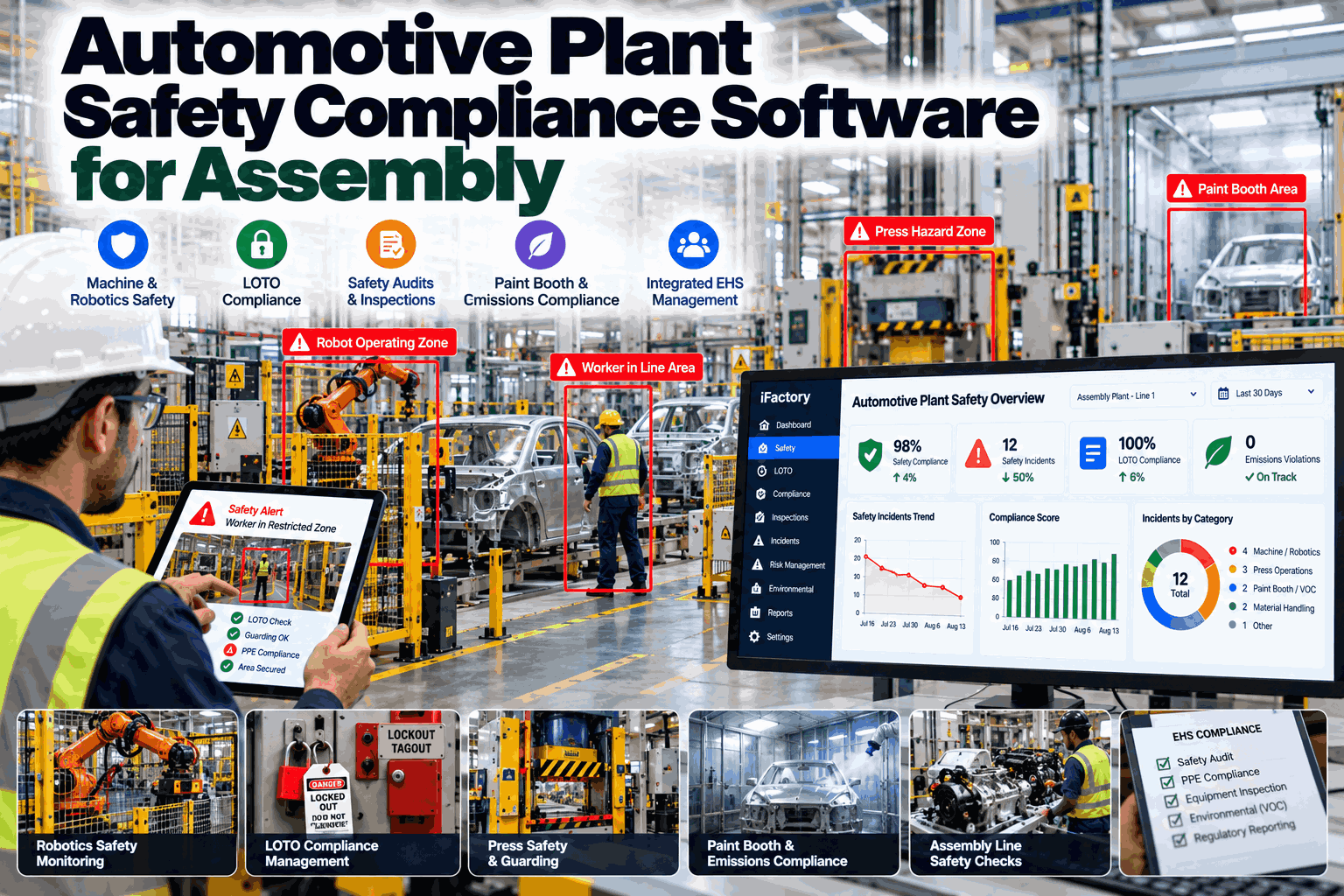
An automotive plant runs several distinct hazard profiles under one roof: mechanical power presses in stamping, dense robot cells in the body shop, flammable coatings and isocyanates in paint, forklifts and repetitive work in general assembly. Each area has its own rules, its own specialists and usually its own spreadsheets, which is exactly where compliance gaps hide. iFactory brings line safety, lockout/tagout, robot-cell safeguarding and paint-shop emissions records into one system, with vision AI watching the zones where people and machines meet. Book a 30-minute review of safety and emissions compliance across your assembly plant.
Presses, robot cells, paint booths and forklifts each carry their own rules. iFactory keeps them in one live compliance view, backed by vision AI where people and machines meet.
At a Glance
Why Automotive Compliance Breaks Down Between Shops
In most vehicle and component plants, safety compliance is organized the way the plant is: by shop. The stamping team owns press inspections, controls engineers own robot-cell safeguarding, the environmental specialist owns paint-shop emissions, and EHS owns the plant-wide programs such as lockout/tagout and hazard communication. Each group does its part well. The gaps appear at the boundaries, when a die change crosses from production into maintenance, when a robot cell is modified without its risk assessment being revisited, or when a paint booth filter change is logged in one place and its fire-protection inspection in another.
The data shows where those gaps show up. Transportation equipment manufacturing recorded a nonfatal injury rate of 2.8 cases per 100 full-time workers in 2024, above manufacturing’s 2.5, according to the Bureau of Labor Statistics. On the enforcement side, OSHA’s fiscal 2025 most-cited list placed lockout/tagout fourth, powered industrial trucks eighth and machine guarding tenth, all core exposures on an assembly line.
Hazards and Rules, Shop by Shop
| Shop | Main hazards | Key rules and standards | What iFactory keeps current |
|---|---|---|---|
| Stamping | Point-of-operation contact, die changes, material handling | OSHA 1910.217 mechanical power presses; ANSI B11.1; 1910.147 for die changes | Weekly press checks and certifications, die-change LOTO, guarding inspections |
| Body shop | Robot cells, welding fume, arc flash, pinch points | ANSI/A3 R15.06-2025 and ISO 10218-1/-2:2025; 1910.212 machine guarding | Robot cell register, risk assessment versions, safeguarding verification |
| Paint shop | Flammable vapors, isocyanates, confined booths | OSHA 1910.107 spray finishing; NFPA 33; 1910.134 respiratory; EPA NESHAP 40 CFR 63 Subpart IIII | Booth and filter logs, fire-protection inspections, respirator fit tests, coating usage records |
| General assembly | Forklifts and tuggers, repetitive motion, overhead handling | OSHA 1910.178 powered industrial trucks; ergonomics under the General Duty Clause | Operator certifications, pedestrian-conflict alerts, ergonomic observations |
| Plant-wide | Hazardous energy, chemicals, egress | 1910.147 LOTO; 1910.1200 HazCom; 1910.37 exit routes | Procedures, annual inspections, training, SDS access, exit-route alerts |
Robot Safety Changed in 2025
The first major revision of the core industrial robot safety standards in more than a decade landed in 2025. ISO 10218-1 and -2 were republished in January 2025, and the U.S. adoption, ANSI/A3 R15.06-2025, followed in September 2025. The changes matter for any plant with dense robot cells.
- “Collaborative application” replaces “collaborative robot.” Safety now attaches to the application, not the robot model.
- ISO/TS 15066 content moved into Part 2, bringing collaborative requirements into the main integration standard.
- Cybersecurity requirements now appear in Part 1, and the list of defined safety functions expanded sharply.
- A separate Part 3 addresses users and integrators directly.
Standards like these are not usually retroactive for existing cells, and your corporate engineering standard decides when an update is required. What auditors and insurers will ask is whether you know which cells were assessed under which revision. iFactory’s cell register answers that in one view, and camera zones around each cell show how often people actually enter while it is running.
Lockout/Tagout at Line Speed
Lockout/tagout is where automotive line speed and safety collide most often. Jams, die changes, robot teach sessions and quick adjustments all tempt people to reach in without full isolation. OSHA’s standard (29 CFR 1910.147) requires written, machine-specific energy control procedures, periodic inspection of each procedure at least annually, and training for authorized and affected employees. Its minor-servicing exception applies only to routine, repetitive tasks integral to production, and only when alternative measures give effective protection.
Energy sources, isolation points and verification steps stored per press, cell and conveyor, with photos.
Periodic inspections assigned, completed on a tablet and certified, with overdue procedures flagged.
Authorized and affected employee training linked to the machines each person works on.
Where PLC signals and cameras are connected, a person detected inside a cell whose isolation is not confirmed raises an alert for supervisor review.
Paint Shop: Fire, Health and Air in One Record
The paint shop is where safety and environmental compliance overlap most. OSHA’s spray finishing standard (1910.107) and NFPA 33 govern booth construction, ventilation and fire protection. Isocyanate-containing coatings bring respiratory protection and exposure monitoring under 1910.134, an area OSHA has targeted through a national emphasis program. On the air side, automobile and light-duty truck coating lines fall under EPA’s NESHAP at 40 CFR Part 63, Subpart IIII, alongside the plant’s air permit, which drives coating usage records and periodic compliance reporting.
These records are often kept by different people in different formats. iFactory brings booth filter changes, fire-suppression inspections, respirator fit tests, coating usage and booth operating data into one paint-shop record. Your environmental team still owns the emissions calculations and signs every report; iFactory makes sure the inputs are complete and time-stamped when they need them.
Bring your robot cell list, LOTO procedure count and paint-shop records. We map them into one view, show where records are thin and outline a pilot for your highest-risk shop.
What iFactory Delivers for Automotive Plants
Every shop, its rules and its open items on one screen, with drill-down to the asset and record.
Machine-specific procedures, annual inspections, training and change control in one place.
Cells, collaborative applications, risk assessment versions and safeguarding checks tracked per cell.
Weekly clutch, brake and single-stroke checks and certifications for mechanical power presses.
Booth, filter, fire-protection, respiratory and coating-usage data kept together for audits.
Alerts for people in robot and press zones, forklift-pedestrian conflicts and blocked exits.
How Deployment Works
The pre-configured NVIDIA AI server arrives racked with software loaded. We connect cameras and systems, confirm data access and agree the first zones and rules.
Models are tuned to your site, lighting and layouts, then piloted on one area with supervisors reviewing every alert and marking false positives.
Rollout to the agreed zones, operator and supervisor training, and handover to 24×7 remote monitoring of the system itself.
Most automotive plants start in one shop, usually the body shop or stamping, where cell density and LOTO frequency are highest, then extend the same records and camera zones across the line.
The Recurring Compliance Calendar
Much of automotive EHS work is a calendar of recurring obligations. Missing one rarely causes an incident directly, but it is exactly what an auditor or investigator finds first. iFactory schedules, assigns and tracks these so nothing depends on one person’s memory.
Frequently Asked Questions
Lockout/tagout (1910.147), machine guarding (1910.212), mechanical power presses (1910.217), powered industrial trucks (1910.178), spray finishing (1910.107), respiratory protection (1910.134) and hazard communication (1910.1200) cover most exposures. Your EHS team confirms the full list for your site.
ANSI/A3 R15.06-2025, adopted from ISO 10218-1 and -2:2025, shifts the focus to collaborative applications, folds ISO/TS 15066 content into Part 2, adds cybersecurity requirements and many more defined safety functions, and adds a Part 3 for users and integrators.
Not automatically. Standards are generally applied to new and modified cells, and your corporate engineering standard sets when reviews are required. The practical step is knowing which revision each cell was assessed under and planning reviews at the next modification.
iFactory collects and time-stamps the inputs, such as coating usage and booth operating data, and keeps them with the related safety records. Your environmental team performs and signs the compliance calculations required by your permit and the applicable NESHAP.
No. Vision AI is a monitoring and early-warning layer. Safety-rated devices, interlocks and lockout/tagout remain the primary protection; the AI shows how often zones are entered and when protections may be bypassed.
Typical programs go live in 6–12 weeks, starting with one shop. The NVIDIA AI server ships pre-configured, and our scope includes integration, camera setup, training and 24×7 remote monitoring.
iFactory gives automotive plants a single live record of line safety, lockout/tagout, robot-cell safeguarding and paint-shop compliance, with vision AI where people and machines meet.